
Lease Presentation and Disclosure Under ASC 842 (Plus Short-Term Leases)

Under ASC 842, the balance sheet reports lease-related assets and liabilities, the income statement reports lease-related income and expenses, and the statement of cash flows classifies lease payments and receipts. Lease disclosure means explaining them in the notes: qualitative information such as lease terms and judgments, plus quantitative data such as lease cost and maturity analyses.
This matters because leases are often a company’s largest obligations outside of borrowed money. Putting them on the balance sheet changes ratios that investors and lenders rely on, so knowing where each number goes and what the notes add helps you read real financial statements.
This guide covers the short-term lease exception and the presentation, disclosure, and analysis part of the special lease accounting problems section in intermediate accounting. The other lessons in this cluster cover the measurement problems, starting with right-of-use asset calculation.
Watch Professor Farhat: This lecture walks through the disclosures a lessee provides under ASC 842.
Watch “Accounting for Leases: Lessee Disclosures. CPA exam FAR” on YouTube
What is the short-term lease exception?
A short-term lease is a lease that, at the commencement date, has a lease term of 12 months or less and does not include a purchase option the lessee is reasonably certain to exercise. A lessee can elect not to record a right-of-use asset and lease liability for these leases. Instead, it recognizes the lease payments as expense on a straight-line basis over the lease term.
The key word is lease term, which the lessor vs. lessee basics lesson introduces. For this test, it includes renewal periods the lessee is reasonably certain to use. So a 12-month lease that the lessee is reasonably certain to renew is not a short-term lease.
Hypothetical example: Delta Builders rents a crane for 7 months, with options to extend in 2-month blocks up to 3 times. In Case A, Delta expects the project to take 9 months, so it is reasonably certain to use one extension. The lease term is 9 months, so Delta can use the short-term exception. In Case B, the project will take 13 months, so Delta is reasonably certain to use all three extensions. The lease term is 13 months, so Delta must record a right-of-use asset and lease liability.
IFRS 16 has a similar short-term exemption and adds one for low-value assets. See the IFRS 16 lease accounting guide for that comparison.
How does a lessee present leases?
| Lease type | Balance sheet | Income statement |
|---|---|---|
| Finance lease | Right-of-use asset; lease liability | Amortization expense and interest expense, shown separately |
| Operating lease | Right-of-use asset; lease liability | A single lease expense, usually straight-line |
| Short-term lease (if elected) | Nothing recognized | Lease expense, straight-line over the lease term |
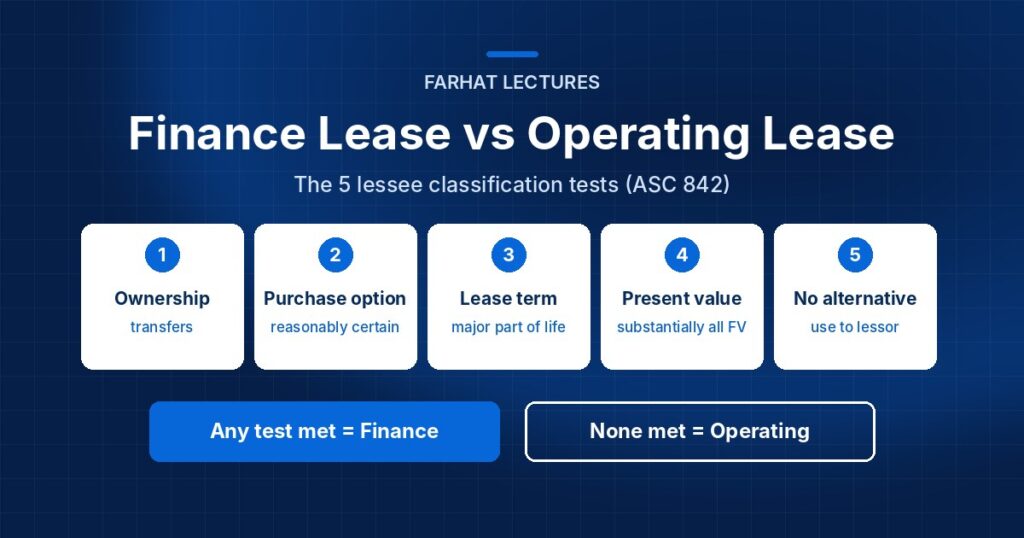
Finance lease assets and liabilities are kept separate from operating lease assets and liabilities, either on the face of the balance sheet or by disclosing which line items include them.
Either way, finance lease and operating lease balances can never share the same balance sheet line. In a classified balance sheet, the lease liability is also split into a current portion and a noncurrent portion, just like other liabilities.
How does a lessor present leases?
| Lease type | Balance sheet | Income statement |
|---|---|---|
| Sales-type lease | Net investment in the lease (the lease receivable plus any unguaranteed residual asset, often just called the lease receivable in textbooks), shown apart from other assets; the leased asset is removed | Selling profit or loss at commencement (a manufacturer or dealer shows it as sales revenue and cost of goods sold), then interest revenue |
| Operating lease | Leased asset stays in property, plant, and equipment | Lease revenue, generally straight-line; depreciation expense |
The sales revenue and cost of goods sold a lessor reports depend on whether the residual value is guaranteed, as shown in the unguaranteed residual value lesson.
How a lessor shows that commencement profit depends on its business model (ASC 842-30-45-4). A manufacturer or dealer that leases as another way to sell its products reports sales revenue and cost of goods sold. A lessor that leases mainly to provide financing reports the profit or loss as one net amount on a single line.
ASC 842 also has a third lessor category, the direct financing lease. It is presented like a sales-type lease, with a net investment in the lease and interest revenue, but any selling profit is deferred instead of recognized at commencement.
How are leases shown in the statement of cash flows?
The cash flow statement is the third piece of lease presentation, and it is easy to forget. The classification depends on the type of lease and the type of payment (ASC 842-20-45-5).
| Lessee payment | Cash flow classification |
|---|---|
| Finance lease, principal portion | Financing activities |
| Finance lease, interest portion | Operating activities |
| Operating lease payments | Operating activities |
| Short-term and variable lease payments not included in the lease liability | Operating activities |
One exception: operating lease payments that are costs to bring another asset to the condition and location needed for its intended use are classified as investing activities.
A lessee discloses a right-of-use asset obtained in exchange for a lease liability as a noncash transaction. Any rent paid at commencement is a separate cash flow.
A lessor generally classifies cash receipts from leases as operating activities.
Exam tip: when a question asks how a finance lease payment hits the cash flow statement, split it. If a $10,000 payment includes $2,000 of interest, $8,000 is a financing outflow and $2,000 is an operating outflow.
Lease presentation and disclosure: what the notes add
Disclosures help users judge the amount, timing, and uncertainty of cash flows from leases. They add to the numbers in the statements rather than repeat them.
Qualitative disclosures (lessees and lessors)
- The nature of the leases, with a general description
- How variable lease payments are determined
- Options to extend or end leases, and the terms of residual value guarantees
- Significant assumptions and judgments, such as discount rates
Quantitative disclosures
| Lessee | Lessor |
|---|---|
| Total lease cost | Lease income, including profit or loss at commencement and interest income |
| Finance lease cost, split between ROU amortization and interest | Income from variable payments not included in the receivable |
| Operating lease cost, short-term lease cost (leases of one month or less can be left out), and variable lease cost | Components of the net investment, including the unguaranteed residual value |
| Weighted-average remaining lease term and weighted-average discount rate, shown separately for finance and operating leases | Maturity analysis of operating lease payments and of the lease receivable |
| Maturity analysis of lease liabilities, finance and operating separately: undiscounted payments for each of the next five years, plus the total after that, reconciled to the lease liability on the balance sheet | How the lessor manages residual value risk, including the carrying amount of residual assets covered by residual value guarantees and other protections such as buyback agreements |
Lessees also disclose sublease income, any net gain or loss on sale-and-leaseback transactions, cash paid for amounts included in the lease liabilities (split between operating and financing cash flows), and right-of-use assets obtained in exchange for new lease liabilities.
Both maturity analyses, the lessee’s lease liabilities and the lessor’s lease receivables, must reconcile the undiscounted cash flows to the discounted balance on the balance sheet. Here is what that looks like for a lessee.
Hypothetical example: Rivera Clinics has operating leases for three locations. Its maturity analysis looks like this:
| Year | Undiscounted lease payments |
|---|---|
| Year 1 | $12,000 |
| Year 2 | $12,000 |
| Year 3 | $12,000 |
| Year 4 | $10,000 |
| Year 5 | $10,000 |
| After Year 5 | $15,000 |
| Total undiscounted payments | $71,000 |
| Less: imputed interest | ($11,000) |
| Operating lease liability on the balance sheet | $60,000 |
The $11,000 difference is the interest built into future payments. The balance sheet shows the present value, $60,000, while the note shows the cash Rivera will actually pay, $71,000.
How leases change financial ratios
Recording leases on the balance sheet “grosses up” assets and liabilities by similar amounts. Equity barely moves, and net income is often about the same, but several ratios change.
Hypothetical example: Before recording its operating leases, Bayline Stores has total assets of $800,000, liabilities of $480,000, equity of $320,000, and net income of $48,000. It then records right-of-use assets and lease liabilities of $160,000.
| Ratio | Before | After |
|---|---|---|
| Return on assets ($48,000 ÷ total assets) | 6.0% | 5.0% |
| Debt to equity (liabilities ÷ $320,000) | 1.50 | 2.00 |
- Return on assets falls because assets rise while net income stays about the same.
- Debt to equity rises because lease liabilities are added.
- The current ratio falls, because the current portion of the lease liability is a current liability while the right-of-use asset is noncurrent.
- Interest coverage falls for finance leases, because part of the cost is reported as interest expense.
- EBITDA (earnings before interest, taxes, depreciation, and amortization) is higher under a finance lease, because its whole cost sits in amortization and interest, which EBITDA adds back. An operating lease’s single lease expense stays inside EBITDA.
These changes can ripple into contracts. Debt covenants, management bonus targets based on return on assets, and agreements that reimburse costs based on rent expense may all need revisiting. Before ASC 842, most of these leases stayed off the balance sheet, which is why analysts worried so much about off-balance-sheet financing.
Common mistakes
- Ignoring renewal options when testing the 12-month limit for short-term leases.
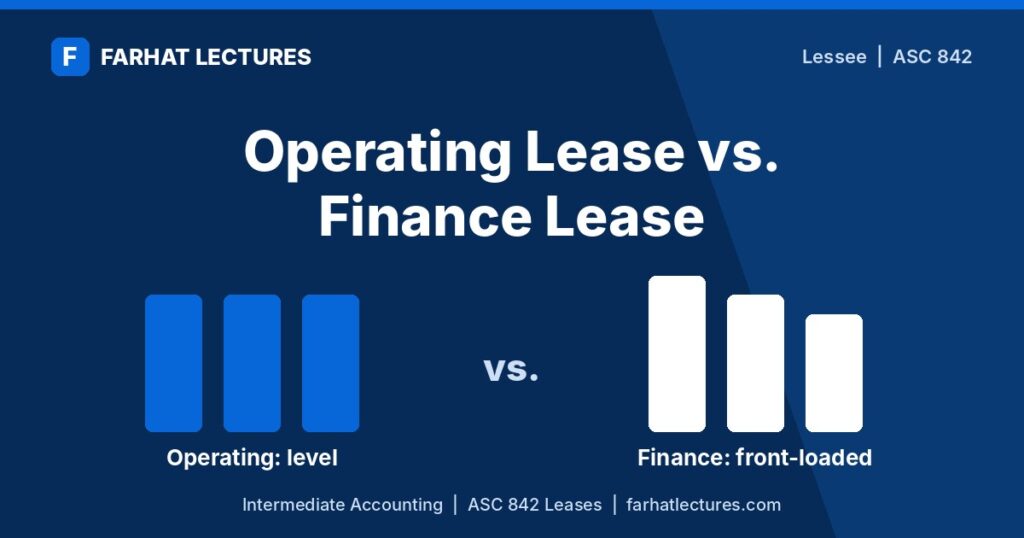
- Showing a single lease expense for a finance lease. Finance leases show amortization and interest. See operating lease vs. finance lease for a side-by-side look at the numbers.
- Removing the asset from the lessor’s books in an operating lease. It stays in PP&E.
- Assuming lease capitalization changes net income a lot. It mainly changes assets, liabilities, and ratios.
Practice questions with answers
Question 1
A lessee signs a 10-month equipment lease with a 6-month renewal option it is reasonably certain to exercise. Can it use the short-term lease exception?
Show answer
Answer: No.
The lease term is 16 months (10 + 6), which is more than 12 months.
Question 2
How does a lessee report an operating lease on the income statement?
Show answer
Answer: As a single lease expense, generally on a straight-line basis.
Only finance leases split the cost into amortization expense and interest expense.
Question 3
A company has current assets of $240,000 and current liabilities of $160,000. It signs an operating lease and records a right-of-use asset and lease liability of $90,000 each. Of the lease liability, $15,000 is current. What happens to the current ratio?
Show answer
Answer: It falls from 1.50 to about 1.37.
$240,000 ÷ $160,000 = 1.50 before; $240,000 ÷ $175,000 = 1.37 after (rounded). The right-of-use asset is noncurrent, so current assets do not change, but current liabilities rise by the $15,000 current portion.
Lease Presentation and Disclosures Practice
Practice applying ASC 842 in seven multiple-choice questions. The first four cover financial statement presentation. The final three cover lease note disclosures.
Frequently asked questions
Does the short-term lease election apply to every lease?
No. A lessee makes the election by class of underlying asset, such as vehicles or equipment. It can use the exception for one class and not another.
Can a lease with a purchase option be a short-term lease?
Not if the lessee is reasonably certain to exercise the option. The bargain purchase option lesson shows how that option changes the lessee’s accounting. A short-term lease must have a term of 12 months or less and no purchase option the lessee is reasonably certain to exercise.
Are finance and operating lease liabilities shown together?
No. They are presented separately from each other and from other liabilities, or the lessee discloses which balance sheet lines include them. The same applies to the right-of-use assets.
Why do lease disclosures matter if leases are already on the balance sheet?
The balance sheet shows one number. The notes explain the timing of future cash payments, the discount rates and lease terms used, and the options and guarantees behind those numbers.
How are lease payments classified in the statement of cash flows?
For a lessee, finance lease principal payments are financing activities and the interest portion is an operating activity. Operating lease payments, short-term lease payments, and variable lease payments not included in the liability are operating activities. A lessor generally reports lease receipts as operating activities.
What does a lessee’s lease maturity analysis show?
It lists the undiscounted lease payments due in each of the next five years and the total after that, shown separately for finance and operating leases. It then reconciles that total to the lease liability on the balance sheet. The difference is the imputed interest.
Do all sales-type lessors report sales revenue and cost of goods sold?
No. A manufacturer or dealer that uses leasing to sell its products usually shows sales revenue and cost of goods sold. A lessor that leases mainly to provide financing shows the profit or loss at commencement as a single net amount.
Sources
- FASB Accounting Standards Codification, Topic 842 (Leases)
- Deloitte Roadmap: Short-term lease recognition exemption
- Deloitte Roadmap: Lessee disclosure requirements
- Deloitte Roadmap: Lessor presentation
- Deloitte Roadmap: Statement of cash flows, leases
- KPMG: Applying the lessee short-term lease exemption
Mansour Farhat, CPA, CIA, DBA, teaches accounting through Farhat Lectures, an online platform for CPA, CMA, and EA candidates and accounting students, and on the Farhat Lectures YouTube channel. Read more about Professor Farhat.
Continue learning with Farhat Lectures
Strengthen your accounting understanding with clear explanations and guided practice.
Explore the free sample course
Responses