
Bargain Purchase Option in a Lease: Lessee Accounting and Entries

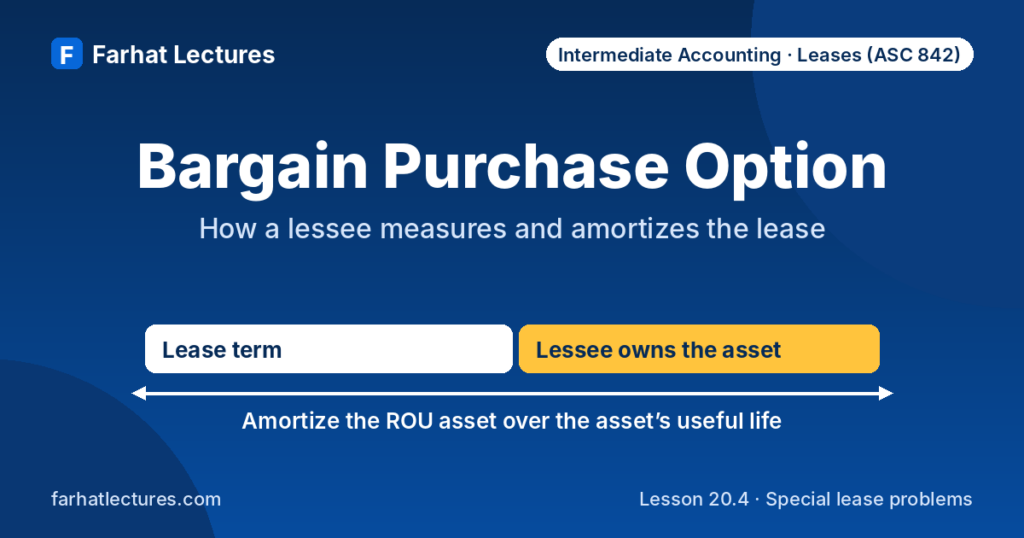
A bargain purchase option lets a lessee buy the leased asset for far less than its expected future fair value. Because exercise is reasonably certain, it is a finance lease under ASC 842. The lessee includes the option price’s present value in the lease liability and amortizes the right-of-use asset over the asset’s useful life, not the lease term.
This matters because the option changes three things at once: the lease classification, the size of the liability, and the yearly amortization expense. Missing any one of them throws off the income statement for every year of the lease.
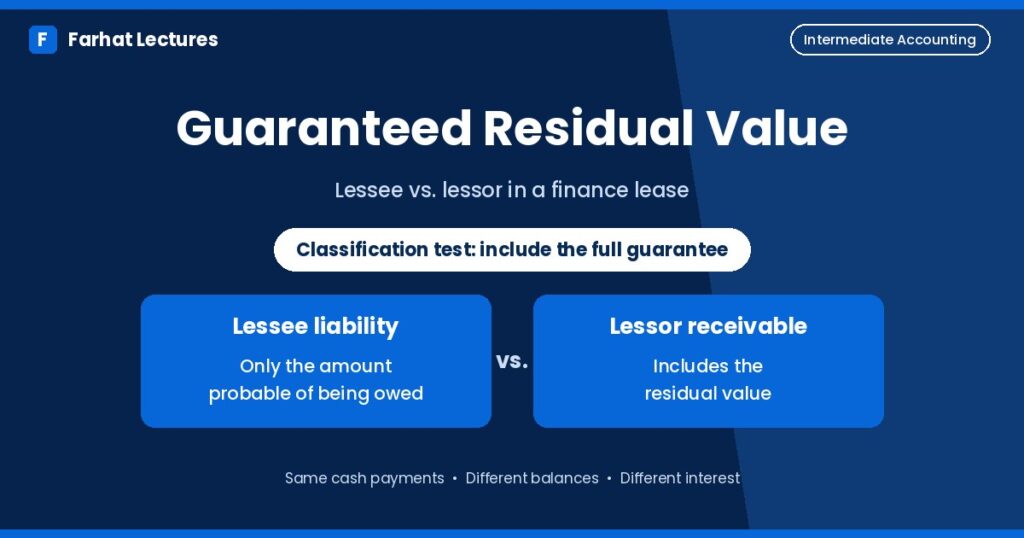
This guide covers bargain purchase options from the special lease accounting problems section of intermediate accounting. It builds on the guaranteed residual value lesson, because the two features look almost identical on paper.
Watch Professor Farhat: This video shows how a bargain purchase option affects the lease liability and amortization.
The video runs just under 8 minutes. Watch it first, then work through the forklift example below and check your numbers against the schedule.
Watch “Accounting for Leases: Depreciation and Bargain Purchase. CPA exam” on YouTube
What is a bargain purchase option?
A bargain purchase option is a lessee’s right to buy the leased asset for a price so low, compared with the asset’s expected future fair value, that exercising it is reasonably certain from the start of the lease. ASC 842 describes this as a purchase option the lessee is reasonably certain to exercise.
Since the lessee is expected to pay the option price, that payment is a present obligation. That is why it goes into the lease liability, and why the lease automatically meets the purchase option classification test.
Quick terms you will see on this page: A right-of-use (ROU) asset is the lessee’s right to use the leased item, recorded as an asset on the balance sheet. The lease liability is the present value of the lease payments the lessee still owes. An annuity due is a series of equal payments made at the start of each period, so the first payment is not discounted.
How does a purchase option affect lease classification?
At lease commencement, the lessee compares the option price with the asset’s expected fair value when the option becomes exercisable. A substantial discount can make exercise reasonably certain. When exercise is reasonably certain, the lessee classifies the lease as a finance lease.
What makes exercise reasonably certain?
Price is the biggest clue, but it is not the only one. At commencement, the lessee looks at all the economic factors: the terms of the contract, the asset itself (for example, costly improvements the lessee would lose by walking away), the lessee’s own business needs, and market conditions. Reasonably certain is a high bar, so a small discount on its own usually is not enough.
This is not a one-time call. If a significant event within the lessee’s control changes the picture, such as a major improvement to the asset, the lessee reassesses the option and remeasures the lease liability.
Select one answer for each of the three scenarios, then choose Check my work.
Bargain purchase option vs. guaranteed residual value: what’s the difference?
A bargain purchase option and a guaranteed residual value with a probable shortfall both create an expected payment at the end of the lease. If the amounts and timing are the same, and both leases are finance leases, the lease liability, the amortization schedule, and the interest entries are identical. The difference is the amortization period. One catch: a guaranteed residual value does not make a lease a finance lease on its own. For the classification test, the lessee counts the full guaranteed amount, even though only the probable shortfall goes into the lease liability.
| Feature | Bargain purchase option | Guaranteed residual value (probable shortfall) |
|---|---|---|
| Expected payment at the end | Option price | Guarantee minus expected residual |
| Included in lease liability? | Yes, present value of option price | Yes, present value of shortfall |
| Who keeps the asset? | Lessee buys and keeps it | Lessee returns it |
| Amortize ROU asset over | Useful life of the asset | Lease term |
Example: lease with a bargain purchase option
Hypothetical example: Cobalt Freight leases a forklift from Atlas Lift Co. on January 1, 2027. The lease runs 3 years with payments of $12,000 due at the start of each year. The rate is 8%. Cobalt can buy the forklift at the end of the lease for $1,500, when its fair value is expected to be $9,000. The forklift’s useful life is 6 years.
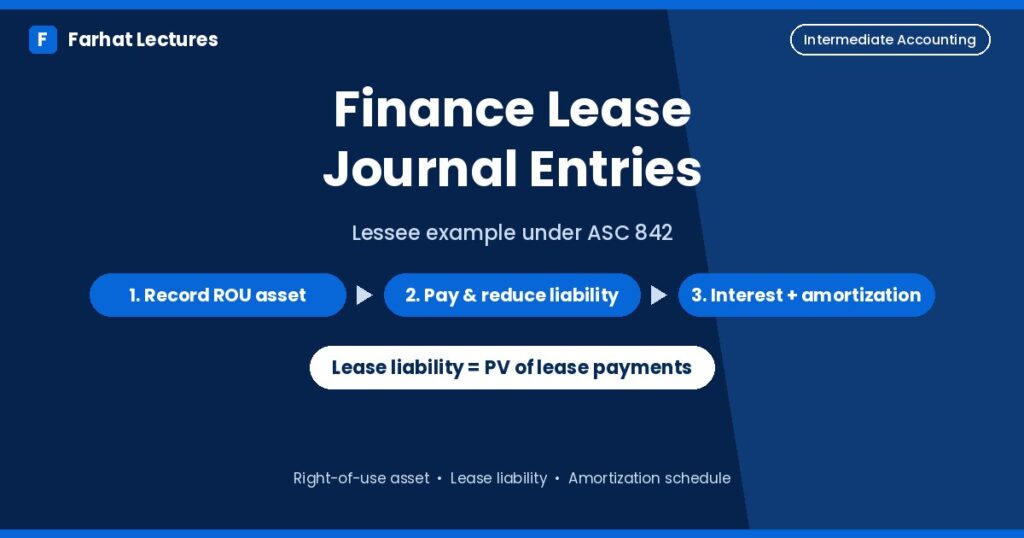
The $1,500 price is far below the expected $9,000 value, so exercise is reasonably certain. The lease is a finance lease for Cobalt, and the entries follow the usual finance lease journal entries pattern with one change in the amortization period.
| Component | Calculation | Present value |
|---|---|---|
| Three annual payments (annuity due) | $12,000 × 2.78326 | 33,399.12 |
| Bargain purchase option | $1,500 × 0.79383 | 1,190.75 |
| Initial right-of-use asset | 34,589.87 | |
| Lease liability after the first payment$34,589.87 − $12,000.00 | 22,589.87 |
| Date | Payment | Interest (8%) | Reduction of liability | Lease liability |
|---|---|---|---|---|
| 1/1/2027 (after first payment) | 22,589.87 | |||
| 1/1/2028 | 12,000.00 | 1,807.19 | 10,192.81 | 12,397.06 |
| 1/1/2029 | 12,000.00 | 991.76 | 11,008.24 | 1,388.82 |
| 1/1/2030 | 1,500.00 (option) | 111.18* | 1,388.82 | 0.00 |
*Interest at 8% on $1,388.82 is $111.11. It is increased by $0.07 so the liability lands exactly on the $1,500 option price. The small gap comes from rounding the present value factors.
Journal entries
| Account | Debit | Credit |
|---|---|---|
| Right-of-Use Asset | 34,589.87 | |
| Lease Liability | 22,589.87 | |
| Cash | 12,000.00 |
| Account | Debit | Credit |
|---|---|---|
| Interest Expense | 1,807.19 | |
| Lease Liability | 1,807.19 |
| Account | Debit | Credit |
|---|---|---|
| Amortization Expense | 5,764.98 | |
| Right-of-Use Asset | 5,764.98 |
If the $1,500 had been a probable guaranteed residual shortfall instead, and the lease still qualified as a finance lease under another test, every number above would match except amortization. Cobalt would return the forklift, so it would amortize over the 3-year lease term: $34,589.87 ÷ 3 = $11,529.96 a year.
What happens when the lessee exercises the option?
After interest of $111.18 is accrued on December 31, 2029, the liability equals the $1,500 option price. Cobalt pays it on January 1, 2030:
| Account | Debit | Credit |
|---|---|---|
| Lease Liability | 1,500.00 | |
| Cash | 1,500.00 |
After three years of amortization, the right-of-use asset has a balance of $17,294.93 ($34,589.87 − 3 × $5,764.98). Cobalt now owns the forklift, so it moves that balance to equipment and depreciates it over the remaining 3 years of useful life:
| Account | Debit | Credit |
|---|---|---|
| Equipment | 17,294.93 | |
| Right-of-Use Asset | 17,294.93 |
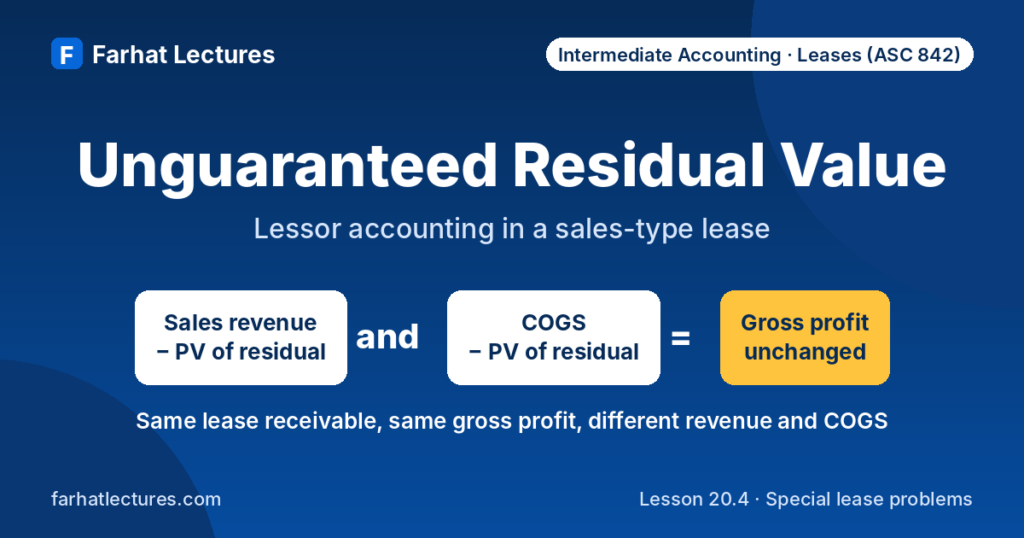
The lessor, Atlas, includes the $1,500 option price in its lease receivable and records a sales-type lease. For how the starting asset is built when there are fees or incentives, see right-of-use asset calculation.
Common mistakes
- Leaving the option price out of the lease liability. If exercise is reasonably certain, it is a lease payment.
- Amortizing over the lease term. With a bargain purchase option, use the asset’s useful life.
- Discounting the option price with the annuity factor. It is a single payment at the end.
- Forgetting to move the remaining ROU balance to equipment after the purchase.
CPA exam tip: In FAR questions, look at the wording before you pick an amortization period. If the lease transfers ownership or has a purchase option the lessee is reasonably certain to exercise, amortize the ROU asset over the asset’s useful life. Every other finance lease is amortized over the shorter of the lease term and the useful life. A guaranteed residual value never stretches amortization to useful life, because the asset goes back to the lessor.
Key takeaways
- A bargain purchase option is a purchase option the lessee is reasonably certain to exercise.
- It makes the lease a finance lease for the lessee and a sales-type lease for the lessor.
- Discount the option price as a single sum and add it to the lease liability.
- Amortize the ROU asset over the asset’s useful life, not the lease term.
- When the lessee buys the asset, move the remaining ROU balance to equipment.
Practice questions with answers
Question 1
A 3-year lease requires $20,000 payments at the start of each year and has a bargain purchase option of $3,000 at the end. The rate is 10% (annuity due factor 2.73554; PV of $1 for 3 periods 0.75131). Immediately after the lessee makes the first $20,000 payment at commencement, what lease liability does it report?
Show answer
Answer: $36,964.73.
The three payments have a present value of $54,710.80 ($20,000 × 2.73554). Add $2,253.93 for the purchase option ($3,000 × 0.75131) to get $56,964.73, the initial right-of-use asset assuming no other adjustments. The first $20,000 has already been paid, so the lease liability is $56,964.73 − $20,000.00 = $36,964.73.
Question 2
A lessee records a $50,000 right-of-use asset for a 5-year lease with a bargain purchase option. The asset’s useful life is 8 years. What is annual amortization?
Show answer
Answer: $6,250.
The lessee expects to own the asset, so it amortizes over the 8-year useful life: $50,000 ÷ 8 = $6,250.
Question 3
Two leases have the same $40,000 right-of-use asset and 4-year term. One has a bargain purchase option, and the other has a guaranteed residual value with a probable shortfall. Both are finance leases. The asset’s useful life is 10 years. What is each lease’s annual amortization?
Show answer
Answer: $4,000 with the bargain purchase option; $10,000 with the guaranteed residual value.
The option means the lessee keeps the asset, so it uses 10 years. With the guarantee, the asset is returned after 4 years, so it uses the lease term.
Frequently asked questions
Is a bargain purchase option the same as a purchase option reasonably certain to be exercised?
A bargain price is one reason a lessee may be reasonably certain to exercise a purchase option. ASC 842 also considers other economic incentives, such as significant improvements that would lose value to the lessee if it returned the asset.
Does a bargain purchase option make a lease a finance lease?
Yes. A purchase option the lessee is reasonably certain to exercise meets one of the five classification criteria, so the lessee has a finance lease and the lessor has a sales-type lease.
Does the lessor include the option price in the lease receivable?
Yes. The lessor expects to collect the option price, so it is part of the lease receivable, just as the lessee includes it in the lease liability.
What happens to the right-of-use asset after the lessee buys the asset?
The lessee reclassifies the remaining right-of-use asset balance to equipment and depreciates it over the rest of the asset’s useful life.
Is “bargain purchase option” still a term in ASC 842?
Not officially. The term comes from the old lease standard, ASC 840, where a bargain purchase option was one of the four tests for a capital lease. ASC 842 replaced it with “a purchase option the lessee is reasonably certain to exercise,” but textbooks and exam questions still use the older name.
Does the lessee ever reassess a purchase option?
Yes. If a significant event within the lessee’s control changes whether exercise is reasonably certain, the lessee reassesses the option and remeasures the lease liability.
How does IFRS 16 treat a bargain purchase option?
Very similarly. Under IFRS 16, an exercise price the lessee is reasonably certain to pay is included in the lease liability, and the right-of-use asset is depreciated over the asset’s useful life. The main difference is that IFRS 16 uses a single model for lessees, so there is no finance versus operating lease split on the lessee’s side.
Sources
- FASB Accounting Standards Codification, Topic 842 (Leases)
- Deloitte Roadmap: Exercise price of a purchase option reasonably certain to be exercised
- Deloitte Roadmap: Purchase options and the lease term
- Deloitte Roadmap: Lease classification
Mansour Farhat, CPA, CIA, DBA, teaches accounting through Farhat Lectures, an online platform for CPA, CMA, and EA candidates and accounting students, and on the Farhat Lectures YouTube channel. Read more about Professor Farhat.
Continue learning with Farhat Lectures
Strengthen your accounting understanding with clear explanations and guided practice.
Explore the free sample course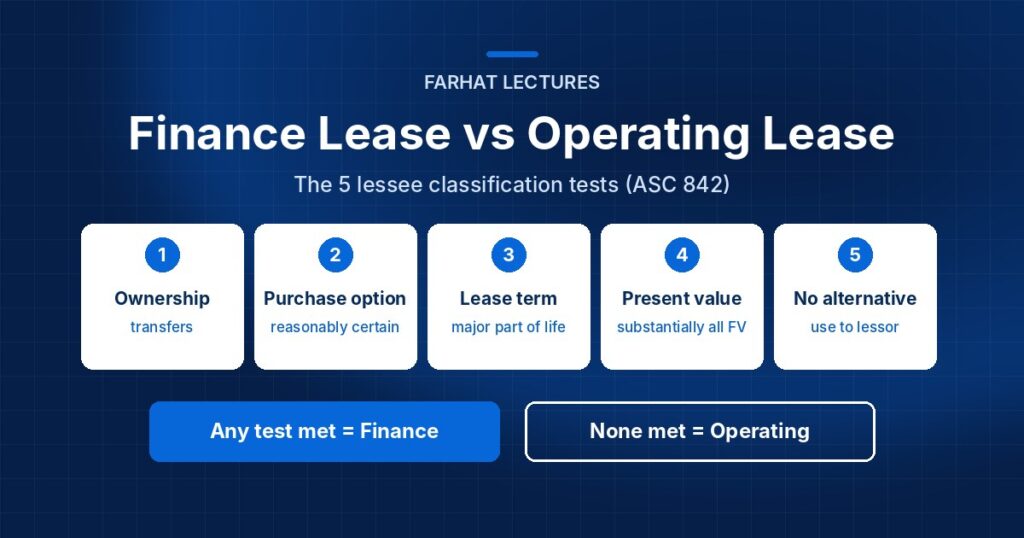
Responses