
Guaranteed Residual Value in a Finance Lease: Lessee vs. Lessor

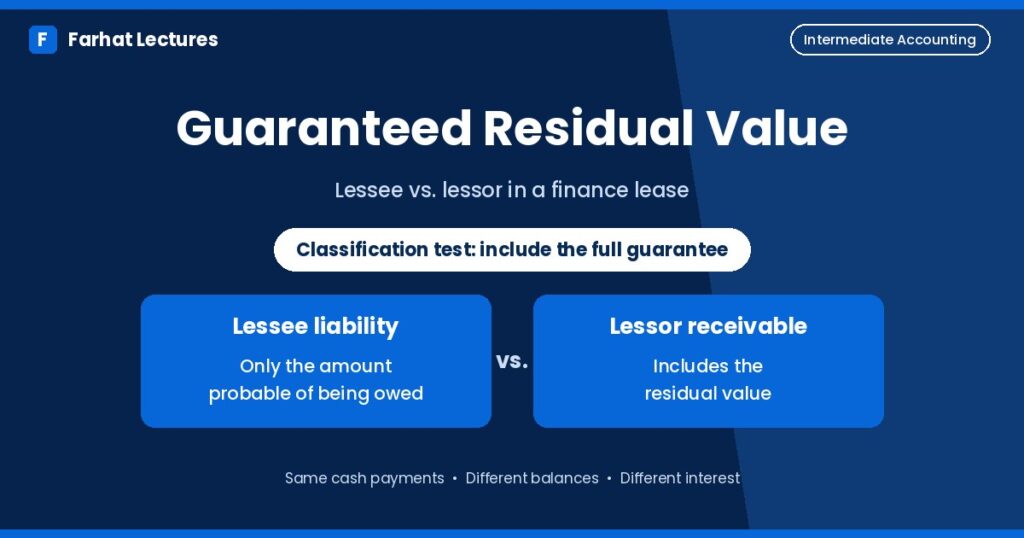
A guaranteed residual value is a lessee’s promise that an asset will be worth at least a stated amount at lease end. If it is worth less, the lessee pays the shortfall. Under ASC 842, the full guarantee counts in the classification test, the lessee’s liability includes only the amount probable of being owed, and the lessor’s receivable includes all of it.
That is why the two sides of one lease can report different balances and different interest.
Why it matters: students often expect the lessee’s amortization schedule to mirror the lessor’s. When a residual value is involved, it usually does not. Knowing which party counts the guarantee, and for what purpose, explains most of the differences between finance lease journal entries for the lessee and sales-type lease accounting for the lessor.
Watch: Guaranteed residual value, lessee liability vs. classification
Three rules for a guaranteed residual value
The residual value is the asset’s estimated value at the end of the lease. A guarantee shifts the risk of a lower value from the lessor to the lessee, which usually means lower lease payments. Each party then uses the guarantee in a different way.
| Purpose | How the guaranteed residual value is treated |
|---|---|
| Classification (present value test), lessee and lessor | Include the full guaranteed amount, discounted, with the lease payments. |
| Lessee’s lease liability and ROU asset | Include only the amount the lessee will probably owe under the guarantee. ASC 842 calls this the amount “probable of being owed.” |
| Lessor’s net investment in a sales-type lease | The lease receivable includes the present value of unpaid lease payments and the guaranteed residual. Add the present value of any unguaranteed residual asset to measure the net investment in the lease. |
Why the rules differ
Classification asks whether control of the asset has passed to the lessee. A lessee that guarantees the residual bears the risk of the asset losing value, so the full guarantee is part of that test.
The lessee’s liability must be a present obligation to give up economic resources. If the lessee expects the asset to be worth more than the guarantee, it expects to pay nothing, so it leaves the guarantee out of the liability.
The lessor’s net investment reflects what it expects to recover through the payments and the returned asset. The lease receivable includes the full guaranteed residual, discounted to present value. If the lessor expects the asset to be worth more than the guarantee, the present value of the excess is the unguaranteed residual asset.
Who can guarantee the residual value?
Most guarantees come from the lessee, but a third party unrelated to the lessor, such as an insurance company, can also guarantee the residual value to the lessor. Who gives the guarantee changes how it is used.
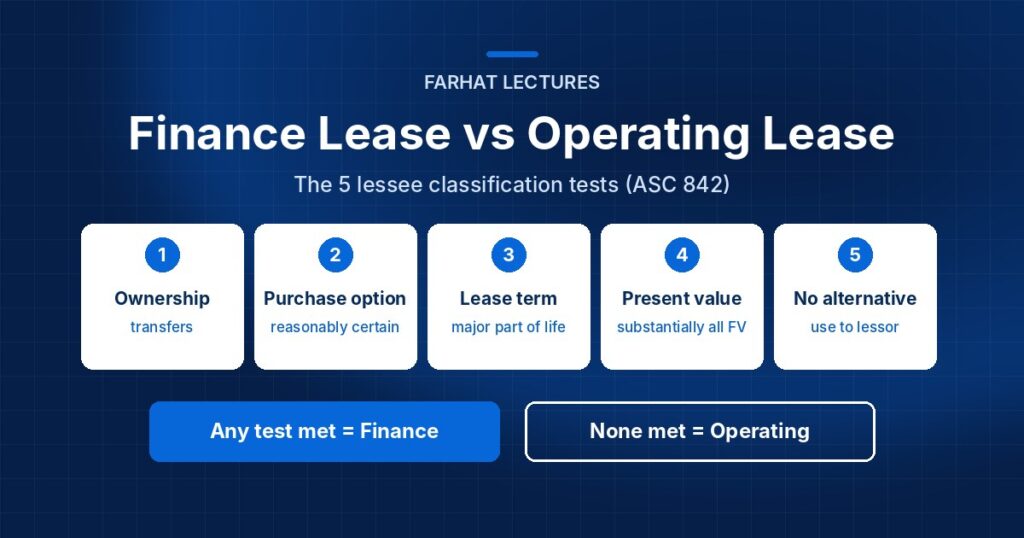
- Lessee classification test: counts only the lessee’s own guarantee.
- Lessor sales-type lease test: also counts only the lessee’s guarantee.
- Lessor direct financing lease test: counts the residual guaranteed by the lessee or by a third party unrelated to the lessor. Count each guaranteed amount only once.
If none of the sales-type criteria are met, the lessor classifies the lease as direct financing when both conditions are met: (1) the present value of the lease payments and qualifying guaranteed residual covers substantially all of the asset’s fair value, and (2) collection of the lease payments and any amount needed to satisfy the guarantee is probable. A third-party guarantee can therefore lead to direct financing classification for the lessor while the lessee classifies the same lease as operating. The lessee never puts a third-party guarantee in its lease liability, because the lessee does not owe it.
Lessee vs. lessor example
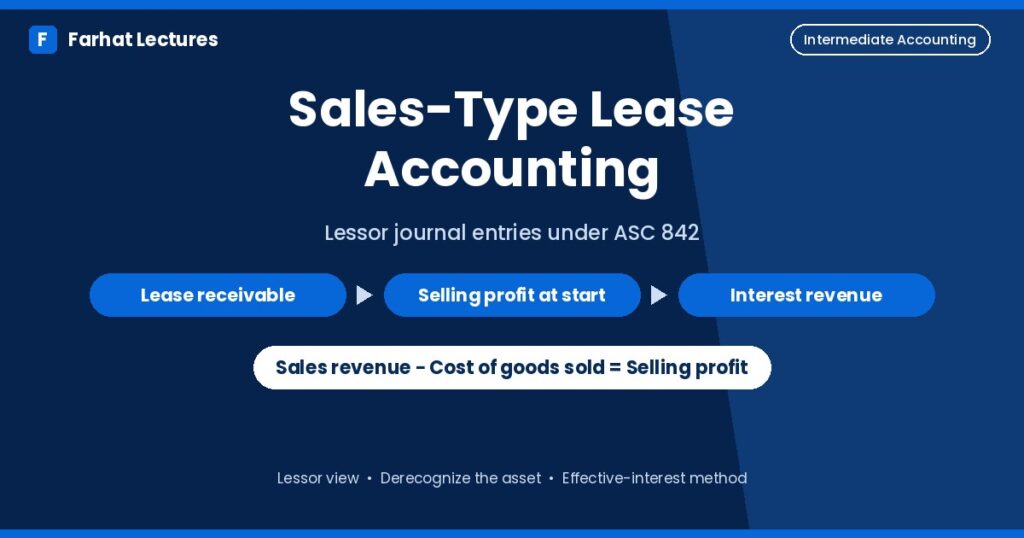
This example is hypothetical and uses the same lease as the sales-type lease accounting lesson. On January 1, 2026, Summit Fabrication leases a machine with a $150,000 fair value to Ridge Auto Parts for 5 years. Ridge pays $31,617.54 at the beginning of each year and guarantees an $8,000 residual value. The implicit rate is 5%, and Ridge knows it. Ridge expects the machine to be worth more than $8,000 at the end, so it does not expect to owe anything under the guarantee. Summit built the machine at a cost of $120,000, so it earns a $30,000 selling profit on day one.
Step 1: Classify the lease (both parties)
Present value of the payments ($143,731.77) plus the present value of the full $8,000 guarantee ($8,000 ÷ 1.055 = $6,268.21) is $149,999.98, about 100% of fair value. The lease also covers the machine’s whole 5-year economic life. It is a finance lease for Ridge and a sales-type lease for Summit.
Step 2: Measure the starting balance
Ridge expects to owe nothing under the guarantee. The present value of all five scheduled payments is $143,731.77, which is the cost of its ROU asset. Ridge pays $31,617.54 at commencement, leaving a lease liability of $112,114.23 for the four unpaid payments. Summit collects the same $31,617.54, reducing its $150,000.00 receivable to $118,382.46.
| Ridge (lessee), January 1, 2026 | Debit | Credit |
|---|---|---|
| Right-of-Use Asset | 143,731.77 | |
| Lease Liability | 112,114.23 | |
| Cash | 31,617.54 |
| Summit (lessor), January 1, 2026 | Debit | Credit |
|---|---|---|
| Cash | 31,617.54 | |
| Lease Receivable | 118,382.46 | |
| Cost of Goods Sold | 120,000.00 | |
| Sales Revenue | 150,000.00 | |
| Inventory | 120,000.00 |
Step 3: Build the lessee’s schedule
| Date | Payment | Interest (5%) | Reduction of liability | Lease liability |
|---|---|---|---|---|
| 1/1/2026 (commencement) | $31,617.54 | $0.00 | — | $112,114.23 |
| 1/1/2027 | 31,617.54 | 5,605.71 | 26,011.83 | 86,102.40 |
| 1/1/2028 | 31,617.54 | 4,305.12 | 27,312.42 | 58,789.98 |
| 1/1/2029 | 31,617.54 | 2,939.50 | 28,678.04 | 30,111.94 |
| 1/1/2030 | 31,617.54 | 1,505.60 | 30,111.94 | 0.00 |
| Total | $158,087.70 | $14,355.93 | $112,114.23 |
Ridge’s liability reaches zero with the last payment. Ridge also amortizes the ROU asset over 5 years: $143,731.77 ÷ 5 = $28,746.35 a year (rounded).
Side-by-side comparison
| Item | Ridge (lessee) | Summit (lessor) |
|---|---|---|
| Guarantee in the present value test | Full $8,000 | Full $8,000 |
| Balance after the January 1, 2026 payment | Lease liability $112,114.23 | Lease receivable $118,382.46 |
| Annual cash payment | $31,617.54 paid | $31,617.54 received |
| 2026 interest | Interest expense $5,605.71 | Interest revenue $5,919.12 |
| Total interest over the lease | $14,355.93 | $16,087.70 |
| Balance after the January 1, 2030 payment | $0.00 | $7,619.07, growing to $8,000 by year-end |
| When the machine is returned | No entry (the ROU asset is fully amortized) | Debit Inventory, credit Lease Receivable, $8,000 |
The lessor earns $1,731.77 more interest because its receivable includes the residual, which grows from $6,268.21 today to $8,000 at the end. The cash is identical; only the accounting balances differ.
A second source of difference is the discount rate. If the lessee cannot readily determine the implicit rate, it uses its own incremental borrowing rate, while the lessor uses the implicit rate. The schedules would then differ even with no residual value.
What if the lessee expects to owe part of the guarantee?
Suppose Ridge instead expects the machine to be worth only $5,000. It would expect to owe Summit the $3,000 shortfall. Ridge adds the present value of that $3,000 to its liability: $3,000 ÷ 1.055 = $2,350.58, bringing the lease liability after the first payment to $114,464.81 and the ROU asset to $146,082.35. Summit’s receivable after collecting the first payment is still $118,382.46. The lessor includes the full $8,000 guarantee no matter what the lessee expects, because Ridge must pay any shortfall in cash.
How does a residual value guarantee affect the lessee? For the classification test, count the present value of the full guarantee once. For the initial lease liability, include the present value of any amount it is probable the lessee will owe under the guarantee.
What happens at the end of the lease?
Go back to the original example, where Ridge expected to owe nothing. Now suppose the machine is actually worth only $5,000 when Ridge returns it. Ridge guaranteed $8,000, so it pays Summit the $3,000 shortfall.
| Account | Debit | Credit |
|---|---|---|
| Loss on Residual Value Guarantee | 3,000.00 | |
| Cash | 3,000.00 |
| Account | Debit | Credit |
|---|---|---|
| Inventory | 5,000.00 | |
| Cash | 3,000.00 | |
| Lease Receivable | 8,000.00 |
Summit is made whole: it gets $5,000 of machine plus $3,000 of cash, which equals the $8,000 still in its receivable.
If Ridge realizes before the end of the lease that a shortfall has become probable, it does not wait. It remeasures the lease liability for the new probable amount and adjusts the ROU asset by the same amount (ASC 842-10-35-4 and ASC 842-20-35-4).
Common mistakes
- Leaving the guarantee out of the classification test. The present value test uses the full guaranteed amount.
- Adding the full guarantee to the lessee’s liability. Add only the amount the lessee expects to owe.
- Overlooking the unguaranteed residual asset. For a sales-type lease, the lessor’s net investment includes the lease receivable and the present value of any unguaranteed residual asset.
- Copying one schedule for both parties. One schedule works only when both parties include the same residual amount and use the same rate.
Practice questions
Question 1
An asset’s fair value is $100,000. The present value of the lease payments is $86,000, and the present value of the lessee’s residual value guarantee is $6,000. Using a 90% benchmark, does the lease pass the present value test?
Answer: Yes. Include the full guarantee: ($86,000 + $6,000) ÷ $100,000 = 92%. Without the guarantee, the result would be 86%, which is why leaving it out is a costly mistake.
Question 2
A lessee guarantees a $10,000 residual value and expects the asset to be worth $12,000 at the end of the lease. How much of the guarantee goes into its lease liability?
Answer: None. The lessee expects the asset to exceed the guaranteed amount, so it does not expect to owe anything.
Question 3
A lessee guarantees a $10,000 residual value at the end of a 4-year lease but expects the asset to be worth $7,000. The rate is 6%. What does it add to its lease liability?
Answer: It expects to owe $3,000. The present value is $3,000 × 0.79209 = $2,376 (rounded), which is added to the present value of the lease payments.
Key takeaways
- The present value test always includes the full guaranteed residual value.
- The lessee’s lease liability includes only the amount it expects to owe under the guarantee.
- For a sales-type lease, the lessor’s net investment includes the lease receivable and the present value of any unguaranteed residual asset.
- The cash payments are identical, but residual values and discount rates can make the two schedules and interest amounts differ.
Frequently asked questions
What is the difference between a guaranteed and an unguaranteed residual value?
A guaranteed residual value is backed by the lessee (or another party) who pays any shortfall. An unguaranteed residual value has no such backing, so the lessor bears all the risk. The lessee ignores an unguaranteed residual entirely.
What happens if the asset is worth less than the guarantee at the end?
The lessee pays the lessor the difference. If the lessee expected that shortfall from the start, it has already included the amount in its lease liability.
Does a guaranteed residual value lower the lease payments?
Usually yes. The guarantee moves the risk of a low end-of-lease value to the lessee, so the lessor needs less cash during the lease to earn its return.
Does the lessor’s receivable change if the lessee expects to owe part of the guarantee?
No. The lessor includes the full guaranteed amount, because the lessee must cover any shortfall. So the lessee’s expectation does not change the lessor’s receivable.
Who can guarantee a residual value?
The lessee or a third party unrelated to the lessor, such as an insurer, can provide a qualifying guarantee. The lessee’s own guarantee counts in both parties’ present value tests. A qualifying third-party guarantee counts only in the lessor’s direct financing test, which also requires probable collection.
Does the lessee remeasure if its expectation changes?
Yes. If the amount probable of being owed under the guarantee changes, the lessee remeasures the lease liability and adjusts the ROU asset by the same amount.
How does IFRS 16 treat a residual value guarantee?
For the lessee, it works much the same way: IFRS 16 includes only the amount the lessee expects to pay under the guarantee. For the lessor, IFRS 16 counts guarantees from the lessee, a party related to the lessee, or an unrelated third party that can pay.
Sources
- FASB Accounting Standards Codification, Topic 842, Leases (ASC 842-10-25-2, 842-10-30-5(f), 842-30-30-1)
- Deloitte Roadmap: Leasing, 6.7 Amounts Probable of Being Owed Under a Residual Value Guarantee (ASC 842-10-30-5(f))
- Deloitte Roadmap: Leasing, 8.3 Lease Classification (reproduces ASC 842-10-25-2 classification criteria)
- Deloitte Roadmap: Leasing, 9.3 Lessor Recognition and Measurement (net investment, selling profit, collectibility)
Prepared by Farhat Lectures for intermediate accounting students and accounting exam candidates. The company names and numbers in the examples are hypothetical. If you are preparing for the CPA exam, check the current AICPA blueprint for your section to see how leases are tested.
About the author: Mansour Farhat, CPA, CIA, DBA, teaches intermediate accounting and accounting exam prep through Farhat Lectures. Learn more about Mansour.
Continue learning with Farhat Lectures
Strengthen your lease accounting skills with clear explanations and guided practice.
Explore the free sample course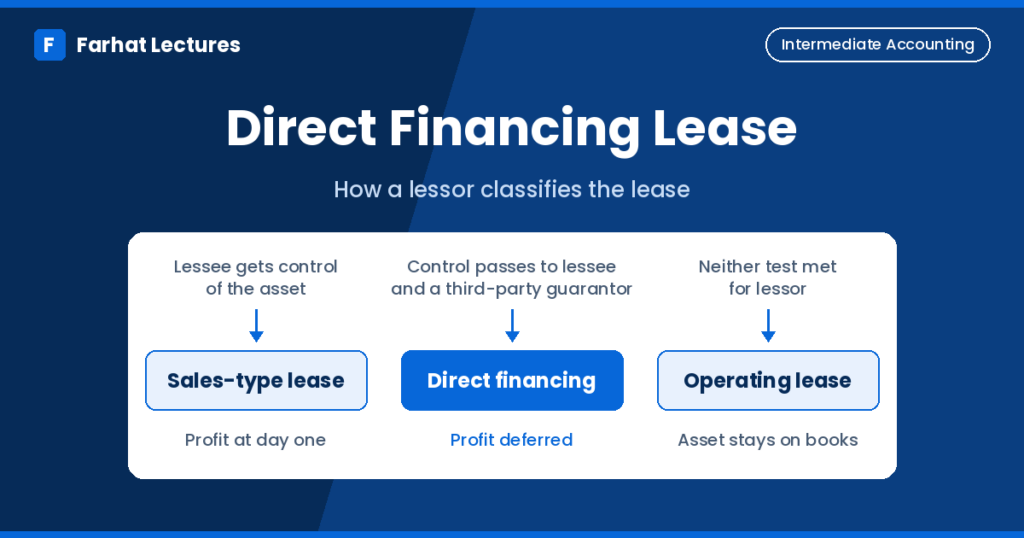
Responses