
Sales-Type Lease Accounting: Lessor Journal Entries and Example

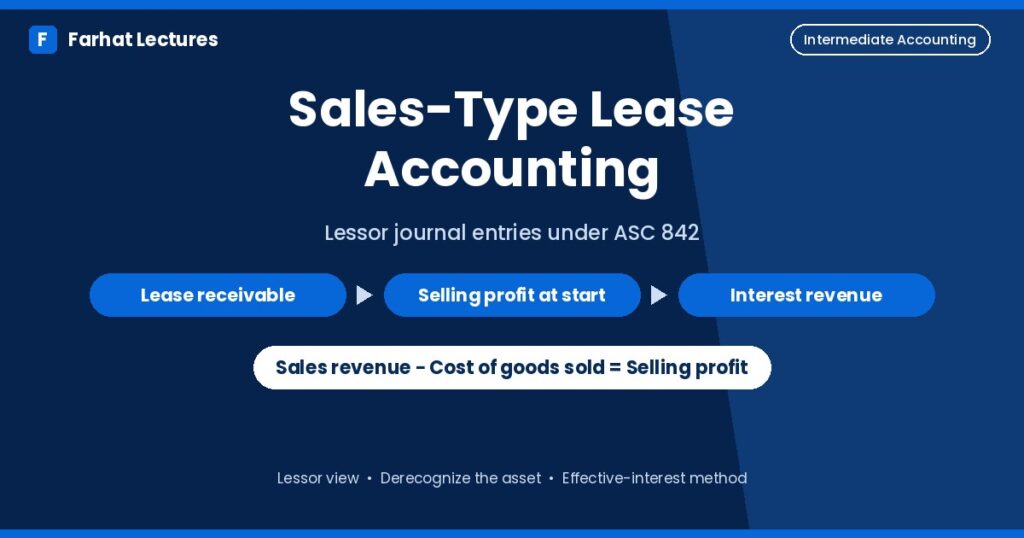
Sales-type lease accounting is how a lessor records a lease that transfers control of the asset to the lessee under U.S. GAAP (ASC 842). When collection is probable at commencement, the lessor removes the asset, recognizes its net investment in the lease and any selling profit or loss, and earns interest revenue over the lease term. If collection is not probable, the lease retains its sales-type classification. The lessor keeps the asset on its books and records cash received as a deposit liability.
Think of it as a sale on credit. Interest revenue uses the effective-interest method, which simply means each period’s interest equals the implicit rate times the receivable balance. This guide walks through the lessor’s journal entries step by step.
Why it matters: manufacturers and dealers often use leases to sell equipment. The classification decides whether the lessor reports a sale and profit on day one or keeps the asset and reports rental income over time. That choice changes revenue, gross profit, and total assets, so exam questions test it often. If you are studying the other side of the same deal, start with finance lease journal entries for the lessee.
Watch: Sales-type lease accounting, lessor journal entries
What is a sales-type lease?
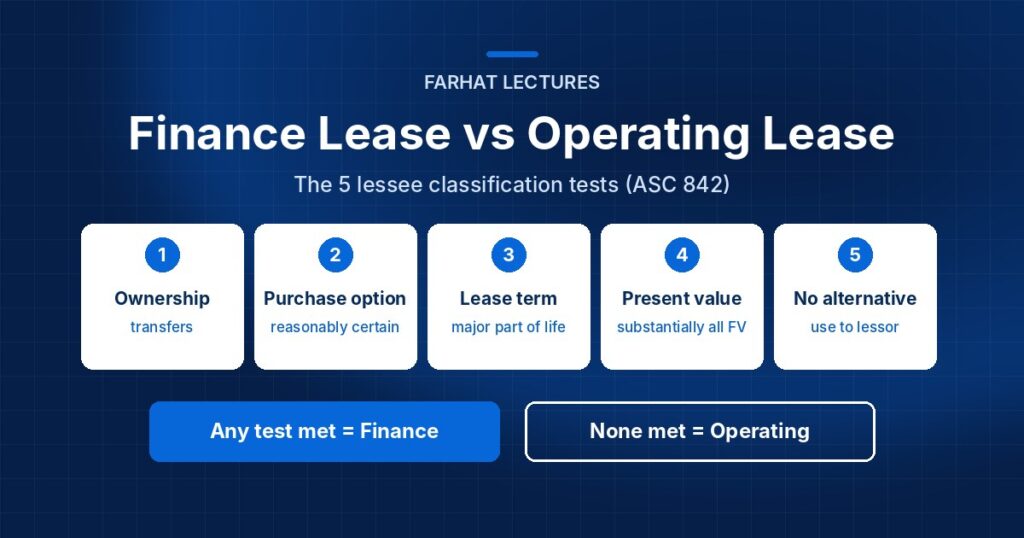
A sales-type lease is the lessor’s name for a lease that meets at least one of the same five classification tests a lessee uses to identify a finance lease: transfer of ownership, a purchase option reasonably certain to be exercised, a lease term for the major part of the asset’s economic life, a present value equal to substantially all of its fair value, or a specialized asset with no alternative use.
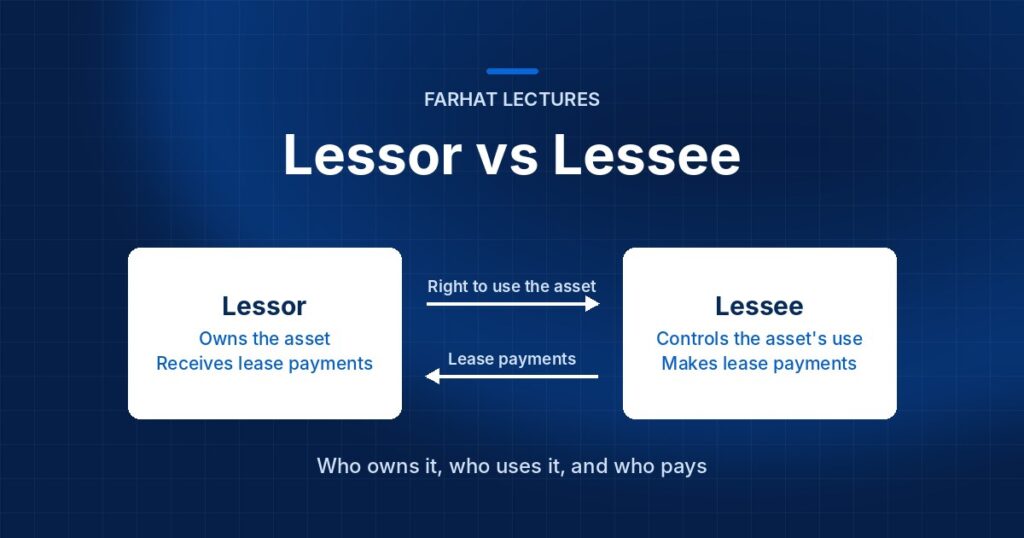
The tests are shared because they ask one question from both sides: has control of the asset passed to the lessee? If the lessee gains control, the lessor has given it up and has satisfied a performance obligation (a promise to transfer a good or service to a customer), the same transfer of control idea used in revenue recognition. That is why the lessor records a sale.
There is one extra check, and it affects recognition, not classification. Even when a test is met, the lessor must judge whether collecting the lease payments (plus any amount needed to satisfy a residual value guarantee) is probable. If it is not, the lease is still a sales-type lease, but the lessor does not record a receivable or remove the asset yet. It records any payments received as a deposit liability.
Sales-type vs. direct financing vs. operating lease
A lessor sorts every lease into one of three buckets under ASC 842-10-25-2 and 25-3. Here is how they compare.
| Sales-type lease | Direct financing lease | Operating lease | |
|---|---|---|---|
| When it applies | Any one of the five classification tests is met | No test is met, but the present value of the payments plus any residual guaranteed by the lessee or an unrelated third party is substantially all of fair value, and collection is probable | Neither of the other two applies |
| Underlying asset | Removed when collection is probable. Otherwise, the lessor keeps the asset and records cash received as a deposit liability. | Removed from the lessor’s books | Stays on the books and keeps being depreciated |
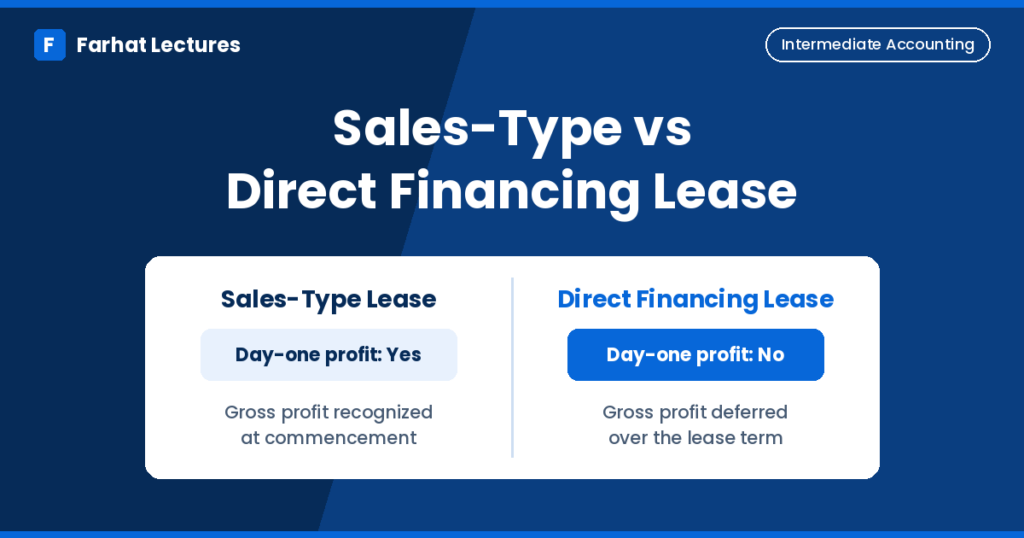
| Selling profit | Recognized at commencement when collection is probable | Deferred and built into the net investment | None at commencement |
| Selling loss | Recognized at commencement when collection is probable | Recognized at commencement | Not applicable |
| Income over the lease term | Interest revenue on the net investment | Interest revenue on the net investment | Lease income, generally straight-line |
Sales-type lease accounting at a glance
| Event | Lessor records | Amount |
|---|---|---|
| Commencement | Lease receivable and sales revenue | Present value of the lease payments, including any residual value the lessee guarantees (sales revenue cannot exceed the asset’s fair value) |
| Commencement | Cost of goods sold; remove the asset from inventory | Carrying amount (cost) of the asset, less the present value of any unguaranteed residual |
| Each payment received | Cash; reduce the lease receivable | The payment |
| Year-end | Increase the lease receivable; interest revenue | Rate × receivable balance outstanding |
| End of lease | Asset back in inventory; remove the receivable | Residual value |
Sales-type lease exercise
Answer three questions about lease classification, collectibility, and the timing of selling profit and interest revenue before working through the journal entries below.
Sales-type lease example
This example is hypothetical. On January 1, 2026, Summit Fabrication Inc., a machine manufacturer, leases a CNC machine to Ridge Auto Parts.
| Lease term | Detail |
|---|---|
| Lease term | 5 years, non-cancelable, no renewal or purchase option |
| Payments | Equal payments at the beginning of each year |
| Fair value of the machine | $150,000 |
| Cost of the machine in Summit’s inventory | $120,000 |
| Economic life | 5 years |
| Residual value | $8,000, guaranteed by Ridge; the machine returns to Summit |
| Rate implicit in the lease | 5%; collectibility is probable |
Setting the payment: Summit wants to recover the fair value, less what it will get back at the end, and earn 5%.
| Payment calculation | Amount |
|---|---|
| Fair value of the machine | $150,000.00 |
| Less: present value of the $8,000 residual ($8,000 × 0.78353) | (6,268.21) |
| Amount to recover through payments | $143,731.79 |
| Five beginning-of-year payments (÷ 4.54595, annuity due, 5 periods, 5%) | $31,617.54 |
The factors are rounded to five decimals; the amounts use unrounded factors, as Excel or a financial calculator would. An annuity due is a series of equal payments made at the start of each period, so the first payment is not discounted at all.
Classification: the lease term equals the machine’s 5-year economic life, and the present value of the payments plus the guaranteed residual equals 100% of fair value. Ridge consumes substantially all of the machine, so Summit has a sales-type lease.
What journal entries does the lessor make at commencement?
The lease receivable equals the present value of the payments plus the present value of the guaranteed residual value: $143,732 + $6,268 = $150,000 (rounded to the nearest dollar). Summit records the sale and the cost at the same time.
| January 1, 2026 | Debit | Credit |
|---|---|---|
| Lease Receivable | 150,000.00 | |
| Cost of Goods Sold | 120,000.00 | |
| Sales Revenue | 150,000.00 | |
| Inventory | 120,000.00 |
Summit reports a $30,000 gross profit ($150,000 − $120,000) in 2026. Because Summit is a manufacturer that uses leasing to sell its products, it shows sales revenue and cost of goods sold gross. Under ASC 842-30-45-4, a lessor presents selling profit in the way that best reflects its business model, so a lessor that leases mainly to provide financing would usually show only the net profit or loss. It also receives the first payment the same day:
| January 1, 2026 | Debit | Credit |
|---|---|---|
| Cash | 31,617.54 | |
| Lease Receivable | 31,617.54 |
What about initial direct costs?
Initial direct costs are the extra costs a lessor pays only because the lease was signed, such as a sales commission. In a sales-type lease, the lessor expenses them at commencement when the asset’s fair value differs from its carrying amount, as it does for Summit. If fair value equals carrying amount, so there is no selling profit or loss, the lessor defers them and includes them in the net investment in the lease.
Lease receivable amortization schedule
| Date | Cash payment or residual recovered | Interest (5%) | Reduction of receivable | Lease receivable |
|---|---|---|---|---|
| 1/1/2026 | $150,000.00 | |||
| 1/1/2026 | $31,617.54 | $0.00 | $31,617.54 | 118,382.46 |
| 1/1/2027 | 31,617.54 | 5,919.12 | 25,698.42 | 92,684.04 |
| 1/1/2028 | 31,617.54 | 4,634.20 | 26,983.34 | 65,700.70 |
| 1/1/2029 | 31,617.54 | 3,285.04 | 28,332.50 | 37,368.20 |
| 1/1/2030 | 31,617.54 | 1,868.41 | 29,749.13 | 7,619.07 |
| 1/1/2031 — Machine returned ($8,000 noncash residual) | 8,000.00 | 380.93* | 7,619.07 | 0.00 |
| Total | $166,087.70 | $16,087.70 | $150,000.00 |
*Adjusted by $0.02 for rounding. The five cash payments total $158,087.70. When Ridge returns the machine, Summit recovers the $8,000 residual in equipment, bringing total cash and residual recovered to $166,087.70.
How does the lessor record interest revenue?
Interest for 2026 is earned during the year but collected with the January 1, 2027 payment, so Summit accrues it by increasing the receivable: $118,382.46 × 5% = $5,919.12.
| December 31, 2026 | Debit | Credit |
|---|---|---|
| Lease Receivable | 5,919.12 | |
| Interest Revenue | 5,919.12 |
| January 1, 2027 | Debit | Credit |
|---|---|---|
| Cash | 31,617.54 | |
| Lease Receivable | 31,617.54 |
The same pair of entries repeats through 2030. Interest revenue declines each year because the receivable balance declines.
Return of the asset at the end of the lease
The last payment arrives on January 1, 2030, but the machine is not returned until January 1, 2031. During 2030, the residual value grows to its full $8,000, so Summit still earns interest that year.
| December 31, 2030 | Debit | Credit |
|---|---|---|
| Lease Receivable | 380.93 | |
| Interest Revenue | 380.93 |
| January 1, 2031 | Debit | Credit |
|---|---|---|
| Inventory | 8,000.00 | |
| Lease Receivable | 8,000.00 |
How is a sales-type lease reported on the financial statements?
At December 31, 2026, the receivable balance is $124,301.58 ($118,382.46 + $5,919.12). The amount to be collected within one year is current.
| Summit Fabrication, 2026 | Amount |
|---|---|
| Current assets: Lease receivable ($5,919.12 interest + $25,698.42 principal) | $31,617.54 |
| Noncurrent assets: Lease receivable | $92,684.04 |
| Income statement: Sales revenue | $150,000.00 |
| Income statement: Cost of goods sold | $120,000.00 |
| Income statement: Interest revenue | $5,919.12 |
Common mistakes
- Using the asset’s cost in the present value test. The test compares present value with fair value. Cost matters only for cost of goods sold.
- Recording only the net profit when the lessor is a dealer. A manufacturer or dealer like Summit records the gross amounts: sales revenue and cost of goods sold.
- Leaving out the residual value. The lessor includes the present value of the residual value in its net investment in the lease. A guaranteed residual is part of the lease receivable, and an unguaranteed residual is recorded alongside it.
- Recording interest on the first payment. With beginning-of-year payments, the first collection is all principal.
- Assuming the lessee’s numbers match. The cash is the same, but balances and interest can differ. See guaranteed residual value: lessee vs. lessor.
Practice questions
Question 1
A dealer leases equipment with a fair value of $60,000 and a cost of $45,000 in a sales-type lease with no residual value. What does it record at commencement, and what is the selling profit?
Answer: Debit Lease Receivable $60,000 and Cost of Goods Sold $45,000; credit Sales Revenue $60,000 and Inventory $45,000. Selling profit is $15,000.
Question 2
In the Summit example, what entry does Summit make on December 31, 2027?
Answer: Interest is $92,684.04 × 5% = $4,634.20. Debit Lease Receivable and credit Interest Revenue for $4,634.20.
Question 3
A lessor wants to recover an asset’s $50,000 fair value through three equal payments at the beginning of each year, earning 8%. There is no residual value. What is the payment?
Answer: $50,000 ÷ 2.78326 (annuity due, 3 periods, 8%) is about $17,965. The exact payment with unrounded factors is $17,964.51.
Key takeaways
- A lessor has a sales-type lease when any one of the five classification tests is met. Collectibility does not change the classification, but if collection is not probable, the lessor waits to record the sale and treats cash received as a deposit liability.
- When collection is probable at commencement, a manufacturer such as Summit removes the equipment from inventory, recognizes its net investment in the lease, and presents sales revenue and cost of goods sold separately.
- The lessor includes the present value of the residual value in its net investment in the lease, whether or not the residual is guaranteed.
- Interest revenue equals the implicit rate times the receivable balance, so it falls over time.
- A returned asset goes back into inventory at its residual value.
Frequently asked questions
Why is it called a sales-type lease?
Because the lessor accounts for it like a sale: control of the asset passes to the lessee, so the lessor recognizes revenue and cost of goods sold at commencement and earns interest on the financing over the term.
What if collectibility is not probable?
The lease is still classified as a sales-type lease, but the lessor does not record a receivable or remove the asset yet. Payments received are recorded as a deposit liability until collectibility becomes probable, or until the contract is terminated (or the lessor repossesses the asset and owes the lessee nothing more) and the payments received are nonrefundable.
Will the lessor’s interest revenue equal the lessee’s interest expense?
Not always. Different discount rates and residual value guarantees can make the two balances differ, even though the cash payment is the same. See guaranteed residual value in a finance lease.
What changes if the residual value is unguaranteed?
The lessor still includes the present value of the expected residual in its net investment in the lease. Under ASC 842, sales revenue and cost of goods sold are each reduced by the present value of the unguaranteed residual, so the selling profit is the same. In the Summit example, if the $8,000 residual were unguaranteed, sales revenue would be $143,731.79 ($150,000 − $6,268.21) and cost of goods sold would be $113,731.79 ($120,000 − $6,268.21). Gross profit stays $30,000.
What is a direct financing lease?
It is another lessor classification that also uses a receivable and interest revenue, but it defers any selling profit instead of recognizing it at commencement. A selling loss is still recognized right away. It is uncommon because a lease usually becomes a direct financing lease only when a third party, not the lessee, guarantees the residual value and that guarantee is what makes the present value test pass. Collection must also be probable.
Is a sales-type lease the same as a finance lease?
They use the same five classification tests, seen from opposite sides of the deal. The lessee calls it a finance lease and records a right-of-use asset and a lease liability. The lessor calls it a sales-type lease and records a lease receivable.
What are initial direct costs in a sales-type lease?
They are extra costs the lessor pays only because the lease was signed, such as a commission. The lessor expenses them at commencement when fair value differs from carrying amount, and defers them into the net investment when the two are equal.
Sources
- Deloitte Roadmap: Leasing, 9.2 Lessor Lease Classification (same five criteria as lessees; control-based model)
- Deloitte Roadmap: Leasing, 9.3 Lessor Recognition and Measurement (net investment, selling profit, collectibility)
- Deloitte Roadmap: Leasing, 14.3 Lessor Presentation (current and noncurrent lease assets)
Prepared by Farhat Lectures for intermediate accounting students and accounting exam candidates. The company names and numbers in the examples are hypothetical. If you are preparing for the CPA exam, check the current AICPA blueprint for your section to see how leases are tested.
About the author: Mansour Farhat, CPA, CIA, DBA, teaches intermediate accounting and accounting exam prep through Farhat Lectures. Learn more about Mansour.
Continue learning with Farhat Lectures
Strengthen your lease accounting skills with clear explanations and guided practice. When you are ready for the full lease chapter, continue in the Farhat Lectures Intermediate Accounting course.
Explore the free sample course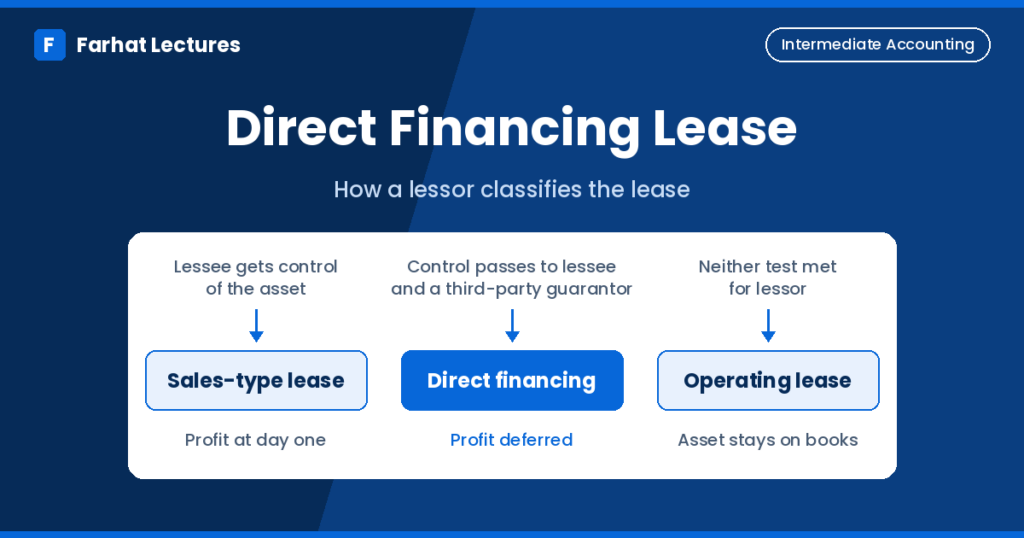
Responses