
Cost-Recovery Method vs. Percentage-of-Completion: The Zero-Profit Method Explained

Last updated 20 November 2026.
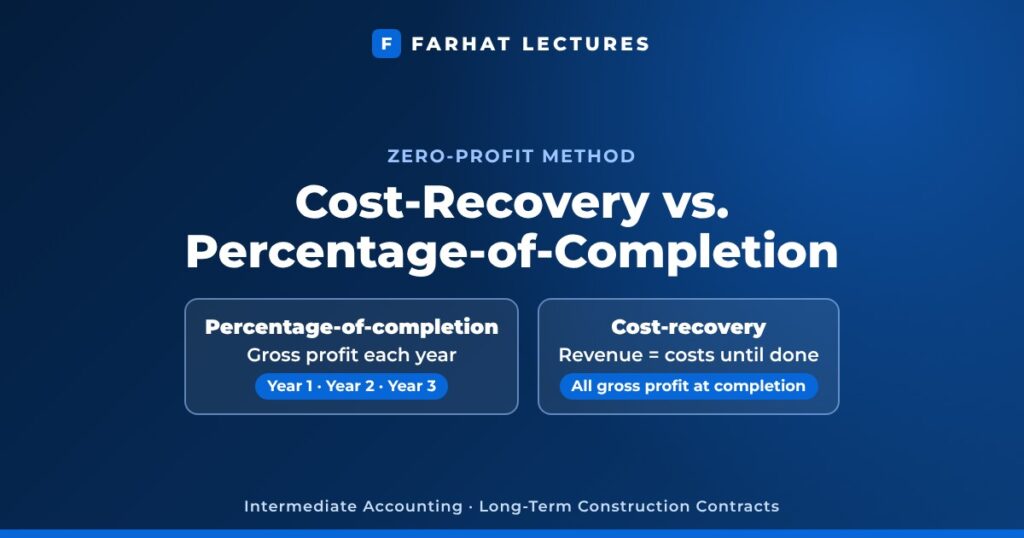
Under ASC 606, the cost-recovery method, also called the zero-profit method, applies when a performance obligation is satisfied over time, the company expects to recover its costs, and progress cannot yet be reasonably measured. The company recognizes revenue equal to costs incurred until it can reasonably measure progress.
One quick note on the name. In tax, cost recovery usually means depreciation under MACRS or amortization under separate tax rules, depending on the asset. In installment sales, the cost recovery method holds back all profit until the seller has recovered its basis. This article is about the third meaning: the method used for long-term contracts in financial accounting.
Why does this matter? The two methods report the same total profit, but at very different times. Using the same set of contract facts shows how the ability to measure progress changes the timing of revenue and gross profit.
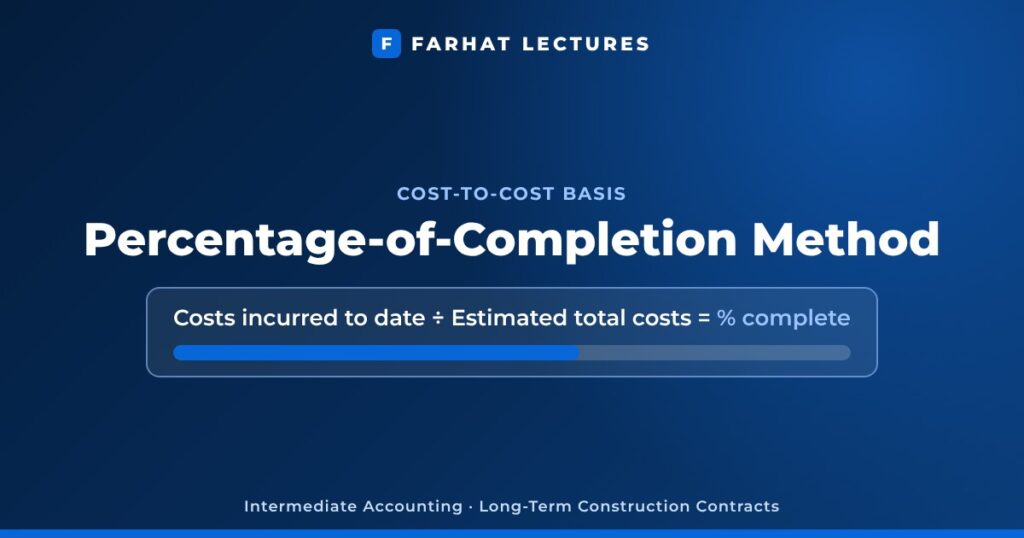
This guide follows Appendix 17A, Long-Term Construction Contracts, in Kieso’s Intermediate Accounting, 18th edition. Earlier Kieso editions cover the same material in Appendix 18A, and other textbooks place it inside their revenue recognition chapter. It builds on the percentage-of-completion method, so read that lesson first if the cost-to-cost formula is new to you.
Watch: when profit is deferred until a contract is complete
Watch this Farhat lesson on YouTube
This video starts at the 2:00 mark. Professor Farhat explains the older completed-contract method and illustrates the Construction in Process and Billings accounts. That method deferred revenue and gross profit until completion. Under the cost-recovery treatment in ASC 606, revenue equals costs incurred while progress cannot reasonably be measured and recovery is expected.
Key takeaways
- Revenue equals costs incurred while progress cannot reasonably be measured and the company expects to recover those costs.
- Once progress can be reasonably measured, the company recognizes revenue based on progress and records any cumulative catch-up in that period. In the Harbor Point example, this happens at completion.
- Use it when the performance obligation is satisfied over time, costs are expected to be recovered, and progress cannot yet be measured.
- This is not the old completed-contract method. That one reported no revenue at all before completion.
- A loss expected on the whole contract is recognized right away under both methods.
The CPA Exam blueprints cover the five-step revenue recognition model in both FAR and BAR. Use the side-by-side schedules below to practice calculating revenue and gross profit under different assumptions about whether progress can be measured.
What is the cost-recovery method?
During the zero-profit phase, each period’s revenue equals contract costs incurred that period, and gross profit is zero. When progress can first be reasonably measured, the contractor uses that measure to determine cumulative revenue and records the difference from revenue already recognized. If progress first becomes measurable at completion, the remaining revenue and the contract’s full gross profit are recognized in the final period. Two terms worth pinning down before we go further. A performance obligation is simply a promise in the contract to deliver something to the customer, which here is the finished building. Construction in Process is the inventory-style asset account where a contractor accumulates what it has spent on a job that is not done yet.
The name describes the logic: the company first “recovers” its costs through revenue, and only then reports profit.
When is the cost-recovery method used?
A company uses this approach early in a contract, or for an unusual project, when it cannot yet reasonably measure the outcome but is confident it will at least recover its costs. ASC 606-10-25-37 states the same principle: if an entity cannot reasonably measure the outcome of a performance obligation but expects to recover the costs it incurs, it recognizes revenue only to the extent of those costs until it can reasonably measure the outcome. The paragraph just before it, ASC 606-10-25-36, is what creates the need for this rule, because it allows revenue over time only when the entity can reasonably measure progress. IFRS 15 paragraph 45 requires the same treatment, so this is not a US-only rule. Deloitte’s summary of Step 5 describes this as recognizing revenue at a zero profit margin.
Once progress can be reasonably measured, the company uses an appropriate measure of progress. The percentage-of-completion example below uses the cost-to-cost input method. The over-time criteria themselves are explained in transfer of control in revenue recognition, and the full five-step model is covered in revenue recognition under ASC 606.
Cost-recovery vs. percentage-of-completion
| Feature | Percentage-of-completion | Cost-recovery (zero-profit) |
|---|---|---|
| When used | Progress toward completion can be reasonably measured | Outcome cannot be reasonably estimated, but costs are expected to be recovered |
| Revenue each year | Percent complete × contract price, less prior revenue | Equal to costs incurred during the zero-profit phase |
| Gross profit before completion | Recognized each year as work progresses | Zero while the cost-recovery treatment applies |
| Gross profit at completion | Only the final year’s share | All of it if progress first becomes measurable at completion |
| Construction in Process includes | Costs plus recognized gross profit | Costs only during the zero-profit phase |
| Loss on a profitable contract in one year | Recognized in that year | No gross loss while revenue equals costs incurred |
| Expected loss on the whole contract | Recognized immediately | Recognized immediately |
Example: the same contract under both methods
Hypothetical example. Harbor Point Builders has a $6,000,000 contract to build a parking garage. Actual costs are $1,440,000 in Year 1, $2,460,000 in Year 2, and $1,100,000 in Year 3, for a total of $5,000,000. Assume the performance obligation is satisfied over time and Harbor Point expects to recover all costs incurred. For the cost-recovery schedule, assume Harbor Point cannot reasonably measure progress until completion. The percentage-of-completion schedule illustrates the same project assuming progress can be measured using the cost-to-cost method.
| Year | Revenue | Costs | Gross profit |
|---|---|---|---|
| Year 1 | $1,440,000 | $1,440,000 | $0 |
| Year 2 | $2,460,000 | $2,460,000 | $0 |
| Year 3 | $2,100,000 | $1,100,000 | $1,000,000 |
| Total | $6,000,000 | $5,000,000 | $1,000,000 |
Year 3 revenue is the contract price less revenue already recognized: $6,000,000 − $3,900,000 = $2,100,000. Compare the gross profit pattern with the percentage-of-completion results from the companion lesson:
One note on the percentage-of-completion column below. Those figures come from the companion lesson, where Harbor Point revises its cost estimate as the job goes on. At the end of Year 1 the estimate of total costs is $4,800,000, so expected gross profit is $1,200,000 and the job is 30 percent complete ($1,440,000 divided by $4,800,000), which gives $360,000. By the end of Year 2 the estimate has risen to $5,000,000, so cumulative gross profit is 78 percent of $1,000,000, or $780,000. That leaves $420,000 for Year 2 and $220,000 for Year 3.
| Year | Percentage-of-completion | Cost-recovery |
|---|---|---|
| Year 1 | $360,000 | $0 |
| Year 2 | $420,000 | $0 |
| Year 3 | $220,000 | $1,000,000 |
| Total | $1,000,000 | $1,000,000 |
Both methods report $1,000,000 of total gross profit on this contract. Only the year it lands in changes.
Cost-recovery journal entries
The entries for construction costs, progress billings, and cash collections are exactly the same as under percentage-of-completion. Only the year-end revenue entry changes. In Years 1 and 2, revenue simply equals expense:
| Account | Debit | Credit |
|---|---|---|
| Construction Expenses | $1,440,000 | |
| Revenue from Long-Term Contracts | $1,440,000 |
In Year 3, the full gross profit is added to Construction in Process along with the remaining revenue:
| Account | Debit | Credit |
|---|---|---|
| Construction in Process (gross profit) | $1,000,000 | |
| Construction Expenses | $1,100,000 | |
| Revenue from Long-Term Contracts | $2,100,000 |
Finally, Billings on Construction in Process ($6,000,000) is debited and Construction in Process ($6,000,000) is credited to close the contract.
Balance sheet presentation
Because no gross profit sits in Construction in Process before completion, billings exceed it more often under cost-recovery. Using billings of $1,500,000 in Year 1 and $3,300,000 in Year 2:
| Year-end | Construction in Process | Billings to date | Reported as |
|---|---|---|---|
| Year 1 | $1,440,000 | $1,500,000 | $60,000 current liability |
| Year 2 | $3,900,000 | $4,800,000 | $900,000 current liability |
The rules for netting these accounts are explained in billings in excess of costs vs. costs in excess of billings.
Common mistakes
- Confusing cost-recovery with completed-contract. Under the older completed-contract method, no revenue was reported until completion. During the zero-profit phase under ASC 606, the contractor recognizes revenue equal to costs incurred when it expects to recover those costs.
- Recognizing zero revenue in early years. Revenue equals costs incurred during the zero-profit phase, so gross profit is zero.
- Ignoring losses. A loss expected on the whole contract is recognized immediately under both methods. See long-term contract losses.
Interactive cost-recovery method practice
Under ASC 606, when a contractor satisfies a performance obligation over time, expects to recover its costs, and cannot reasonably measure progress, revenue equals the costs incurred until progress can be measured reliably.
Cost-Recovery (Zero-Profit) Method for Construction Contracts
How much revenue, cost, and gross profit does a contractor recognize each year under the cost-recovery method? Complete the annual schedule for a three-year bridge project.
Practice questions with answers
1. Under the cost-recovery method, a company incurs $700,000 of recoverable costs in Year 1 of a $2,500,000 contract. What revenue and gross profit are reported?
Answer: Revenue of $700,000 and gross profit of $0. Revenue is limited to the costs incurred.
2. A contract earns $400,000 of total gross profit. How much total gross profit is reported under each method over the life of the contract?
Answer: $400,000 under both methods. The methods change the timing, not the total.
3. Costs rise in Year 2, but the contract is still expected to be profitable. Progress still cannot be reasonably measured and the contractor expects to recover its costs. Does the contractor report a gross loss in Year 2?
Answer: No. The contractor is still in the zero-profit phase, so Year 2 revenue equals Year 2 costs. In a percentage-of-completion comparison, a higher cost estimate can reduce revised cumulative gross profit below the amount recognized in prior years, resulting in a current-year gross loss.
Frequently asked questions
What is the cost-recovery method for long-term contracts?
It recognizes revenue equal to costs incurred while the contractor expects to recover those costs and cannot reasonably measure progress on a performance obligation satisfied over time. Gross profit can be recognized once progress is reasonably measurable.
Why is it called the zero-profit method?
During the cost-recovery phase, revenue equals costs incurred, so gross profit is zero.
When should a company use the cost-recovery method?
When a performance obligation is satisfied over time, the company expects to recover costs incurred and it cannot yet reasonably measure progress.
Is the cost-recovery method the same as the completed-contract method?
The older completed-contract method deferred revenue and profit until completion. ASC 606’s cost-recovery treatment recognizes revenue equal to costs incurred while progress cannot reasonably be measured and recovery is expected.
Does total gross profit differ between the two methods?
No. Total gross profit is the same. Only the year in which it is reported changes.
Continue learning with Farhat Lectures
Strengthen your accounting understanding with clear explanations and guided practice.
Explore the free sample courseRelated lessons
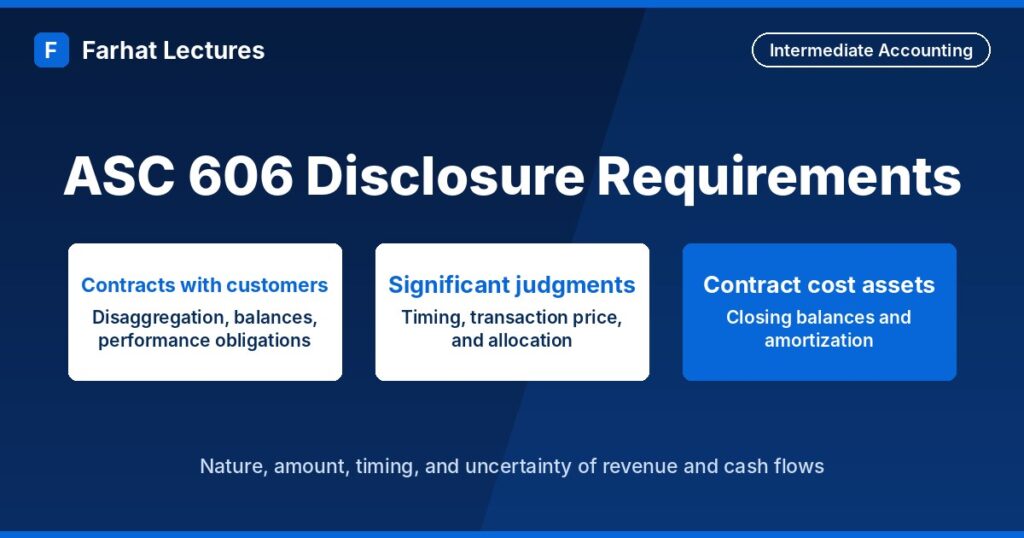
Next step: once you are comfortable with both methods, see what a contractor actually has to disclose in ASC 606 disclosure requirements.

Responses