
Percentage-of-Completion Method: Cost-to-Cost Formula, Example, and Journal Entries

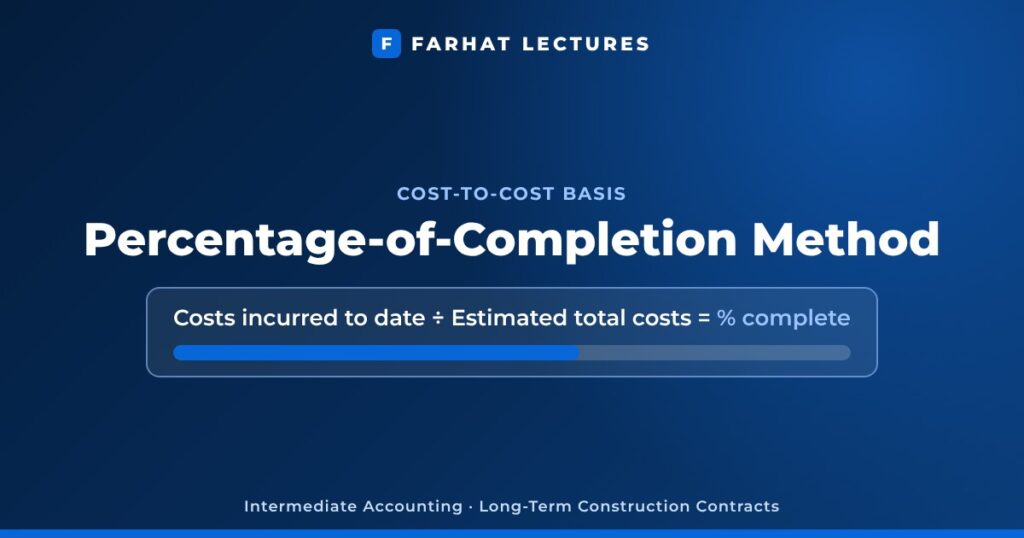
The percentage-of-completion method recognizes revenue and gross profit on a long-term contract as work progresses instead of at completion. Under the cost-to-cost basis, percent complete equals costs incurred to date divided by the latest estimate of total costs. Multiply that percentage by the contract price for revenue to date, then subtract revenue recognized in prior years.
Why does this matter? A bridge or a factory can take several years to build. If the builder waited until the end to report any revenue, its income statements would show nothing for years and then one large spike. The percentage-of-completion method matches each year’s revenue with the work actually performed that year.
This guide supports Long-Term Construction Contracts in Kieso’s Intermediate Accounting (Appendix 17A or 18A, depending on the edition). The same material sits in the revenue recognition chapter of most other intermediate texts. A company uses this method when a performance obligation is satisfied over time and progress can be reasonably measured. The criteria for recognizing revenue over time are covered in transfer of control in revenue recognition.
Watch: percentage of completion method, 3-year example and journal entries
Watch this Farhat lesson on YouTube
This video starts at the 5:31 mark, where Professor Farhat explains how to measure progress toward completion, walks through the three cost-to-cost steps, and then records a full three-year contract.
What is the percentage-of-completion method?
The percentage-of-completion method is the traditional name for recognizing revenue over time on a construction-type contract. Each period, the company estimates how far the project has progressed and recognizes that share of the total revenue and gross profit.
The textbook entries use two bookkeeping accounts to track the project:
- Construction in Process (CIP) accumulates construction costs and the gross profit recognized to date.
- Billings on Construction in Process tracks the progress billings sent to the customer.
Why is revenue allowed to go in over time at all? The FASB answers that in ASC 606-10-25-27, which gives three criteria. A construction contract normally qualifies in one of two ways. Either the customer controls the asset as it is being built, which is common when the work sits on land the customer already owns, or the asset has no alternative use to the builder and the builder has an enforceable right to payment for the work completed to date. Watch that second route, because both halves have to hold. A plain right to send progress bills is not the same as a right to be paid for performance already delivered, and exam questions turn on exactly that difference.
Input vs. output measures of progress
To recognize revenue based on progress, the company needs a reasonable measure of progress toward satisfying the performance obligation. If the obligation qualifies for over-time recognition and the company expects to recover its costs, ASC 606-10-25-37 requires revenue equal to the costs incurred in satisfying the obligation until the company can reasonably measure progress. ASC 606-10-25-33 says appropriate methods include two families, input methods and output methods.
| Measure | What it compares | Examples |
|---|---|---|
| Input methods | The company’s efforts so far relative to total expected efforts | Costs incurred, labor hours, machine hours, time elapsed |
| Output methods | The value transferred to the customer so far relative to the total promised | Units delivered, milestones reached, surveys or appraisals of work completed |
Neither type fits every project. Input measures can mislead when costs are front-loaded. For example, a builder that buys all the steel for a project in the first month should not treat that uninstalled material as progress.
Under ASC 606-10-55-21, the builder adjusts the cost-to-cost calculation so the cost of the uninstalled materials does not overstate progress. When the customer obtains control before installation and the conditions for the adjustment are met, the builder recognizes revenue equal to the cost of the materials, with no gross profit on the materials at that point.
Output measures can mislead when the units are not comparable. The first floor of a ten-story building usually takes far more than one-tenth of the effort because the foundation comes first.
The most widely used input measure is the cost-to-cost basis, and the rest of this guide uses it.
The cost-to-cost formula in 3 steps
| Step | Calculation |
|---|---|
| 1. Percent complete | Costs incurred to date ÷ Most recent estimated total costs |
| 2. Revenue (or gross profit) to date | Percent complete × Contract price (or estimated total gross profit) |
| 3. Current-year amount | Amount to date − Amount recognized in prior years |
Step 3 is the one students skip most often. The formula always produces a cumulative figure, so you must subtract what earlier years already recognized.
Example: a three-year construction contract
Hypothetical example. Harbor Point Builders signs a $6,000,000 contract to build a parking garage. It originally estimates total costs of $4,800,000. By the end of Year 2, it raises that estimate to $5,000,000.
| Item | Year 1 | Year 2 | Year 3 |
|---|---|---|---|
| Costs incurred to date | $1,440,000 | $3,900,000 | $5,000,000 |
| Estimated costs to complete | $3,360,000 | $1,100,000 | $0 |
| Estimated total costs | $4,800,000 | $5,000,000 | $5,000,000 |
| Percent complete | 30% | 78% | 100% |
| Progress billings during the year | $1,500,000 | $3,300,000 | $1,200,000 |
| Cash collected during the year | $1,200,000 | $3,000,000 | $1,800,000 |
Now apply the three steps. Year 1 is 30% complete ($1,440,000 ÷ $4,800,000). Year 2 is 78% complete ($3,900,000 ÷ $5,000,000).
| Year | Revenue to date | Less prior years | Revenue this year | Costs this year | Gross profit this year |
|---|---|---|---|---|---|
| Year 1 | $1,800,000 | $0 | $1,800,000 | $1,440,000 | $360,000 |
| Year 2 | $4,680,000 | $1,800,000 | $2,880,000 | $2,460,000 | $420,000 |
| Year 3 | $6,000,000 | $4,680,000 | $1,320,000 | $1,100,000 | $220,000 |
| Total | $6,000,000 | $5,000,000 | $1,000,000 |
Total gross profit over the three years equals the contract price less actual total costs: $6,000,000 − $5,000,000 = $1,000,000.
Percentage-of-completion journal entries
Three routine entries are recorded during each year. They are the same whether the company recognizes revenue over time or waits until the contract is finished:
| Account | Debit | Credit |
|---|---|---|
| Construction in Process | $1,440,000 | |
| Materials, Cash, Payables, etc. | $1,440,000 | |
| Accounts Receivable | $1,500,000 | |
| Billings on Construction in Process | $1,500,000 | |
| Cash | $1,200,000 | |
| Accounts Receivable | $1,200,000 |
At year-end, the company recognizes revenue and gross profit. The gross profit is debited to Construction in Process, and the difference between revenue and gross profit is debited to Construction Expenses, which works like cost of goods sold.
| Account | Year 1 | Year 2 | Year 3 |
|---|---|---|---|
| Construction in Process (gross profit) | $360,000 | $420,000 | $220,000 |
| Construction Expenses | $1,440,000 | $2,460,000 | $1,100,000 |
| Revenue from Long-Term Contracts | $1,800,000 | $2,880,000 | $1,320,000 |
By the end of Year 3, Construction in Process holds $5,000,000 of costs plus $1,000,000 of gross profit, or $6,000,000. Billings also total $6,000,000. When the customer approves the finished garage, the two accounts close against each other:
| Account | Debit | Credit |
|---|---|---|
| Billings on Construction in Process | $6,000,000 | |
| Construction in Process | $6,000,000 |
What the exam calls these accounts
Construction in Process and Billings on Construction in Process are textbook bookkeeping accounts. Under ASC 606-10-45-1 through 45-4, balance-sheet presentation depends on the relationship between the company’s performance and the customer’s payment. The company presents unconditional rights to payment separately as receivables.
In this example, if costs plus recognized gross profit exceed billings, the net amount illustrates a contract asset. If billings exceed that balance, the net amount illustrates a contract liability. Harbor Point at the end of Year 1 has $1,800,000 in Construction in Process against $1,500,000 of billings, so it reports a $300,000 contract asset.
Learn both sets of names. Textbooks and homework tend to use the older ones, while the CPA, CMA, and EA exams use the ASC 606 labels.
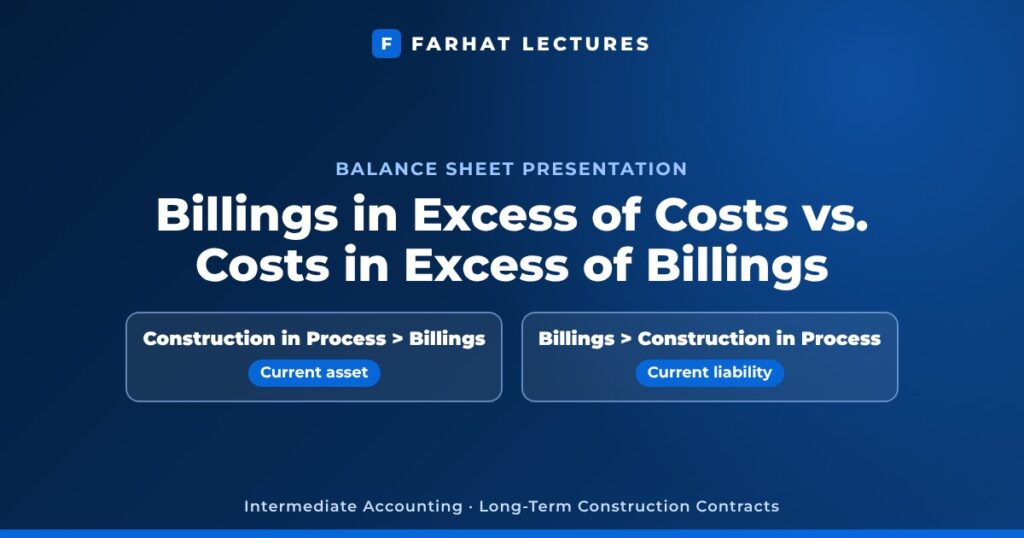
How these two accounts appear on the balance sheet before completion is explained in billings in excess of costs vs. costs in excess of billings.
Want to watch these entries recorded in real time? The three-year walkthrough in the lesson above picks up the journal entries at 15:07.
What happens when estimated costs change?
In Year 2, Harbor Point raised its estimated total costs from $4,800,000 to $5,000,000. It does not go back and restate Year 1. Instead, it recomputes the percent complete with the new estimate and takes the difference in the current year. This is called a cumulative catch-up adjustment, and it treats the revision as a change in accounting estimate.
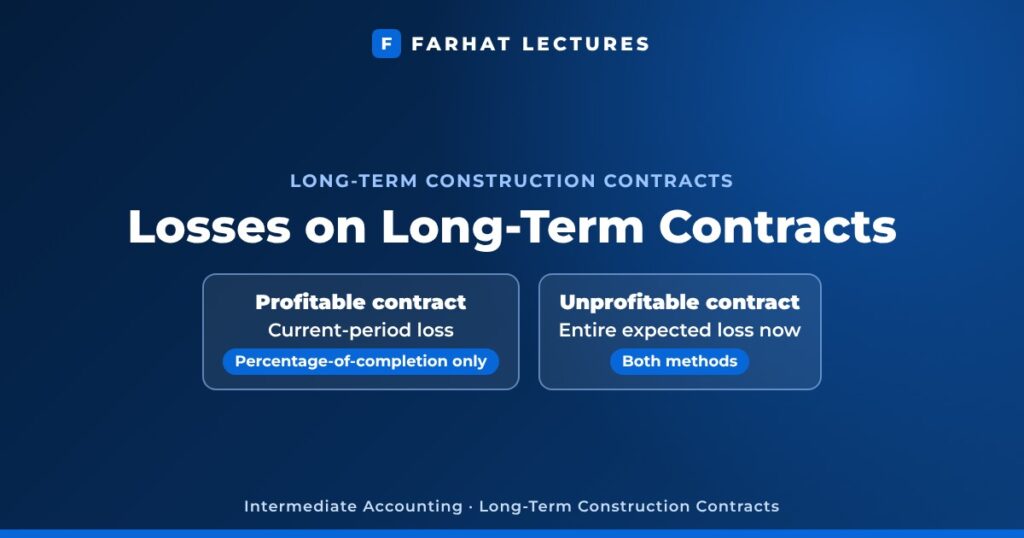
If a revision is large enough, the current year can show a loss even on a profitable contract. If the whole contract becomes unprofitable, the entire expected loss is recognized right away. Both cases are covered in long-term contract losses.
Common mistakes
- Forgetting to subtract prior years. Percent complete × contract price gives revenue to date, not revenue for the year.
- Using the original cost estimate. Always divide by the latest estimate of total costs.
- Treating billings or cash as revenue. The textbook entries credit progress invoices to Billings on Construction in Process. Revenue under the cost-to-cost method follows measured progress.
- Debiting gross profit to the wrong account. Recognized gross profit increases Construction in Process.
Key takeaways
- Percent complete on the cost-to-cost basis is costs incurred to date divided by the latest estimate of total costs.
- Percent complete times the contract price gives revenue to date, never revenue for the year. Subtract the prior years.
- A revised cost estimate is a change in accounting estimate. Recompute with the new total and take the whole difference this year. Prior years are never restated.
- Recognized gross profit is debited to Construction in Process, which is why that account ends the contract at the full contract price.
- In the textbook example, the net balance illustrates a contract asset or a contract liability. Under ASC 606, present unconditional receivables separately.
- An expected loss on the whole contract is recognized in full as soon as it is known, not spread over the remaining years.
Is the percentage-of-completion method required for taxes?
Financial reporting and tax reporting are two separate questions, and this is where students mix them up. A company can recognize revenue over time for GAAP and still use a different method on its return.
For federal income tax, Internal Revenue Code section 460 generally requires the percentage-of-completion method for a long-term contract, meaning a contract that is not finished in the tax year it starts.
Two exceptions carry most of the weight. The first covers home construction contracts. The One Big Beautiful Bill Act of 2025 extended the exception to residential construction contracts such as apartment and condominium projects for contracts entered into in tax years beginning after July 4, 2025. The small construction contract exception excludes tax shelters barred from using the cash method under section 448(a)(3). Other contractors must meet both tests:
- At the time the contract is signed, the contractor expects to finish it within two years of the start date, and
- The contractor meets the gross receipts test in section 448(c) for the tax year in which it enters into the contract. For tax years beginning in 2026 that means average annual gross receipts of $32 million or less across the three prior tax years, per Revenue Procedure 2025-32. The figure was $31 million for tax years beginning in 2025, and it is adjusted for inflation each year.
A contractor that qualifies may use the completed-contract method or another permitted method for tax purposes. A contractor that stays on the percentage-of-completion method for tax may also owe look-back interest, which is computed on Form 8697.
Interactive Percentage-of-Completion Practice
Cost-to-Cost Revenue and Gross Profit
Practice measuring progress under ASC 606 and use the cost-to-cost method to calculate revenue and gross profit on a long-term contract. Calculate the cumulative amounts first, then subtract the amounts recognized in prior years to find the current-year figures.
Practice questions with answers
1. A $2,000,000 contract has costs to date of $450,000 and estimated costs to complete of $1,050,000. How much revenue and gross profit are recognized in Year 1?
Answer: Percent complete is $450,000 ÷ $1,500,000 = 30%. Revenue is 30% × $2,000,000 = $600,000, and gross profit is $600,000 − $450,000 = $150,000.
2. In Year 2 of the same contract, costs to date are $1,200,000 and estimated costs to complete are $400,000. How much revenue is recognized in Year 2?
Answer: $900,000. The contract is $1,200,000 ÷ $1,600,000 = 75% complete, so revenue to date is $1,500,000. Subtract the $600,000 recognized in Year 1.
3. Which account is debited for the gross profit recognized each year?
Answer: Construction in Process. That is why the account ends the contract equal to the contract price: total costs plus total gross profit.
Frequently asked questions
What is the percentage-of-completion method?
It is a way of recognizing revenue and gross profit on a long-term contract as the work progresses. Each period, the company applies the percent complete to the contract price and recognizes the portion not yet recognized.
How do you calculate percentage of completion?
Under the cost-to-cost basis, divide costs incurred to date by the most recent estimate of total contract costs. Multiply that percentage by the contract price to get revenue to date.
Is the percentage-of-completion method allowed under ASC 606?
ASC 606 does not use that name, but recognizing revenue over time using a cost-based input measure produces the same accounting. It applies when a performance obligation is satisfied over time and progress can be reasonably measured.
Is Construction in Process an asset?
In the textbook entries, Construction in Process is a debit-balance account that accumulates construction costs and recognized gross profit. Its balance net of billings illustrates the contract position in this example. Under ASC 606, balance-sheet presentation depends on performance and customer payment, and the company presents unconditional rights to payment separately as receivables.
Does IFRS 15 allow the same approach?
Yes. IFRS 15 also recognizes revenue over time using input or output methods when the over-time criteria are met.
Is the percentage-of-completion method required for taxes?
For federal income tax, Internal Revenue Code section 460 generally requires the percentage-of-completion method for long-term contracts. The expanded residential construction exception applies to contracts entered into in tax years beginning after July 4, 2025. The small construction contract exception excludes tax shelters barred from using the cash method. Other contractors must expect completion within two years of the start date and meet the section 448(c) gross receipts test for the tax year in which they enter into the contract. The threshold is average annual gross receipts of $32 million or less for tax years beginning in 2026.
What is the difference between the percentage-of-completion and completed-contract methods?
The percentage-of-completion method spreads revenue and gross profit across the years the work is performed. The completed-contract method reports nothing until the contract is finished, then recognizes all of the revenue and gross profit at once. The cost, billing, and collection entries are identical under both.
Are Construction in Process and a contract asset the same thing?
Construction in Process is a textbook bookkeeping account. A contract asset is a conditional right to payment for goods or services the company has already transferred. In the Harbor Point example, Construction in Process exceeds billings by $300,000, illustrating a contract asset. A right to payment that is unconditional is presented separately as a receivable.
What happens if a long-term contract is expected to lose money?
The entire expected loss is recognized immediately, in the period the loss becomes apparent, rather than spread over the remaining years. This applies whether the company recognizes revenue over time or at completion.
Can you use the percentage-of-completion method if you cannot estimate total costs?
No. A reasonable measure of progress is a prerequisite. If a company cannot measure progress but expects to recover its costs, it recognizes revenue only up to the costs incurred, which is the cost-recovery or zero-profit approach.
Continue learning with Farhat Lectures
Long-term contracts are one piece of revenue recognition. Work through the whole topic with short video lessons, worked examples, and practice questions built for the CPA, CMA, and EA exams.
Explore the free sample course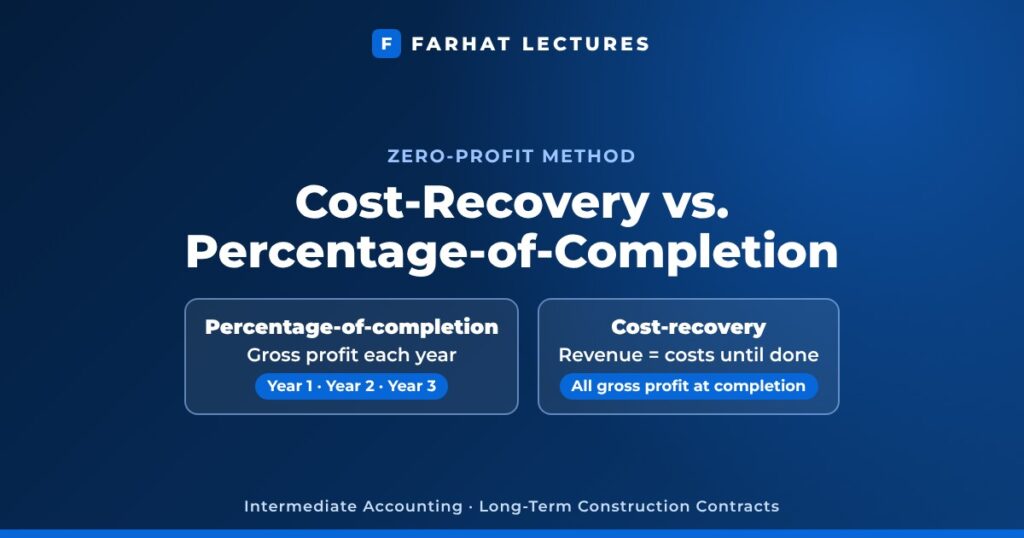

Responses