
Equity Method vs. Consolidation: When an Investor Becomes a Parent

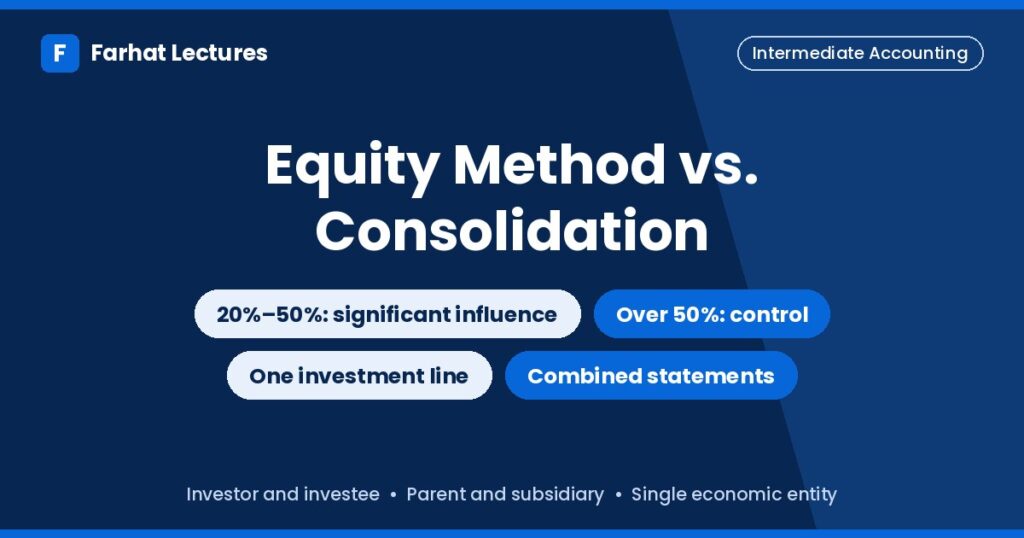
Equity method vs. consolidation comes down to influence versus control. An investor with significant influence, usually 20% to 50% of the voting stock, uses the equity method: one investment line and one income line. An investor with control, usually more than 50%, becomes a parent and consolidates 100% of the subsidiary’s accounts, showing outside owners as noncontrolling interest.
Gaining control changes how the relationship appears in the financial statements. A company with a 45% stake and one with a 60% stake can report very different balance sheets even if the investees are identical. If you need the mechanics of the first method, see the equity method of accounting.
Watch: Fair value vs. equity method vs. consolidation (starts at 10:47, consolidation and controlling interests)
Ownership levels and accounting methods
| Voting ownership (usual) | Relationship | Method | What the investor reports |
|---|---|---|---|
| Less than 20% | Passive investor | Fair value method | Investment at fair value; dividends and price changes in income |
| 20% to 50% | Significant influence | Equity method | One investment line; share of investee income or loss |
| More than 50% | Control (parent and subsidiary) | Consolidation | All of the subsidiary’s assets, liabilities, revenues, and expenses |
The percentages are starting points. The real tests are significant influence and control.
Two exceptions are worth knowing. An investor with significant influence can elect the fair value option instead of using the equity method. Under ASC 321, an investor may elect the measurement alternative for eligible equity securities without a readily determinable fair value. The investment is measured at cost less impairment, adjusted up or down for observable price changes in orderly transactions for identical or similar investments of the same issuer.
What’s changing: On October 28, 2026, the FASB issued a proposed update to ASC 323 that would make significant influence the test for using the equity method no matter what legal form the investee takes. Today, investments in limited partnerships and similar entities often use a much lower ownership threshold. This is only a proposal. Comments are due January 11, 2027, and the FASB has not set an effective date, so current rules still apply.
Equity method vs. consolidation compared
| Feature | Equity method | Consolidation |
|---|---|---|
| Who uses it | Investor with significant influence | Parent with a controlling interest |
| The other company is called | Investee | Subsidiary |
| Balance sheet | One line: investment in the investee | Subsidiary’s individual assets and liabilities; investment account eliminated |
| Income statement | One line: share of investee income or loss | Subsidiary’s revenues and expenses combined with the parent’s |
| Outside owners’ share | Not shown | Shown as noncontrolling interest if ownership is below 100% |
| Reporting view | Two separate entities | One economic entity |
What does control mean for consolidation?
Under FASB ASC 810-10-15-8, the usual condition for a controlling financial interest is ownership of a majority voting interest. As a general rule, owning more than 50% of another company’s outstanding voting shares points toward consolidation (Deloitte consolidation roadmap). The investor is then the parent, and the investee is the subsidiary.
Majority ownership is not automatic, though. A majority owner does not consolidate when control does not actually rest with it, for example when the subsidiary is in bankruptcy or legal reorganization, or when minority owners hold substantive participating rights. Variable interest entities (VIEs) follow a separate model, where a company can have control without owning a majority of the voting stock. Our guide to off-balance-sheet financing explains how VIEs work.
Consolidated statements treat the parent and subsidiary as a single economic entity, even though they remain separate legal companies. On its own books, the parent can track the investment with the equity method, a partial equity method, or the cost (initial value) method. The choice does not change the consolidated statements, because that investment account is eliminated in consolidation. The detailed consolidation process, including eliminating intercompany transactions, is covered in the Farhat Lectures Advanced Accounting course.
Worked example: Summit Holdings
Hypothetical example. Summit Holdings owns 45% of Ridge Co. and 60% of Bay Co. Assume each purchase price equaled Summit’s share of book value and there are no intercompany transactions.
| Company | Revenues | Expenses | Net income |
|---|---|---|---|
| Summit (its own operations) | $2,000,000 | $1,500,000 | $500,000 |
| Ridge Co. (45% owned) | $600,000 | $500,000 | $100,000 |
| Bay Co. (60% owned) | $900,000 | $700,000 | $200,000 |
Ridge (45%, significant influence): Summit uses the equity method and reports one line, investment income of 45% × $100,000 = $45,000. None of Ridge’s revenues or expenses appear in Summit’s statements.
Bay (60%, control): Summit consolidates Bay and reports all of Bay’s revenues and expenses, then assigns 40% of Bay’s income to the noncontrolling interest.
| Line | Amount |
|---|---|
| Revenues ($2,000,000 + $900,000) | $2,900,000 |
| Expenses ($1,500,000 + $700,000) | (2,200,000) |
| Equity method income from Ridge (45%) | 45,000 |
| Consolidated net income | $745,000 |
| Less: net income attributable to noncontrolling interest (40% × $200,000) | (80,000) |
| Net income attributable to Summit | $665,000 |
On Summit’s separate books, using the equity method for Bay would give net income of $500,000 + $45,000 + (60% × $200,000) = $665,000. That equals net income attributable to Summit in the consolidated statements. Consolidated net income of $745,000 also includes the $80,000 attributable to Bay’s noncontrolling interest. Consolidated revenue is $2.9 million, and Summit’s separate revenue is $2.0 million.
What happens when an investor crosses 50%?
Consolidation begins on the date the investor gains control. When an investor with an equity method stake obtains control of a business in a transaction outside common control, the deal is a business combination achieved in stages, often called a step acquisition.
In a step acquisition within ASC 805, the investor remeasures its previously held stake at acquisition-date fair value and records any resulting gain or loss in net income (ASC 805-10-25-10). From that date on, it stops using the equity method for that company and consolidates it instead.
Hypothetical example. Suppose Summit later buys another 15% of Ridge Co. for $210,000 cash, which brings its stake to 60%. Assume Ridge qualifies as a business under ASC 805, Summit gains control at closing, and the transaction is outside common control. Just before the purchase, Summit’s 45% equity method investment in Ridge is carried at $500,000. Assume the fair value of that 45% stake on the purchase date matches the price Summit just paid: $210,000 ÷ 15 = $14,000 for each 1%, so 45 × $14,000 = $630,000. (In real deals, the old stake’s fair value can differ from the price of the new shares, for example because of a control premium.)
| Line | Amount |
|---|---|
| Fair value of the old 45% stake | $630,000 |
| Less: carrying amount under the equity method | (500,000) |
| Gain recognized in net income | $130,000 |
Summit then applies the acquisition method. It adds the $210,000 it paid, the $630,000 fair value of its old stake, and the fair value of the 40% noncontrolling interest, then compares that total with the fair value of Ridge’s identifiable net assets. Any excess is goodwill. From then on, Ridge’s assets, liabilities, revenues, and expenses appear in Summit’s consolidated statements.
Common mistakes
- Consolidating an investee with significant influence. Influence without control means the equity method.
- Including only the parent’s percentage of the subsidiary’s accounts. Consolidation combines 100% of the subsidiary’s assets, liabilities, revenues, and expenses and shows the outside share as noncontrolling interest.
- Leaving the investment account on the consolidated balance sheet. It is replaced by the subsidiary’s individual accounts.
- Thinking consolidation merges the companies legally. They remain separate legal entities.
- Treating 50% as control. The usual test is more than 50% of the voting interest.
- Forgetting to remeasure the old stake. In a step acquisition accounted for as a business combination under ASC 805, remeasure the previously held interest at acquisition-date fair value and recognize the resulting gain or loss in net income.
Exam tip: On the CPA exam, business combinations and consolidations are tested mainly in the BAR discipline section. Whichever section you sit for, know the influence and control thresholds cold, because they tell you which method a question is really asking about.
Interactive practice
Under U.S. GAAP, significant influence without control calls for the equity method. A controlling financial interest generally calls for consolidation.
Equity Method vs. Consolidation Practice
Choose one answer for each of the three questions. Use voting stock ownership, significant influence, and control to identify the reporting approach and how it affects the financial statements.
Practice questions with answers
Question 1: Choose the method
Orion Corp. owns 55% of Pella Inc.’s voting stock. How does Pella appear in Orion’s financial statements?
Answer:
Orion consolidates Pella
More than 50% of the voting stock usually gives a controlling financial interest. Orion combines Pella’s accounts with its own and reports a 45% noncontrolling interest. On its own books, Orion can track the investment with the equity, partial equity, or cost method, but that account is eliminated when Orion consolidates.
Question 2: Influence but no control
Quarry Co. owns 40% of Reed Inc. and holds a board seat. Does Quarry consolidate Reed?
Answer:
No, Quarry uses the equity method
A 40% stake with a board seat gives significant influence but not control, so Reed is reported as one investment line and one income line.
Question 3: Income attributable to the parent
Sable Corp. earns $300,000 from its own operations and owns 80% of Tern Co., which earns $50,000. Assume no intercompany transactions and a purchase price equal to book value. Compute consolidated net income, the noncontrolling interest’s share, and net income attributable to Sable.
Answer:
Consolidated net income $350,000; noncontrolling interest $10,000; Sable $340,000
Consolidated net income: $300,000 + $50,000 = $350,000. Noncontrolling interest: 20% × $50,000 = $10,000. Attributable to Sable: $350,000 − $10,000 = $340,000, the same as $300,000 + 80% × $50,000.
Want more practice like this? Work through the Equity Method lesson in the Farhat Lectures Intermediate Accounting course.
Key takeaways
- Significant influence (usually 20% to 50%): equity method, one line on each statement.
- Control (usually more than 50%): consolidation of the parent and subsidiary as one economic entity.
- Consolidation combines all of the subsidiary’s accounts and shows outside owners as noncontrolling interest.
- The parent’s own bookkeeping method (equity, partial equity, or cost) does not affect the consolidated statements.
- In the simplified example, the equity-method calculation gives $665,000, which equals net income attributable to Summit. Consolidated net income of $745,000 includes $80,000 attributable to the noncontrolling interest.
Frequently asked questions
What ownership percentage requires consolidation?
Usually more than 50% of the voting stock, because a majority voting interest is the usual sign of a controlling financial interest. Advanced accounting covers cases where control exists without a majority, such as variable interest entities. Our guide to off-balance-sheet financing explains how VIEs work.
Is consolidation the same as a merger?
No. When a parent prepares consolidated financial statements, the parent and subsidiary stay separate legal companies. The statements just present them as one economic entity. Don’t confuse this with a statutory consolidation, which is a legal business combination where two companies combine into a brand-new company and the original companies stop existing.
What is a noncontrolling interest?
When the parent owns less than 100% of a subsidiary, the portion owned by outside shareholders is the noncontrolling interest. It is shown separately in consolidated equity and net income.
Does the parent still use the equity method?
It can. On its own books, the parent may track the investment with the equity method, a partial equity method, or the cost (initial value) method. Whichever it picks, the investment account is eliminated in consolidation and replaced by the subsidiary’s individual assets and liabilities, so the consolidated statements come out the same.
Why is the equity method called a one-line consolidation?
Under the equity method, the investor reports its investment and its share of the investee’s income on single lines. In the simplified example, the equity-method calculation of $665,000 equals net income attributable to Summit. Consolidated net income of $745,000 includes $80,000 attributable to the noncontrolling interest.
What if an investor owns exactly 50%?
Owning exactly 50% usually is not control, because the usual test is more than 50% of the voting interest. A 50% owner with significant influence generally uses the equity method, often as a partner in a joint venture. Other facts, such as an agreement that gives one owner control or a variable interest, can change the answer.
What happens if a parent loses control of a subsidiary?
It deconsolidates the subsidiary. The parent recognizes a gain or loss in net income and measures any investment it keeps at fair value (ASC 810-10-40-5). If it still has significant influence, it uses the equity method from that point on.
Sources
- Deloitte Roadmap: Consolidation, Section D.1 General Consolidation Principles (ASC 810-10-15-8)
- Deloitte Roadmap: Equity Method Investments and Joint Ventures, Chapter 1 Overview (ASC 323 vs. ASC 810)
- FASB Accounting Standards Codification, Topics 323, 805, and 810
- Deloitte DART: FASB Proposes Targeted Improvements to Equity Method of Accounting (October 28, 2026)
- NASBA: CPA Evolution Is Here (BAR section content)
About the author
Mansour Farhat, CPA, CIA, DBA, teaches accounting and CPA exam review at Farhat Lectures and on the Farhat Lectures YouTube channel. His lessons help CPA, CMA, and EA candidates and accounting students work through topics like the equity method and consolidation step by step, with original examples, practice questions, and the mistakes students make most often.
Continue learning with Farhat Lectures
Strengthen your accounting understanding with clear explanations and guided practice.
Explore the free sample course



Responses