
Equity Method vs. Fair Value Method: Side-by-Side Journal Entries


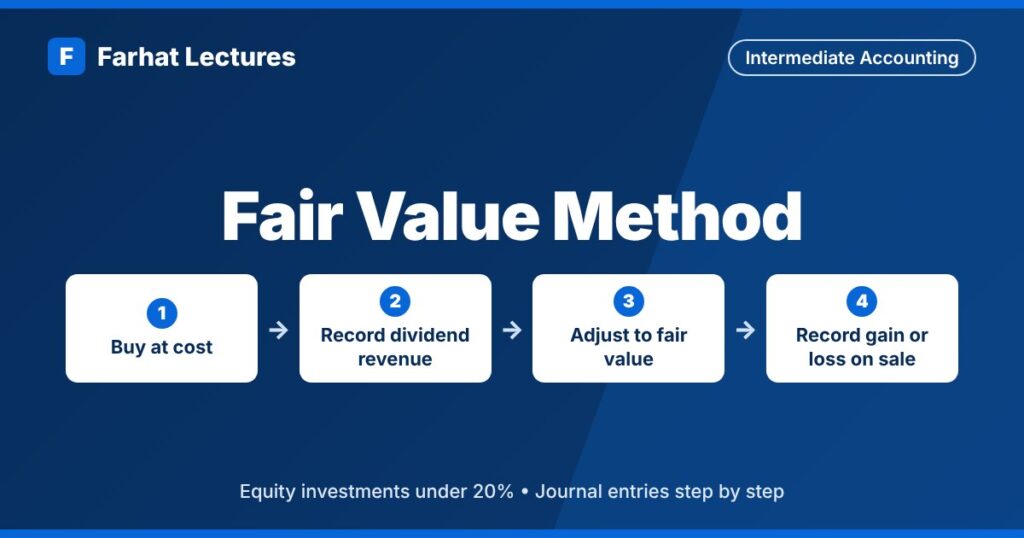
Equity method vs. fair value method comes down to influence. With significant influence (usually 20% to 50% of voting stock), an investor uses the equity method under ASC 323: it records its share of investee income or loss, and dividends reduce the investment. Passive equity holdings outside consolidation generally fall under ASC 321. Dividends are generally recognized in income. Investments with a readily determinable fair value are measured at fair value through net income. Eligible holdings without a readily determinable fair value may use the measurement alternative.
This matters because the same shares can produce very different income and balance sheet amounts depending on the method. Exam questions often give one set of facts and ask for the numbers under both. If you are not sure whether influence exists, see significant influence.
Watch: Fair value versus equity method (about 10 minutes). Professor Farhat compares the initial entry, dividends, and year-end fair value adjustments under both methods, then shows the effect on net income.
Equity method vs. fair value method: side-by-side comparison
| Feature | Fair value method | Equity method |
|---|---|---|
| When used | No significant influence (usually under 20%) and a readily determinable fair value | Significant influence (usually 20% to 50%) |
| Initial recording | At cost | At cost |
| Investee net income | No entry | Investment income for the investor’s share; investment increases |
| Investee net loss | No entry | Investment loss for the investor’s share; investment decreases |
| Dividends received | Dividend revenue | Reduce the investment account |
| Change in market price | Adjust to fair value; unrealized gain or loss in net income | No entry (except an impairment loss if the value falls below carrying amount and the decline is other than temporary) |
| Balance sheet amount | Fair value | Cost plus share of income, minus share of losses and dividends |
The fair value treatment comes from ASU 2016-01, which requires equity investments that are not accounted for under the equity method or consolidated to be measured at fair value through net income (Deloitte summary). For background on the two measurement ideas, see historical cost vs. fair value.
One exception to know: if the shares have no readily determinable fair value (for example, stock in a private company), ASC 321 lets the investor elect a measurement alternative. The investment is carried at cost, minus any impairment, and adjusted up or down when there is an observable price in an orderly transaction for identical or similar shares of the same company. Every example in this guide uses shares with a quoted market price.
Worked example: Crestview Inc. and Pinewood Co.
Hypothetical example. On January 2, 2027, Crestview Inc. buys 50,000 shares (25%) of Pinewood Co. at $16 per share, or $800,000. We record the facts twice: once assuming no significant influence and once assuming significant influence.
To keep the focus on the comparison, assume the $800,000 equals 25% of Pinewood’s book value, so there is no extra cost to amortize under the equity method. On the exam, any extra cost assigned to depreciable assets is amortized and reduces equity method income each year. Assume the 2028 decline in market value is temporary.
| Date | Event | Crestview’s 25% share or value |
|---|---|---|
| 2027 | Pinewood net income $240,000 | $60,000 |
| 2027 | Pinewood pays dividends of $100,000 | $25,000 |
| Dec. 31, 2027 | Market price $17 per share | Fair value $850,000 |
| 2028 | Pinewood net loss $80,000 | ($20,000) |
| 2028 | Pinewood pays dividends of $40,000 | $10,000 |
| Dec. 31, 2028 | Market price $15.50 per share | Fair value $775,000 |
Fair value method entries (no significant influence)
An unrealized gain or loss is a change in value on shares the investor still owns. For these investments, it goes straight to net income each year.
| Account | Debit | Credit |
|---|---|---|
| Jan. 2, 2027: purchase | ||
| Equity Investments | 800,000 | |
| Cash | 800,000 | |
| 2027: Pinewood net income | ||
| No entry | ||
| 2027: dividend received | ||
| Cash | 25,000 | |
| Dividend Revenue | 25,000 | |
| Dec. 31, 2027: adjust to fair value ($850,000 − $800,000) | ||
| Fair Value Adjustment | 50,000 | |
| Unrealized Holding Gain or Loss, Income | 50,000 | |
| 2028: Pinewood net loss | ||
| No entry | ||
| 2028: dividend received | ||
| Cash | 10,000 | |
| Dividend Revenue | 10,000 | |
| Dec. 31, 2028: adjust to fair value ($775,000 − $850,000) | ||
| Unrealized Holding Gain or Loss, Income | 75,000 | |
| Fair Value Adjustment | 75,000 | |
Equity method entries (significant influence)
| Account | Debit | Credit |
|---|---|---|
| Jan. 2, 2027: purchase | ||
| Equity Investments | 800,000 | |
| Cash | 800,000 | |
| 2027: 25% of Pinewood’s net income | ||
| Equity Investments | 60,000 | |
| Investment Income | 60,000 | |
| 2027: dividend received | ||
| Cash | 25,000 | |
| Equity Investments | 25,000 | |
| Dec. 31, 2027: market price change | ||
| No entry | ||
| 2028: 25% of Pinewood’s net loss | ||
| Investment Loss | 20,000 | |
| Equity Investments | 20,000 | |
| 2028: dividend received | ||
| Cash | 10,000 | |
| Equity Investments | 10,000 | |
| Dec. 31, 2028: market price change | ||
| No entry | ||
Balance sheet and income compared
| Amount | Fair value method | Equity method |
|---|---|---|
| Investment, Dec. 31, 2027 | $850,000 | $835,000 |
| 2027 income from the investment | $75,000 ($25,000 dividends + $50,000 gain) | $60,000 |
| Investment, Dec. 31, 2028 | $775,000 | $805,000 |
| 2028 income (loss) from the investment | ($65,000) ($10,000 dividends − $75,000 loss) | ($20,000) |
Equity method balances: $800,000 + $60,000 − $25,000 = $835,000, then $835,000 − $20,000 − $10,000 = $805,000.
Why do the two methods report income and dividends differently?
A passive investor cannot affect how the investee performs, so it reports what it actually receives (dividends) and what the shares are worth (fair value). An investor with significant influence helps steer the investee, so it reports its share of the results as they are earned. Because it already counted those earnings, a dividend is just cash coming back, which is why it reduces the investment. The equity method of accounting lesson walks through that logic step by step.
What happens when a passive investor gains significant influence?
Say an investor owns 10% of a company and buys another 15%. Assume the additional purchase gives the investor significant influence, so it switches from the fair value method to the equity method.
Since ASU 2016-07, there is no going back to restate prior years. The investor adds the cost of the new shares to the current carrying amount of the shares it already owns and applies the equity method from that date forward.
Example: Alder Co. owns 10% of a company, carried at its fair value of $120,000 on the date it buys another 15% for $190,000. Alder’s starting equity method balance is $120,000 + $190,000 = $310,000.
Common mistakes
- Recording dividend revenue under the equity method. Dividends reduce the investment.
- Recording a share of investee income under the fair value method. Passive investors make no entry for investee earnings.
- Making a fair value adjustment under the equity method. The equity method ignores ordinary market price changes.
- Sending fair value changes on equity securities to other comprehensive income. Under current U.S. GAAP they go to net income.
- Picking the method by percentage alone. The test is significant influence, and 20% is only a presumption.
- Restating prior years when influence is gained. Since ASU 2016-07, the equity method starts from the date significant influence begins.
Interactive practice: Equity method vs. fair value method
Apply U.S. GAAP to two investors in Harbor Co. This four-question exercise covers significant influence, investee earnings, cash dividends, and unrealized gains in net income.
Practice questions with answers
Question 1: Income and balance under both methods
Lark Co. pays $300,000 for 20% of Mesa Inc. on January 1. Mesa earns $100,000 and pays $40,000 of dividends. At year-end Lark’s shares are worth $310,000. Compute Lark’s income from the investment and year-end balance under each method.
Answer:
Fair value: income $18,000, balance $310,000. Equity: income $20,000, balance $312,000.
Fair value: dividend revenue 20% × $40,000 = $8,000, plus a $10,000 unrealized gain = $18,000. Equity: share of income 20% × $100,000 = $20,000; balance $300,000 + $20,000 − $8,000 = $312,000.
Question 2: Which method?
Under which method does an investor credit Dividend Revenue when it receives a cash dividend?
Answer:
The fair value method
Without significant influence, dividends are revenue. Under the equity method, the investor credits the investment account instead.
Question 3: Investee net loss
Nolan Corp. owns 30% of an investee that reports a $50,000 net loss. What entry does Nolan make under each method?
Answer:
Fair value method: no entry. Equity method: debit Investment Loss $15,000; credit Equity Investments $15,000.
Only the equity method picks up the investor’s 30% share of the investee’s loss.
Want more practice like this? Try the CPA simulation on fair value vs. the equity method and the Accounting for Equity Securities lesson in the Farhat Lectures Intermediate Accounting course.
Key takeaways
- No significant influence: fair value method, dividend revenue, and unrealized gains and losses in net income.
- Significant influence: equity method, share of income or loss, and dividends that reduce the investment.
- The equity method makes no fair value adjustments.
- Both methods start by recording the investment at cost.
- With control (usually over 50%), neither applies in the consolidated statements; see equity method vs. consolidation.
Frequently asked questions
Which method records dividends as revenue?
The fair value method. Dividends are dividend revenue when the investor has no significant influence. Under the equity method, dividends reduce the investment account.
Do unrealized gains and losses go to net income or other comprehensive income?
Under current U.S. GAAP, equity securities with readily determinable fair values are measured at fair value with changes recognized in net income. The available-for-sale category with other comprehensive income no longer applies to equity securities.
Why does the equity method ignore the stock price?
Because the investor reports its share of the investee’s actual earnings instead. Adjusting for both earnings and market price would count the same performance twice. One exception: if the investment’s value falls below its carrying amount and the decline is other than temporary, the investor records an impairment loss.
Can a company choose fair value for an investment that qualifies for the equity method?
Yes. The fair value option lets an investor elect fair value for an investment that would otherwise use the equity method. The election is made investment by investment and cannot be reversed.
Which method usually reports more income?
It depends on the facts. The equity method reports a share of the investee’s earnings, while the fair value method reports dividends plus market price changes, which can swing up or down.
What if the shares have no readily determinable fair value?
Under ASC 321, the investor can elect the measurement alternative: carry the shares at cost, minus any impairment, adjusted for observable prices in orderly transactions for identical or similar shares of the same company.
What happens when an investor gains significant influence?
It switches to the equity method from that date forward. Since ASU 2016-07, prior years are not restated. The cost of any new shares is added to the current carrying amount of the investment.
Sources
- Deloitte Heads Up: FASB Amends Guidance on Classification and Measurement of Financial Instruments (ASU 2016-01)
- Deloitte Roadmap: Equity Method Investments and Joint Ventures, Chapter 1 Overview (ASC 321 vs. ASC 323)
- Deloitte Roadmap: Equity Method Investments Eligible for the Fair Value Option (ASC 825-10)
- Deloitte: FASB Issues Final Standard on Simplifying the Equity Method of Accounting (ASU 2016-07)
- Deloitte Roadmap: Decrease in Investment Value and Impairment (ASC 323-10-35-32)
- FASB Accounting Standards Codification, Topics 321 and 323
About the author
Mansour Farhat, CPA, CIA, DBA, teaches accounting and CPA exam review at Farhat Lectures and on the Farhat Lectures YouTube channel. His lessons help CPA, CMA, and EA candidates and accounting students work through topics like investments in equity securities step by step, with original examples, practice questions, and the mistakes students make most often.
Continue learning with Farhat Lectures
Strengthen your accounting understanding with clear explanations and guided practice.
Explore the free sample course



Responses