
Stock Warrants vs. Stock Rights: Key Differences and Journal Entries

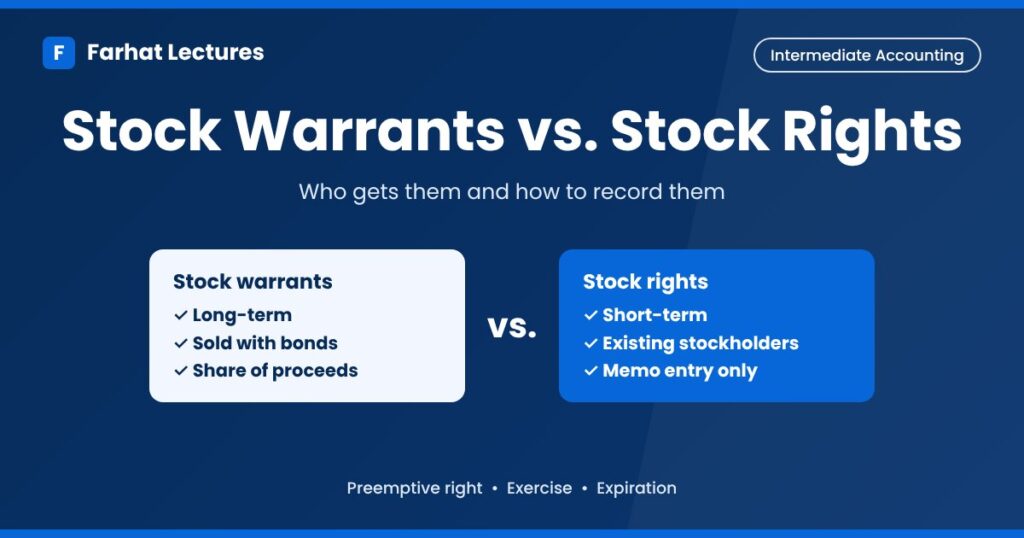
Stock warrants vs stock rights: both let the holder buy a company’s shares at a fixed price. Stock rights go to existing stockholders, last a few weeks, and need only a memorandum entry when issued. Warrants usually come with bonds or preferred stock and can last years. Equity-classified detachable warrants receive part of the proceeds as paid-in capital.
This comparison is the learning objective of the stock warrants lesson in intermediate accounting, and it is a favorite multiple-choice topic. The question is usually simple (“What entry is required when stock rights are issued?”), but it is easy to miss if you treat rights and warrants as the same thing.
Watch: stock subscriptions and stock rights explained
In this 21-minute Farhat Lectures video, Professor Farhat covers stock subscriptions first and then stock rights, with journal entries and a short quiz. The video focuses on rights, so watch it with the stock rights example below, then use the warrant example and the stock warrants overview for the warrant side.
What is a stock right?
When a corporation issues new shares, its current stockholders often have a preemptive right: the right to buy new shares in proportion to what they already own. This protects them from having their voting power diluted without their consent.
A stock right is the certificate that carries out this privilege for a specific offering. Each share owned usually earns one right. The certificate states:
- how many new shares the holder may buy (for example, one new share for every four rights), and
- the price per share, which is normally below the current market price. That discount is what gives the rights value.
Rights have a short life, often a few weeks. Holders can exercise the rights before expiration or let them lapse. They can also sell the rights if the offering terms permit transfer.
What is a stock warrant?
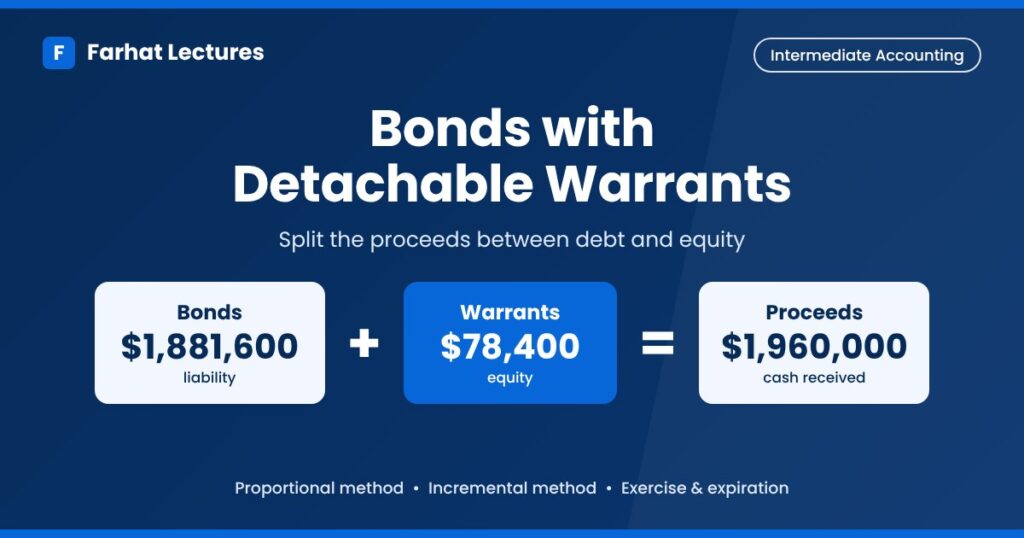
A stock warrant also gives the right to buy shares at a set price, but it is usually issued to new investors as a sweetener with bonds or preferred stock, and it can last for years. When bonds carried at amortized cost are sold with equity-classified detachable warrants (warrants that can be traded separately from the bond), U.S. GAAP (ASC 470-20-25-2) requires the company to split the proceeds between the bonds and the warrants based on their relative fair values. The amount assigned to the warrants is recorded as paid-in capital. Companies use the same approach by analogy when warrants come with preferred stock. The stock warrants overview covers warrants in more depth.
Detachable vs. nondetachable warrants
Not every warrant gets a share of the proceeds. A nondetachable warrant can only be used by turning in the bond. In that case, the bond and warrant work like convertible debt, so the company generally records the whole amount as debt and allocates nothing to the warrants (ASC 470-20-25-3).
Exam tip: If a question says the warrants are nondetachable, there is no Paid-in Capital—Stock Warrants entry at issuance.
One more note: this lesson assumes the warrants are classified as equity, which is how intermediate accounting courses and most exam questions treat them. Some warrants must be reported as liabilities under ASC 480 (Distinguishing Liabilities from Equity) or ASC 815-40 (Contracts in Entity’s Own Equity), both issued by the FASB. That topic is beyond this lesson.
What is the difference between stock warrants and stock rights?
| Stock warrants (issued with other securities) | Stock rights | |
|---|---|---|
| Who receives them | Investors who buy the bonds or preferred stock | Existing stockholders, in proportion to their holdings |
| Main purpose | Make a bond or preferred issue more attractive and lower its cost | Let current owners avoid dilution when new shares are issued |
| Typical life | Long, often several years | Short, often a few weeks |
| Exercise price | Set when issued, often above the market price at that time; the market price can later rise above or fall below it | Normally below the current market price |
| Entry when issued | Equity-classified detachable warrants: part of the proceeds credited to Paid-in Capital—Stock Warrants. Nondetachable warrants: no separate amount | No journal entry; memorandum only |
| Entry when exercised | Debit Cash and Paid-in Capital—Stock Warrants; credit Common Stock and Paid-in Capital in Excess of Par | Debit Cash; credit Common Stock and Paid-in Capital in Excess of Par |
| Entry when they expire | Move the balance to Paid-in Capital—Expired Stock Warrants | No journal entry |
Example: recording stock rights
Lakeview Corp. (hypothetical) has 200,000 shares of $1 par common stock outstanding, trading at $24. To raise new capital, the board issues one right per share. Four rights plus $18 buy one new share, so up to 50,000 new shares could be issued (200,000 ÷ 4).
When the rights are issued: no cash is received and no stock is issued, so there is no journal entry. Lakeview makes a memorandum note that 200,000 rights are outstanding and keeps 50,000 unissued shares available in case they are exercised. This is the standard treatment in intermediate accounting: issuing stock rights requires a memorandum entry only.
When the rights are exercised: holders turn in 180,000 rights, which buy 45,000 shares (180,000 ÷ 4) for $18 each.
| Account | Debit | Credit |
|---|---|---|
| Cash (45,000 × $18) | 810,000 | |
| Common Stock (45,000 × $1) | 45,000 | |
| Paid-in Capital in Excess of Par—Common Stock | 765,000 |
This is the same entry as an ordinary issuance of common stock for cash. When the rest expire: the remaining 20,000 rights lapse. Nothing was recorded for them, so there is nothing to remove; Lakeview only updates its memorandum.
Example: recording stock warrants
Compare that with Pine Hill Co. (hypothetical), which sold bonds with 10,000 detachable warrants and allocated $35,000 of the proceeds to the warrants ($3.50 per warrant). Each warrant buys one $2 par share for $20.
When the warrants are issued: the $35,000 is credited to Paid-in Capital—Stock Warrants as part of the bond issuance entry.
When the warrants are exercised: holders exercise 8,000 warrants. Pine Hill removes 8,000 × $3.50 = $28,000 of warrant capital.
| Account | Debit | Credit |
|---|---|---|
| Cash (8,000 × $20) | 160,000 | |
| Paid-in Capital—Stock Warrants | 28,000 | |
| Common Stock (8,000 × $2) | 16,000 | |
| Paid-in Capital in Excess of Par—Common Stock | 172,000 |
When the rest expire: the remaining 2,000 warrants carry $7,000 of paid-in capital, which is reclassified. No gain is recorded.
| Account | Debit | Credit |
|---|---|---|
| Paid-in Capital—Stock Warrants | 7,000 | |
| Paid-in Capital—Expired Stock Warrants | 7,000 |
The allocation that produced the $35,000 is explained in bonds with detachable warrants, and the contrast with a convertible feature is in convertible bonds vs. bonds with warrants.
What journal entries do stock rights and warrants require?
| Event | Stock rights | Stock warrants |
|---|---|---|
| Issued | Memorandum only | Credit Paid-in Capital—Stock Warrants for the amount allocated to equity-classified detachable warrants (nondetachable warrants get no separate amount) |
| Exercised | Debit Cash; credit Common Stock and Paid-in Capital in Excess of Par | Same, plus debit Paid-in Capital—Stock Warrants for the exercised portion |
| Expired | No entry | Debit Paid-in Capital—Stock Warrants; credit Paid-in Capital—Expired Stock Warrants |
How do stock rights and warrants affect EPS?
Both instruments can change earnings per share (EPS), which is income available to common stockholders divided by the weighted-average number of common shares outstanding. Here is how each one shows up.
- Stock warrants: For standard cash-exercise warrants, the treasury stock method under ASC 260 assumes that exercise proceeds are used to repurchase shares at the period’s average market price. An average market price above the exercise price produces incremental shares. Include those shares in diluted EPS only if they are dilutive.
- Stock rights: When rights are offered to all existing stockholders at a subscription price below the stock’s fair value at issuance, the discount creates a bonus element, similar to a stock dividend. Under ASC 260-10-55-13, reflect that bonus element retroactively in the share counts used for basic and diluted EPS for all periods presented.
The full EPS calculations are covered in the Intermediate Accounting course.
Common mistakes
- Recording a journal entry when stock rights are issued. Only a memo is needed.
- Allocating proceeds to stock rights. Rights are given to existing stockholders, so there are no proceeds to split.
- Allocating proceeds to nondetachable warrants. Only detachable warrants get a separate share of the proceeds.
- Forgetting to debit Paid-in Capital—Stock Warrants when warrants are exercised.
- Recording an entry for expired rights, or a gain for expired warrants.
- Assuming both instruments are long-term. Rights usually expire within weeks; warrants can run for years.
Key takeaways
- Stock rights go to existing stockholders so they can keep their ownership percentage. Warrants usually go to new investors along with bonds or preferred stock.
- Issuing stock rights requires only a memorandum entry, because no cash is received and no shares are issued.
- Equity-classified detachable warrants receive part of the proceeds, based on relative fair values, recorded as Paid-in Capital—Stock Warrants. Nondetachable warrants receive none.
- Exercising either one is recorded like an ordinary stock issuance. For warrants, also debit Paid-in Capital—Stock Warrants for the exercised portion.
- Expired rights need no entry. Expired warrants move their balance to Paid-in Capital—Expired Stock Warrants, with no gain.
Practice questions with answers
Interactive Preemptive Stock Rights Practice
Test how preemptive rights help stockholders maintain their ownership percentage, what the subscription terms mean, and when the issuer records a journal entry.
Written practice problems. Now try these three on paper before reading each answer.
1. A corporation issues 50,000 stock rights to its existing stockholders. What journal entry is required?
Answer: None. The company receives no cash and issues no shares, so it records a memorandum of the rights outstanding and the shares reserved for them.
2. Stockholders exercise 40,000 rights. Two rights plus $15 buy one share of $5 par common stock. Record the exercise.
Shares issued are 40,000 ÷ 2 = 20,000, and cash received is 20,000 × $15 = $300,000.
| Account | Debit | Credit |
|---|---|---|
| Cash | 300,000 | |
| Common Stock (20,000 × $5) | 100,000 | |
| Paid-in Capital in Excess of Par—Common Stock | 200,000 |
3. A company has 10,000 warrants outstanding with a Paid-in Capital—Stock Warrants balance of $35,000, and all of them expire. In the same month, 5,000 unexercised stock rights expire. Record both events.
| Account | Debit | Credit |
|---|---|---|
| Paid-in Capital—Stock Warrants | 35,000 | |
| Paid-in Capital—Expired Stock Warrants | 35,000 |
Why: The warrants had a recorded balance that must be reclassified. The stock rights were never recorded, so their expiration needs no entry.
Frequently asked questions
Is a journal entry needed when stock rights are issued?
No. The company receives no cash and issues no shares, so only a memorandum entry is made. It notes how many rights were issued so it keeps enough unissued shares available.
Are stock rights the same as preemptive rights?
A preemptive right is the stockholder’s privilege to keep their ownership percentage when new shares are issued. A stock right is the certificate that puts that privilege into action for a specific offering.
Why do warrants get part of the proceeds but rights do not?
When equity-classified detachable warrants are sold with bonds, investors pay for both instruments. For bonds carried at amortized cost, the issuer allocates part of the proceeds to the warrants and records it as paid-in capital. Stock rights are distributed to existing stockholders without charge, so there is nothing to allocate. Nondetachable warrants also get no separate amount, because the bond must be turned in to use them.
What entry is made when stock rights expire?
None, apart from updating the memorandum. Nothing was recorded when the rights were issued, so there is no balance to remove. Expired warrants are different: their paid-in capital moves to Paid-in Capital—Expired Stock Warrants.
Are employee stock options the same as stock warrants?
They are similar options to buy stock, but employee stock options are compensation and follow separate share-based payment rules in ASC 718. This lesson covers warrants issued with other securities and stock rights only.
Do nondetachable warrants get part of the bond proceeds?
No. If the bond must be turned in to exercise the warrant, the package is treated like convertible debt, and the company generally records the full proceeds as debt. Only detachable warrants get a separate share of the proceeds.
How do stock warrants affect diluted EPS?
For standard cash-exercise warrants, the treasury stock method under ASC 260 assumes that exercise proceeds are used to repurchase shares at the period’s average market price. An average market price above the exercise price produces incremental shares. Include those shares in diluted EPS only if they are dilutive.
Can stockholders sell their stock rights?
Stockholders can sell their rights before expiration if the offering terms permit transfer. The issuer makes no journal entry when stockholders transfer rights to other investors.
Stock rights are one of several rights that come with common stock ownership. The stockholders’ equity section shows where common stock, paid-in capital, and expired warrant capital appear on the balance sheet.
About the author
Mansour Farhat, CPA, CIA, DBA, is the instructor behind Farhat Lectures, where he teaches accounting courses and CPA exam review. Learn more about Mansour.
Continue learning with Farhat Lectures
Strengthen your accounting understanding with clear explanations and guided practice. Start free, then move into the full Intermediate Accounting course when you are ready.
Explore the free sample course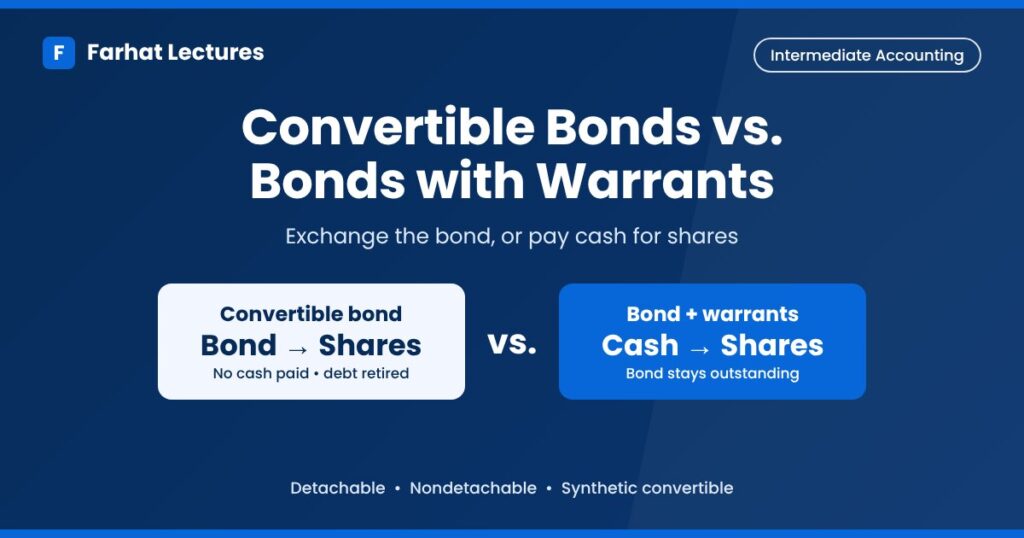
Responses