
Book Value per Share with Preferred Stock: Formula and Examples

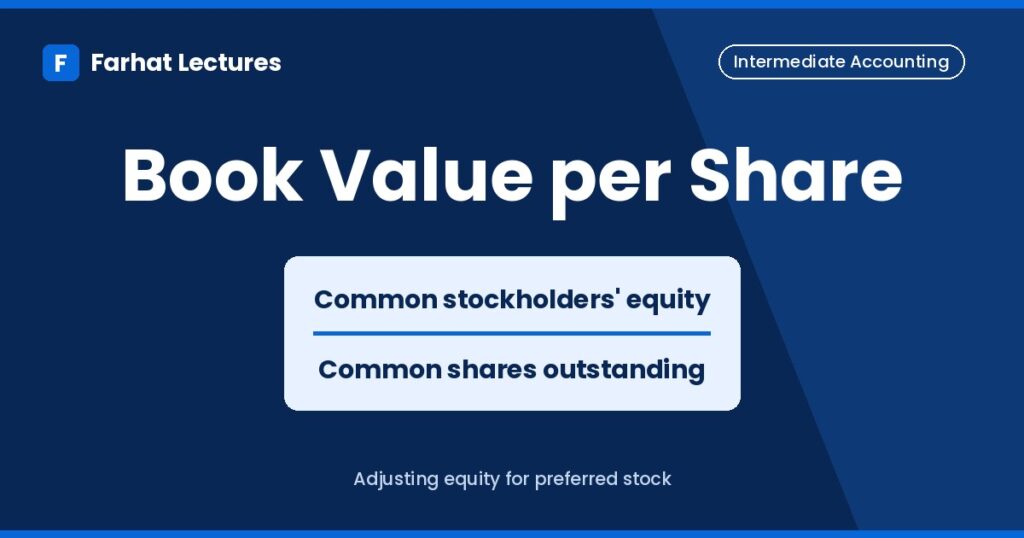
Book value per share is the stockholders’ equity that belongs to each share of common stock. The formula is (total stockholders’ equity − preferred stockholders’ equity) ÷ common shares outstanding at the balance sheet date. Preferred equity includes the higher of par or liquidating value, any cumulative dividends in arrears, and any participation share.
This matters because book value per share is a common way to compare a company’s accounting net worth with its share price. Getting the preferred stock adjustment wrong overstates what common stockholders own. For an overview of the equity accounts themselves, see stockholders’ equity explained.
Where you’ll see it: Book value per share is a core intermediate accounting topic, and the CMA Part 2 learning outcomes ask you to calculate it, interpret it, and explain its limitations.
Watch: Book value per share, formula and preferred stock
This short lesson walks through the formula, the preferred stock adjustments, and how book value per share feeds into the price-to-book ratio.
What is the book value per share formula?
If a company has only common stock:
Book value per share = Total stockholders’ equity ÷ Common shares outstanding
If it also has preferred stock:
Book value per common share = (Total stockholders’ equity − Preferred stockholders’ equity) ÷ Common shares outstanding
Use shares outstanding, not shares issued. Treasury stock has been bought back, so it is excluded.
Basic example with preferred stock
Hypothetical example. Harbor Company reports this stockholders’ equity at year-end:
| Account | Amount |
|---|---|
| Preferred stock, 6%, $100 par, 2,000 shares | $200,000 |
| Common stock, $10 par, 30,000 shares outstanding | $300,000 |
| Paid-in capital in excess of par, common | $90,000 |
| Retained earnings | $210,000 |
| Total stockholders’ equity | $800,000 |
If the preferred stock has no dividends in arrears, is nonparticipating, and has a liquidating value equal to par, preferred equity is simply its $200,000 par value.
Book value per common share = ($800,000 − $200,000) ÷ 30,000 = $20.00.
How does preferred stock change book value per share?
Three features increase the equity assigned to preferred stockholders, which lowers book value per common share:
| Feature | Adjustment | Harbor result |
|---|---|---|
| Cumulative dividends in arrears (2 years) | Add arrears of 2 × $12,000 = $24,000 to preferred equity | ($800,000 − $224,000) ÷ 30,000 = $19.20 |
| Liquidating value above par ($105 per share) | Use liquidating value: also add 2,000 × $5 = $10,000 | ($800,000 − $234,000) ÷ 30,000 = $18.87 |
| Participation | Assign part of retained earnings to preferred | See the next example |
The arrears adjustment uses the same amounts you would pay out under the dividends in arrears order of payment. Public companies must show aggregate liquidation preferences that differ from par or stated value in the equity section, under Regulation S-X, Rule 4-08(d).
Example: cumulative, participating preferred
Hypothetical example. Assume Harbor’s 6% preferred stock is cumulative, participates up to 9% in total, and has a liquidating value equal to par. Two years of dividends are in arrears, and the board has not yet acted on the current year’s dividend. Each class first keeps its own par value and paid-in capital. Then the $210,000 of retained earnings is split in this order:
| Equity allocation | Preferred | Common |
|---|---|---|
| Par value and paid-in capital | $200,000 | $390,000 |
| Dividends in arrears (2 years at 6%) | $24,000 | |
| Current-year requirement at 6% | $12,000 | $18,000 |
| Participation, additional 3% | $6,000 | $9,000 |
| Remainder to common | $141,000 | |
| Total equity | $242,000 | $558,000 |
| Shares outstanding | 2,000 | 30,000 |
| Book value per share | $121.00 | $18.60 |
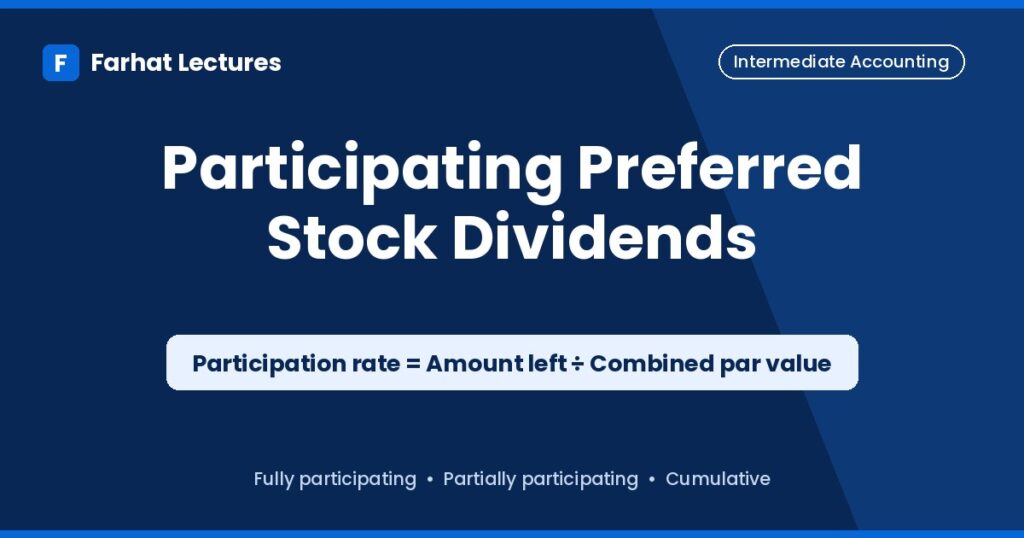
The common stock receives a matching 6% current-year amount and its own extra 3% before the remainder, the same pattern used in participating preferred stock dividends. Check: $242,000 + $558,000 = $800,000 of total equity.
How do you interpret book value per share?
Book value per share shows how much accounting equity stands behind each common share. It starts from the same common equity figure used in return on common stockholders’ equity (ROE).
Investors usually compare it with the market price using the price-to-book (P/B) ratio:
Price-to-book ratio = Market price per share ÷ Book value per share
Hypothetical example. In the basic Harbor example above, book value per common share is $20.00. If Harbor’s common stock trades at $30 per share, its price-to-book ratio is $30 ÷ $20.00 = 1.5. Investors are paying $1.50 for every $1 of book value.
A ratio above 1 means the market values the company above its accounting net worth. A ratio below 1 means the share price is lower than book value, which can mean investors doubt the recorded asset values or expect weak earnings.
Limitations of book value per share
- Most assets are recorded at historical cost less depreciation, not at what they are worth today.
- Many internally developed intangibles, such as brands and customer relationships, are not recorded as assets under U.S. GAAP. Book value can understate companies that rely on them.
- Accounting choices, such as inventory and depreciation methods, change reported equity.
- Buying back shares above book value lowers book value per share, even when the business itself has not changed.
Some analysts also use tangible book value per share, which subtracts intangible assets, including goodwill, from common equity before dividing by common shares outstanding.
Items to check before you calculate
- The number of common shares outstanding (issued minus treasury shares).
- Whether preferred dividends are cumulative and how many years are in arrears.
- Whether the preferred stock is participating, and any cap on participation.
- Whether the preferred stock’s liquidating value is higher than its carrying amount.
- Any commitments to issue more shares, such as authorized but unissued shares the company has agreed to issue, or treasury shares it has agreed to reissue.
Common mistakes
- Using shares issued. Treasury shares are not outstanding.
- Using weighted-average shares. Weighted-average shares are for earnings per share. Book value per share uses shares outstanding on the balance sheet date.
- Ignoring arrears. Cumulative arrears belong to preferred stockholders even though they are not a liability.
- Using par when liquidating value is higher. Use the higher liquidating amount for preferred equity.
- Double-counting declared dividends. A declared dividend is already a liability and is not in equity.
- Treating book value as market value. Book value is an accounting measure, not a price.
Key takeaways
- Book value per common share = (total stockholders’ equity − preferred equity) ÷ common shares outstanding at the balance sheet date.
- Preferred equity includes the higher of par or liquidating value, any cumulative dividends in arrears, and any participation share.
- Use shares outstanding, not shares issued and not weighted-average shares.
- Book value is an accounting measure. Compare it with the market price using the price-to-book ratio.
Practice questions with answers
Question 1: Treasury shares
Maple Co. has only common stock. Total stockholders’ equity is $450,000. It has issued 20,000 shares and holds 2,000 shares as treasury stock. What is book value per share?
Answer:
$25.00 per share.
Shares outstanding are 20,000 − 2,000 = 18,000. Book value per share is $450,000 ÷ 18,000 = $25.00.
Question 2: Cumulative preferred dividends in arrears
Cedar Corp. has total stockholders’ equity of $1,000,000, including 8% cumulative preferred stock with a par value of $250,000. One year of preferred dividends is in arrears. There are 40,000 common shares outstanding. What is book value per common share?
Answer:
$18.25 per share.
Arrears are 8% × $250,000 = $20,000. Preferred equity is $250,000 + $20,000 = $270,000. Common equity is $1,000,000 − $270,000 = $730,000, and $730,000 ÷ 40,000 = $18.25.
Question 3: Liquidating value above par
Same facts, except Cedar’s 5,000 preferred shares ($50 par) have a liquidating value of $54 per share. What is book value per common share?
Answer:
$17.75 per share.
The liquidation premium is 5,000 × ($54 − $50) = $20,000. Preferred equity is $250,000 + $20,000 premium + $20,000 arrears = $290,000. Common equity is $710,000, and $710,000 ÷ 40,000 = $17.75.
Interactive practice: calculate book value per common share
Try a two-question exercise on your own. A company has nonparticipating preferred stock with no dividends in arrears, so you only subtract the preferred stock’s carrying amount before dividing by common shares outstanding. Use the hints if you get stuck, then check the step-by-step solution.
Frequently asked questions
Is book value per share the same as market price per share?
No. Book value per share is based on accounting amounts in stockholders’ equity, many of which reflect historical cost. Market price reflects what investors will pay for a share today, so the two numbers are usually different.
Do I use shares issued or shares outstanding?
Use common shares outstanding at the end of the period. Treasury shares are issued but not outstanding, so they are excluded.
Where do I find the liquidating value of preferred stock?
It is set in the preferred stock’s terms, such as the company’s charter or certificate of designation. Under U.S. GAAP (ASC 505-10-50-4), when the liquidation preference is considerably higher than par or stated value, the company shows the total amount in the equity section of the balance sheet, rather than only in the notes. SEC rules (Regulation S-X, Rule 4-08(d)) also require public companies to show it in parentheses in the equity section.
Is book value per share required in GAAP financial statements?
No. Book value per share is an analytical measure that investors and analysts compute. U.S. GAAP does not require companies to report it.
What if this year’s preferred dividend has already been declared?
A declared dividend is already a liability, so it has been removed from stockholders’ equity. Do not subtract it again when you compute book value per share.
Can book value per share be negative?
Yes. If total liabilities are larger than total assets, stockholders’ equity is negative, and so is book value per common share. It can also turn negative when the preferred stockholders’ claims are larger than total equity.
Does buying back stock change book value per share?
It depends on the price paid. A buyback lowers both equity and shares outstanding. If the company pays more than the current book value per share, book value per share falls. If it pays less, book value per share rises. For example, Maple Co. has $450,000 of equity and 18,000 shares, or $25.00 per share. If it buys back 1,000 shares at $40, book value per share drops to $410,000 ÷ 17,000 = $24.12.
What is a good book value per share?
There is no single good number. Book value per share is most useful when you compare it with the company’s market price (the price-to-book ratio), with its own past years, and with similar companies.
Sources
- SEC Regulation S-X, 17 CFR 210.4-08(d), preferred shares
- FASB Accounting Standards Codification, ASC 505-10-50-4 and 505-10-50-5 (disclosure of liquidation preferences and dividend arrearages)
About the author
Mansour Farhat, CPA, CIA, DBA, teaches the lessons and YouTube videos on Farhat Lectures for CPA, CMA, and EA candidates and accounting students. The examples on this page are original hypotheticals written for exam-style practice.
Continue learning with Farhat Lectures
Strengthen your accounting understanding with clear explanations and guided practice.
Explore the free sample course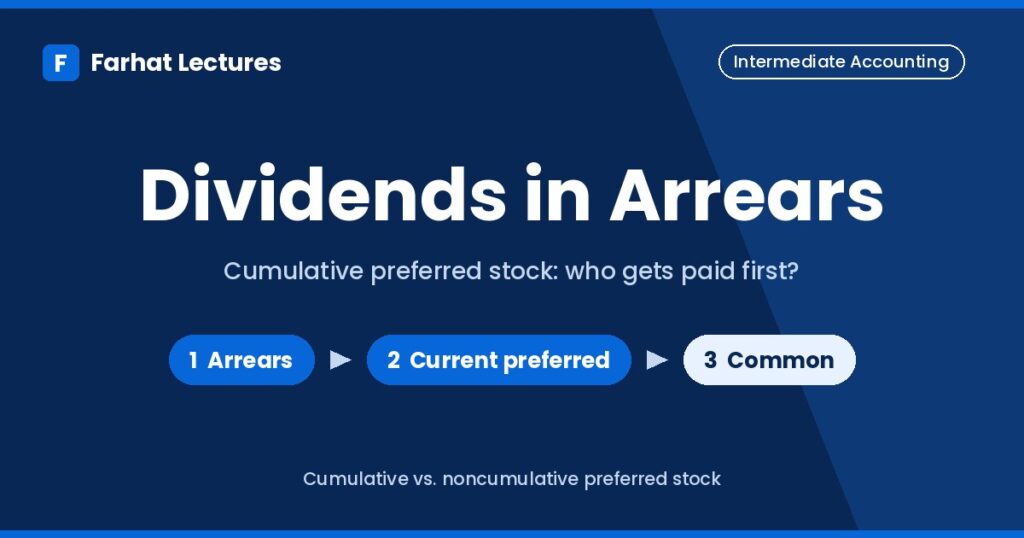



Responses