
Preferred Stock Features: Cumulative, Participating, Convertible, Callable, and Redeemable

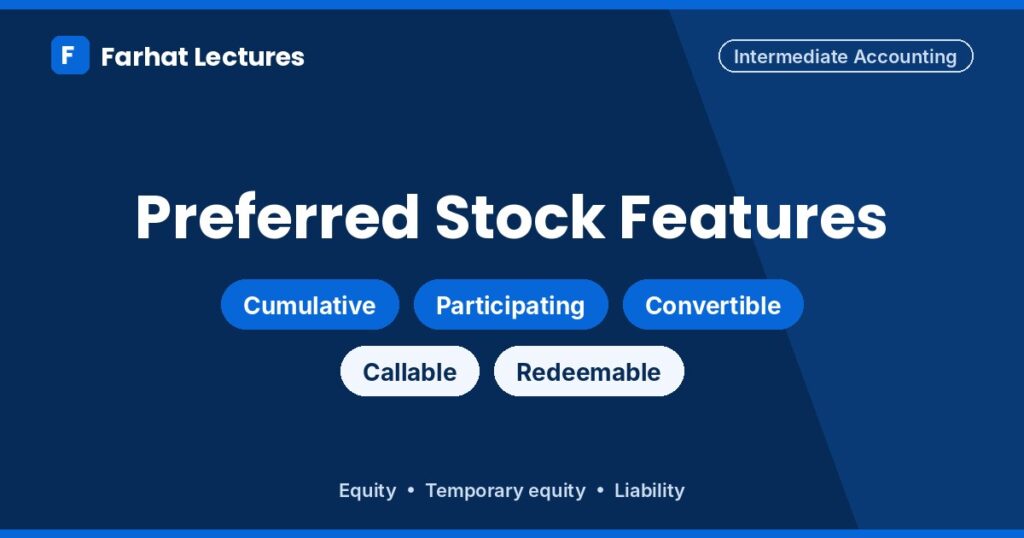
Preferred stock features are the rights attached to preferred shares that set them apart from common stock. The five main features are cumulative dividends, participation in extra dividends, conversion into common stock, a call option for the issuer, and a redemption option for the holder. The redemption feature decides whether the shares are equity, temporary equity, or a liability.
Preferred stock sits between bonds and common stock. Holders get their dividends before common stockholders and are paid ahead of them in a liquidation, but after creditors. Companies use it to raise money without adding debt to the balance sheet and without giving up voting control. For accounting students, the hard part is not the issuance entry, which mirrors common stock, but knowing how each feature changes dividends, conversions, and balance sheet classification. These rules come up often in intermediate accounting and on the FAR section of the CPA exam.
This guide covers the main preferred stock characteristics, how to record and report it, each feature with a short example, and the classification rules for redeemable preferred stock.
Watch: Accounting for Preferred Stock | Financial Accounting
Watch this Farhat lesson on YouTube
In this 13-minute lesson, Professor Farhat explains why preferred stock is a hybrid of debt and equity, how its dividend priority works, and how to record issuance and the cumulative and participating features.
Preferred stock features vs. common stock
| Characteristic | Preferred stock | Common stock |
|---|---|---|
| Dividends | Paid before common dividends, usually at a fixed rate | Paid only after preferred dividends; amount varies |
| Voting | Generally nonvoting | Votes for the board and on major actions |
| Liquidation | Paid after creditors but before common stockholders | Paid last, from whatever is left |
| Term | Generally perpetual; some issues are redeemable | Perpetual |
| Upside | Limited, unless participating or convertible | Unlimited share of growth |
Common stock rights and the basic issuance entry are covered in the issuance of common stock guide. The SEC’s investor education site also gives a plain-language definition of preferred stock.
Recording and reporting preferred stock
The dividend preference is usually stated as a percentage of par. An 8% preferred stock with a $100 par value pays $8 per share each year ($100 × 8%). For no-par preferred stock, the preference is a dollar amount, such as “$5 preferred,” which pays $5 per share.
Issuance is recorded like common stock, with separate accounts. Example: Lakeshore Bank (hypothetical) issues 4,000 shares of $25 par preferred stock for $31 per share.
| Account | Debit | Credit |
|---|---|---|
| Cash (4,000 × $31) | 124,000 | |
| Preferred Stock (4,000 × $25) | 100,000 | |
| Paid-in Capital in Excess of Par (Preferred Stock) | 24,000 |
When preferred stock is classified as equity, it is usually listed first in the stockholders’ equity section, and any excess over par is part of additional paid-in capital. Preferred dividends are a distribution of earnings, not an expense. To see how dividend preferences affect book value per share, work through the dividend preference and book value per share example. Companies must disclose the rights of outstanding preferred stock, such as dividend and liquidation preferences. When the liquidation preference is considerably more than par or stated value, the total preference must also be shown in the equity section of the balance sheet itself, for example in parentheses next to the preferred stock line.
If a lump-sum price covers both preferred and common shares, allocate it first using the proportional or incremental method.
Cumulative preferred stock
With cumulative preferred stock, any dividend the board skips (a “passed” dividend) must be paid in a later year before common stockholders get anything. Unpaid cumulative dividends are called dividends in arrears. They are not a liability, because no obligation exists until the board declares a dividend. They are disclosed in the notes.
Example: Ridgeway Corp. (hypothetical) has 10,000 shares of 6%, $50 par cumulative preferred stock, so the annual preferred dividend is $30,000. It pays no dividends in Year 1 or Year 2, then declares $100,000 in Year 3.
| Item | Preferred | Common |
|---|---|---|
| Dividends in arrears (Years 1 and 2) | $60,000 | |
| Current-year preferred dividend (Year 3) | $30,000 | |
| Remainder | $10,000 | |
| Total of $100,000 | $90,000 | $10,000 |
Noncumulative preferred stock is less common in most industries, because a passed dividend is lost forever, which makes the shares harder to sell. Banks are the big exception. Bank regulators generally count perpetual preferred stock toward Tier 1 capital only if it is noncumulative, so many bank preferred issues are noncumulative.
Participating preferred stock
Participating preferred stock receives its stated rate and then shares in any additional dividends with common stockholders. If a 5% fully participating preferred stock is outstanding and the board pays common stockholders the equivalent of 8% of their par value, the preferred stockholders also receive 8% of their par value. Participating preferred stock is seldom issued today.
Example: Maple Grove Co. (hypothetical) has $100,000 of 5% fully participating preferred stock and $400,000 of common stock, both at par. The board declares $60,000 of dividends.
| Step | Preferred | Common |
|---|---|---|
| 1. Preferred gets its 5% ($100,000 × 5%) | $5,000 | |
| 2. Common gets a matching 5% ($400,000 × 5%) | $20,000 | |
| 3. Remaining $35,000 shared by par ($100,000 to $400,000) | $7,000 | $28,000 |
| Total of $60,000 | $12,000 | $48,000 |
Both classes end up with 12% of their par value ($12,000 ÷ $100,000 and $48,000 ÷ $400,000). Partially participating preferred stock works the same way, except its share of the extra dividends stops at a stated cap, such as 9% of par.
Convertible preferred stock
Convertible preferred stock lets the holder exchange preferred shares for common shares at a set ratio. The holder gets a dividend preference now and the option to share in the company’s growth later.
On conversion, the company uses the book value method: it removes the preferred stock and its related paid-in capital and credits the common stock accounts for the same total. There is no gain or loss, and the fair value of the shares at conversion is ignored.
Example: Northgate Inc. (hypothetical) has convertible preferred stock with a par value of $200,000 and related paid-in capital of $30,000. Holders convert all of it into 20,000 shares of $5 par common stock, at a time when the preferred stock’s fair value is $280,000.
| Account | Debit | Credit |
|---|---|---|
| Preferred Stock | 200,000 | |
| Paid-in Capital in Excess of Par (Preferred Stock) | 30,000 | |
| Common Stock (20,000 × $5) | 100,000 | |
| Paid-in Capital in Excess of Par (Common Stock) | 130,000 |
Notice that the $280,000 fair value does not appear anywhere in the entry. Only the $230,000 book value moves from preferred to common, so no gain or loss is recorded.
One exam trap: if the par value of the common shares issued is more than the book value of the preferred stock, the company usually debits Retained Earnings for the difference.
Example: Preferred stock with a $100,000 par value and $5,000 of related paid-in capital converts into 12,000 shares of $10 par common stock. The book value is $105,000, but Common Stock must be credited for $120,000.
| Account | Debit | Credit |
|---|---|---|
| Preferred Stock | 100,000 | |
| Paid-in Capital in Excess of Par (Preferred Stock) | 5,000 | |
| Retained Earnings | 15,000 | |
| Common Stock (12,000 × $10) | 120,000 |
If a company offers holders something extra to convert early (an induced conversion), the fair value of that sweetener is also charged to Retained Earnings, not to an expense.
For more worked problems, see the Convertible Preferred Stock lesson in the Farhat Lectures Intermediate Accounting course. To see how convertible preferred stock affects earnings per share, review the if-converted method for diluted EPS.
Callable preferred stock
Callable preferred stock lets the issuing company buy back (call) the shares at a set price on or after specified dates. The call price is usually a little above the original issue price. Companies like this flexibility: if market rates fall, they can call the shares and replace them with cheaper financing. The call price tends to cap the market price of nonconvertible preferred stock, and any dividends in arrears must be paid when the shares are called.
Example: Harbor Point Co. (hypothetical) originally issued 2,000 shares of $100 par callable preferred stock at $105 per share. It later calls all of the shares at $108 per share. No dividends are in arrears.
| Account | Debit | Credit |
|---|---|---|
| Preferred Stock (2,000 × $100) | 200,000 | |
| Paid-in Capital in Excess of Par (Preferred Stock) (2,000 × $5) | 10,000 | |
| Retained Earnings | 6,000 | |
| Cash (2,000 × $108) | 216,000 |
The $6,000 paid above the $210,000 carrying amount is not a loss on the income statement. It is charged to Retained Earnings, and when the company reports earnings per share, it also reduces income available to common stockholders.
Is redeemable preferred stock equity or a liability?
Some preferred stock gives the holder the right to make the company buy back the shares for a set amount. This feature makes the stock look more like debt, so classification depends on how certain the redemption is.
| Redemption feature | Classification | Why |
|---|---|---|
| No redemption feature, or callable only at the issuer’s option | Permanent equity | The company controls whether it ever pays cash |
| Redeemable at the holder’s option, or upon an event outside the issuer’s control | Temporary (mezzanine) equity, between liabilities and equity, for SEC registrants | The company cannot avoid redemption, but the timing is uncertain |
| Mandatorily redeemable on a fixed date or upon an event certain to occur | Liability | The company has an unconditional obligation to pay |
The liability rule for mandatorily redeemable shares came from FASB Statement No. 150, now in ASC 480. The temporary-equity presentation comes from SEC guidance codified in ASC 480-10-S99; Deloitte’s roadmap on temporary equity summarizes its sources. In short, for SEC registrants, preferred stock stays in permanent equity only if redemption is solely within the issuer’s control. Private companies are not required to use temporary equity, so holder-redeemable preferred stock generally stays in equity for them.
To see where preferred stock fits among all equity components, read Stockholders’ Equity Explained. For why companies choose the corporate form in the first place, see the advantages and disadvantages of a corporation.
Other preferred stock features you may see
The five features above are the ones accounting courses test most. Real preferred stock issues often carry a few more terms, and you will see these in prospectuses and investing courses.
- Liquidation preference: a stated amount per share, often the par value or the original issue price, that holders receive in a liquidation before common stockholders get anything. Creditors are still paid first.
- Contingent voting rights: preferred stock is usually nonvoting, but some issues give holders the right to elect some directors if preferred dividends go unpaid for a set number of periods.
- Adjustable-rate (floating-rate) dividends: instead of a fixed rate, the dividend rate resets from time to time based on a benchmark interest rate.
- Paid-in-kind (PIK) dividends: some issues pay dividends in additional shares or by increasing the liquidation preference instead of paying cash. In 2026, the FASB issued ASU 2026-01, which requires companies to measure PIK dividends on equity-classified preferred stock by applying the stated PIK rate to the liquidation preference. Deloitte’s summary of ASU 2026-01 explains the details.
How IFRS treats redeemable preferred shares
Under IFRS, IAS 32 classifies a preferred share as a financial liability if the issuer must redeem it or if the holder can require redemption. IFRS has no temporary equity category, so holder-redeemable preferred stock that a U.S. public company shows as temporary equity is a liability under IFRS.
Key takeaways on preferred stock features
- Preferred stock features change who gets paid first, how much, and whether the shares can become common stock or be bought back.
- Cumulative dividends in arrears are disclosed, not recorded, until declared.
- Conversions use the book value method, with no gain or loss.
- Classification depends on redemption: issuer-controlled stays in equity, holder-redeemable is temporary equity for SEC registrants, and mandatorily redeemable is a liability.
Common mistakes
- Recording dividends in arrears as a liability before they are declared.
- Treating preferred dividends as an expense on the income statement.
- Recognizing a gain or loss when preferred stock is converted into common stock.
- Recording a loss when preferred stock is called for more than its carrying amount. The excess is a charge to retained earnings.
- Mixing up callable (the issuer’s option) with redeemable (the holder’s option, or a required redemption date).
- Reporting all redeemable preferred stock as a liability. Only mandatorily redeemable stock is a liability; holder-redeemable stock is temporary equity for public companies.
Practice questions with answers
1. A company has 5,000 shares of 8%, $100 par cumulative preferred stock. No dividends were paid for two years. In Year 3, it declares $150,000 of dividends. How much goes to each class?
Answer: The annual preferred dividend is $40,000 (5,000 × $100 × 8%). Preferred receives $80,000 in arrears plus $40,000 for the current year, or $120,000. Common receives the remaining $30,000.
2. Preferred stock with a par value of $150,000 and related paid-in capital of $15,000 is converted into 30,000 shares of $1 par common stock. Record the conversion.
| Account | Debit | Credit |
|---|---|---|
| Preferred Stock | 150,000 | |
| Paid-in Capital in Excess of Par (Preferred Stock) | 15,000 | |
| Common Stock (30,000 × $1) | 30,000 | |
| Paid-in Capital in Excess of Par (Common Stock) | 135,000 |
Why: Under the book value method, the $165,000 carrying amount moves to common stock, with no gain or loss.
3. A public company issues two preferred stocks. Issue A is redeemable at any time at the holder’s option. Issue B must be redeemed for cash on December 31, 2032. How is each classified?
Answer: Issue A is temporary (mezzanine) equity, because redemption is not solely within the company’s control but its timing is uncertain. Issue B is a liability, because it is mandatorily redeemable on a fixed date.
Interactive quiz: preferred stock dividends and shareholder rights
Now check the core preferred stock rights in one place: the dividend preference, cumulative dividends, voting rights, and liquidation priority. Use the hints if you get stuck, then open the solution to see how each answer is derived.
Frequently asked questions
Is preferred stock debt or equity?
Usually equity, because the company generally has no legal obligation to pay dividends or buy the shares back. Preferred stock that must be redeemed on a fixed or certain date is a liability, and for public companies, preferred stock the holder can redeem is shown as temporary equity.
Are dividends in arrears a liability?
No. No liability exists until the board declares a dividend. Dividends in arrears on cumulative preferred stock are disclosed in the notes.
Are preferred dividends an expense?
No. Like common dividends, preferred dividends are a distribution of earnings, not an expense, as long as the preferred stock is classified as equity.
Is there a gain or loss when preferred stock is converted into common stock?
No. The company uses the book value method: it moves the carrying amount of the preferred stock and its paid-in capital to the common stock accounts, and no gain or loss is recognized.
What is the difference between callable and redeemable preferred stock?
Callable preferred stock lets the issuing company buy the shares back at its option. Redeemable preferred stock either lets the holder require the company to buy the shares back or requires the company to buy them back on a set date. Either way, redemption is not solely the company’s choice, and that is what pushes it out of permanent equity.
What is a liquidation preference?
A liquidation preference is the amount per share that preferred stockholders receive if the company is liquidated, before common stockholders receive anything. It is often equal to par value or the original issue price. Creditors are still paid first.
Do preferred stockholders ever get to vote?
Usually not on ordinary matters. Some preferred stock gives holders contingent voting rights, such as the right to elect some directors if preferred dividends go unpaid for a set number of periods.
About the author
Mansour Farhat, CPA, CIA, DBA, is the founder of Farhat Lectures and its YouTube channel. He holds a Doctor of Business Administration from Temple University and a Master of Accountancy from Bloomsburg University. As a veteran accounting educator, he helps students and CPA candidates understand the reasoning behind the answers, one step at a time. Learn more about Professor Farhat.
Continue learning with Farhat Lectures
Strengthen your accounting understanding with clear explanations and guided practice.
Explore the free sample course
Responses