
Short-Term Debt Refinancing: A Simple GAAP Guide

Under U.S. GAAP (ASC 470-10-45-14), short-term debt refinancing lets a company classify short-term debt as noncurrent only if it intends to refinance it on a long-term basis and can prove it. Proof means issuing long-term debt or equity after the balance sheet date but before the statements are issued, or having a qualifying financing agreement in place by then.
A plan alone is not enough. Only the amount the financing actually supports can move out of current liabilities, and the order of events can change the answer. Textbooks often call these “short-term obligations expected to be refinanced.”
This distinction matters because a company may owe the same total debt while reporting a different amount as current. That changes working capital and liquidity ratios without creating income or eliminating the obligation.
You will see this topic on the CPA exam’s FAR section and in CMA Part 1, usually as a “how much stays current?” question.
Watch Professor Farhat explain
Professor Farhat explains intent and ability at 1:22, actual refinancing at 2:28, and financing agreements at 3:37.
When can short-term debt be classified as noncurrent?
Start with an obligation otherwise due within one year, or the operating cycle if longer. Then evaluate whether it qualifies for long-term refinancing treatment. The idea is simple. If the debt will be replaced with long-term financing, paying it will not use up this year’s current assets, so it does not belong in current liabilities.
| Requirement | Student question | Insufficient evidence |
|---|---|---|
| Intent | Does the company plan to refinance on a long-term basis? | No documented plan or intention |
| Demonstrated ability | Does qualifying financing evidence support that plan? | A hope that a bank will lend |
| Supported amount | How much of the obligation can actually be refinanced? | Classifying more than the qualifying financing supports |
Trade payables and operating accruals that arise in the normal course of business and are due on customary terms are classified as current (ASC 470-10-45-13). The refinancing exception does not apply to them. It is meant for items like notes payable, commercial paper, construction loans, and the current portion of long-term debt.
The core rule is in ASC 470-10-45-14. The amount limits are in ASC 470-10-45-16 through 45-19, and the repayment-timing rule is in ASC 470-10-45-15.
A September 2025 FASB staff memo prepared for the Private Company Council summarizes this guidance while researching possible changes to how subjective acceleration clauses are handled. Those ideas are still under discussion, so they are not a new rule.
How can a company prove it is able to refinance?
Actual long-term financing
The company may issue long-term debt or equity securities after the balance-sheet date but before the financial statements are issued, or available to be issued when applicable. The financing must support the stated refinancing purpose. A later transaction outside the relevant reporting cutoff does not establish the required evidence for that set of statements.
A qualifying financing agreement
An agreement can also demonstrate ability, but signing a document is not enough.
Under ASC 470-10-45-14(b), the agreement must be in place before the statements are issued, and it must clearly permit long-term refinancing on terms that are readily determinable. It also has to pass three tests:
- It does not expire within one year (or the operating cycle, if longer) from the balance sheet date. During that period, the lender cannot cancel it, or call amounts borrowed under it, except for a violation of a provision that can be objectively measured, such as a stated debt-to-equity limit.
- No violation of the agreement exists at the balance sheet date, and nothing suggests one happened before the statements are issued. If one did happen, the company has obtained a waiver.
- The lender is expected to be financially able to honor the agreement.
A clause that lets the lender cancel for a vague reason, such as a “material adverse change,” does not pass the first test.
How much can move out of current liabilities? Only the amount available under the agreement. Reduce it further if other restrictions will keep the funds from being available. If the available amount will fluctuate, use a reasonable estimate of the minimum expected to be available. If no reasonable estimate can be made, the entire obligation stays current.
The historical FASB Statement No. 6 explains the origin of this intent-and-ability framework. Today, the Codification is the authoritative U.S. GAAP reference; the historical statement is provided for learning context.
Example: only part of the debt qualifies
Hypothetical example: Maple Devices owes a $240,000 note at December 31, Year 1. It matures in April, Year 2. Management intends to refinance it. On February 12, before the March 8 statement-issuance date, Maple issues shares with net proceeds of $180,000 designated and available to repay the note. Assume all relevant conditions are satisfied.
Maple classifies $180,000 as noncurrent and the remaining $60,000 as current at December 31. Only the supported portion qualifies. The subsequent share issue does not turn the December 31 debt balance into equity.
How Maple reports it: In the long-term liabilities section, Maple shows “Note payable expected to be refinanced, $180,000,” with a reference to the notes. The remaining $60,000 stays in current liabilities. The note to the financial statements describes the share issuance used to refinance the debt.
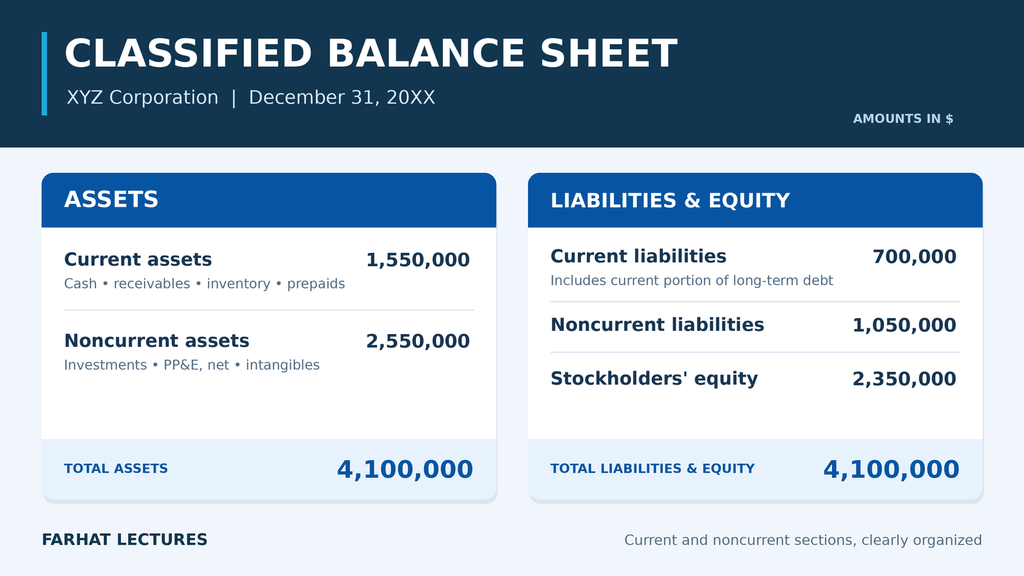
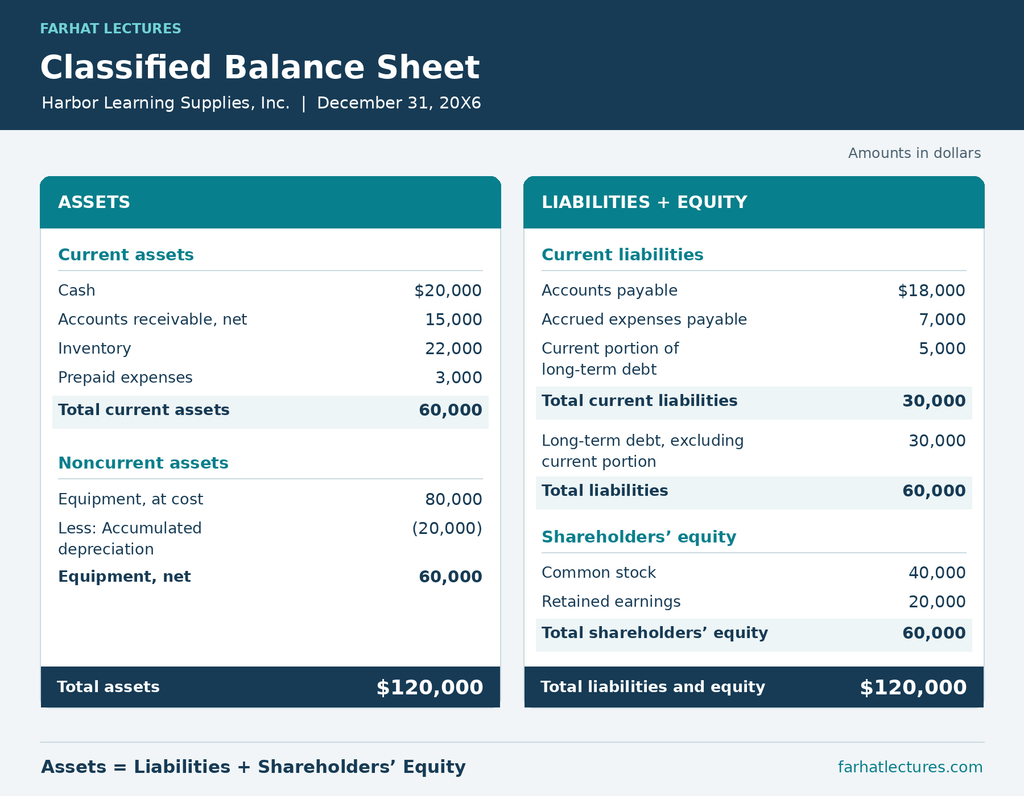
For the surrounding balance-sheet layout and current installment rules, see current liabilities presentation.
What if the debt is repaid before the new loan?
Hypothetical example: Pine Services has a $55,000 short-term note outstanding on December 31. It pays the note using existing cash on January 9. On February 14, it obtains a new four-year loan of $95,000. Its statements are issued March 6. No earlier qualifying financing agreement supports the old note.
| Date | Event | Why it matters |
|---|---|---|
| December 31 | $55,000 note outstanding | Obligation being classified |
| January 9 | Existing cash pays the note | Working capital is used first |
| February 14 | New four-year borrowing | Later financing replenishes funds |
| March 6 | Statements issued | Reporting cutoff |
The $55,000 remains current at December 31. Paying it first from existing current resources and borrowing later does not retroactively make that payment a qualifying long-term refinancing. The new loan’s larger amount does not fix the sequence. This is the rule in ASC 470-10-45-15.
Compare Maple: financing proceeds are obtained and available for the planned repayment before that repayment occurs. A timeline is often the easiest way to distinguish these exam situations.
How classification changes liquidity ratios
In a separate hypothetical case, current assets are $300,000 and current liabilities before the adjustment are $200,000. If $50,000 of debt qualifies as noncurrent, current liabilities become $150,000.
The current ratio changes from $300,000 ÷ $200,000 = 1.50 to $300,000 ÷ $150,000 = 2.00. Working capital increases from $100,000 to $150,000. Total liabilities do not change, and this reclassification creates no gain.
The quick ratio also uses current liabilities as its denominator. For interpretation beyond the calculation, read what a current ratio less than 1 means.
Want more practice with liabilities? The Intermediate Accounting course walks through current liabilities and long-term debt with more examples, and you can try it first in the free sample course.
Common refinancing mistakes
- Using intent alone: management’s plan needs qualifying evidence of ability.
- Ignoring the reporting cutoff: identify when the statements are issued or available to be issued, as applicable.
- Overstating the amount: unsupported portions remain current.
- Ignoring event order: repayment from existing cash before later borrowing can change the result.
- Mixing frameworks: under IFRS (IAS 1), refinancing arranged after the reporting date does not count. The company needs the right to defer settlement for at least 12 months at the end of the reporting period. So the same facts can mean current under IFRS and noncurrent under U.S. GAAP.
- Looking for a gain: this is a presentation decision only. The amount owed, the interest, and net income do not change.
Key takeaways
- Short-term debt can move to noncurrent only when the company has both the intent and the demonstrated ability to refinance it on a long-term basis.
- Ability comes from long-term debt or equity actually issued before the statements are issued, or from a qualifying financing agreement.
- Only the supported amount moves. The rest stays current.
- Paying the debt with existing cash first and borrowing later keeps the debt current.
- Trade payables due on customary terms always stay current.
- Under IFRS, refinancing arranged after the reporting date does not change the classification.
Practice questions with answers
Question 1: Intention without evidence
A company plans to refinance a $70,000 note but has neither completed qualifying financing nor obtained a qualifying agreement by the reporting cutoff. What is the classification?
Answer: Current. Intent exists, but demonstrated ability is missing.
Question 2: Partial support
A $120,000 obligation has only $85,000 of qualifying refinancing support. How much remains current?
Answer: $35,000. Subtract the supported $85,000 from the $120,000 obligation; do not classify the entire balance as noncurrent.
Question 3: Cash first, borrowing later
A company pays a $25,000 note in January from existing cash, then borrows long term in February. There was no earlier qualifying agreement. How is the old note classified at December 31?
Answer: Current. The later borrowing does not undo the earlier use of current resources.
Interactive practice: refinancing and current classification
Ready to apply the intent-and-ability test? Work through four questions on operating cycles, qualifying financing agreements, and partial refinancing. Choose one answer for each question, use the hints if you get stuck, and check the step-by-step solution.
Frequently asked questions
Can an equity issue demonstrate ability?
Yes. Issuing shares after the balance sheet date but before the statements are issued can prove ability. The amount excluded from current liabilities cannot exceed the net proceeds, and the debt is still reported as a liability, just a noncurrent one.
Does repeatedly renewing a 90-day note automatically qualify?
No. Replacing one short-term note with another short-term note is not, by itself, proof of long-term refinancing ability (ASC 470-10-45-21). A rollover only works if it is backed by an agreement that meets the financing agreement tests above.
Where should the refinancing be explained?
In the notes to the financial statements. ASC 470-10-50-4 requires a general description of the financing agreement and the terms of any new debt or equity issued, or expected to be issued, to refinance the obligation.
Does the current portion of long-term debt qualify?
Yes. The currently maturing portion of long-term debt can be classified as noncurrent if the company meets the same intent and ability tests.
Is there a journal entry when debt is classified as noncurrent?
No gain or loss is recorded, and the amount owed does not change. It is a balance sheet presentation decision.
How is this different under IFRS?
Under IAS 1, a refinancing arranged after the reporting date does not count. The company must have the right to defer settlement for at least 12 months at the end of the reporting period.
Can a revolving credit agreement prove ability?
Only if it meets the same financing agreement tests: it does not expire or become cancelable within one year (or the operating cycle) except for objectively measurable violations, no violation exists, and the lender can honor it.
Lesson scope
This lesson covers how to classify short-term debt that a company expects to refinance. It does not cover debt modification or extinguishment accounting. All examples and practice questions are hypothetical.
Continue learning: Intermediate Accounting course · Farhat Lectures free sample course.
Related lessons
Current Liabilities Presentation: A Simple Guide
Learn how to present current liabilities, separate current debt maturities, read disclosure notes, and avoid classification mistakes with an original worked example.
Current Ratio Less Than 1: A Simple Liquidity Analysis
Use an original retail case to interpret a current ratio below 1, compare the quick ratio, and examine deferred revenue, supplier terms, and refinancing risk.

Responses