
Current Liabilities Presentation: A Simple Guide


Current liabilities presentation is how a company reports obligations due within one year, or within its operating cycle if longer, in their own section of a classified balance sheet. They appear before long-term liabilities, are usually shown at the amount due, and include items such as accounts payable, accrued wages, unearned revenue, and the current portion of long-term debt.
Under U.S. generally accepted accounting principles (GAAP), ASC 210-10 defines current liabilities as obligations expected to be paid using current assets or by creating other current liabilities. The operating cycle is the time it takes a business to turn cash into inventory, sell it, and collect the cash again. Classification depends on the obligation’s terms and the applicable guidance, not simply on management calling a loan “long term.”
This matters because lenders and students use current liabilities to assess near-term financial pressure. Moving an amount between current and noncurrent liabilities changes liquidity measures even though total liabilities stay the same.
Watch Professor Farhat explain
Professor Farhat explains the current portion of long-term debt and its balance-sheet presentation. The debt classification explanation begins at 0:38.
How are current liabilities presented on the balance sheet?
In a classified balance sheet, current liabilities normally appear before noncurrent liabilities. Common lines include accounts payable, accrued wages, taxes payable, short-term borrowings, current debt maturities, and customer advances for services due soon.
You may also see interest payable, dividends payable (once the board declares a cash dividend), and the current portion of lease liabilities. Newer financial statements often label customer advances as contract liabilities, the ASC 606 term for cash a customer paid before the company delivers the goods or services. Many textbooks still call this unearned revenue.
Companies may arrange these items by maturity, size, or liquidation priority. Read the labels and notes rather than assuming every company follows an identical sequence. The SEC balance-sheet presentation rule identifies important liability captions and disclosures for applicable filers.
Short-term payables are generally reported at their maturity amounts when discounting would be immaterial. That practical convention does not eliminate specific measurement rules for interest, discounts, or other debt features.
A simple current liabilities example
Hypothetical example: Harbor Learning Supplies has a one-year operating cycle. At December 31, it prepares this current-liabilities section:
| Current liability | Amount | Reason |
|---|---|---|
| Accounts payable | $42,000 | Supplier invoices due in 30 days |
| Wages payable | $8,000 | Earned wages awaiting payment |
| Taxes payable | $5,000 | Taxes due shortly |
| Unearned service revenue | $12,000 | Services to be delivered within six months |
| Current portion of bank loan | $18,000 | Principal due in the next year |
| Total current liabilities | $85,000 | Current classification subtotal |
The bank loan totals $90,000. Harbor reports $18,000 as current and the remaining $72,000 as noncurrent. It does not report the full $90,000 again in the noncurrent section.
If current assets are $102,000, working capital is $102,000 − $85,000 = $17,000. The current ratio is $102,000 ÷ $85,000 = 1.20. Omitting the current installment would make near-term liquidity look stronger than the correct classification supports.
Three debt distinctions students must recognize
1. Current maturities of long-term debt
A loan can have a long original term and still have principal due next year. Separate that installment from the later installments. Do not include all future, unaccrued interest in the principal amount merely because the repayment schedule lists interest payments.
2. Obligations settled through noncurrent resources
Some amounts otherwise due soon can qualify for exclusion from current liabilities, such as debt retired using appropriately classified noncurrent resources, qualifying long-term refinancing, or conversion to capital stock. The applicable conditions must be satisfied and the plan appropriately disclosed.
A label such as “cash reserved for repayment” is not enough. For the refinancing test and timing traps, see short-term debt refinancing under U.S. GAAP.
3. Demand debt, covenant violations, and acceleration clauses
A demand loan is generally current because the lender can require repayment. Similarly, a covenant violation can make otherwise long-term debt callable. A covenant is a condition in the borrowing agreement, such as maintaining a specified financial ratio.
Do not assume the original maturity date settles the question. Waivers and contractual grace periods require careful analysis. Under ASC 470-10-45-11, a waiver keeps the debt noncurrent only if the lender has waived or lost the right to demand repayment for more than one year (or the operating cycle, if longer) from the balance-sheet date. For example, the grace-period exception requires it to be probable that the violation will be cured within that period, preventing the debt from becoming callable. An unsupported expectation that the lender will be patient is insufficient.
What about a subjective acceleration clause? This is a loan term that lets the lender demand early repayment based on a judgment call, such as a “material adverse change” in the borrower’s business.
Under current GAAP (ASC 470-10-45-2), long-term debt with this kind of clause is classified as current when circumstances such as recurring losses or liquidity problems make acceleration likely. In other situations, disclosing the clause is enough. If acceleration is remote, neither reclassification nor disclosure is required.
In May 2026, the FASB directed its staff to draft a proposed update on these clauses. Nothing from that project is final, so answer exam questions using the current rule in ASC 470-10.
What should you check in the notes?
The balance sheet gives the amounts; the notes explain terms that change their meaning. Look for pledged collateral, repayment dates, borrowing restrictions, and the basis for any refinancing classification.
For Harbor, a selected illustrative note might say: “The bank loan has outstanding principal of $90,000, including $18,000 due during the next year, and is secured by equipment.” This is a teaching excerpt, not a complete disclosure checklist. The collateral explains what supports the borrowing; it does not remove the liability.
Current liabilities presentation and liquidity analysis therefore work together. A subtotal alone cannot show when cash will arrive or whether inventory will sell. Continue with how to interpret a current ratio less than 1 to examine those questions.
Common presentation mistakes
- Confusing classification with recognition. Recognition means recording an item on the balance sheet, while classification decides which section it goes in. A loss contingency that is only disclosed in the notes is not recorded, so it is not part of current liabilities.
- Double-counting the loan. Current and noncurrent portions must add back to total principal.
- Netting unrelated cash against debt. Cash available for payment does not automatically permit balance-sheet offsetting.
- Ignoring customer advances. A current liability can require services rather than a direct cash payment.
- Treating reclassification as an expense. Moving principal between sections does not itself create a new expense or change total debt.
CPA and CMA exam traps
If you are preparing for the CPA exam’s Financial Accounting and Reporting (FAR) section or CMA Part 1, expect questions that test these points:
- Split a loan between current and noncurrent, then compute working capital or the current ratio after the split.
- Decide whether a short-term loan refinanced after year-end can be reported as noncurrent. Check the refinancing test, not management’s intent alone.
- Classify debt after a covenant violation, a waiver, or a grace period.
- Spot items that are not current liabilities. Stock dividends distributable belong in stockholders’ equity, and a contingency that is only disclosed is not recorded.
- Apply the operating cycle rule. If a company’s operating cycle is 18 months, obligations due within 18 months are current.
Practice questions with answers
Question 1: Split the principal
A $150,000 loan requires $30,000 of principal next year. No exception applies. How is it presented?
Answer: $30,000 current and $120,000 noncurrent. The classification follows the principal payment schedule, while total principal remains $150,000.
Question 2: Customer advance
A company receives $9,000 for training it will provide next quarter. Is the unearned amount current?
Answer: Yes. The company must deliver the training next quarter, well within one year. A performance obligation (a promise to deliver goods or services to a customer) is settled by doing the work rather than paying cash, but it is still a current liability.
Question 3: Demand provision
A note has a three-year stated term, but the lender can demand repayment at any time. Management expects no demand. Is the expectation enough for noncurrent classification?
Answer: No. The demand feature generally makes the obligation current; management’s expectation does not remove the lender’s contractual right.
Want more practice like this? Work through the full current liabilities material in the Intermediate Accounting course, or try the Farhat Lectures free sample course first.
Interactive practice: current liabilities presentation quiz
Ready to test yourself? This three-question exercise checks the ideas students miss most often: the amount at which current liabilities are reported, how companies order individual liabilities, and where the current liabilities classification sits on a classified balance sheet. Choose one answer per question, select Check my work, then open the detailed solution to see why each answer works. Need a refresher first? Revisit current liabilities on the balance sheet.
Key takeaways
- Current liabilities are obligations expected to be settled within one year or the operating cycle, whichever is longer.
- They appear first in the liabilities section of a classified balance sheet, before long-term liabilities.
- They are usually reported at the amount due, because discounting such short-term amounts rarely makes a material difference.
- Companies may order them by maturity, amount, or liquidation preference.
- The current portion of long-term debt is current, the rest stays noncurrent, and the two parts add back to total principal.
- Demand debt and debt callable after a covenant violation are generally current unless a specific exception applies.
- Reclassifying debt changes working capital and the current ratio but not total liabilities.
Frequently asked questions
Are accounts payable and current liabilities the same?
No. Accounts payable is one component. Current liabilities also include other qualifying obligations, such as accrued expenses and current loan installments.
Does reclassification change total liabilities?
No. A classification-only change shifts an amount between sections without changing the total.
Where does this fit in the whole balance sheet?
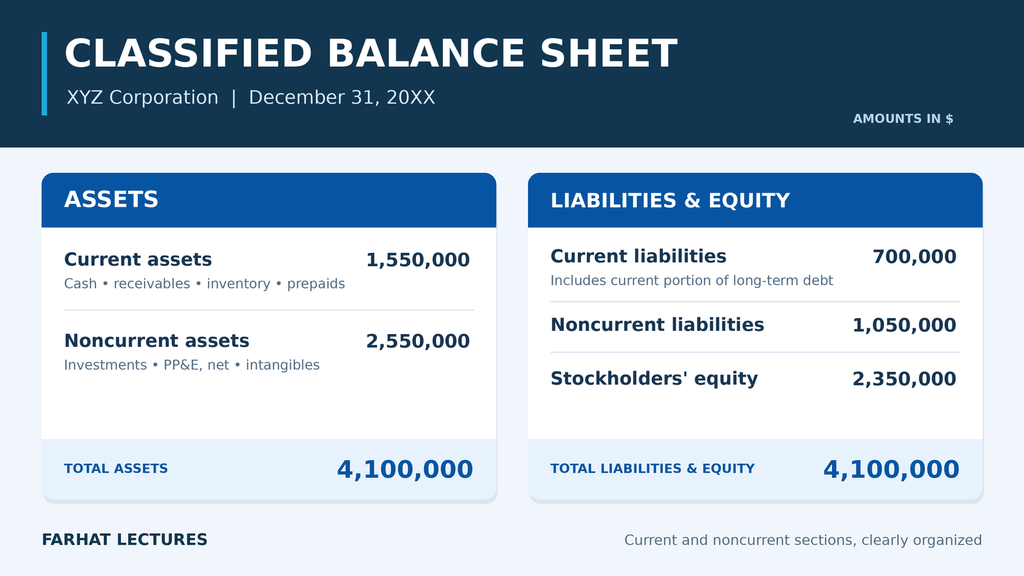
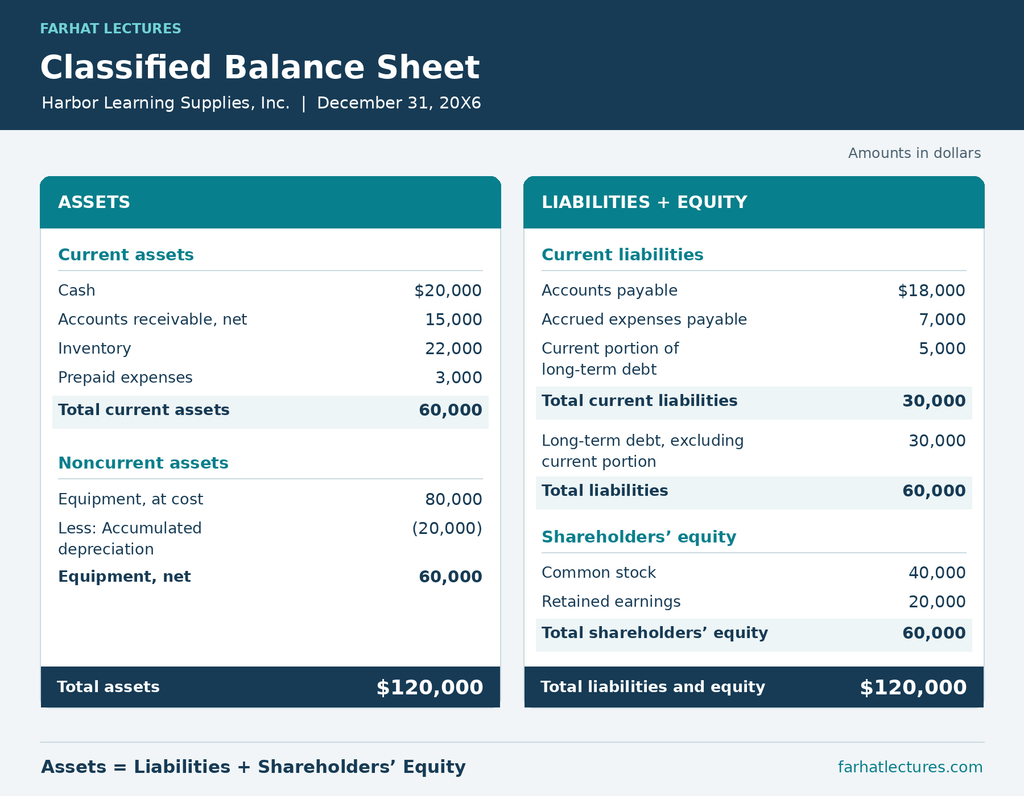
Current liabilities are the first group in the liabilities section, followed by long-term liabilities and then stockholders’ equity. On the asset side, current assets come first. Comparing the two current sections gives you working capital and the current ratio. See the broader classified balance sheet guide for the asset, liability, and equity sections together.
What order do current liabilities appear in?
There is no single required order. A company may list current liabilities by maturity date, by amount, or by liquidation preference (which debts would be paid first if the company were wound up). Read the labels and notes instead of assuming a fixed sequence.
Is the current portion of long-term debt a current liability?
Yes. Principal due within one year, or within the operating cycle if longer, is a current liability, and the remaining principal stays noncurrent. The main exceptions are debt that will be refinanced on a long-term basis under the GAAP refinancing test and debt that will be paid from assets already classified as noncurrent.
At what amount are current liabilities reported?
Usually at the amount due. Because payment is close, the difference from present value is normally immaterial, and ASC 835-30 does not require interest to be imputed on ordinary trade payables due within about one year.
Can a short-term loan be reported as noncurrent?
Yes, if the company intends to refinance it on a long-term basis and shows it can do so before the financial statements are issued (or available to be issued). Under ASC 470-10, that ability is shown by actually issuing long-term debt or equity after the balance-sheet date, or by signing a qualifying financing agreement. See short-term debt refinancing under U.S. GAAP for the full test.
Sources and lesson context
This original guide follows the scope of Wiley Section 12.4, Presentation and Decision Analysis. For debt-classification context, the FASB’s 2025 discussion materials reproduce relevant existing guidance. In May 2026, the FASB directed its staff to draft a proposed update on subjective acceleration clauses. Nothing from that project is treated here as an enacted standard. The existing guidance in ASC 470-10 applies until a final Accounting Standards Update is issued and takes effect. All examples and questions above are hypothetical.
Continue learning: Intermediate Accounting course · Farhat Lectures free sample course.
About the author
Mansour Farhat, CPA, CIA, DBA, is an accounting professor and the instructor behind Farhat Lectures, where he teaches CPA, CMA, and EA candidates and accounting students.
Related lessons
Short-Term Debt Refinancing: A Simple GAAP Guide
Work through the U.S. GAAP refinancing test, distinguish intent from demonstrated ability, and see why the order of repayment and financing changes classification.
Current Ratio Less Than 1: A Simple Liquidity Analysis
Use an original retail case to interpret a current ratio below 1, compare the quick ratio, and examine deferred revenue, supplier terms, and refinancing risk.


Responses