
Accounting Equation: Simple Examples and Equity Effects

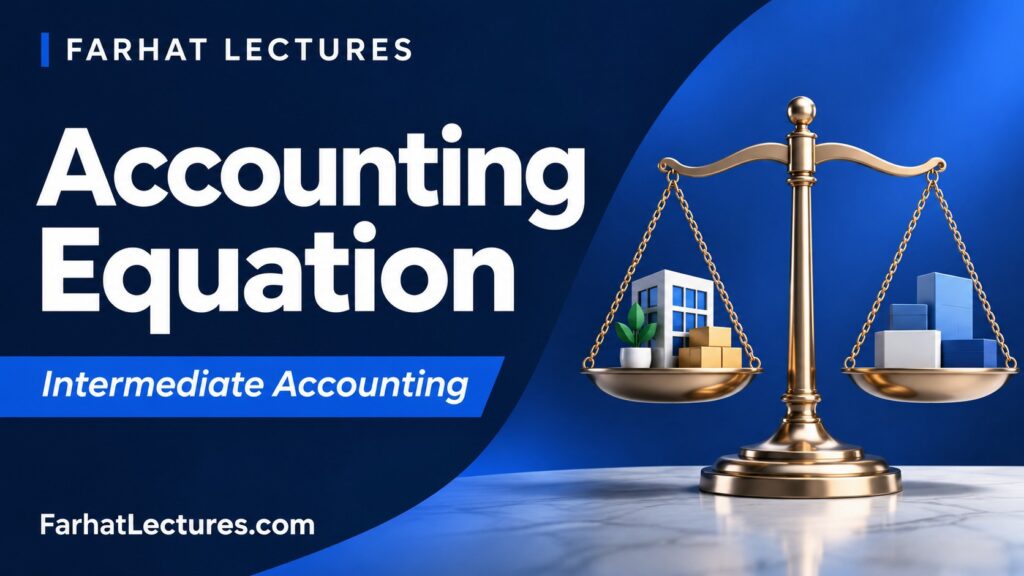
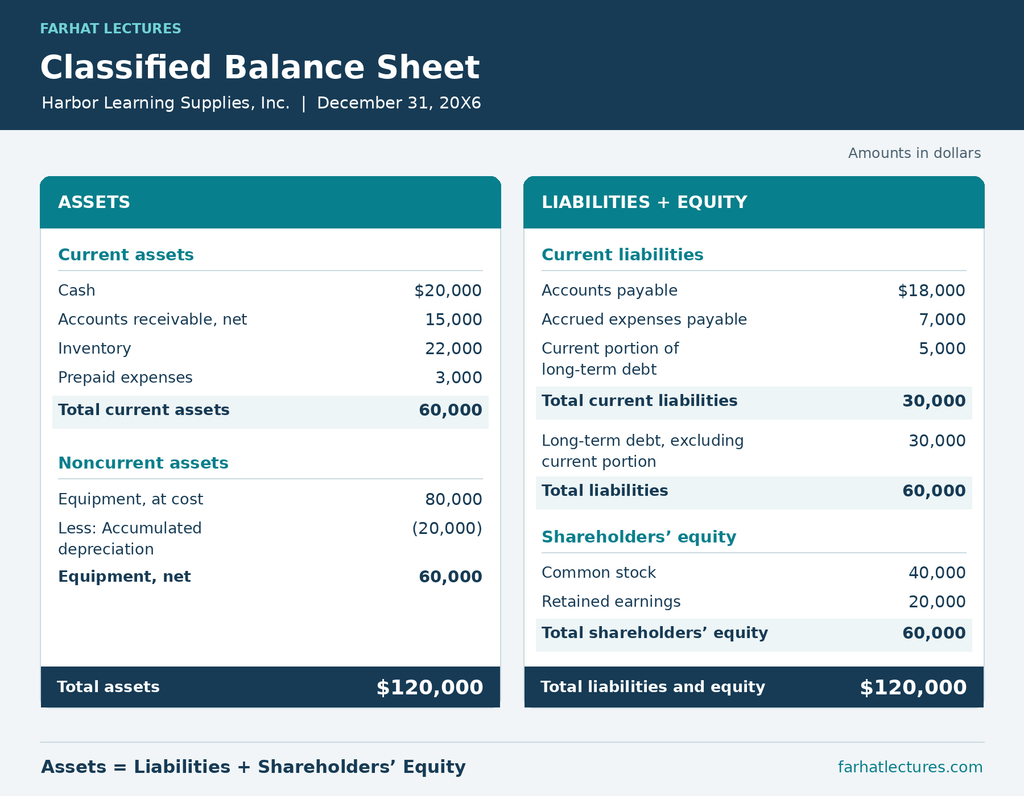
The accounting equation is Assets = Liabilities + Equity. It says every asset a business holds was financed either by creditors (liabilities) or by owners (equity). Every recorded transaction changes at least two accounts but keeps the equation in balance. Corporations call equity stockholders’ or shareholders’ equity; sole proprietors call it owner’s equity.
This relationship gives you a way to explain a transaction before choosing debits and credits. It also connects profit, dividends, and the balance sheet without treating every cash receipt as revenue.
Video: Professor Farhat Explains the Accounting Equation
Full lesson: the equity component of the accounting equation. Watch Professor Farhat walk through the equity side of Assets = Liabilities + Equity, then use the examples below to practice each transaction type.
Watch this Farhat Lectures lesson on YouTube.
The accounting equation and its three elements
| Element | Meaning in this lesson | Example |
|---|---|---|
| Assets | Present rights to an economic benefit. In plain terms, things the business has that will bring in or save cash. | Cash, accounts receivable, and equipment. |
| Liabilities | Present obligations to transfer an economic benefit, such as paying cash or delivering a service later. | Accounts payable and notes payable. |
| Equity | The residual interest after subtracting liabilities from assets. | Contributed capital and retained earnings in a simple corporation. |
These definitions follow the Financial Accounting Standards Board (FASB), the group that sets U.S. accounting standards, in its conceptual framework (Concepts Statement No. 8, Chapter 4, Elements of Financial Statements).
Rearranging gives Equity = Assets − Liabilities. The U.S. Securities and Exchange Commission’s financial-statement guide explains the balance-sheet relationship. Equity is a leftover amount, which accountants call a residual. It is not a separate pile of cash, and it doesn’t tell you what the company would sell for.
You may also see this formula called the basic accounting equation, the fundamental accounting equation, or the balance sheet equation. They all mean the same thing. Because equity equals assets minus liabilities, it is also called net assets. To see the equation laid out as a real statement, review the balance sheet overview.
For the recording method behind the equation, see debits and credits and normal balances. The equality applies even when a transaction moves amounts entirely within one side.
Why Does the Accounting Equation Always Balance?
Every asset a business holds came from somewhere. Either a creditor supplied it, which creates a liability, or an owner supplied it, by investing directly or by leaving profits in the business, which creates equity. So the two sides of the equation are two views of the same resources: what the business has, and who has a claim on it.
Double-entry bookkeeping keeps that true for every transaction. Each entry records equal debits and credits, so a change on one side is matched by an equal change on the other side, or by an offsetting change on the same side.
For example, borrowing $5,000 adds $5,000 to Cash (an asset) and $5,000 to Notes Payable (a liability). Both sides grow by $5,000, so the equation stays balanced.
Exam tip: when a question gives you two of the three totals, rearrange the equation to find the third. Equity = Assets − Liabilities, and Liabilities = Assets − Equity.
Accounting Equation Interactive Exercise
Check your understanding of assets, liabilities, stockholders’ equity, and the relationship between debits and credits with this four-question exercise.
Quick Check: The Accounting Equation
The accounting equation is Assets = Liabilities + Stockholders’ Equity. In double-entry accounting, total debits must equal total credits for each transaction. An entry may include more than one debit or credit.
Complete the statements
Choose an answer for each blank, then select “Check answers” for your score and an explanation. Select “Try again” to reset the exercise.
Ready to apply the formula? Continue to the expanded accounting equation, then work through the calculation questions with explanations.
The expanded accounting equation
For a simple corporation with only contributed capital and retained earnings in equity, expand the relationship as follows:
Assets = Liabilities + Contributed Capital + Beginning Retained Earnings + Revenues − Expenses − Dividends
This introductory version leaves out other equity items, such as treasury stock and accumulated other comprehensive income, and direct adjustments to retained earnings, such as corrections of prior-period errors. Contributed capital represents amounts stockholders contribute in exchange for shares, including cash, other assets, or services. A corporation often splits it between Common Stock (usually the stock’s par value, a small legal amount per share) and additional paid-in capital (the amount paid above par). The example below combines them so you can focus on the transaction effects.
Use beginning retained earnings in this expansion. Ending retained earnings already reflects the period’s net income and dividends. Adding the period’s revenue again would count it twice.
| Event | Effect on total equity | Effect on net income |
|---|---|---|
| Owner contributes capital | Increase | None |
| Company earns revenue | Increase | Increase |
| Company incurs an expense | Decrease | Decrease |
| Company declares a cash dividend | Decrease | None |
The crucial distinction is the source of the change. Owner investments and distributions change equity without being revenues or expenses.
Accounting equation example: a new business
Hypothetical example. Alder Tutoring Inc. begins with zero balances. The following six transactions occur during its first month. All services described are completed, and the rent relates entirely to that month.
| Transaction | Change in assets | Change in liabilities | Change in equity |
|---|---|---|---|
| 1. Stockholders contribute $18,000 cash | +$18,000 Cash | — | +$18,000 contributed capital |
| 2. Buy equipment on account for $4,000 | +$4,000 Equipment | +$4,000 Accounts Payable | — |
| 3. Earn $3,200 cash for tutoring | +$3,200 Cash | — | +$3,200 revenue |
| 4. Pay $900 current-month rent | −$900 Cash | — | −$900 expense |
| 5. Pay $1,500 of the equipment payable | −$1,500 Cash | −$1,500 Accounts Payable | — |
| 6. Declare and immediately pay a $400 cash dividend | −$400 Cash | No net change (Dividends Payable +$400, then −$400) | −$400 dividend |
Ending Cash is $18,000 + $3,200 − $900 − $1,500 − $400 = $18,400. Add Equipment of $4,000 to obtain total assets of $22,400. Accounts Payable is $4,000 − $1,500 = $2,500.
Net income is $3,200 − $900 = $2,300. Ending retained earnings is $0 + $2,300 − $400 = $1,900. Total equity is $18,000 contributed capital + $1,900 retained earnings = $19,900.
Check: $22,400 assets = $2,500 liabilities + $19,900 equity. The $1,500 payment reduced an existing liability; it did not reduce profit. Buying equipment did not create an immediate expense in this simplified transaction analysis. Later depreciation is outside this example. Want another full walkthrough? Try this transaction analysis for a service company.
Transactions that students commonly confuse
Collecting an existing receivable
Receiving $600 from a customer who already owes the business increases Cash and decreases Accounts Receivable by $600. Total assets do not change, and no new revenue arises from the collection itself.
Borrowing cash
Borrowing $5,000 increases Cash and Notes Payable by $5,000. Equity does not increase. A loan provides financing; it is not income earned from customers.
Declaring versus paying a dividend
Declaring a $400 cash dividend reduces equity and creates Dividends Payable. Paying it later reduces Cash and Dividends Payable. Equity decreases at declaration and is not reduced again on payment. Alder’s table combines the two actions only because payment is immediate.
Exchanging one asset for another
Buying equipment for $2,000 cash increases Equipment and decreases Cash by equal amounts. Total assets stay constant. The business changed the form of its resources.
Receiving Cash Before You Earn It
Suppose a student pays $1,200 today for tutoring that will happen next month. Cash increases $1,200, and so does Unearned Revenue, a liability that means the business still owes the service. Equity does not change yet. Revenue is recorded later, once the tutoring is delivered. Learn more in the unearned revenues lesson.
Owing an Expense You Haven’t Paid
At month-end, the business owes $300 for this month’s utilities but hasn’t paid the bill. Utilities Expense increases $300, which lowers equity, and Utilities Payable, a liability, increases $300. No cash moved, but the expense still belongs to this month. This is called an accrued expense; see the accrued expenses and liabilities lesson.
How equity connects financial statements
The income statement reports revenue minus expenses. Net income then increases retained earnings, while dividends reduce retained earnings. The ending retained-earnings amount becomes part of equity on the balance sheet. The statement of retained earnings lesson shows how this roll-forward is presented.
| Statement relationship | Alder example |
|---|---|
| Income statement: revenue − expenses | $3,200 − $900 = $2,300 net income |
| Retained earnings: beginning + net income − dividends | $0 + $2,300 − $400 = $1,900 |
| Balance sheet: contributed capital + retained earnings | $18,000 + $1,900 = $19,900 equity |
The names depend on ownership structure. Corporations commonly use Common Stock, additional paid-in capital, Retained Earnings, and Dividends. Sole proprietorships and partnerships use owner or partner Capital and Drawings accounts. Revenue, expense, and dividend (or drawings) accounts are temporary accounts, which means they are closed to zero at the end of each period through closing entries. Capital and retained earnings are permanent accounts, so their balances carry forward.
The accounting information system overview places these statements in the accounting cycle. For a broader introduction, review what accounting communicates; for additional equity components, see the existing stockholders’ equity guide.
Key Takeaways
- The accounting equation is Assets = Liabilities + Equity, and it holds after every recorded transaction.
- Equity is what’s left after subtracting liabilities from assets. It is not a pile of cash.
- Revenues increase equity. Expenses and dividends decrease it. Owner contributions increase equity without being revenue.
- Borrowing money and collecting a receivable are not revenue.
- Cash received before the work is done is a liability (unearned revenue), not revenue.
- A balanced equation does not prove the records are error-free.
Practice questions with explanations
1. Assets are $72,000 and liabilities are $29,000. What is equity?
Answer: $43,000. Subtract liabilities from assets: $72,000 − $29,000. Equity is the remaining accounting interest.
2. A company earns $1,700 for completed services and bills the customer. What changes?
Answer: Accounts Receivable and equity each increase $1,700. The asset rises because the customer owes payment; revenue increases equity. Cash is unchanged.
3. Beginning retained earnings is $8,200, net income is $3,600, and declared dividends are $1,100. What is ending retained earnings?
Answer: $10,700. Compute $8,200 + $3,600 − $1,100. Dividends reduce retained earnings but do not reduce the $3,600 net income.
4. Assets Are $50,000 And Equity Is $32,000. What Are Liabilities?
Answer: $18,000. Rearrange the equation: Liabilities = Assets − Equity, so $50,000 − $32,000 = $18,000.
Frequently asked questions
Does every transaction change both sides of the equation?
No. Exchanging cash for equipment affects two asset accounts on the same side. The equality still holds.
Is retained earnings the same as cash?
No. Retained earnings tracks accumulated earnings retained after distributions and other applicable adjustments. Those earnings can be invested in many different assets.
Can the accounting equation balance even when the records contain an error?
Yes. An omitted transaction or a balanced entry in the wrong accounts can leave the equation equal. Balance is necessary, but it is not complete proof of accuracy. The same limit applies to a trial balance: equal debit and credit totals don’t guarantee the right accounts were used.
Is The Accounting Equation The Same As The Balance Sheet?
The balance sheet is built on it. Assets appear on one side, and liabilities and equity appear on the other, as of a single date. The two totals must match, which is why it is called a balance sheet.
What Happens To The Equation When A Company Has A Net Loss?
A net loss means expenses were larger than revenues for the period. The loss reduces retained earnings and total equity. The revenue and expense entries that produce the loss reduce net assets (assets minus liabilities) by the amount of the loss. Individual assets and liabilities can change in different combinations, and the equation still balances.
Learning scope: Intermediate Accounting, Section 2.1, Accounting Information System.
About the Author
Mansour Farhat, CPA, CIA, DBA, is the instructor behind Farhat Lectures, where he teaches accounting to CPA, CMA, and EA candidates and accounting students through video lessons and practice exercises. His YouTube lessons, including the one above, break exam topics into small, practical steps.
CONTINUE LEARNING


Responses