
Notes to Financial Statements: A Simple Reading Guide

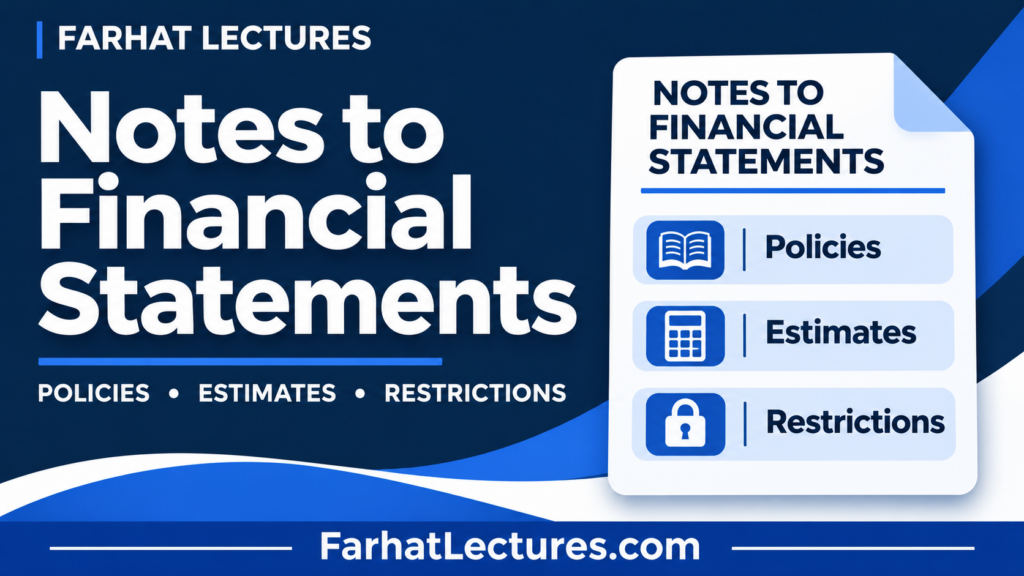
Notes to financial statements are the explanations and schedules that accompany a company’s balance sheet, income statement, statement of cash flows, and statement of stockholders’ equity. Under U.S. generally accepted accounting principles (GAAP), they are an integral part of the financial statements. They disclose the accounting policies, estimates, supporting detail, commitments, and contingencies behind the reported numbers.
To read them well, connect each important note to the balance it explains and ask what the number alone does not tell you.
This matters because identical balances can represent different circumstances. Two companies may report the same equipment amount but use different depreciation methods or have different restrictions on those assets.
Video: notes to financial statements explained
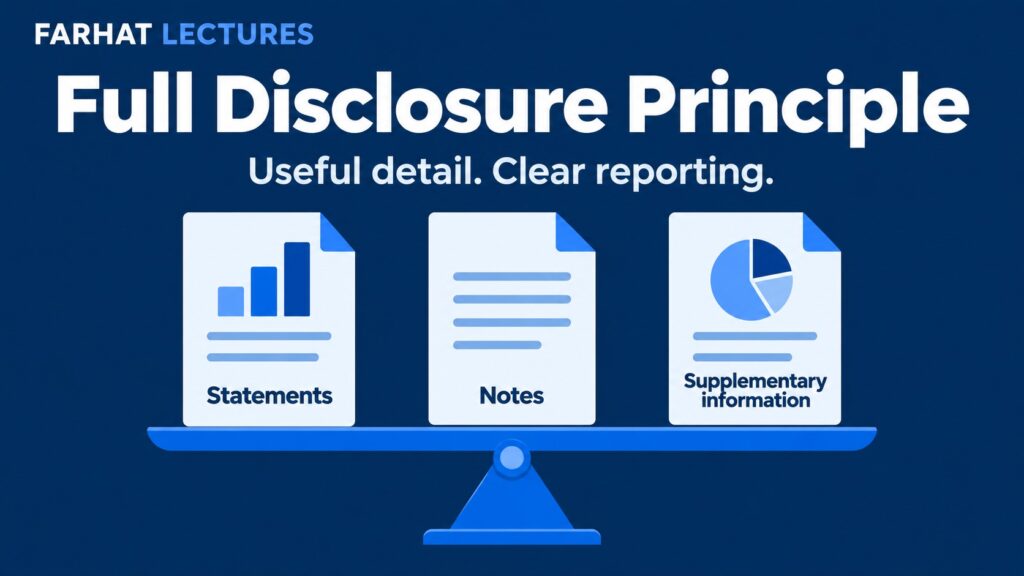
This lesson is part of Professor Farhat’s full disclosure principle lecture (10:59). The player starts at the notes segment. Jump to the part you need:
What are notes to financial statements?
A financial statement condenses many transactions into totals. Notes supply narrative explanations, numerical detail, and important conditions affecting those totals. They can also describe relevant uncertainties that do not appear as recognized liabilities. A note is therefore more than a glossary or a collection of optional comments.
| Information | Question it answers | Simple example |
|---|---|---|
| Accounting policy | How was the amount determined? | Inventory cost is assigned using first-in, first-out. |
| Estimate | Which uncertain amount required judgment? | Equipment has an estimated useful life of six years. |
| Supporting detail | What makes up the balance? | A schedule separates land, buildings, and equipment. |
| Restriction or uncertainty | What affects use or future cash flows? | A loan agreement restricts dividend payments. |
The full disclosure principle overview explains the broader reporting framework. Here, the focus is reading the content of the notes. Management’s discussion and analysis (MD&A) provides a separate management perspective; it is not another name for the financial statement notes.
What is included in the notes to financial statements?
No single rule lists every note a company must provide. The disclosure requirements are spread across the topics of the Financial Accounting Standards Board (FASB) Accounting Standards Codification (ASC), and a company provides the ones that are material to its situation. These are the notes you will see most often.
| Note | What it tells you | ASC topic |
|---|---|---|
| Summary of significant accounting policies | The methods used to prepare the statements, such as the inventory and depreciation methods | 235 |
| Risks and uncertainties | The nature of the business, the use of estimates, and concentrations such as reliance on one customer | 275 |
| Inventory | What inventory is made of and the basis used to state it | 330 |
| Property, plant, and equipment | Major classes of assets, accumulated depreciation, and the depreciation methods used | 360 |
| Debt | The terms of the company’s borrowings, including when the debt comes due | 470 |
| Leases | Lease costs and the timing of future lease payments | 842 |
| Income taxes | Current and deferred taxes, and why the effective tax rate differs from the statutory rate | 740 |
| Commitments and contingencies | Purchase obligations, assets pledged as collateral, and uncertain items such as pending lawsuits | 440 and 450 |
| Fair value measurements | Which level of inputs (Level 1, 2, or 3 of the fair value hierarchy) supports amounts reported at fair value | 820 |
| Related-party transactions | Dealings with owners, management, and affiliates | 850 |
| Subsequent events | Significant events after the balance sheet date but before the statements are issued or available to be issued | 855 |
In a public company’s annual report on Form 10-K, the notes come right after the financial statements in Part II, Item 8. Our guide to SEC reporting requirements shows how the 10-K is organized.
What is changing for public companies
Public companies will soon show more expense detail in their notes. FASB Accounting Standards Update (ASU) 2024-03 requires public business entities to break down certain income statement expense lines in a table in the notes. The table shows categories such as purchases of inventory, employee compensation, depreciation, and intangible asset amortization. Under the effective dates clarified by ASU 2025-01, the new disclosures are required for annual periods beginning after December 15, 2026, and for interim periods within annual periods beginning after December 15, 2027. Early adoption is allowed.
Accounting policy vs. estimate: what is the difference?
An accounting policy is a principle or method applied in preparing the statements. An estimate is a judgment about an uncertain amount used in applying that policy. Under U.S. GAAP, a company must disclose its significant accounting policies (ASC 235). The summary of significant accounting policies usually comes before the other notes or appears as the first note.
For example, first-in, first-out (FIFO) and weighted-average are inventory cost-flow methods. Straight-line is a depreciation method. A six-year equipment life and an expected $24,000 residual value are estimates. Residual value (also called salvage value) is the amount a company expects to recover when it disposes of an asset at the end of its useful life.
Do not assume all measurement methods are freely interchangeable. The standard governing an item determines the permitted treatment. The policy note identifies the approach actually used; it does not give management unrestricted choice. Disclosures about the nature of operations and the use of estimates also help readers understand the business and its uncertainties.
Why does the difference matter? Because the two are handled differently when they change. A change in accounting principle, such as switching from FIFO to weighted-average, is generally applied retrospectively. That means the prior periods presented are adjusted as if the new method had always been used. A change in estimate, such as revising a useful life, is applied prospectively, in the current and future periods only (ASC 250). A change in depreciation method is a special case. GAAP treats it as a change in estimate effected by a change in accounting principle, so it is also handled prospectively. Our lesson on change in accounting estimate works through examples.
Example: how do you tie a note to the balance sheet?
Hypothetical example. Cedar Packaging reports equipment with a $72,000 carrying amount at December 31, 20X8. For Cedar’s equipment, carrying amount (also called book value) equals cost minus accumulated depreciation, assuming no impairment. Accumulated depreciation is the total depreciation recorded so far. Cedar’s notes explain that the equipment cost $120,000 and accumulated depreciation is $48,000. Cedar bought the equipment on January 1, 20X6. It uses straight-line depreciation with a six-year useful life and a $24,000 residual value. That is ($120,000 − $24,000) ÷ 6 = $16,000 of depreciation per year, or $48,000 for the three years 20X6 through 20X8. The equipment is also pledged as collateral for a bank loan, which means the bank can claim it if Cedar does not repay.
Here is how Cedar’s note might read:
Note 4. Equipment
Equipment is stated at cost less accumulated depreciation. Depreciation is computed using the straight-line method over an estimated useful life of six years, with an estimated residual value of $24,000.
Equipment, at cost: $120,000
Less accumulated depreciation: (48,000)
Equipment, net: $72,000The equipment is pledged as collateral for the bank loan described in Note 6.
| Fact | Interpretation |
|---|---|
| $120,000 − $48,000 = $72,000 | The note reconciles gross cost to the reported carrying amount. |
| Straight-line depreciation | This is the depreciation method. |
| Six-year useful life and $24,000 residual value | These are estimates used in allocating cost. |
| ($120,000 − $24,000) ÷ 6 = $16,000 per year × 3 years = $48,000 | Accumulated depreciation agrees with the method and the estimates in the note. |
| Equipment pledged to the bank | The bank can claim the equipment if Cedar does not repay the loan. Lawyers call this a security interest. |
The $72,000 amount is not automatically its current selling price. The pledge does not create another equipment asset or automatically remove the existing one. Read the associated debt disclosure to understand the obligation. These connections make the note useful instead of merely repetitive.
Commitments, restrictions, and contingencies
A commitment is an obligation or arrangement arising from a contract, such as a material purchase agreement. A restriction limits an action, such as paying dividends or using an asset. Loan covenants are contractual conditions, sometimes requiring minimum working capital or specified financial ratios. A borrowing total alone may not reveal those conditions.
A contingency involves an existing condition whose possible gain or loss depends on uncertain future events. Pending litigation is a common example. A disclosed uncertainty is not automatically a recognized liability, and recognizing a liability does not remove related disclosure requirements. The rules for when to record a contingency are a topic of their own. For the short version, see the loss contingencies part of our full disclosure principle lesson.
A note on older textbooks. Some textbooks still show a contractual obligations table next to this topic. That table was an MD&A requirement, not a note requirement, and the Securities and Exchange Commission (SEC) eliminated it in its 2020 MD&A amendments. The SEC kept and updated the requirement to discuss liquidity and capital resources in MD&A. So treat a textbook table as a helpful illustration, not a required SEC format. See the SEC’s adopted amendments.
Fair value notes answer a different question: what inputs support reported valuations?
How do you read the notes to financial statements?
Use these five steps each time.
- Start with the balance sheet line and its note reference.
- Find the accounting policy behind the number.
- Check the supporting amounts. Do they add up to the balance on the statement?
- Read the restrictions and uncertainties before you draw a conclusion.
- Confirm the note covers the same reporting date as the statement.
Common mistakes include treating notes as optional, confusing a method with an estimate, and assuming a note fixes incorrect recognition. Disclosure of an omitted expense does not correct the understated expense or liability.
Exam tip. On the CPA Exam, notes to financial statements are a named topic in FAR Area I, Financial Reporting. The AICPA blueprint’s representative tasks ask you to adjust the notes to correct errors and omissions, and to compare the notes with the statements and supporting documents to find inconsistencies. So practice the tie-out you just did with Cedar. Does every number in the note agree with the statement, the method, and the date? Check the current AICPA blueprint for your testing window.
Key takeaways
- Notes to financial statements are an integral part of the statements. They are not optional extras.
- An accounting policy is a method, such as FIFO or straight-line. An estimate is a judgment about an uncertain amount, such as a useful life or residual value.
- A good note ties to the statement. Cedar’s $120,000 cost minus $48,000 of accumulated depreciation equals the $72,000 on its balance sheet.
- Commitments, restrictions, and contingencies can matter even when no liability is recorded.
- A note explains the accounting. It never fixes accounting that is wrong.
- MD&A is separate from the notes. A financial statement audit covers the notes. MD&A sits outside the audited statements.
Practice exercise · 5 questions
Notes to the Financial Statements: Interactive Exercise
Ready to check yourself? These five questions use the ideas from this guide: where the detail behind a balance lives, policy versus estimate, recognition versus disclosure, and contractual restrictions.
Try them before you move on to the practice questions below.
Choose one answer for each question, then select Check answers to see your score and explanations.
View answers and explanations
-
Cedar’s balance sheet shows equipment of $72,000. Where do you find the cost and accumulated depreciation behind that number?
The notes break a balance into its parts. Cedar’s note shows cost of $120,000 less accumulated depreciation of $48,000, which equals the $72,000 on the balance sheet.
-
Which item is an accounting estimate, not an accounting policy?
Useful life is a judgment about the future, so it is an estimate. Straight-line and FIFO are methods, which makes them accounting policies.
-
A company leaves a required expense out of its income statement but describes it in a note. Is the reporting now correct?
Recognition and disclosure do different jobs. If an expense must be recognized, the statements are wrong until the accounting is corrected, no matter what the note says.
-
A note says Cedar’s loan agreement limits dividend payments. What does that tell you?
A restriction describes a limit set by a contract. It changes how you read the company’s flexibility, but it does not create a liability by itself.
-
Where does the summary of significant accounting policies usually appear?
Under U.S. GAAP (ASC 235), the summary of significant accounting policies usually comes before the other notes or is presented as the first note.
Practice questions and explained answers
1. Is a five-year useful life a policy or an estimate?
Answer: an estimate. Useful life reflects a judgment about how long an asset will provide service. The depreciation method is a separate accounting-method decision.
2. Cedar’s note lists cost of $120,000 and accumulated depreciation of $48,000. What carrying amount should reconcile?
Answer: $72,000. Subtract accumulated depreciation from cost. Do not add the gross cost to the already reported net balance.
3. Does disclosure of a dividend restriction mean a new liability must be recorded?
Answer: no. The restriction describes a contractual limitation. Recognition depends on the applicable accounting requirements, not merely on whether information appears in a note.
4. A draft note lists Cedar’s accumulated depreciation as $40,000 at December 31, 20X8. Is the note consistent with Cedar’s method and estimates?
Answer: no. ($120,000 − $24,000) ÷ 6 = $16,000 per year. Three years of use (20X6, 20X7, and 20X8) gives $48,000, not $40,000. A note showing $40,000 would imply a carrying amount of $80,000, which does not match the $72,000 on the balance sheet. The note, or the records behind it, must be corrected.
Frequently asked questions
Are footnotes the same as notes to financial statements?
Yes. Footnotes and notes to financial statements are two names for the same thing: the explanations that accompany the financial statements. U.S. GAAP uses the term notes. ASC 235 is titled Notes to Financial Statements.
Are notes to financial statements required?
Yes. Under U.S. GAAP, the notes are an integral part of the financial statements. ASC 235 requires a company to disclose its significant accounting policies, and other ASC topics add their own required disclosures.
Are notes to financial statements audited?
When financial statements are audited, the audit also covers the related notes. The auditor’s opinion refers to the financial statements and the related notes. MD&A is different. It sits outside the audited financial statements.
What is the difference between the notes and MD&A?
The notes are part of the financial statements and follow U.S. GAAP. Management’s discussion and analysis (MD&A) is management’s own commentary on results, liquidity, and trends. SEC rules require it for public companies, and it appears outside the financial statements.
Where are the notes in an annual report?
Right after the financial statements. In a Form 10-K, the financial statements and their notes appear in Part II, Item 8, Financial Statements and Supplementary Data.
Can notes contain tables?
Yes. A table can explain a balance or payment schedule, while nearby text explains policies, restrictions, or uncertainty.
Should I read every note before comparing companies?
Begin with significant policies and the notes affecting your comparison. Different methods, estimates, or restrictions can make an apparently simple numerical comparison misleading.
Sources and learning context
See the SEC guide to financial statements and the Financial Accounting Standards Board (FASB) Accounting Standards Codification, especially Topics 235 and 275. FASB’s conceptual discussion of notes provides background, not a substitute for authoritative GAAP.
About the author
Mansour Farhat, CPA, CIA, DBA, teaches the Farhat Lectures video lessons used on this site, covering intermediate accounting and CPA, CMA, and EA exam preparation. Learn more about Professor Farhat.
CONTINUE LEARNING
Explore the connected lessons
View the full Intermediate Accounting course
Preparing for the CPA Exam? Notes to financial statements have their own lesson in our FAR supplemental course. Explore the CPA FAR course.



Responses