
Sales Returns and Allowances: Journal Entries Explained

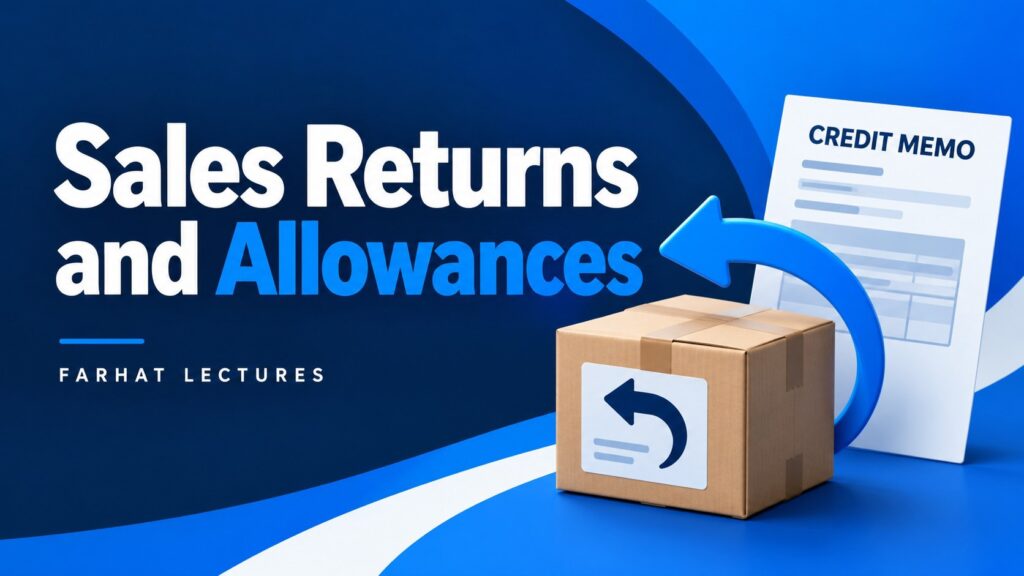
Sales returns and allowances is a contra-revenue account that reduces gross sales when customers send goods back (returns) or keep goods at a lower price (allowances). For a return or allowance not previously estimated on an unpaid credit sale, debit Sales Returns and Allowances and credit Accounts Receivable. Under a perpetual inventory system, a resalable return also goes back into inventory and reduces Cost of Goods Sold if no recovery asset was previously recorded. Previously estimated returns settle the recorded refund liability and recovery asset.
This lesson walks through the journal entries, shows how to calculate net sales, and explains how ASC 606 handles returns you expect but haven’t received yet. It’s written for Intermediate Accounting students and CPA FAR candidates. For a full walkthrough of expected refunds on cash sales, see the refund liability worked example.
Watch: Sales Returns and Allowances Journal Entry Example
Watch this Farhat Lectures lesson on YouTube
In this 14-minute lesson, Professor Farhat works through a tablet-sales example. The written example below uses different numbers, so you get two chances to practice.
Jump to a section of the video:
- 0:42 Sales allowances: customer keeps the goods
- 2:20 Right of return and revenue recognition
- 4:52 Example: 100 tablets and a 45-day return right
- 6:43 Recording the actual return
- 8:13 Month-end estimate: two more returns
- 10:08 Net sales, COGS and gross profit
- 12:18 What changes when the customer paid cash?
- 13:00 Estimated refunds on cash sales
Key takeaways
- Sales Returns and Allowances is a contra-revenue account with a normal debit balance.
- A return reverses revenue and brings goods back. An allowance reduces revenue only.
- Net sales equals gross sales minus sales returns and allowances and sales discounts.
- Expected returns create a refund liability at selling price and a recovery asset at cost.
- A return already in the estimate settles the liability. It does not reduce revenue again.
What Is the Difference Between a Sales Return and a Sales Allowance?
A sales return occurs when a customer sends goods back and receives a refund or credit. A sales allowance reduces the price while the customer keeps the goods, often because they are damaged or otherwise unsatisfactory.
Both reduce the seller’s revenue. However, only the return involves recovering merchandise. An allowance does not automatically reverse cost of goods sold because the seller has not recovered the goods.
| Feature | Sales return | Sales allowance |
|---|---|---|
| Customer sends goods back? | Yes | No |
| Revenue effect | Reduce revenue for the refund or credit | Reduce revenue for the price concession |
| Inventory effect | Recognize recoverable merchandise cost | No recovery asset if goods remain with the customer |
| Credit sale already outstanding | Actual credit generally reduces the receivable | Actual credit generally reduces the receivable |
Sales Returns and Allowances is a contra-revenue account: its debit balance is deducted from gross sales. It is different from a refund liability, which represents expected future refunds or credits.
Is Sales Returns and Allowances a Debit or a Credit?
Sales Returns and Allowances has a normal debit balance. That’s the opposite of Sales Revenue, which has a normal credit balance.
A contra-revenue account is an account that sits against revenue and reduces it. Companies use one instead of debiting Sales Revenue directly so they can see how much of their sales came back. A rising balance can point to a problem worth fixing.
On the income statement, the account appears as a deduction from gross sales:
Net sales = Gross sales − Sales returns and allowances − Sales discounts
How Do Actual Credits Differ From Estimated Future Returns?
Under Accounting Standards Codification (ASC) 606, a sale with a right of return requires revenue for the amount expected to be retained, a refund liability for expected refunds or credits, and an asset for recoverable products expected back. Estimates are updated at reporting dates.
An actual credit reduces what a customer currently owes. An expected return doesn’t reduce the invoice yet. The customer still owes the full amount, which is an unconditional receivable, meaning only the passage of time stands between the seller and payment. A separate refund liability holds the expected credit. That’s why accounts receivable and net revenue can be different numbers.
The example below separates the gross sale, actual credits, and remaining expected returns into teaching steps so each entry is easier to follow. This sequence does not permit delaying required estimates until period-end. Under ASC 606, revenue reflects expected returns and allowances when control of the goods transfers, with a refund liability and a recovery asset for products expected back. Estimates are then updated at each reporting date. The actual-credit entries below assume those credits were not previously included in an estimate.
Sales Returns and Allowances Journal Entry Example
Hypothetical facts: Harbor Homeware sells 80 storage units on account for $150 each. Each unit costs $90. Assume Harbor uses a perpetual inventory system. Customers have a return right. During the same reporting period, one unit is returned and Harbor grants a separate $300 allowance on merchandise the customer keeps. No cash has been collected.
At period-end, Harbor expects three additional units to be returned and another $120 allowance. Returned goods can be resold at their original carrying cost (the amount at which they sat in inventory), with no recovery costs or loss in value. Assume these estimates pass ASC 606’s constraint, meaning it is probable that Harbor will not have to reverse a significant amount of the revenue it has recorded.
Record the gross sale and merchandise cost
| Account | Debit | Credit |
|---|---|---|
| Accounts Receivable | $12,000 | — |
| Sales Revenue | — | $12,000 |
| Cost of Goods Sold | $7,200 | — |
| Inventory | — | $7,200 |
Revenue uses selling price: 80 × $150. Merchandise cost uses carrying cost: 80 × $90. See trade receivable recognition and classification for the underlying credit-sale rules.
Record the actual return and allowance
The one-unit return reduces the unpaid invoice by $150. Harbor sends the customer a credit memo, the document that confirms the lower balance, and records two entries: one for the selling price and one for the cost.
| Account | Debit | Credit |
|---|---|---|
| Sales Returns and Allowances | $150 | |
| Accounts Receivable | $150 | |
| Returned Inventory | $90 | |
| Cost of Goods Sold | $90 |
Returned Inventory is the merchandise that is physically back in Harbor’s hands.
The $300 allowance needs only one entry. There is no inventory entry because the customer keeps those goods.
| Account | Debit | Credit |
|---|---|---|
| Sales Returns and Allowances | $300 | |
| Accounts Receivable | $300 |
How Do You Record Expected Returns and Allowances?
The remaining expected returns equal 3 × $150 = $450. Add the expected $120 allowance to obtain a $570 refund liability. The recovery asset is only 3 × $90 = $270; no merchandise will be recovered for the allowance.
| Account | Debit | Credit |
|---|---|---|
| Sales Returns and Allowances | $570 | — |
| Refund Liability | — | $570 |
| Estimated Inventory Returns | $270 | — |
| Cost of Goods Sold | — | $270 |
“Estimated Inventory Returns” describes the right to recover products; those units are not physically back yet. You may also see this called a return asset. Measure that asset using former carrying cost less expected recovery costs and reductions in value. Present it separately from the refund liability.
If estimates were already recorded, adjust the existing balances to the newly required amounts. Do not record the full estimate again. For recognition at the initial sale date and subsequent settlement entries, study the existing refund liability worked example.
How Do Returns and Allowances Affect Net Sales and Gross Profit?
| Reported item | Calculation | Amount |
|---|---|---|
| Net sales | $12,000 − $150 − $300 − $570 | $10,980 |
| Cost of goods sold | $7,200 − $90 − $270 | $6,840 |
| Gross profit | $10,980 − $6,840 | $4,140 |
| Accounts receivable | $12,000 − $150 − $300 | $11,550 |
| Refund liability | $450 expected returns + $120 allowance | $570 |
| Returned goods physically held | 1 × $90 | $90 |
| Separate recovery asset | 3 × $90 | $270 |
Here’s how those amounts look on the income statement:
| Gross sales | $12,000 |
| Less: Sales returns and allowances | ($1,020) |
| Net sales | $10,980 |
| Cost of goods sold | ($6,840) |
| Gross profit | $4,140 |
The $1,020 is the $150 return, the $300 allowance, and the $570 estimate.
The receivable exceeds net sales by $570 because expected credits have been recognized as a liability. Don’t assume you can net the liability against receivables on the balance sheet. Offsetting is a separate question under ASC 210-20, so the two balances stay separate in this example.
If one of the three expected units is later returned, debit Refund Liability $150 and credit Accounts Receivable $150. Debit Returned Inventory $90 and credit Estimated Inventory Returns $90. Because that return was already estimated, these settlement entries do not reduce revenue and cost of goods sold again.
What If the Customer Already Paid or the Goods Can’t Be Resold?
If Harbor’s customer had already paid and the return had not been previously estimated, only the credit side of the customer entry changes. For the same one-unit return, debit Sales Returns and Allowances $150 and credit Cash $150. If no recovery asset was previously recorded, the cost entry stays the same: debit Returned Inventory $90 and credit Cost of Goods Sold $90.
If the return was already included in a refund liability, debit Refund Liability instead of Sales Returns and Allowances. If a $90 recovery asset was also recorded and the goods retain that value, debit Returned Inventory $90 and credit Estimated Inventory Returns $90. This settles the existing balances without reducing revenue or Cost of Goods Sold again.
The example assumes returned goods are as good as new. That isn’t always true. Say a unit that cost $90 comes back damaged and is now worth only $40 to Harbor. If no recovery asset was previously recorded, Harbor debits Returned Inventory $40 and credits Cost of Goods Sold $40. The other $50 of cost stays in Cost of Goods Sold.
If a recovery asset was previously recorded, first reduce that asset for any additional loss in value, with a corresponding increase in Cost of Goods Sold. Then transfer its remaining carrying amount to Returned Inventory. Do not record the same loss or cost recovery twice.
Common Sales Returns and Allowances Mistakes
- Using selling price for the recovery asset instead of recoverable cost.
- Recognizing a recovery asset for a price allowance when no goods come back.
- Reducing revenue again for an actual return already included in the refund liability.
- Confusing product-related price concessions with sales discounts for early payment or with credit losses caused by nonpayment.
- Forgetting the cost entry on a return. A return that can be resold needs one entry for selling price and one for cost.
Exam tip: On CPA FAR and Intermediate Accounting questions, start by asking whether the return was already estimated. If it was, revenue doesn’t change when the goods come back.
Sales Returns and Allowances: Interactive Exercise
Ready to check your understanding? Try this three-question exercise, check your score, and review the explanations.
Practice identifying what Falco Solar should recognize when solar panels are sold and returned.
What should Falco Solar recognize?
Falco Solar sells solar panels to customers on account and grants a right of return for various reasons, including dissatisfaction with the product.
Falco expects some panels to come back. Use what you learned above to choose the best answer.
Choose one answer for each question, then select Check answers. All questions are required.
Answer key and explanations
- Refund Liability. Expected credits are an obligation to customers, so they stay in a liability account until they are settled or the estimate changes.
- Revenue for the amount it expects to keep, Cost of Goods Sold, a refund liability, and an asset for panels expected back. Under ASC 606, revenue is not recognized for products expected to be returned.
- A reduction of Cost of Goods Sold. The asset pairs with Cost of Goods Sold. The revenue reduction pairs with the refund liability.
Practice Questions and Explanations
1. Record an allowance
A customer keeps damaged goods and receives a $180 credit on an unpaid invoice. No allowance was previously estimated. What entry is required?
Answer: Debit Sales Returns and Allowances $180 and credit Accounts Receivable $180. No goods are recovered, so this credit creates no inventory recovery entry.
2. Measure expected returns
Five units are expected back. Each sold for $80 and cost $45. There are no recovery costs or value reductions. What balances are required?
Answer: Refund liability $400 and recovery asset $225. The liability uses the expected customer credit; the asset uses recoverable merchandise cost.
3. Avoid counting an estimate twice
The refund liability already has a $350 credit balance. The revised required ending balance is $500. What adjustment is needed?
Answer: Debit Sales Returns and Allowances $150 and credit Refund Liability $150. The adjustment is the $150 difference, not another $500.
Want more practice? Try the FAR practice question bank.
Frequently Asked Questions
What is the journal entry for sales returns and allowances?
For a return or allowance not previously estimated, debit Sales Returns and Allowances and credit Accounts Receivable for the customer credit; credit Cash instead if the customer already paid. Under a perpetual inventory system, also debit Returned Inventory and credit Cost of Goods Sold for the recoverable cost of returned goods if no recovery asset was previously recorded. A previously estimated return instead settles Refund Liability and transfers the recovery asset to Returned Inventory, with any difference from the estimate recognized separately.
Is sales returns and allowances an expense?
No. It is a contra-revenue account, so it reduces revenue at the top of the income statement instead of appearing with operating expenses.
How does a sales return work under a periodic inventory system?
For a return not previously estimated, debit Sales Returns and Allowances and credit Accounts Receivable or Cash. If the return was already included in a refund liability, debit that liability instead. A periodic system does not update inventory and Cost of Goods Sold with each transaction, so no routine cost entry is recorded when the goods return. Account for the recovered goods and update any remaining recovery asset in the period-end inventory and cost-of-goods-sold calculations.
Why do some textbooks use an allowance account instead of a refund liability?
Some textbooks and homework problems credit a contra-receivable account, such as Allowance for Sales Returns and Allowances, on unpaid credit sales. ASC 606 requires a refund liability for expected refunds or credits. Use the account labels specified in a course problem, but distinguish those labels from financial-statement presentation. Calling an account an allowance does not, by itself, permit offsetting a refund liability against Accounts Receivable; any offset must meet the applicable ASC 210-20 requirements. Both approaches reduce net sales, but the balance-sheet presentation is not automatically interchangeable.
Can a refund liability arise before cash is collected?
Yes. Expected credits against amounts receivable can create a refund liability. ASC 606-10-55-25 covers amounts received or receivable, so cash doesn’t have to be collected first.
Is every exchange a sales return?
No. Exchanges for the same product type, quality, condition, and price, such as another color, are not treated as returns under this guidance. Defective-product replacement arrangements may require warranty analysis.
Are returned inventory and estimated returns identical?
No. One represents merchandise already recovered; the other represents a right to recover merchandise still with customers.
Accounting References
See FASB ASC 606-10-55-22 through 55-29 for rights of return, refund liabilities, and recovery assets. See ASC 606-10-32-5 through 32-7 for variable consideration, including price concessions, ASC 606-10-32-10 for refund liabilities, and ASC 606-10-32-11 for the constraint on estimates. The corresponding provisions are available in the FASB Topic 606 issuance document, printed pages 54–55. The Codification is the current authoritative source.
About Professor Farhat
Professor Mansour Farhat, DBA, CPA, CIA, MAcc, is the founder of Farhat Lectures. His teaching uses explanations, worked examples, and practice questions to support accounting students and professional exam candidates.
For more worked examples and practice, explore the Intermediate Accounting course.
Learn with Farhat Lectures
Strengthen your accounting foundation with clear explanations and guided practice. Explore the free sample course to experience the lessons.
Try the free sample course →


Responses