
Receivables Presentation: Classification and Disclosures

Last reviewed for accuracy: November 2026
Receivables presentation means showing receivables on the balance sheet as current or noncurrent assets at the amount expected to be collected: the amount owed, adjusted for any discount, minus an allowance for credit losses. Companies also separate material categories and disclose credit risk, allowance changes, and any receivables pledged as collateral.
Two companies can report the same net receivable balance but face very different collection risks. A useful presentation connects the number to its composition and uncertainty. This guide covers the reporting portion of Intermediate Accounting lesson 6.5 and supports CPA exam FAR review. All numerical examples are hypothetical and use U.S. GAAP.
Watch: Receivable classification: trade and nontrade
Review receivable types with Professor Farhat (0:23–6:22), then apply the presentation and disclosure guidance below.
Receivables Presentation: Current or Noncurrent?
Trade accounts and notes receivable generally belong in current assets when collection is expected within one year or the normal operating cycle, whichever is longer. The operating cycle is the time needed to acquire or produce goods or services, sell them, and collect the proceeds. If it is not clearly identifiable, use one year. Do not automatically extend this rule to nontrade balances: receivables from officers, employees, affiliates, and others generally qualify as current only when collectible in the ordinary course of business within one year (ASC 210-10-45-1).
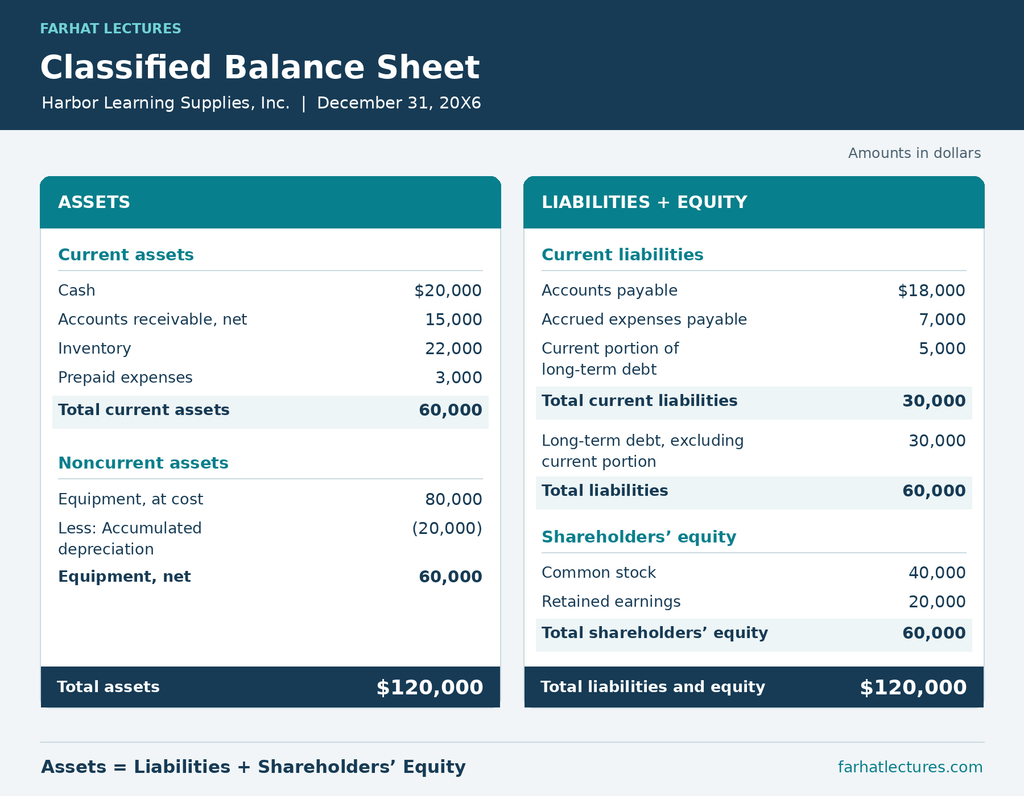
A written note is not automatically noncurrent, and an account receivable is not automatically current. Separate amounts falling outside the relevant current-asset period. For background, see the classified balance sheet.
| Hypothetical item | Classification reasoning |
|---|---|
| Customer invoice due in 45 days | Normally current: collection falls within one year. |
| Note principal due in three years | Normally noncurrent. A longer operating cycle may change the analysis for a trade note arising in the normal operating cycle; it does not automatically extend the current period for a nontrade loan. |
| Operating trade receivable due in 15 months in an established 18-month cycle | Can be current because it falls within the normal operating cycle. |
| Current installment of a longer-term note | Separate the current portion from the noncurrent remainder. |
How Are Receivables Shown on the Balance Sheet?
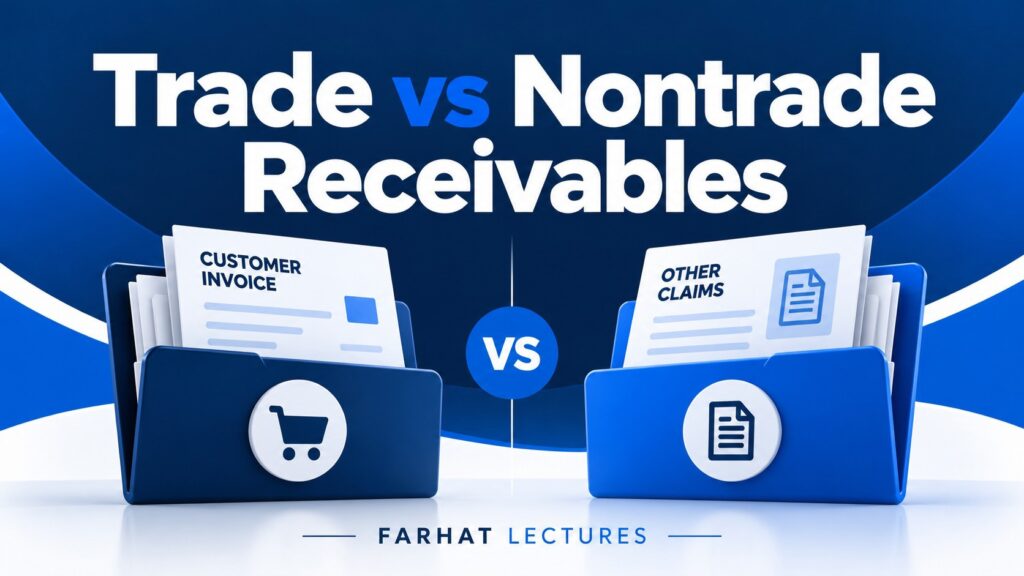
Trade receivables arise from ordinary customer sales. Nontrade balances arise from other activities, such as employee advances or interest earned. Present or disclose material categories separately so users can understand the balances. Do not combine unrelated amounts solely because all of them involve future cash.
A valuation account (a balance that adjusts an asset’s carrying amount) reduces its related asset. Under ASC 326-20-45-1, the allowance for credit losses is shown separately on the balance sheet as a deduction from the asset’s amortized cost basis. Amortized cost basis is the amount owed, adjusted for items such as unamortized discounts and write-offs. A common format is a line such as ‘Accounts receivable, net of allowance of $9,000.’ The credit-loss allowance is not a payable. A note discount represents a different measurement adjustment from a credit-loss allowance. See note discounts and premiums for that distinction.
| Current receivable category | Gross amount | Allowance | Net amount |
|---|---|---|---|
| Trade accounts receivable | $240,000 | $9,000 | $231,000 |
| Current notes receivable | $40,000 | $1,000 | $39,000 |
| Total | $280,000 | $10,000 | $270,000 |
Assume the notes have no unamortized discount or premium. A further $70,000 note due in three years, with a $3,000 allowance, is reported as a noncurrent net receivable of $67,000. Keeping the current and noncurrent amounts separate helps users assess near-term liquidity.
What this looks like on the balance sheet
Here’s how those same numbers could appear on a partial balance sheet.
| Partial balance sheet | Amount |
|---|---|
| Current assets | |
| Trade accounts receivable | $240,000 |
| Less: Allowance for credit losses | ($9,000) |
| Trade accounts receivable, net | $231,000 |
| Notes receivable, current, net of $1,000 allowance | $39,000 |
| Total current receivables, net | $270,000 |
| Noncurrent assets | |
| Notes receivable, noncurrent, net of $3,000 allowance | $67,000 |
Total receivables are $350,000 gross, less a $13,000 allowance, or $337,000 net.
Receivables that need separate treatment
- Officers, employees, and affiliates: Show these receivables separately instead of inside a general receivables line (ASC 310-10-45).
- Notes received for stock: These generally reduce equity and aren’t reported as assets (ASC 505-10-45-2).
- Contract assets: A contract asset is a right to payment that still depends on something other than time, such as finishing more work. Present it separately from receivables (ASC 606-10-45).
- Customer credit balances: A material credit balance is money you owe a customer. Report it as a liability unless the offset conditions in ASC 210-20-45 are met.
What Does the Allowance Rollforward Show?
An allowance rollforward reconciles the opening estimate to the closing estimate. It distinguishes the period’s expense from write-offs and recoveries. The ending allowance is a balance-sheet amount; the provision is an income-statement amount.
| Allowance activity | Amount |
|---|---|
| Beginning credit balance | $8,000 |
| Add: credit-loss provision | $5,000 |
| Subtract: balances written off | ($4,000) |
| Add: recoveries reinstated | $1,000 |
| Ending credit balance | $10,000 |
The reconciliation is $8,000 + $5,000 − $4,000 + $1,000 = $10,000. It matches the $10,000 allowance on the current receivables above. To keep the example simple, this rollforward leaves out the $3,000 allowance on the noncurrent note, so the company’s total allowance is $13,000. The current-period provision is $5,000, not $10,000. ASC 326-20-50-13 calls for this rollforward by portfolio segment, which is the level where an entity builds its allowance estimate. The short-term trade receivable exceptions covered below don’t apply to it, so a company whose receivables are all customer invoices still needs a rollforward if the amounts are material. For the underlying entries, review bad debt write-offs and recoveries.
What Credit Risk Disclosures Apply to Receivables?
Credit risk is the possibility that a debtor will not pay as promised. Useful disclosures explain the relevant risk characteristics, how expected losses are estimated, and why estimates changed. Historical loss experience, current conditions, and reasonable and supportable forecasts inform the estimate under ASC 326-20, the current expected credit loss guidance.
There’s one newer shortcut to know. ASU 2025-05 lets any entity assume that conditions at the balance-sheet date won’t change over the remaining life of current accounts receivable and current contract assets from customer contracts under ASC 606. Entities other than public business entities that elect this practical expedient may also make a separate accounting policy election to consider collections after the balance-sheet date, before the financial statements are available to be issued or before an earlier selected cutoff date. An entity must disclose whether it elected the practical expedient alone or both options. An entity electing to consider subsequent collections must also disclose the collection cutoff date in its annual financial statements (ASC 326-20-50-12A through 50-12B). These options are effective for annual periods beginning after December 15, 2025, including interim periods within those years.
To see how an estimate gets built, work through the accounts receivable aging example and the credit loss journal entry guide.
For relevant financing receivables (contractual rights to receive money, such as loans and notes), additional disclosures address credit-quality indicators (statistics about credit quality), past-due balances, and nonaccrual status. Nonaccrual means ordinary accrual of interest income has been suspended under the entity’s applicable policy. Do not memorize “90 days overdue” as an automatic universal GAAP rule: the guidance separately contemplates assets 90 days or more past due that are still accruing.
Disclosure requirements vary by instrument and entity. ASC 326-20 provides specific exceptions for certain trade receivables due in one year or less, other than credit-card receivables, from some credit-quality, past-due, and nonaccrual disclosures. Do not impose a lender’s entire disclosure package on every short-term customer invoice.
Concentrations of credit risk
A concentration arises when receivables share characteristics that could expose them to the same economic problem. Examples include one major customer, a common industry, or a geographic region. Many separate invoices can still represent one concentrated risk. When a concentration is significant, disclose what ties the group together, the maximum credit exposure, and the policy on collateral (ASC 825-10-50). There’s no universal percentage threshold, so judge it on the facts.
How Do You Disclose Pledged and Sold Receivables?
If receivables secure a loan, disclose the collateral arrangement and relevant amounts. The pledge does not remove the assets or permit automatic offset against the loan. If the lender has the right by contract or custom to sell or repledge the collateral, the borrower must present those assets separately from assets that are not similarly encumbered (ASC 860-30-45-1). Compare pledging receivables and secured borrowing.
When a transfer qualifies as a sale under ASC 860, remove the transferred receivables and recognize any assets and obligations you keep. A factor is a company that buys receivables. A due-from-factor balance is cash the factor is holding back, and a recourse liability is what you may owe if customers don’t pay. The factoring receivables example shows both.
What About Foreign-Currency Receivables?
Foreign-currency receivables add exchange-rate risk. Collection in a fixed foreign-currency amount can produce a different amount in the entity’s functional currency (the main currency of its business environment) as rates change. Distinguish transaction gains and losses, generally recognized in earnings, from translation adjustments associated with foreign operations. Detailed hedge accounting is outside this lesson.
Key Takeaways and CPA Exam Traps
Trade receivables sit in Area II, Select Balance Sheet Accounts, of the CPA exam FAR blueprint. Watch for these traps:
- For trade receivables, current classification generally uses the longer of one year or the normal operating cycle. Nontrade receivables from officers, employees, affiliates, and others generally use one year. The invoice or note label alone does not determine classification.
- The provision goes on the income statement, and the ending allowance goes on the balance sheet. Don’t swap them.
- Pledged receivables stay on the books, and the loan is reported separately. Present the pledged assets separately from unencumbered assets if the lender can sell or repledge them.
- A receivable from an officer, employee, or affiliate gets shown separately.
- A note received for stock generally reduces equity instead of appearing as an asset.
Presentation of Receivables: Interactive Exercise
Practice the six general rules for classifying and presenting receivables. Choose one answer for each question, then select Check answers.
Topics: receivable types, valuation accounts, current assets, credit risk concentrations, collateral, and credit risk disclosures.
Study guide: What are the six rules for presenting receivables?
- Show each material type of receivable separately, on the balance sheet or in the notes.
- Deduct each valuation account from the receivable it relates to.
- For normal operating trade receivables, use one year or the normal operating cycle, whichever is longer. Nontrade receivables from officers, employees, affiliates, and others generally qualify as current only when collectible in the ordinary course of business within one year.
- Disclose significant concentrations of credit risk, including what ties the group together, the maximum exposure, and the collateral policy.
- Disclose any receivables designated or pledged as collateral. If the lender can sell or repledge them, present those assets separately from assets that are not similarly encumbered.
- Explain the credit risk in the receivables, how the allowance was estimated, what changed in the allowance, and why.
Using older notes? Some study materials still list ‘disclose loss contingencies’ as a receivables rule. That wording comes from before ASC 326, the current expected credit loss model. ASU 2016-13 removed the loss-contingency guidance for receivables from ASC 310, so credit losses on receivables now run through the allowance and the ASC 326-20 disclosures.
Continue with the worked practice questions below to apply these presentation principles.
Practice Questions and Explanations
1. Classify a receivable
A business has a clearly established 16-month operating cycle. A normal operating trade receivable is expected to be collected in 14 months. Is it necessarily noncurrent?
Answer: No. It falls within the normal operating cycle, which is longer than one year, so it can be current.
2. Reconcile the allowance
Beginning allowance is $6,000. The provision is $4,500, write-offs are $2,800, and recoveries are $300. What is the ending balance?
Answer: $8,000: $6,000 + $4,500 − $2,800 + $300. The $4,500 provision is not the ending allowance.
3. Evaluate collateral presentation
A company pledges $90,000 of receivables for a $60,000 loan. Should it report only $30,000 of receivables?
Answer: No. Report the receivable asset, reduced by its appropriate valuation allowance, and report the borrowing separately. Disclose the pledge. If the lender can sell or repledge the collateral, present those receivables separately from assets that are not similarly encumbered.
Want more receivables practice? Keep going with the receivables lessons in the Intermediate Accounting course.
Frequently Asked Questions
Is the allowance for credit losses a liability?
No. It is a contra-asset account, which means it reduces the related receivables instead of standing as an amount owed to someone.
Must every receivable be shown as a separate balance-sheet line?
No. Materiality and applicable presentation requirements determine the detail. Supporting notes can explain categories and risks. One exception to watch: receivables from officers, employees, or affiliates are shown separately, not inside a general receivables line.
Does a healthy net balance prove customers pay promptly?
No. Combine the statements with receivables turnover, collection days, and aging information.
Are notes receivable always noncurrent?
No. For trade notes arising in the normal operating cycle, amounts expected to be collected within one year or that cycle, whichever is longer, are generally current. Nontrade notes, such as loans to officers, employees, or affiliates, generally use a one-year collection period. Present the noncurrent remainder separately.
Do short-term trade receivables need an allowance for credit losses?
They fall under ASC 326-20, so a company estimates expected credit losses on them. ASU 2025-05 adds an optional simplification for current accounts receivable and current contract assets from customer contracts.
What is the difference between a receivable and a contract asset?
A receivable is a right to payment that depends only on the passage of time. A contract asset is a right to payment that still depends on something else, such as finishing more work. Companies present them separately under ASC 606.
Can customer credit balances be netted against accounts receivable?
Usually not. A material credit balance is money the company owes the customer, so it is reported as a liability unless the offset conditions in ASC 210-20-45 are met.
Accounting References
Consult FASB ASC 210-10, 210-20, 310-10, 326-20-45, 326-20-50, 440-10-50, 505-10-45, 606-10-45, 825-10-50, 830-20, 830-30, and 860 for the presentation, credit-risk, collateral, currency, and transfer guidance. The FASB credit-loss update provides public background, including the disclosure objectives and short-term trade-receivable exceptions. ASU 2025-05 adds the practical expedient for current accounts receivable and current contract assets. Use the current Codification for the requirements applicable to a particular entity.
Learn with Farhat Lectures
Strengthen your accounting foundation with clear explanations and guided practice. Explore the free sample course to experience the lessons.
Try the free sample course →
Responses