
Montana CPA Exam Pass Rates: 2024 NASBA Data

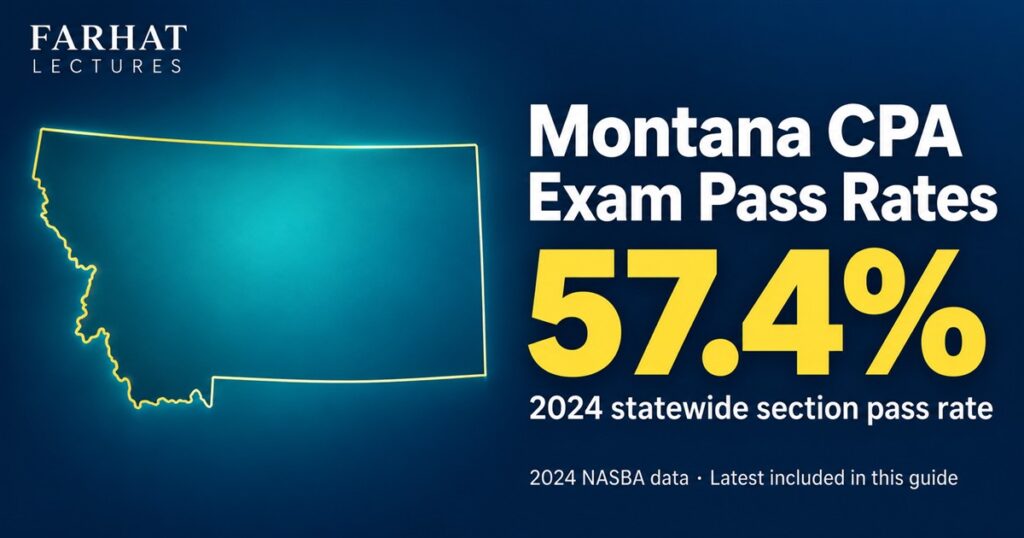
MONTANA CPA EXAM PASS RATES
What is the Montana CPA exam pass rate?
The Montana CPA pass rate is 57.4% in the 2024 jurisdiction dataset used in this guide. It measures exam sections passed, not candidates who completed all four sections.
Data year: 2024. The tables do not include 2025 or 2026 results. See the source and update notes for details.
See our CPA exam pass rate by jurisdiction comparison.
This guide keeps Montana CPA exam pass rates simple: compare public, private nonprofit, and for-profit/proprietary schools as separate categories. The university results below describe specific school cohorts; they are separate from Montana’s jurisdiction rate.
Jump to: School comparison · Interpret the results · First attempts and retakes · School appendices · How to apply · Study plan · FAQs · Sources and data year
Montana CPA Exam Pass Rates by School Type
The two tables show the highest listed rates in each group (up to five records) from this guide’s 2024 bachelor’s first-time dataset. The bachelor’s first-time source reports three public schools and one private nonprofit school for Montana. Every row uses the same year, degree category, and attempt type. These are individual school results, not public-versus-private sector averages. Ties are ordered by section-attempt count, from larger to smaller.
For-profit / proprietary schools
No for-profit/proprietary results were identified in Montana’s 2024 bachelor’s first-time table. This category remains separate from private nonprofit schools. Missing results do not mean a 0% pass rate or that the state has no proprietary schools.
Read the sample size: A rate based on a small number of section attempts can change sharply with just one result. NASBA excludes institutions with fewer than five candidates from these appendices. These selected results do not predict an individual candidate’s performance. School names follow the report, with minor shortening; some institutions have since changed their names.
How to Interpret Montana CPA Exam Pass Rates
Start with a comparable group. In the 2024 bachelor’s first-time results above, the University of Montana – Missoula reported 67.7% across 31 section attempts, compared with 58.3% across 24 attempts for Montana State University – Billings. The difference is 9.4 percentage points. These percentages describe those reported attempts; they do not establish that attending one school causes a candidate to perform better.
Consider how much one result can affect a small group. In a hypothetical group of 20 section attempts, changing one unsuccessful result to a pass increases the rate by five percentage points. This illustrates why a high percentage based on a small cohort should be read alongside its attempt count. Section attempts are also different from unique candidates, because one person may sit for several sections.
Keep the 57.4% Montana jurisdiction rate separate from the university tables. The jurisdiction statistic and the school cohorts describe different reporting populations. Averaging the displayed school percentages would not reproduce the jurisdiction rate. Even weighting these selected school rows by section attempts would describe only the selected rows, not the full jurisdiction.
Use Montana CPA exam pass rates as context when considering a program, alongside its curriculum, academic support, cost, and fit with your goals. For personal preparation, evaluate what you can explain and apply. A school’s historical percentage cannot measure your current understanding or guarantee your exam result.
Looking for another school? Browse our CPA Exam Pass Rates by University page for searchable historical results. Check its reporting year before comparing.
First-Time Attempts, Retakes, and Degrees—Simply Explained
- First-time attempt: A candidate’s first try at an individual exam section.
- Retake: Another attempt at a section after an unsuccessful attempt.
- All attempts: First-time attempts plus retakes. This is not a retake-only pass rate.
- Degree: Bachelor’s and advanced-degree cohorts are reported separately. Compare like with like.
One candidate can contribute several section attempts. For example, a 60% pass rate means 60 of 100 section attempts were passed. The tables do not provide a separately verified retake-only rate.
Montana CPA Exam Pass Rates: School Appendices
Each appendix below shows the first five Montana records from the source (or all records where fewer than five are reported), sorted by pass rate from highest to lowest, with three useful columns: school, pass rate, and section attempts. These are mixed school-type excerpts, not statewide top-five rankings. Open a panel for the degree and attempt type you want. All figures are for 2024.
Comparison note: Small cohorts can produce unusually high or low rates. Keep degree and attempt categories separate. A school may appear in an all-attempt table but be absent from a first-time table because the candidate counts differ. A missing row does not mean a 0% pass rate.
Applying for the CPA Exam in Montana
Ready to apply? Use these official Montana resources to check current exam eligibility, required documents, and the application process. Applying for the exam and applying for a CPA license are separate steps.
- NASBA’s Montana CPA Exam page — Review current eligibility and transcript instructions, then follow the CPA Examination Services application steps through the CPA Portal.
- Montana Board of Public Accountants — Check the state board’s current licensing requirements, forms, rules, and applicant guidance.
Build a Study Plan with Farhat Lectures
Turn the comparison into a practical next step: identify a topic you find difficult, review its explanation, and solve related questions before checking the solution. When you miss a question, record the concept or reasoning step that caused the error, then revisit it in a later practice session. This provides more actionable feedback than comparing yourself with a school average.
Explore the Farhat Lectures free sample course to see the teaching approach. Use the course catalog to locate lessons relevant to your coursework or CPA Exam preparation. Focus on understanding why an answer is correct and why the alternatives are incorrect.
Montana CPA Exam Pass Rates: Frequently Asked Questions
Does the 57.4% Montana CPA pass rate mean candidates passed all four sections?
No. The 57.4% figure is a section pass rate for the 2024 jurisdiction dataset used here. It is not the percentage of candidates who completed the entire CPA Exam. One candidate may contribute multiple section attempts.
Why does Montana Technological University appear only in the all-attempt table?
The selected 2024 bachelor’s all-attempt table includes Montana Technological University, while the first-time table reproduced here does not. The tables represent different attempt groups, and reporting thresholds can affect which institutions appear. The displayed data do not establish the precise reason for this omission. An absent row does not mean a zero pass rate.
Does a higher university pass rate guarantee individual success?
No. A university pass rate summarizes a particular cohort, degree category, attempt type, and year. It does not predict an individual candidate’s outcome. Read the attempt count and comparison notes before drawing conclusions, and use your own practice performance to identify areas needing further study.
Are these Montana CPA exam pass rates for 2025 or 2026?
No. Every pass-rate table in this article uses 2024 data. The publication or editorial update date does not change the reporting year. Consult the source notes below before comparing these figures with another article or dataset.
Sources and the Latest Data Included
Data year: 2024. Statistical source review: September 29, 2026. Editorial update: October 20, 2026. Figures were checked against the supplied NASBA 2024 Candidate Performance Report scans: 2024 Overall Statistics by Jurisdiction (printed page 14); Appendix A-2 (page 191); Appendix A-3 (page 215); Appendix B-2 (page 272); and Appendix B-3 (page 294). The 57.4% jurisdiction rate covers 3,019 exam sections from 1,489 candidates; it is not an average of Montana university rates.
Data availability disclaimer: The 2024 figures are the latest NASBA Montana dataset currently included on this page; 2025 and 2026 figures are not included here. NASBA’s 2025 Edition was released in August 2026, but its Montana tables have not yet been incorporated. This site will be updated as newer Montana data is obtained and verified.
School categories distinguish public control, private nonprofit status, and for-profit/proprietary ownership. The appendices mix school types and are not sector averages.
About Professor Farhat
Professor Mansour Farhat, DBA, CPA, CIA, MAcc, founded Farhat Lectures. His accounting instruction uses explanations, worked examples, and practice questions to help students strengthen their understanding and apply concepts in coursework and professional exam preparation.
Responses