
California CPA Exam Pass Rates: 2024 Data & Success Tips

CALIFORNIA CPA EXAM PASS RATES
What is the California CPA exam pass rate?
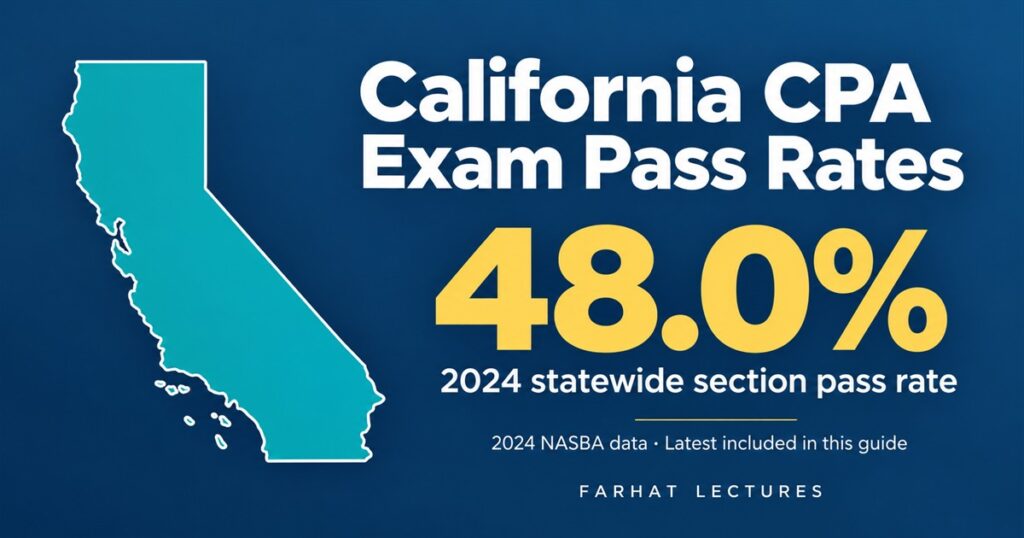
The California CPA pass rate is 48.0% in the 2024 jurisdiction dataset used in this guide. It measures exam sections passed, not candidates who completed all four sections.
Data disclaimer: This page uses 2024 NASBA data, the latest dataset currently included in this guide. Figures for 2025 and 2026 are not included here. NASBA has released its 2025 report; this site will be updated as newer California data is obtained and verified.
See our CPA exam pass rate by jurisdiction comparison.
This guide keeps California CPA exam pass rates simple: compare public, private nonprofit, and for-profit/proprietary schools as separate categories. The university results below describe specific school cohorts; they are separate from California’s jurisdiction rate.
Jump to: School comparison · First attempts and retakes · Five-school appendices · Study tips · How to apply · FAQs · Sources and data year
California CPA Exam Pass Rates by School Type
The two tables show the five highest listed rates in each group from this guide’s 2024 bachelor’s first-time dataset. Every row uses the same year, degree category, and attempt type. These are individual school results, not public-versus-private sector averages.
For-profit / proprietary schools
No for-profit/proprietary school results were identified in the tables used for this guide.
This category remains separate. Missing results do not mean a 0% pass rate or that no such schools exist in California.
Read the sample size: A rate based on 10 section attempts can change sharply with just one result. These selected rows do not rank every California program or predict an individual candidate’s performance.
Looking for another school? Browse our CPA Exam Pass Rates by University page for searchable historical results. Check its reporting year before comparing.
First-Time Attempts, Retakes, and Degrees—Simply Explained
- First-time attempt: A candidate’s first try at an individual exam section.
- Retake: Another attempt at a section after an unsuccessful attempt.
- All attempts: First-time attempts plus retakes. This is not a retake-only pass rate.
- Degree: Bachelor’s and advanced-degree cohorts are reported separately. Compare like with like.
One candidate can contribute several section attempts. For example, a 60% pass rate means 60 of 100 section attempts were passed. The tables do not provide a separately verified retake-only rate.
California CPA Exam Pass Rates: Five-School Appendices
Each appendix below keeps only its first five school rows, with three useful columns: school, pass rate, and section attempts. Open a panel for the degree and attempt type you want. All figures are for 2024.
Comparison note: Small cohorts can produce unusually high or low rates. Keep each appendix separate; differences between source-table counts mean these excerpts should not be combined to calculate retake rates.
California CPA Exam Pass Rates: Study Tips for Success
Use California CPA exam pass rates to understand historical results, then build a study plan around your own learning needs. A university’s percentage does not measure your readiness or establish which preparation method caused its results.
- Compare similar groups. Match the reporting year, degree category, and attempt type before comparing schools. Read the number of section attempts alongside each percentage.
- Identify the concept behind each mistake. After a practice set, record whether an error came from a knowledge gap, an incorrect calculation, or a misread requirement. Use that record to select your next review topic.
- Connect explanations with practice. Review a worked example, then solve a new question independently. The Farhat Lectures FAR CPA test bank provides practice questions, video explanations, and simulation walkthroughs for candidates strengthening financial accounting skills.
- Review progress regularly. Revisit missed questions after a delay and explain why each alternative is correct or incorrect. Include mixed practice so you can distinguish between similar concepts.
For your next step, explore the Farhat Lectures course catalog and select resources for the exam section you are preparing to take. Use the historical school results as context while directing study time toward the skills you need to improve.
Applying for the CPA Exam in California
Ready to apply? Start with the California Board of Accountancy (CBA), which handles California CPA Exam applications. These official resources explain the process:
- California Board of Accountancy: CPA Exam application guide — Review application instructions, transcript requirements, and the link to apply.
- NASBA’s California CPA Exam page — Find guidance on the CPA Portal, exam payment coupons, and your Notice to Schedule (NTS) after the CBA approves your eligibility.
California CPA Exam Pass Rates: Frequently Asked Questions
Does the California CPA pass rate measure completion of all four sections?
No. The 48.0% figure in this guide describes exam sections passed in the 2024 jurisdiction dataset. It does not mean that 48.0% of candidates completed all four sections. One candidate can contribute multiple section attempts.
Why can a small school cohort have a high pass rate?
Each result has a larger effect when the number of attempts is small. For example, one additional passing result among 10 attempts changes the rate by 10 percentage points. Compare cohort size as well as the reported percentage before drawing conclusions about a school.
Can I calculate a retake-only rate from these tables?
No. These selected excerpts do not provide a separately verified retake-only rate. An all-attempts percentage includes first attempts and retakes. Subtracting the two percentages does not produce a valid retake rate, and the excerpts should not be combined when their reporting populations or counts differ.
Are these California CPA exam pass rates for 2025 or 2026?
No. All statistical tables on this page use 2024 data. The publication or editorial update date is separate from the year measured. Check the data year whenever you compare this article with another report or with the Farhat Lectures university pass-rate resource.
Sources, Data Year, and Methodology
Data year: 2024. Last data review noted: September 29, 2026. Editorial update: October 20, 2026. The university figures are excerpts from the 2024 NASBA tables reproduced in this guide. NASBA released its 2024 Candidate Performance Report in 2025.
How to trace the figures: The statewide percentage is also listed in the Farhat Lectures 2024 jurisdiction comparison. The school excerpts above retain their appendix labels: A-2 for advanced-degree all attempts, A-3 for bachelor’s all attempts, B-2 for advanced-degree first attempts, and B-3 for bachelor’s first attempts. The public and private nonprofit comparison uses the bachelor’s first-time category. These are selected excerpts, not complete institutional rankings.
Data availability disclaimer: The 2024 figures are the latest NASBA California data currently included on this page; 2025 and 2026 figures are not included here. NASBA’s 2025 Edition was released in August 2026, but its California tables have not yet been incorporated. This site will be updated as newer California data is obtained and verified.
School categories distinguish public control, private nonprofit status, and for-profit/proprietary ownership. Classification references include the WSCUC institution directory. Pacific States University, which appears in the longer source tables, identifies itself as private nonprofit and is not placed in the proprietary category.
About Professor Farhat
Professor Mansour Farhat, DBA, CPA, CIA, MAcc, is an accounting educator and the founder of Farhat Lectures. His lessons combine explanations, worked examples, and practice activities to support accounting students and professional exam candidates.
Responses