
CPA Exam Discipline: How to Choose BAR, TCP, or ISC

Updated with AICPA pass rates through the third quarter of 2026 and the 2027 testing calendar.
A CPA exam discipline is the specialty section you choose on top of the three required Core sections: auditing (AUD), financial accounting (FAR), and tax and regulation (REG). Your options are Business Analysis and Reporting (BAR), Tax Compliance and Planning (TCP), and Information Systems and Controls (ISC). Each is a four-hour exam, and all lead to the same CPA license.
Quick answer: Explore BAR if financial reporting and business analysis are strengths, TCP if you are comfortable applying tax rules, and ISC if systems, technology risks, and controls interest you. Then use practice questions to test that initial impression. A section’s reputation alone should not determine your choice.
Prefer to watch first? Professor Farhat’s short video on how each discipline pairs with a Core section is in the study order section below.
What Is a CPA Exam Discipline?
A discipline is the section you select alongside the three required Core sections: Auditing and Attestation (AUD), Financial Accounting and Reporting (FAR), and Taxation and Regulation (REG). Under the current Core and Discipline model, candidates complete those three Core sections and one discipline. Your discipline choice leads to the same CPA license; it does not create a separate BAR, TCP, or ISC license.
Begin by comparing the tested topics, then assess how much preparation each option would require.
Compare the CPA Exam Disciplines: BAR vs. TCP vs. ISC
Use this comparison as a starting point. The background column lists experience that can help, not a requirement. Before you commit to a study plan, check the AICPA Blueprints for your testing date. The Blueprints are the official outline of what each section tests.
| Discipline | Main areas of emphasis | Potentially helpful background | Preparation focus |
|---|---|---|---|
| BAR Business Analysis and Reporting |
Business analysis, technical accounting and reporting, and state and local governmental accounting. | Financial reporting, cost and managerial accounting, or financial analysis. | Work through calculations and journal entries, then explain what the results mean. |
| TCP Tax Compliance and Planning |
Individual and entity tax compliance and planning, personal financial planning, and property transactions. | Tax coursework, return preparation, or experience analyzing tax consequences. | Apply rules to the facts, track basis, and compare the consequences of alternative transactions. |
| ISC Information Systems and Controls |
Information systems and data management; security, confidentiality, and privacy; and System and Organization Controls (SOC) engagements. | Accounting information systems, technology controls, or audit-related systems work. | Connect a system or process to its risks, relevant controls, and evidence. |
Exam Format And Pass Rates At A Glance
| Exam feature | BAR | TCP | ISC |
|---|---|---|---|
| Testing time | 4 hours | 4 hours | 4 hours |
| Multiple-choice questions (MCQs) | 50 | 68 | 82 |
| Task-based simulations (TBSs) | 7 | 7 | 6 |
| Score weighting | 50% MCQ, 50% TBS | 50% MCQ, 50% TBS | 60% MCQ, 40% TBS |
| Skill emphasis | More application and analysis | More application and analysis | More remembering and understanding |
| 2025 pass rate | 41.94% | 77.65% | 67.79% |
| 2026 pass rate (Q1–Q3) | 43.88% | 79.75% | 68.56% |
A task-based simulation (TBS) is a case-style question where you work with documents, data, or calculations. Sources: AICPA exam Blueprints and AICPA published pass rates. Pass rates describe groups of candidates. The AICPA says higher pass rates reflect better-prepared candidates, not an easier exam.
For additional explanations, explore the independent Farhat Lectures BAR supplemental course, TCP supplemental course, and ISC supplemental course. These links are for candidates using Becker; the course catalog also lists supplements organized around other review providers.
When Can You Take BAR, TCP, Or ISC?
Here is a detail that catches many candidates off guard. You can take Core sections almost any time of year, but the disciplines are offered only during set testing windows, usually the first month of each quarter. Scores also arrive on a fixed schedule after each window closes.
These are the AICPA’s target dates for 2027:
| Discipline testing window | Target score release |
|---|---|
| January 1–31, 2027 | March 16, 2027 |
| April 1–30, 2027 | June 9, 2027 |
| July 12 to August 12, 2027 | September 28, 2027 |
| October 1–31, 2027 | December 17, 2027 |
The summer 2027 window starts later and runs longer because the CPA Exam is moving to a new testing platform in July 2027. All dates are targets and can change, so confirm them on the AICPA score-release schedule before you book.
What this means for your plan:
- Pick your window first. Then build your study calendar backward from that date.
- Leave room for a retake. If you don’t pass, your next chance is the following window, about three months later.
- Watch your credit clock. The AICPA says candidates have at least 30 months to complete all four sections, and some states allow up to three years. Check your state board’s exact rule.
- Use current materials. New Blueprints take effect January 1, 2027. If you choose TCP, make sure your materials cover the H.R. 1 (One Big Beautiful Bill Act) tax changes that became testable on July 1, 2026.
Planning around 2027? The Farhat Lectures guide to CPA Exam changes in 2027 walks through the new platform and score delays.
5 Steps to Choose Your CPA Exam Discipline
- Identify the topics you already understand. List the reporting, tax, and systems topics you can explain without notes. Distinguish familiarity with terminology from the ability to solve a new problem.
- Review the full scope of each option. A favorite college course may cover only part of a discipline. Look for unfamiliar areas as well as familiar ones, and use materials aligned with your testing date.
- Try comparable practice tasks. Sample unfamiliar multiple-choice questions and a simulation from each option you are seriously considering. Use similar conditions and record both your reasoning and your mistakes. A small sample helps reveal learning needs; it does not predict an exam score. One Farhat Lectures subscription includes the BAR test bank, TCP test bank, and ISC test bank, so you can run this comparison side by side.
- Estimate the work required. Consider how much foundation-building you need, how consistently you can study, and which explanations help you improve. A familiar topic can still require substantial practice.
- Choose and schedule a progress review. Commit to a realistic plan, then reassess after a meaningful block of study. Use evidence of learning and remaining gaps when deciding whether the plan needs adjustment.
Consider professional interests as another useful input. Interest can make sustained study more manageable, but your decision should also reflect your current skills and preparation needs. Avoid choosing a CPA exam discipline solely because someone else found it easy.
Quick Self-Check: One Question From Each Discipline
Try each question before reading the answer. These brief examples illustrate the subject matter of each discipline; they are not equivalent in difficulty and cannot establish which section will be easiest for you. For Step 3, compare larger practice sets of similar difficulty and include simulations.
BAR: A city reports its general fund in the governmental fund financial statements. Which basis of accounting does the general fund use?
Answer: Modified accrual. Governmental funds, like the general fund, use the modified accrual basis with a current financial resources focus. The government-wide statements use full accrual.
TCP: Sam contributes land to a partnership in exchange for a partnership interest. The land has an adjusted basis of $40,000, a fair market value of $60,000, and no debt. What is Sam’s basis in his partnership interest?
Answer: $40,000. Basis is your tax investment in an asset. A partner’s starting basis equals the cash plus the adjusted basis of any property contributed, under Internal Revenue Code (IRC) Section 722. The land’s fair market value does not set Sam’s basis.
ISC: A company outsources its payroll. Its auditor wants assurance about the payroll provider’s controls that affect the company’s financial statements. Which System and Organization Controls (SOC) report fits?
Answer: A SOC 1 report. SOC 1 covers a service organization’s controls that are relevant to its customers’ internal control over financial reporting. SOC 2 focuses on security, availability, processing integrity, confidentiality, or privacy.
Three Examples of Choosing a Discipline
The following examples are hypothetical. They illustrate a decision process rather than a universal recommendation.
A financial-reporting candidate considering BAR
Nora prepares financial reports and enjoys explaining why a transaction changes income or assets. BAR is worth a close look. She tries questions involving business analysis and governmental accounting before deciding, because her reporting experience does not establish readiness across the entire section. Her study plan reserves extra time for the unfamiliar areas.
A tax candidate considering TCP
Elias has recent tax coursework and experience preparing individual returns. TCP may connect well with that background. He also samples entity and property-transaction questions instead of assuming individual-return experience covers everything. When he struggles to explain an owner’s basis calculation, he studies the underlying rule and tests it again with a different fact pattern.
A systems-oriented candidate considering ISC
Maya understands user-access controls and has studied accounting information systems. ISC is a natural place to start exploring. She checks her understanding of data management, security, privacy, and SOC engagements. Her goal is to explain why a particular control addresses a stated risk, including situations she has not encountered at work.
How Should Your Discipline Fit Into Your Study Order?
Professor Farhat recommends considering FAR first to develop a financial-accounting foundation. His guide to CPA Exam difficulty and taking FAR first explains that approach, and Why Take FAR First? 3 Smart Reasons for CPA Candidates walks through his reasoning in more detail. It is a study recommendation, not a mandatory exam sequence.
Watch Professor Farhat explain CPA Exam difficulty and why he recommends considering FAR first. Use the lesson to evaluate your foundation as you plan all four sections.
Once you have assessed your foundation, consider studying related subjects near one another. The pairings below describe learning connections; each discipline still requires its own complete preparation.
- FAR and BAR: Financial-accounting knowledge provides context for more specialized reporting and analytical work.
- REG and TCP: A foundation in taxation can support further work on tax compliance and planning.
- AUD and ISC: Understanding risks, controls, and evidence can help you approach technology and SOC-related scenarios.
Watch: CPA Exam Core and Discipline Study Order
In this brief Farhat Lectures video, Professor Farhat explains how FAR supports BAR, REG supports TCP, and AUD supports ISC. Use these connections when planning the preparation for your selected discipline.
This order is a study strategy, not a rule. You can sit for any discipline before or after its related Core section. Watch the video on the Farhat Lectures YouTube channel.
Build the schedule around readiness, testing availability, your Notice to Schedule (NTS, the authorization that lets you book your exam appointment), and your jurisdiction’s credit deadlines. Include time for final review and a possible retake. If your plan extends into 2027, read the Farhat Lectures guide to CPA Exam changes and scheduling considerations and confirm the dates applicable to your appointment.
Turn Your Choice Into a Practical Study Plan
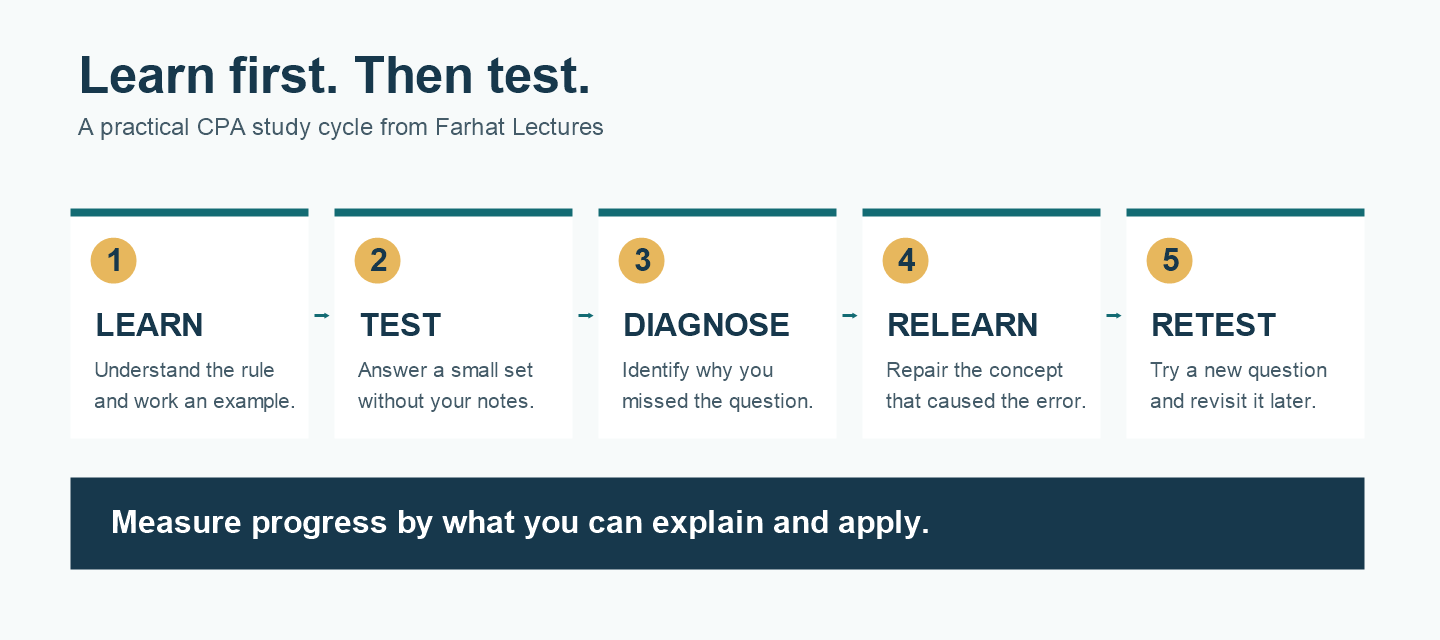
After choosing a CPA exam discipline, set a repeatable routine that connects explanations with independent practice. Use this checklist to make each study session purposeful:
- Define the task: Write down what you should be able to calculate, identify, evaluate, or explain by the end of the session.
- Learn the concept: Study a focused explanation and work through one example carefully.
- Solve independently: Attempt a fresh question before viewing the solution.
- Explain the error: Identify whether the mistake came from a missing rule, an incorrect calculation, overlooked facts, or time pressure.
- Revisit the topic: Return to difficult concepts later and include earlier topics in cumulative practice.
Keep an error log with three short entries for each difficult question: the task, the reason for the error, and the action needed to correct it. For example, “I confused system access approval with periodic access review” suggests a different study action from “I knew the control but missed the question’s time period.”
As you progress, practice simulations as well as multiple-choice questions. Being able to recognize a definition is only one part of preparation. You also need to apply concepts to unfamiliar facts and organize your work clearly.
Common Mistakes When Selecting a CPA Exam Discipline
- Choosing solely by pass rate. Published rates describe groups of candidates. They do not establish your personal probability of passing. Use the Farhat Lectures CPA passing percentage guide for context, then assess your own preparation.
- Assuming a related Core section covers the whole discipline. Connections help learning, but they do not replace discipline-specific study.
- Using outdated transition advice. Plans built around taking BEC in 2023 do not describe the current exam choices.
- Changing direction after every difficult chapter. Evaluate a pattern of progress and specific knowledge gaps before abandoning a workable plan.
Key Takeaways
- A discipline is the one section you pick alongside AUD, FAR, and REG. All three options lead to the same CPA license.
- BAR leans on financial reporting and analysis, TCP on applying tax rules, and ISC on systems, data, and controls.
- Disciplines are offered only in set windows, usually the first month of each quarter, so plan your date and a possible retake early.
- Pass rates differ a lot, but they describe groups, not you. Test yourself with practice questions before you commit.
- If a discipline isn’t working after a failed attempt, you can retake it or switch to another one.
CPA Exam Discipline FAQs
Do I need to pass BAR, TCP, and ISC?
No. Under the current model, you take the three Core sections and choose one discipline. You do not need to pass all three disciplines.
Which CPA exam discipline is easiest?
There is no single answer for every candidate. TCP has posted the highest pass rate so far: 79.75% for 2026 through the third quarter, compared with 68.56% for ISC and 43.88% for BAR, according to the AICPA. Those rates describe groups of candidates, not your personal odds, so compare your knowledge, interests, practice performance, and study requirements. A section with familiar subject matter can still be demanding when questions require deeper application.
Does choosing TCP limit me to a tax career?
No. The discipline you pass does not create a different CPA license. Choose a section with your preparation and interests in mind; develop the competence needed for your professional responsibilities throughout your career.
Must I pass a related Core section before taking a discipline?
No. Taking related subjects in a particular order is a learning strategy. Plan your exam sequence around preparation and scheduling requirements, and confirm your jurisdiction’s applicable rules.
Can I still take BEC?
No. BEC testing ended in December 2023. Candidates planning under the current exam model should focus on AUD, FAR, REG, and their selected discipline.
I Passed BEC Before 2024. Do I Still Need A Discipline?
Not while your BEC credit is still valid. Under the NASBA transition policy, valid BEC credit satisfies the discipline requirement. If that credit expires before you finish the exam, you will need to pass BAR, TCP, or ISC instead. Check your expiration date with your state board.
When Can I Take BAR, TCP, Or ISC?
Disciplines are offered during set windows, usually the first month of each quarter: January, April, July, and October. In 2027, the summer window runs July 12 to August 12 because of the move to a new testing platform. Scores are released on the AICPA’s published target release dates. Use the testing-window table above and confirm the current official schedule before booking.
Can I Switch Disciplines If I Fail One?
Yes. You only need to pass one discipline. If you fail one, you can retake it in a later window or choose a different discipline instead. Before you switch, compare how much new material the other option would require, and confirm the steps with your state board or NASBA (the National Association of State Boards of Accountancy).
Build Your Foundation With Farhat Lectures
Start with a topic that exposes a specific knowledge gap. Use the Farhat Lectures free sample course to experience Professor Farhat’s explanations, then select supplemental resources that match your section and main review course.
For subscription options and current billing terms, visit the pricing page. If you need help finding a suitable course, contact [email protected].
About the educator: Professor Mansour Farhat, DBA, CPA, CIA, MAcc, is the founder of Farhat Lectures. His teaching uses explanations and worked examples to help accounting students and exam candidates understand and apply concepts. Learn about Professor Farhat’s background and teaching approach.
Exam facts come from the AICPA’s published Blueprints, pass rates, and score-release schedule, with pass rates through the third quarter of 2026. Study suggestions draw on the Farhat Lectures resources linked throughout the article. Match your study materials to your testing date and verify exam scheduling and credit requirements with the appropriate exam authority.




Responses