
Unguaranteed Residual Value: Lessor Accounting in a Sales-Type Lease

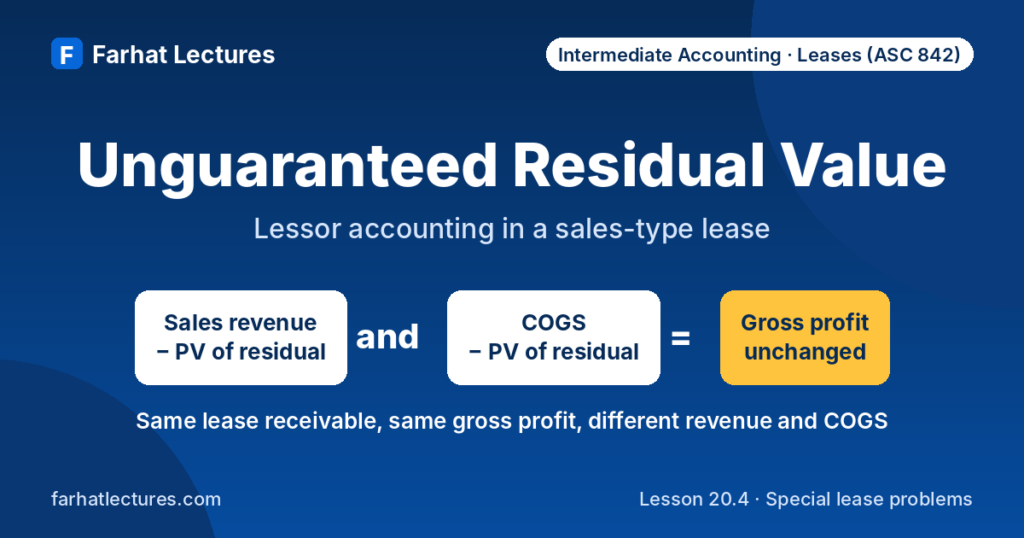
An unguaranteed residual value is the part of a leased asset’s expected end-of-lease value that no one has promised to pay the lessor. In a sales-type lease, the lessor’s net investment in the lease consists of the lease receivable and the unguaranteed residual asset. The present value of the unguaranteed residual reduces sales revenue and cost of goods sold by the same amount, so gross profit is unchanged.
This matters because two leases with identical payments and identical gross profit can report different revenue. Exam questions like to test that difference, and they also test what happens at the end of the lease when the returned asset is worth less than expected.
This guide focuses on the lessor side, with a quick lessee check along the way. For the full lessee treatment, see the lesson on guaranteed residual value.
Watch Professor Farhat: This lesson compares guaranteed and unguaranteed residual values from the lessor’s side.
Watch “Lessor Accounting for Residual Value in Leases Explained — CPA & CMA Exams” on YouTube
Residual values at a glance
| Party and purpose | Guaranteed residual value | Unguaranteed residual value |
|---|---|---|
| Lessee: classification test | Include the full amount of the lessee’s own guarantee, if any | Ignore |
| Lessee: lease liability | Include only the amount the lessee will probably owe under its own guarantee | Ignore |
| Lessor: classification test | Include a lessee guarantee. Third-party guarantees count only in the direct financing test. | Ignore |
| Lessor: net investment in the lease (Lease Receivable in most textbooks) | Include | Include |
| Lessor: sales revenue and COGS (sales-type) | No adjustment | Reduce both by the present value of the residual |
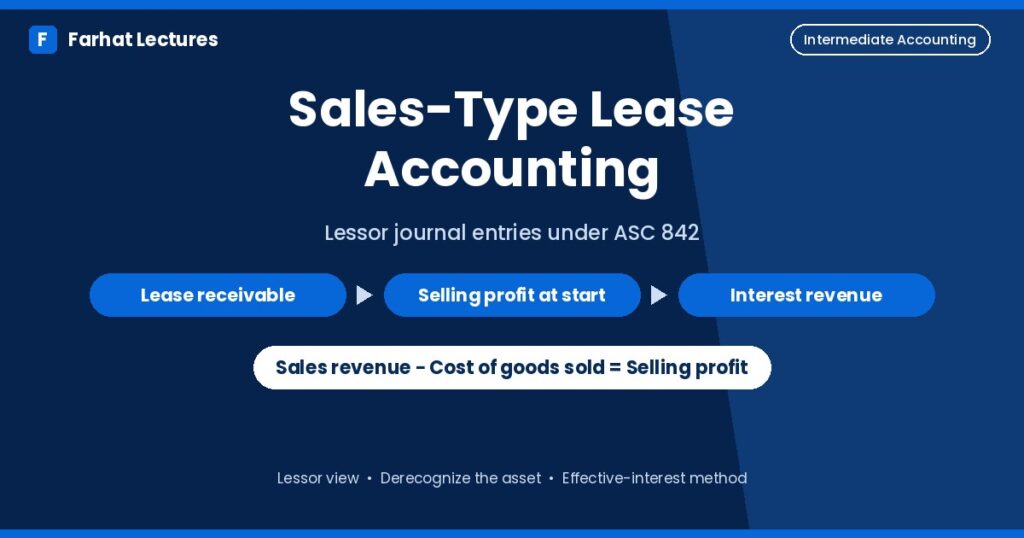
Under ASC 842, the lessor’s asset is called the net investment in the lease. It has two parts: the lease receivable (the present value of the lease payments plus any guaranteed residual) and the unguaranteed residual asset (the present value of the unguaranteed residual). Most textbooks, and the entries below, combine both parts in one account. The entries use the label Net Investment in the Lease for that combined balance. Either way, the residual value is part of what the lessor records, guaranteed or not. Not sure which lease type you’re looking at? Start with the present value test for leases.
Does an unguaranteed residual value affect the lessee’s lease liability?
For both operating and finance leases, the lessee excludes an unguaranteed residual value from the lease liability because the lessee has made no promise to pay a residual shortfall.
Why revenue and cost change
In a sales-type lease, the lessor is treated as having sold the asset. With a guaranteed residual, the lessor is sure to recover the residual amount, in cash or in returned asset value, so the whole asset counts as sold.
With an unguaranteed residual, the lessor will get the asset back and has no promise about what it will be worth. So the lessor treats only the part it is sure to recover as sold. It subtracts the present value of the residual from sales revenue, and the same amount from cost of goods sold. Both numbers drop by the same amount, so gross profit does not change.
Example: guaranteed vs. unguaranteed
Hypothetical example: Granite Machine Works, a dealer, leases a packaging machine to Lakeview Printing on January 1, 2027. The machine cost Granite $45,000 and has a fair value of $60,000. The lease runs 4 years with payments due at the start of each year, and Granite wants a 6% return. The expected residual value at the end of the lease is $6,000.
Step 1: Compute the payment
Use present-value table factors rounded to five decimal places. These factors give the $15,041.47 payment used throughout the example. A calculator using full precision gives $15,041.45.
Present value of the residual: $6,000 × 0.79209 = $4,752.54. Amount to recover through payments: $60,000 − $4,752.54 = $55,247.46. Annual payment: $55,247.46 ÷ 3.67301 (annuity due, 4 periods, 6%) = $15,041.47. The payment is the same whether or not Lakeview guarantees the residual.
Step 2: Compare the amounts at commencement
| Item | Guaranteed | Unguaranteed |
|---|---|---|
| Net investment in the lease | 60,000.00 | 60,000.00 |
| Sales revenue | 60,000.00 | 55,247.46 (60,000 − 4,752.54) |
| Cost of goods sold | 45,000.00 | 40,247.46 (45,000 − 4,752.54) |
| Gross profit | 15,000.00 | 15,000.00 |
| Date | Receipt | Interest (6%) | Reduction of net investment | Net investment in the lease |
|---|---|---|---|---|
| 1/1/2027 | 60,000.00 | |||
| 1/1/2027 | 15,041.47 | 0.00 | 15,041.47 | 44,958.53 |
| 1/1/2028 | 15,041.47 | 2,697.51 | 12,343.96 | 32,614.57 |
| 1/1/2029 | 15,041.47 | 1,956.87 | 13,084.60 | 19,529.97 |
| 1/1/2030 | 15,041.47 | 1,171.80 | 13,869.67 | 5,660.30 |
| 1/1/2031 | 6,000.00 (expected residual) | 339.70* | 5,660.30 | 0.00 |
*Rounded by $0.08. The final $6,000 is the expected residual value. The lessor mainly gets it back as the returned machine, not as a cash payment.
Journal entries
Guaranteed residual value
| Account | Debit | Credit |
|---|---|---|
| Net Investment in the Lease | 60,000.00 | |
| Cost of Goods Sold | 45,000.00 | |
| Sales Revenue | 60,000.00 | |
| Inventory | 45,000.00 |
Unguaranteed residual value
| Account | Debit | Credit |
|---|---|---|
| Net Investment in the Lease | 60,000.00 | |
| Cost of Goods Sold | 40,247.46 | |
| Sales Revenue | 55,247.46 | |
| Inventory | 45,000.00 |
Notice that Inventory is credited for the full $45,000 cost in both cases, because the whole machine leaves Granite’s warehouse. The entries after commencement are identical in both cases:
| Account | Debit | Credit |
|---|---|---|
| Cash | 15,041.47 | |
| Net Investment in the Lease | 15,041.47 |
| Account | Debit | Credit |
|---|---|---|
| Net Investment in the Lease | 2,697.51 | |
| Interest Revenue | 2,697.51 |
End of the lease
On January 1, 2031, the net investment in the lease equals the $6,000 expected residual. Suppose Lakeview returns the machine and it is worth only $4,000. Assume the decline first becomes evident when the machine is returned and Granite has recorded no allowance for this shortfall. The two cases now split:
| Account | Debit | Credit |
|---|---|---|
| Inventory | 4,000.00 | |
| Cash | 2,000.00 | |
| Net Investment in the Lease | 6,000.00 |
| Account | Debit | Credit |
|---|---|---|
| Inventory | 4,000.00 | |
| Loss on Lease | 2,000.00 | |
| Net Investment in the Lease | 6,000.00 |
In the guaranteed case, Lakeview bears the shortfall because it gave the guarantee. Without it, the lessor records the loss. If the machine had been worth exactly $6,000, both cases would simply debit Inventory and credit Net Investment in the Lease for $6,000. A lessee’s expected purchase works differently, as shown in the bargain purchase option lesson.
In practice, a lessor doesn’t wait until the asset comes back. Under ASC 842-30-35-3, it applies the credit loss guidance in Topic 326 to the whole net investment in the lease, and the expected value of the returned asset is part of that assessment. Exam problems usually keep it simple and record the shortfall at the end, as shown above.
What about direct financing and operating leases?
The revenue and cost adjustment only happens in a sales-type lease, because that is the only lessor lease type that records a sale at commencement.
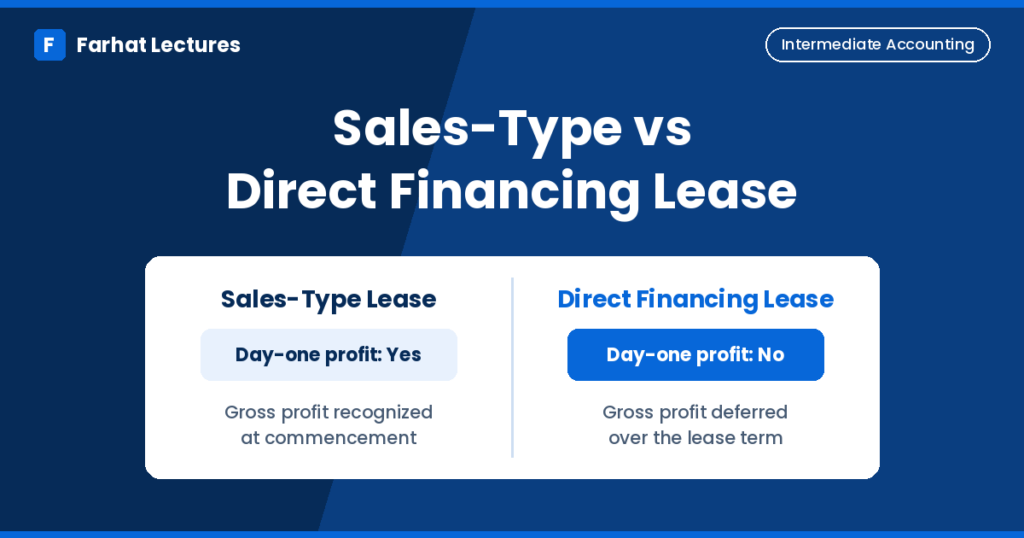
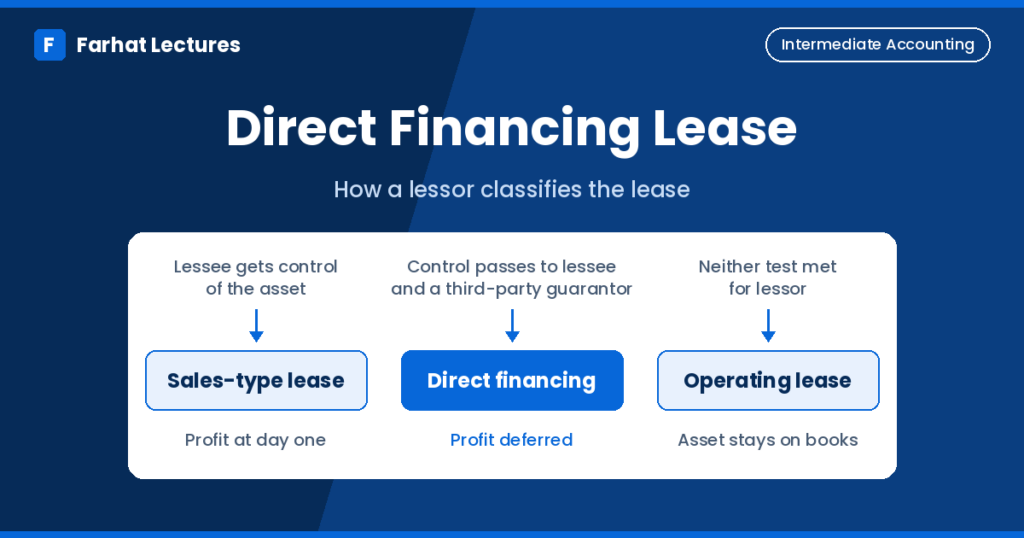
Direct financing lease. The lessor still includes the present value of the unguaranteed residual in its net investment in the lease. There is no sales revenue or cost of goods sold line. Any selling profit is deferred inside the net investment and earned over the lease term. A lease often lands in this category when a guarantee from an unrelated third party, such as residual value insurance, pushes it over the present value threshold. You can compare the two in sales-type vs. direct financing lease, or read more about the direct financing lease.
Operating lease. The asset stays on the lessor’s books and keeps being depreciated. The expected residual value affects the depreciation estimate, but there is no lease receivable and no residual entry at commencement.
Key takeaways
- An unguaranteed residual value is the expected end-of-lease value that no one has promised to pay the lessor.
- The lessor includes its present value in the net investment in the lease (Lease Receivable in most textbooks).
- In a sales-type lease, sales revenue and cost of goods sold both drop by that present value, so gross profit does not change.
- Inventory is still credited for the asset’s full cost.
- The lease payment is calculated the same way whether or not the residual is guaranteed.
- If the returned asset is worth less than expected, the lessor records a loss. The guarantor pays any shortfall covered by the guarantee.
- The lessee ignores an unguaranteed residual value in both the classification test and the lease liability.
Common mistakes
- Leaving the unguaranteed residual out of the lessor’s asset. It belongs in the net investment in the lease, which most textbooks record as Lease Receivable.
- Reducing only sales revenue. Cost of goods sold drops by the same present value.
- Reducing gross profit. Gross profit is the same in both cases.
- Crediting Inventory for the reduced cost. Inventory still leaves at full cost.
- Counting a third-party guarantee in the sales-type test. Only a lessee guarantee counts there. A third-party guarantee counts only in the direct financing test.
Practice questions with answers
Question 1
A dealer leases equipment with a fair value of $80,000 and a cost of $50,000 under a sales-type lease. The present value of the unguaranteed residual value is $5,000. What are sales revenue, cost of goods sold, and gross profit?
Show answer
Answer: Sales revenue $75,000; cost of goods sold $45,000; gross profit $30,000.
Both amounts drop by the $5,000 present value of the unguaranteed residual, so gross profit equals $80,000 − $50,000 = $30,000.
Question 2
A lessor is setting the annual payment on a new lease. Does the payment calculation change depending on whether the lessee guarantees the residual value?
Show answer
Answer: No.
The payment is based on the fair value minus the present value of the expected residual. Who guarantees that residual does not change the calculation.
Question 3
At the end of a sales-type lease, the lessor’s net investment in the lease is $3,000. The returned asset is worth $2,200 and the residual was unguaranteed. Assume the decline first becomes evident at return and the lessor has recorded no allowance for it. What is the entry?
Show answer
Answer: Debit Inventory $2,200 and Loss on Lease $800; credit Net Investment in the Lease $3,000.
With no guarantee, the lessor absorbs the $800 shortfall. If the residual had been guaranteed, the lessor would debit Cash $800 instead of a loss.
Frequently asked questions
Why does the lessor reduce sales revenue for an unguaranteed residual value?
Because nobody has promised the lessor that amount. The lessor has not really sold that slice of the asset, so it removes the present value of the unguaranteed residual from both sales revenue and cost of goods sold.
Does an unguaranteed residual value change the lease payments?
No. The lessor sets the payments to recover the asset’s fair value minus the present value of the expected residual, whether or not that residual is guaranteed.
Does the lessee record an unguaranteed residual value?
No. The lessee ignores an unguaranteed residual value in both the classification test and the lease liability. It simply returns the asset at the end of the lease.
Does an unguaranteed residual value count in the lessor’s classification test?
No. For the sales-type test, the lessor counts the lease payments plus any residual value guaranteed by the lessee. A guarantee from an unrelated third party, such as residual value insurance, does not count toward the sales-type test. It only counts in the direct financing test. An unguaranteed residual value is left out of both. See the present value test for leases for the full calculation.
Is an unguaranteed residual value part of the lease receivable?
It’s part of the lessor’s net investment in the lease. ASC 842 splits that asset into the lease receivable and the unguaranteed residual asset, but most textbooks record both in one Lease Receivable account. The total is the same either way.
What is the difference between a guaranteed and an unguaranteed residual value?
With a guaranteed residual value, the lessee or a third party promises the lessor a minimum value for the asset at the end of the lease and pays any shortfall. With an unguaranteed residual value, no one makes that promise, so the lessor carries the risk of a lower value.
What happens if the residual value drops during the lease?
The lessor doesn’t wait for the end of the lease. Under ASC 842-30-35-3, it applies the credit loss guidance in Topic 326 to its net investment in the lease, which includes the expected value of the returned asset. In exam problems, the shortfall is usually recorded as a loss when the asset comes back.
Sources
- FASB Accounting Standards Codification, Topic 842 (Leases)
- Deloitte Roadmap: Lessor recognition and measurement
- Deloitte Roadmap: Lessor presentation
- Deloitte Roadmap: Residual value guarantees in lease payments
- Deloitte Roadmap: Lessor lease classification
- Deloitte Roadmap: Credit losses on lease receivables
Mansour Farhat, CPA, CIA, DBA, teaches accounting through Farhat Lectures, an online platform for CPA, CMA, and EA candidates and accounting students, and on the Farhat Lectures YouTube channel. Read more about Professor Farhat.
Continue learning with Farhat Lectures
Strengthen your accounting understanding with clear explanations and guided practice.
Explore the free sample course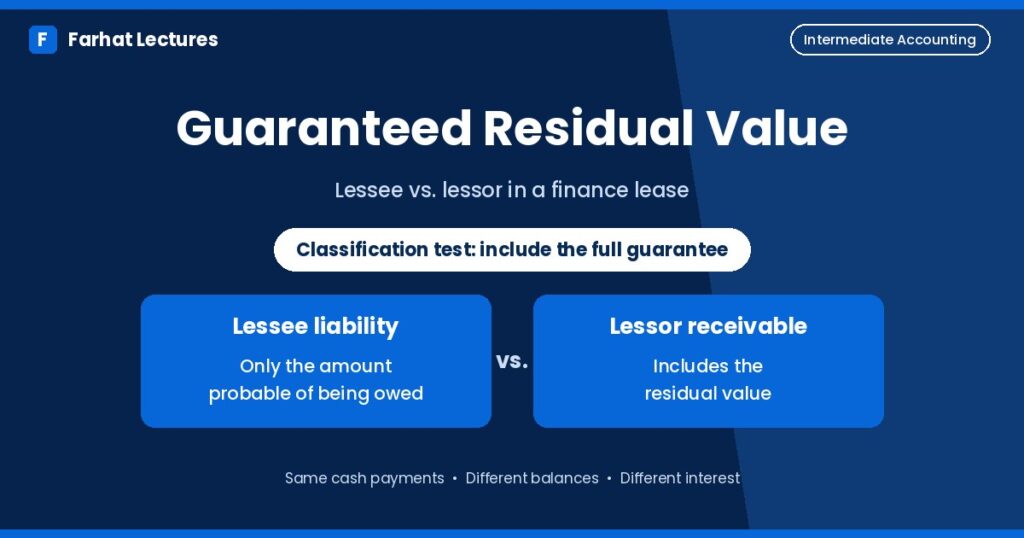
Responses