
NOL Valuation Allowance Across 2 Years of Tax Reporting


An NOL valuation allowance reduces the deferred tax asset from a net operating loss to the portion a company expects to realize. Under FASB ASC 740, you record an allowance for the part that is more likely than not, above 50% likelihood, to go unused. It changes the timing of the tax benefit, not the loss on the tax return.
Watch the lesson. Begin at 8:18 for the valuation allowance decision.
What does an NOL valuation allowance measure?
Start with the gross deferred tax asset. Multiply the eligible loss carryforward by the enacted rate expected when the deduction is used. Next, determine how much of that benefit the available evidence supports. The gap between gross and supported benefit is the required ending allowance. A credit to the allowance reduces the net asset on the balance sheet.
“More likely than not” means a likelihood above 50%. Record an allowance for the amount of the deferred tax asset that is more likely than not to go unrealized. Depending on the evidence, the allowance can cover part or all of the asset. Suppose management can support the use of $60,000 of a $100,000 loss. At 21%, the net asset is $12,600 and the allowance is $8,400. The conclusion depends on the amount of loss that usable taxable income can absorb. Applying a subjective probability to the entire $21,000 asset would answer a different question.
Evidence behind the estimate
Ask where the taxable income would come from, when it would arise, and whether tax law permits it to absorb this loss. Existing taxable temporary differences may reverse and generate taxable amounts. Accelerated depreciation is a common example. A company takes the tax deduction before it records the corresponding book expense, leaving a taxable amount in a future year. Future operating profits may also support recovery. Count those profits separately from reversals so the same dollars enter the analysis only once. A tax-planning strategy can also supply taxable income, but only when it is prudent and feasible, which is the exact wording FASB uses, and only when carrying it out is primarily within management’s control. Prior-year taxable income matters only when tax law permits a carryback.
Recent cumulative losses are significant negative evidence. A forecast that assumes sales will double deserves less weight than an enforceable order at a known price and a demonstrated production cost. Even a signed order requires analysis. Expected margins, delivery capacity, and the annual NOL limitation determine how much of the loss it can actually absorb. Review the evidence at each reporting date. The rules live in FASB ASC 740-10, Income Taxes. The more-likely-than-not test is in ASC 740-10-30-5, the four sources of taxable income are listed in ASC 740-10-30-18, and the examples of negative and positive evidence are in ASC 740-10-30-21 and ASC 740-10-30-22.
Compare three loss-year outcomes
Consider three hypothetical manufacturers. Each reports a $100,000 pretax book loss and federal NOL in Year 1. Each has a 21% enacted rate, no carryback, and no other book-tax differences. The only difference is what management can support at the Year 1 reporting date. Cedar has sufficient contracted margins to use the entire loss. Elm can substantiate the use of $60,000. Ash has recurring losses and no supportable source of taxable income.
| Year 1 result | Cedar | Elm | Ash |
|---|---|---|---|
| Gross tax asset | $21,000 | $21,000 | $21,000 |
| Allowance | $0 | $8,400 | $21,000 |
| Net asset and net tax benefit | $21,000 | $12,600 | $0 |
| Net loss | $79,000 | $87,400 | $100,000 |
| Loss carried on tax return | $100,000 | $100,000 | $100,000 |
Each company first debits Deferred tax asset and credits Income tax benefit for $21,000. Elm then debits Income tax expense and credits Valuation allowance for $8,400. Ash records that second entry for the full $21,000. Ash therefore reports no net tax benefit in Year 1, even though its tax return still shows the full carryforward.
Here are those Year 1 entries written out.
| Company | Account | Debit | Credit |
|---|---|---|---|
| All three | Deferred tax asset | $21,000 | |
| All three | Income tax benefit | $21,000 | |
| Elm | Income tax expense | $8,400 | |
| Elm | Valuation allowance | $8,400 | |
| Ash | Income tax expense | $21,000 | |
| Ash | Valuation allowance | $21,000 |
Cedar stops after the first entry. It has nothing to allow for.
Release in the profitable year
Now assume an unexpected supply shortage at a competitor sends customers to all three manufacturers. Each earns $150,000 before tax in Year 2. The annual ceiling is $120,000, so each can use its full $100,000 loss. Each owes $10,500 on the $50,000 that remains taxable.
Where does that $120,000 ceiling come from? Under Internal Revenue Code Section 172, the 80% limit applies in this example. Here that is 80% of $150,000, which is $120,000. The $100,000 carryforward sits under the ceiling, so all of it gets used. Any unused loss in this example can carry forward indefinitely.
For the deduction mechanics, see the net operating loss carryforward schedule and journal entries.
Each debits Income tax expense $31,500, credits Income taxes payable $10,500, and credits Deferred tax asset $21,000. Elm also debits its allowance and credits Income tax expense for $8,400. Ash makes the same release for $21,000. Cedar has no allowance to release.
And here are the Year 2 entries.
| Company | Account | Debit | Credit |
|---|---|---|---|
| All three | Income tax expense | $31,500 | |
| All three | Income taxes payable | $10,500 | |
| All three | Deferred tax asset | $21,000 | |
| Elm | Valuation allowance | $8,400 | |
| Elm | Income tax expense | $8,400 | |
| Ash | Valuation allowance | $21,000 | |
| Ash | Income tax expense | $21,000 |
Notice what the release does for Ash. Its total tax expense drops to $10,500, which is just the cash tax, so the whole $21,000 benefit it skipped in Year 1 shows up here instead.
| Year 2 result | Cedar | Elm | Ash |
|---|---|---|---|
| Current tax payable | $10,500 | $10,500 | $10,500 |
| Net deferred tax expense | $21,000 | $12,600 | $0 |
| Total tax expense | $31,500 | $23,100 | $10,500 |
| Net income | $118,500 | $126,900 | $139,500 |
Ash reports the highest Year 2 net income despite the identical pretax profits. Its tax benefit first reaches earnings in Year 2. Add each company’s Year 1 loss to its Year 2 profit and cumulative net income is $39,500 for all three. The allowance affected the timing of earnings. A later recovery also does not, by itself, prove that management’s original estimate was mistaken. Evaluate that estimate using the information available at the earlier reporting date.
Key takeaways
- The allowance equals the gross deferred tax asset minus the portion the evidence supports. Nothing more complicated than that.
- More likely than not means a likelihood above 50%. The allowance covers part or all of the deferred tax asset, depending on the evidence.
- A valuation allowance only ever reduces a deferred tax asset. It never touches a deferred tax liability.
- The allowance moves tax benefit between years. It never changes the loss the company deducts on its tax return.
- Across the full cycle the allowance washes out. Cedar, Elm, and Ash all land at $39,500 of cumulative net income.
- Reassess at every reporting date, and judge an old estimate on the evidence that existed back then.
Related lessons on income taxes
- Deferred tax asset versus deferred tax liability, and how each one arises
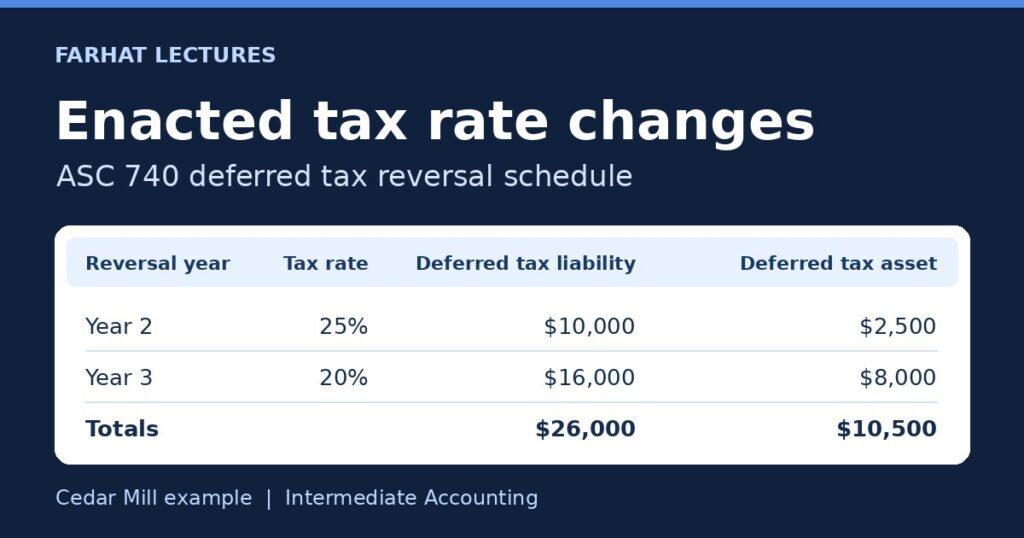
- Enacted tax rates and what happens to deferred balances when a rate changes
- Current versus deferred income tax expense in the provision
Two traps that catch students
The first one shows up on exams constantly. A valuation allowance only ever reduces a deferred tax asset. There is no such thing as a valuation allowance on a deferred tax liability, because the whole question an allowance answers is whether a future deduction will find taxable income to absorb it. A liability is a future payment, so realizability never enters the picture.
The second trap is the one this whole article is built around. The allowance is a book number. Ash, sitting on a full allowance and reporting no tax benefit at all, still walks into Year 2 with the same $100,000 deduction Cedar has. If a question asks what the company can deduct on its return, the allowance is a distraction. Go to the tax law.
On the CPA exam, this topic lives in FAR under accounting for income taxes, and the blueprint asks you to recall the criteria for recognizing or adjusting a valuation allowance for deferred tax assets. Know the threshold and know the four sources of taxable income.
Practice questions
NOL Valuation Allowance Practice: Deferred Tax Asset Realizability
Practice determining when a net operating loss (NOL) requires a valuation allowance and how the allowance affects the tax benefit reported in earnings and the loss available on the tax return.
1. How large is the allowance?
A manufacturer has an $80,000 NOL and an enacted 21% rate. Evidence supports using $50,000. How large is the allowance?
Answer: $6,300. The gross asset is $80,000 at 21%, or $16,800. Evidence supports $50,000 at 21%, which is $10,500. The unsupported $30,000 at 21% gives the $6,300 allowance, and $10,500 plus $6,300 brings you back to $16,800. The net asset is $10,500.
2. How much should be released?
New evidence supports use of another $20,000 of that loss before any deduction is claimed. How much should be released?
Answer: $4,200. That is $20,000 at 21%. Debit the valuation allowance and credit income tax expense, which drops the remaining allowance from $6,300 to $2,100. The gross asset and the tax loss schedule do not move, because the company has not used any of the loss yet.
3. Does a full allowance cancel the deduction?
Answer: no. A full allowance brings the net asset to zero on the balance sheet, and that is all it does. A later tax return can still use the loss if the law allows it. Reassess the allowance whenever the underlying evidence changes.
Frequently asked questions
Can management wait for a profitable year before recording the benefit?
The evidence at each reporting date determines the amount. If sufficient evidence supports realization in the loss year, recognize the supported benefit then. Management cannot choose a later year to smooth earnings.
Does IFRS use the same presentation?
Under IAS 12, an entity recognizes an asset for unused tax losses to the extent that sufficient future taxable profit is probable. The gross-asset and separate allowance entries illustrated here follow U.S. GAAP. See the IFRS Foundation’s IAS 12 overview.
Does a valuation allowance reduce the NOL on the tax return?
No. The allowance is a book entry under U.S. GAAP. It lowers the net deferred tax asset on the balance sheet and delays the tax benefit in earnings, but the loss carryforward on the tax return is set by tax law. A company carrying a full allowance deducts the same loss as a company carrying none.
Can a company record a valuation allowance against a deferred tax liability?
No, and this one trips up a lot of candidates. A valuation allowance only ever reduces a deferred tax asset, because the question it answers is whether a future deduction will find taxable income to absorb it. A deferred tax liability is a future tax payment, so realizability does not apply to it.
How much of an NOL carryforward can a company deduct in one year?
For the manufacturers in this example, Internal Revenue Code Section 172 limits the NOL deduction to 80% of taxable income before the loss deduction. Any amount they cannot use carries forward indefinitely and remains subject to the 80% limit in the next year.
Continue your accounting practice
Working the entries by hand is what makes this stick. The sample lesson covers the full income tax provision, from the current tax calculation through the deferred balances and the allowance, with practice problems after each piece.
About the author
Mansour Farhat is a CPA, CIA, and DBA who has taught accounting and auditing at the university level and has spent years coaching CPA, CMA, and EA candidates through the income tax topics that cost them the most points. He writes and records the lessons at Farhat Lectures.
Related lessons
Trace the available deduction, annual limit, and deferred tax asset across three years.




Responses