
Enacted Tax Rate Changes and Deferred Taxes Under ASC 740

Under ASC 740, enacted tax rate changes affect deferred tax assets and liabilities in the reporting period that includes enactment. Measure each balance using the enacted rate expected to apply when its temporary difference reverses. A law can change deferred tax expense this year even when the new rate first applies to a later year’s taxable income.
Prefer to watch it worked through? This lecture walks the remeasurement end to end, including the reversal schedule and the entry.
When does ASC 740 recognize a tax rate change?
The enactment date determines when to record the remeasurement. The effective date helps determine which reversal periods use the new rate. For U.S. federal law, enactment generally occurs when the president signs the bill into law. A proposed rate does not enter the calculation.
ASC 740-10-25-47 addresses recognition. ASC 740-10-35-4 requires adjustment of deferred tax assets and liabilities, and ASC 740-10-45-15 places the deferred remeasurement effect in income from continuing operations. Reevaluate the valuation allowance if the change affects the realizability of a deferred tax asset. A valuation allowance is a contra account that reduces a deferred tax asset to the portion you expect to actually use.
One more rule trips people up. The whole deferred adjustment lands in income from continuing operations, even when the underlying transaction was originally reported in other comprehensive income or directly in equity. You do not trace the adjustment back to where the original item was reported.
Retroactive changes work a little differently. If a new law changes rates for a year that has already passed, ASC 740-10-25-48 tells you to measure the effect at the enactment date, using the temporary differences and currently taxable income that exist on that date.
What does an enactment date look like in practice?
The federal corporate tax rate has been 21% since the Tax Cuts and Jobs Act of 2017. When Congress passed the One Big Beautiful Bill Act, the enactment date was July 4, 2025, the day the president signed it. That date drives remeasurement for provisions that affect deferred taxes.
Build the reversal schedule
- Identify the temporary differences outstanding when the law is enacted. A temporary difference is a gap between the book value of an asset or liability and its tax basis that will reverse in a future year. Taxable differences mean more tax later, so they create a deferred tax liability. Deductible differences mean less tax later, so they create a deferred tax asset.
- Schedule the reversals by tax year. Multiply each reversal by the enacted rate expected to apply in that year. If you need a refresher first, start with introduction to deferred tax assets and liabilities or the lesson on temporary differences.
- Compare the remeasured deferred tax balances with the pre-change amounts. Record the differences in the period of enactment.
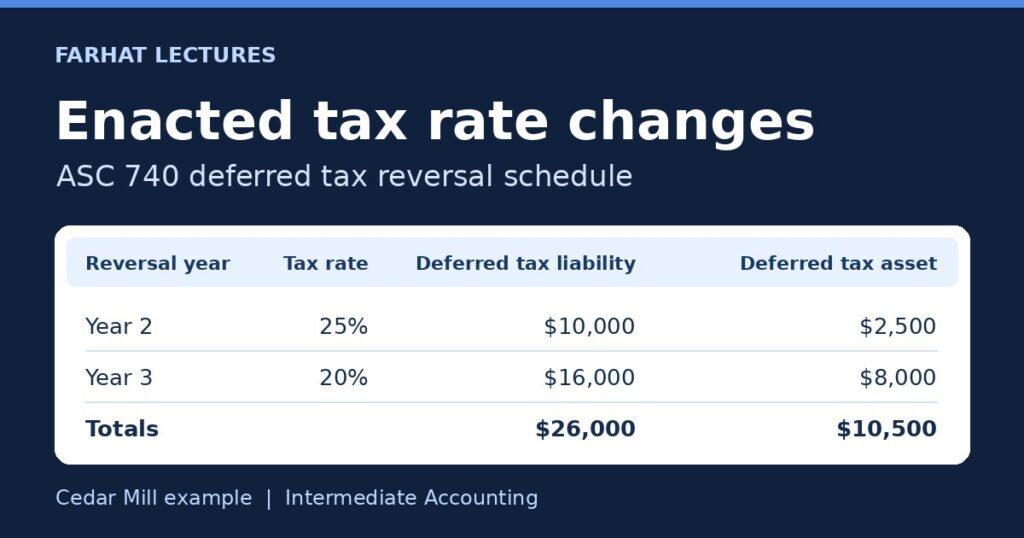
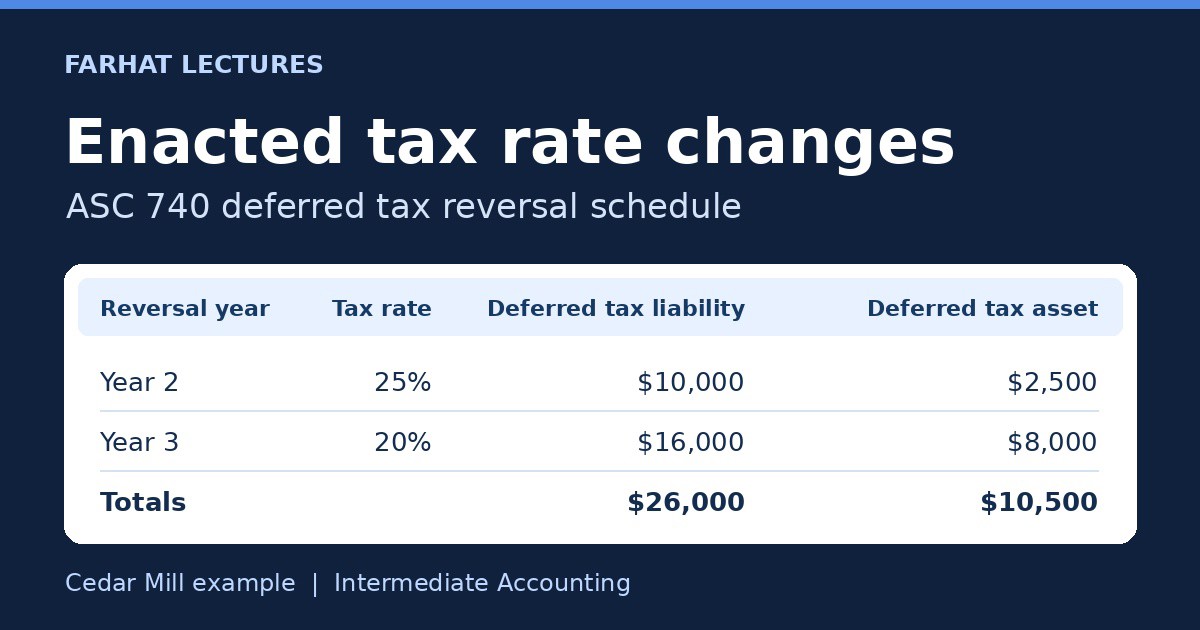
On December 31 of Year 1, a hypothetical jurisdiction enacts a rate reduction from 25% to 20% for tax years beginning in Year 3. The rate is 25% in Years 1 and 2. At enactment, Cedar Mill has a $120,000 taxable temporary difference from depreciation and a $50,000 deductible temporary difference from warranty accruals. Assume one tax-paying component in one tax jurisdiction, no other balances, and full realization of the deferred tax asset (DTA).
| Reversal year | Taxable amount | Deductible amount | Enacted rate | DTL | DTA |
|---|---|---|---|---|---|
| Year 2 | $40,000 | $10,000 | 25% | $10,000 | $2,500 |
| Year 3 | $80,000 | $40,000 | 20% | $16,000 | $8,000 |
| Totals | $120,000 | $50,000 | — | $26,000 | $10,500 |
The pre-change deferred tax liability (DTL) was $30,000 ($120,000 × 25%). The pre-change DTA was $12,500 ($50,000 × 25%). Remeasurement decreases the liability by $4,000 and decreases the asset by $2,000. The liability decrease produces a deferred tax benefit. The asset decrease produces deferred tax expense.
Record the tax rate change
| Account | Debit | Credit |
|---|---|---|
| Deferred tax liability | $4,000 | — |
| Deferred tax asset | — | $2,000 |
| Income tax expense (deferred benefit) | — | $2,000 |
The balances offset into a single noncurrent amount because they relate to the same tax-paying component in the same tax jurisdiction. The net deferred liability falls from $17,500 to $15,500. The resulting $2,000 deferred tax benefit reduces Year 1 income tax expense. In this example Year 1 current taxes payable are unaffected because the rate for Year 1 taxable income is still 25%. For more on each side of the entry, see deferred tax liabilities and deferred tax assets and the valuation allowance.
Want to see this taught rather than read it? The free sample lesson on deferred tax assets and the valuation allowance is open to everyone, no account needed.
Where do students go wrong?
- Waiting for the effective date. The remeasurement happens when the law is enacted, even if the new rate first applies three years out.
- Applying one rate to the whole balance. If the reversals straddle the effective date, you need a rate for each reversal year.
- Assuming a rate cut always helps. A lower rate shrinks a deferred tax liability, which is a benefit, but it also shrinks a deferred tax asset, which is an expense.
- Routing the adjustment to other comprehensive income because the underlying transaction was reported there. The deferred tax remeasurement goes to income from continuing operations.
- Forgetting the valuation allowance. A rate change can change how much of a deferred tax asset you expect to use.
Practice questions
1. An enacted rate goes into effect in a later year. When do you adjust deferred taxes?
Show answer
Adjust in the period of enactment. Apply the new rate to reversals that fall under the new law and the previous rate to reversals still subject to the previous law.
2. A $60,000 deductible difference will reverse entirely at 20%. The previous rate was 25%. What is the effect?
Show answer
The fully realizable DTA falls from $15,000 to $12,000. Debit deferred income tax expense $3,000 and credit the DTA $3,000.
3. A $100,000 taxable difference will reverse entirely at 28%, up from 25%. What is the effect?
Show answer
The DTL rises from $25,000 to $28,000. Debit deferred income tax expense $3,000 and credit the DTL $3,000.
Check yourself: five quick questions
Test your understanding of ASC 740 with five questions on enactment timing, reversal-year tax rates, the remeasurement adjustment, continuing operations, and valuation allowances.
Key takeaways
- Record the effect of a rate change in the period that includes the enactment date, not the effective date.
- Measure every balance at the enacted rate expected to apply in the year that difference reverses.
- Put the deferred tax remeasurement in income from continuing operations, including when the underlying transaction was reported in other comprehensive income or directly in equity.
- Check whether the change affects current taxes payable and whether it changes your valuation allowance.
Frequently asked questions
What is the enactment date for a U.S. federal tax rate change?
It is generally the day the president signs the bill into law. A proposed bill, or one that has passed both chambers and is still awaiting enactment, changes nothing in your deferred tax balances.
Which rate do I use if a temporary difference reverses over several years?
Schedule the reversals by year and apply the enacted rate for each year. Reversals that happen before the new rate takes effect keep the old rate. Reversals after it use the new rate.
Does the adjustment ever go to other comprehensive income or equity?
The deferred tax remeasurement from an enacted rate change goes to income from continuing operations, including when the underlying transaction was originally reported in other comprehensive income or directly in equity.
Does an enacted rate change affect current taxes payable?
It can. A rate that applies to this year’s taxable income can change current taxes payable. A retroactive rate change can also change taxes payable or refundable for a prior year. Recognize that prior-year effect in the enactment period. A rate that applies only to future tax years can change deferred taxes while current taxes payable stay the same.
Is this tested on the CPA exam?
Yes. Income taxes is tested in Financial Accounting and Reporting (FAR). You can practice remeasuring deferred balances after an enacted rate change with multiple-choice questions and task-based simulations.
Does a tax rate decrease always reduce income tax expense?
The result depends on the balances and their reversal schedules. A decrease can reduce a DTL and create a benefit or reduce a DTA and create expense. Measure each effect before calculating the net impact.
What if a new law is enacted after the balance sheet date?
Recognize the remeasurement in the period that includes enactment. If enactment occurs before the earlier financial statements are issued or available to be issued, as applicable, evaluate whether the subsequent event requires disclosure.
See FASB ASC 740-10-25-47, 30-8, 35-4, and 45-15 and, for a worked regulatory example, the federal banking agencies’ guidance on applying ASC 740 to the 2017 rate change.
Deferred taxes get easier once you have worked twenty of these. Continue with the Farhat Lectures Intermediate Accounting course.





Responses