
Deferred Tax Asset vs Deferred Tax Liability

A deferred tax asset is the future tax saving from a difference that will give you a tax deduction when it reverses. A deferred tax liability is the future tax cost of a difference that will add to taxable income when it reverses. Multiply the difference by the enacted tax rate.
In the video above, Professor Farhat uses a receivable to explain how a deferred tax liability arises and works through a separate example of a deferred tax asset. If you would rather read it first, keep going and come back to the video afterward.
Deferred tax asset vs deferred tax liability at a glance
Here is the whole comparison in one place. Everything after this table is the reasoning behind it.
| Deferred tax asset (DTA) | Deferred tax liability (DTL) | |
|---|---|---|
| What happens when the difference reverses | You get a tax deduction, so future taxable income goes down | Taxable income goes up, so you pay more tax later |
| Name for the temporary difference | Deductible temporary difference | Taxable temporary difference |
| How you measure it | Deductible difference multiplied by the enacted tax rate | Taxable difference multiplied by the enacted tax rate |
| Typical cause | You record an expense for books before tax law lets you deduct it | You record revenue for books before tax law taxes it, or you take a tax deduction before the book expense |
| Common examples | Warranty obligations, accrued expenses not yet paid, allowance for credit losses, net operating loss carryforwards | Installment sale receivables, accelerated depreciation for tax, gains taxed only when the asset is sold |
| Valuation allowance | Recognize the gross deferred tax asset and record a valuation allowance for any portion that is more likely than not to go unrealized. | No realization test |
| Balance sheet classification | Noncurrent | Noncurrent |
If you only remember one line from this table, make it the first one. A future deduction is an asset. Future taxable income is a liability.
What changes when the difference reverses?
A company reports pretax financial income under U.S. generally accepted accounting principles (GAAP). It calculates taxable income under the rules of the applicable tax jurisdiction. Both calculations can be correct even when they recognize an item in different years.
Start with a balance sheet item. Its carrying amount is the amount reported in the financial statements. Its tax basis reflects the amount attributed to it for tax purposes. When recovery of an asset or settlement of a liability will produce a future taxable or deductible amount, a temporary difference exists. The dollar amount of that difference and the dollar amount of the deferred tax are two different numbers.
Consider a $10,000 future deduction. At an enacted rate of 25%, using the deduction would reduce taxes by $2,500. The $10,000 is measured in dollars of taxable income. The $2,500 is measured in dollars of tax.
One more thing before the examples. Not every gap between book and tax creates a deferred balance. A permanent difference never reverses, so it produces no deferred tax asset and no deferred tax liability at all. Interest on municipal bonds is tax free but still lands in book income. Fines and penalties reduce book income and are never deductible. Those gaps change the company’s effective tax rate for the year and then they are finished. Temporary differences can create a DTA or a DTL. Operating loss and tax credit carryforwards can also create a DTA. If you want to go deeper on sorting one from the other, see our lesson on permanent and temporary differences.
Deferred tax asset vs deferred tax liability in two cases
Suppose North Pier Service recognizes $24,000 of revenue in December. For this hypothetical transaction, assume tax law includes the revenue when the customer pays. At year-end North Pier has a $24,000 receivable with a zero tax basis. Collection will produce taxable income even though North Pier has already recognized the book revenue. At a constant enacted tax rate of 25%, the deferred tax liability (DTL) is $6,000.
Now consider its warranty program. North Pier records a $16,000 warranty expense and liability in December. Assume the payment qualifies for a tax deduction only when North Pier performs the repairs and pays the costs. The liability has a zero tax basis. At the same tax rate, the future deduction gives rise to a $4,000 deferred tax asset (DTA). Assume the company expects to realize the full benefit.
| Year-end item | Tax consequence on settlement | Deferred tax balance |
|---|---|---|
| $24,000 receivable | Collection adds $24,000 to taxable income | $6,000 liability |
| $16,000 warranty obligation | Payment deducts $16,000 from taxable income | $4,000 asset |
The word “liability” in warranty liability describes what the company owes customers. The word “asset” in deferred tax asset describes the tax benefit of settling that obligation. Both descriptions apply to the same underlying transaction.
How these two balances appear on the balance sheet
North Pier now has a $6,000 deferred tax liability and a $4,000 deferred tax asset. Those are the two separate measurements, and you do work them out one difference at a time. Presenting them is a different step, and it surprises a lot of students.
In a classified balance sheet, every deferred tax asset and every deferred tax liability is reported as noncurrent. It makes no difference that the receivable is a current asset or that North Pier expects to pay some warranty claims within the year. The deferred tax balances are noncurrent either way.
Then you net them. Within one tax jurisdiction, and for one tax-paying component of the company, you offset all the deferred tax assets and liabilities, along with any valuation allowance, and report a single noncurrent amount. For North Pier that is one $2,000 noncurrent deferred tax liability, not a $6,000 liability sitting next to a $4,000 asset. You keep amounts separate only when they belong to different tax jurisdictions or different tax-paying components. For a refresher on where noncurrent items sit, see our walkthrough of the classified balance sheet.
Watch out for this one. A question can hand you four deferred tax balances, tell you which ones relate to current assets and which relate to noncurrent liabilities, and then ask for the current portion. The answer is zero. There is no current deferred tax. On the CPA exam this topic lives in FAR, where one of the listed tasks is calculating deferred tax assets and liabilities that come from book-to-tax basis differences, so it is worth getting the presentation rule into muscle memory alongside the math.
Follow the balances into year two
Assume North Pier collects half the receivable and pays $6,000 of warranty costs next year. The collection adds $12,000 to taxable income. Half of the original DTL reverses, leaving $3,000. The warranty payment produces a $6,000 deduction. The DTA falls by $1,500 to $2,500, the tax effect of the $10,000 still unpaid.
At the end of year two, use the outstanding balances to check the answer. The $12,000 still to be collected will generate $3,000 of future tax. The $10,000 still to be paid will generate $2,500 of future tax savings. Applying the same netting rule, North Pier reports a $500 net noncurrent deferred tax liability ($3,000 − $2,500). This check works even when several installments reverse at different dates.
Depreciation can produce the same liability by a different route. Earlier tax deductions leave fewer deductions available as an asset’s remaining book carrying amount is recovered. For the underlying timing difference, see tax vs book depreciation. To record the resulting change, work through the income tax expense journal entry.
Once you are comfortable with these two cases, the rest of the topic is the same idea applied to longer lists of differences. A full exam question will hand you several at once, ask you to sort each into a deduction or a taxable amount, apply the rate, and then present one net noncurrent figure for each tax-paying component within each tax jurisdiction. You can practice that sequence end to end in the free Farhat Lectures sample course, and you can watch more worked examples on the Farhat Lectures YouTube channel.
Practice questions
Deferred Tax Assets and Liabilities
What happens when a temporary difference reverses? A future tax deduction gives rise to a deferred tax asset (DTA). A future taxable amount gives rise to a deferred tax liability (DTL).
A company owes $9,000 for a deductible cost already expensed for books. It can deduct the cost when paid. At 20%, what arises?
Answer. A $1,800 DTA. Settlement gives the company a $9,000 future deduction, and $9,000 × 20% is $1,800.
A $7,500 receivable will be taxed entirely on collection. The rate is 30%. What is the DTL?
Answer. $2,250. Collecting the receivable will produce $7,500 of taxable income, so multiply by 30%.
North Pier pays the remaining $10,000 warranty obligation in year three. What happens to the remaining DTA?
Answer. It falls from $2,500 to zero. The company now uses the deduction that previously supported the asset.
Key takeaways
- A future tax deduction is a deferred tax asset. Future taxable income is a deferred tax liability.
- The temporary difference and the deferred tax are two different numbers. Multiply the difference by the enacted tax rate to get from one to the other.
- A warranty liability can create a deferred tax asset. The two words describe different things, so do not let the labels throw you.
- Deferred tax assets and liabilities are noncurrent. Net them only for the same tax-paying component in the same tax jurisdiction.
- Permanent differences never reverse, so they create no deferred tax at all.
- Check your work from the outstanding balances. Whatever is left to collect or pay, multiplied by the rate, is the balance that should still be on the books.
Frequently asked questions
Does every account receivable create a DTL?
No. A receivable only creates a deferred tax liability when collecting it will add to taxable income later. If the revenue has already been taxed, the receivable’s tax basis equals its carrying amount, there is no temporary difference, and there is nothing to defer. The North Pier receivable is different because its tax basis is zero.
Does a DTA mean the government owes the company cash today?
A DTA can represent a future reduction of tax. Whether the company will realize that benefit is a separate question addressed in the valuation allowance lesson.
Can a company have a deferred tax asset and a deferred tax liability at the same time?
Yes, and most companies do. You measure every temporary difference on its own, so one company can easily have a dozen of each. For the same tax-paying component in the same tax jurisdiction, you offset the balances and report one noncurrent amount.
Are deferred tax assets current or noncurrent?
Noncurrent, every one of them. It makes no difference whether the underlying asset or liability is current. There is no such thing as a current deferred tax balance, and questions that seem to ask for one are testing exactly that.
Which tax rate do you use?
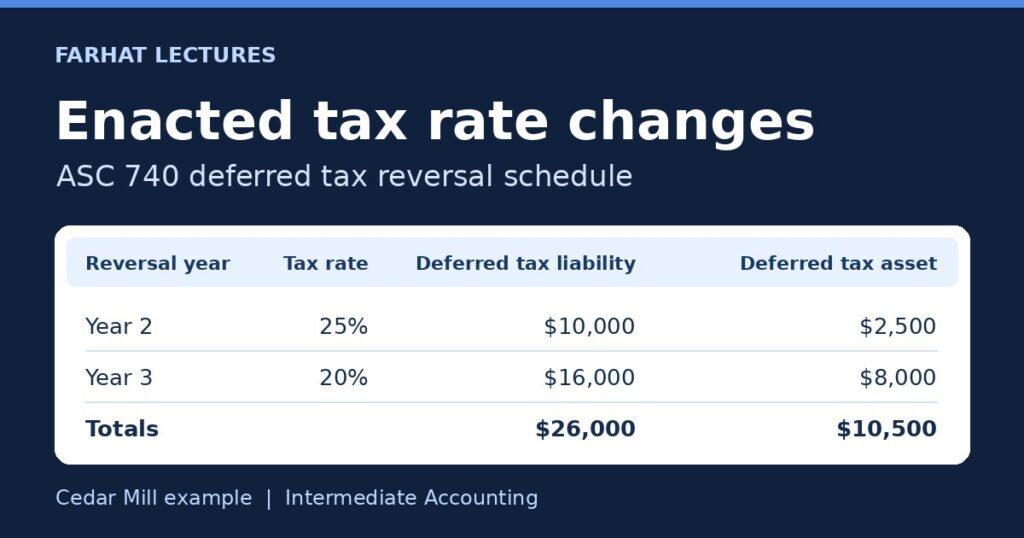
The enacted rate you expect to apply in the year the difference reverses. Enacted means already written into law. You do not use a rate that lawmakers are only discussing, however likely it looks.
Is a deferred tax liability bad news for a company?
Not on its own. It means tax on income the company has already reported in its financial statements is coming later rather than now. Whether that is helpful depends on the business, so read it alongside the rest of the income tax note.
For the authoritative U.S. guidance, see Topic 740, Income Taxes, in the FASB Accounting Standards Codification. The presentation rules described above are in ASC 740-10-45, which requires deferred tax assets and liabilities to be classified as noncurrent and to be offset only for the same tax-paying component in the same tax jurisdiction.
Practice intermediate accounting
Work through an accounting lesson with Professor Farhat and test your understanding.
Explore the free sample course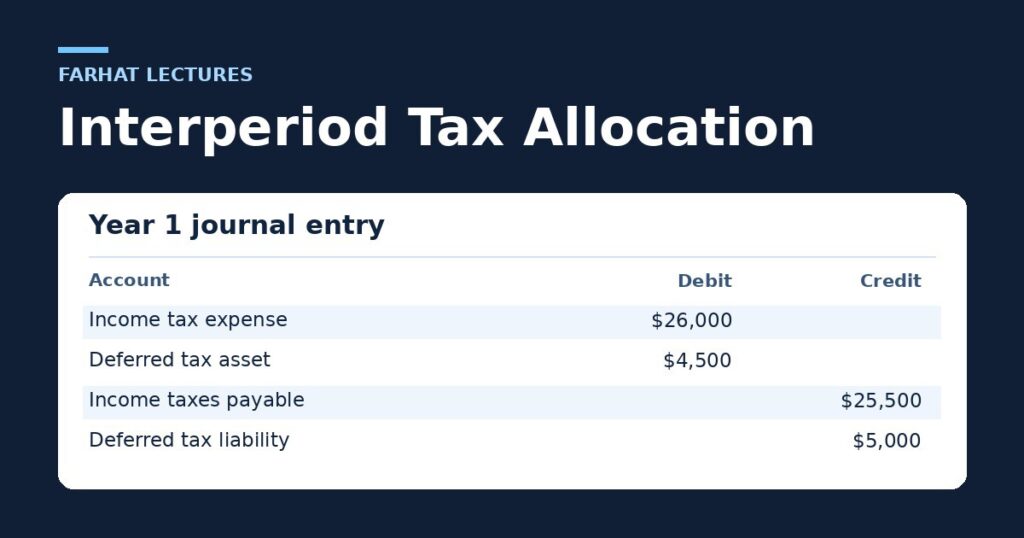




Responses