
ASC 606 Disclosure Requirements: What Companies Report and Why

Last updated
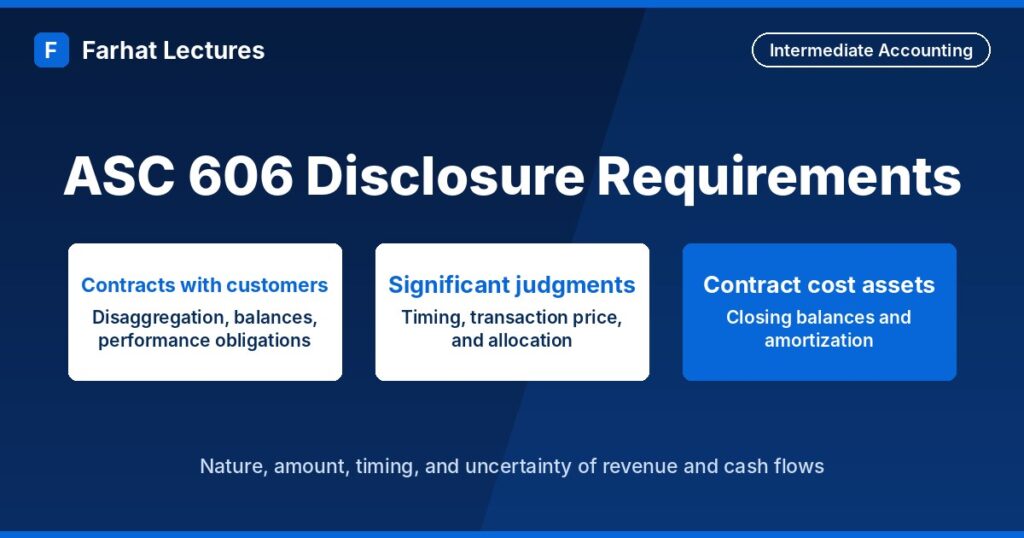
ASC 606 disclosure requirements are the information a company reports so readers can understand the nature, amount, timing, and uncertainty of revenue and cash flows from contracts with customers (ASC 606-10-50-1). They cover three areas: contracts with customers, the significant judgments used to apply the standard, and assets recognized from contract costs.
Inside the first area sit the revenue and loss amounts, disaggregated revenue, contract balances, and performance obligations, including the remaining performance obligation or backlog figure. The Financial Accounting Standards Board (FASB) set these requirements, and private companies can elect out of several of them.
Video: revenue recognition and disclosure
Professor Farhat walks through revenue recognition from the contract criteria to the journal entries in this lesson series. The disclosure material in this guide is what sits on top of all of it, so it helps to have the recognition steps fresh first.
Why does this matter? Two companies can report the same revenue number while carrying very different risks. One may sell one product in one country with cash up front; the other may earn revenue over five-year contracts with variable fees. The footnotes are where readers see that difference. On the CPA exam, revenue questions often ask you to match a disclosure to its category or to compute a contract balance figure. If you want the recognition side first, start with the five steps of revenue recognition under ASC 606 and then come back here.
This guide supports the Presentation and Disclosure lesson in the Farhat Lectures Intermediate Accounting course. It assumes you know the balances described in contract asset vs contract liability.
Key takeaways
- ASC 606 disclosures have one objective: show the nature, amount, timing, and uncertainty of revenue and cash flows from customer contracts.
- They fall into three groups: contracts with customers, significant judgments, and assets from contract costs.
- Disaggregated revenue has to relate clearly to segment revenue, but no reconciliation table is required.
- Contract balance disclosures cover amounts already recorded. The backlog disclosure covers revenue not yet recorded.
- A company that skips the backlog number under an optional exemption must say which exemption it used and describe what it left out.
- Private companies have five separate elections, and some elections still require limited disclosures.
The disclosure objective
ASC 606-10-50-1 states one overall objective: help users understand the nature, amount, timing, and uncertainty of revenue and cash flows from contracts with customers. A second paragraph, ASC 606-10-50-2, says how to get there. Companies decide how much detail each requirement needs, and they group or split their disclosures so that useful information is not buried under trivial detail or blended together with items that behave very differently. Deloitte’s overview of the disclosure objective summarizes each requirement, and you can read the requirements themselves in the FASB codification.
To meet the objective, companies disclose information in three areas:
- Contracts with customers: disaggregated revenue, contract balances, and performance obligations.
- Significant judgments, and changes in them, that affect the amount and timing of revenue.
- Assets from contract costs, meaning capitalized costs to obtain or fulfill contracts.
Start with the two amounts every company reports
Before any of the detailed breakdowns, ASC 606-10-50-4 asks for two plain amounts. First, revenue recognized from contracts with customers, shown separately from any other kind of revenue the company earns, such as interest income or lease income. Second, any credit losses on receivables and contract assets that came from those customer contracts, shown separately from losses on anything else. A company can satisfy both by presenting the amounts on the face of the income statement instead of in the notes.
The main ASC 606 disclosure requirements at a glance
| Disclosure | What the company reports | Simple illustration |
|---|---|---|
| Disaggregation of revenue | Revenue split into categories that show how economic factors affect it, plus enough information to show how those categories relate to segment revenue | Revenue by product line, region, and point in time vs over time |
| Contract balances | Opening and closing receivables, contract assets, and contract liabilities; revenue recognized from the opening contract liability; explanation of significant changes | Deferred revenue rollforward |
| Remaining performance obligations | Transaction price allocated to unsatisfied (or partly satisfied) obligations and when it is expected to become revenue | $2.4 million of backlog, 55% expected within 12 months |
| Costs to obtain or fulfill contracts | Closing balances of capitalized costs, amortization and impairment for the period, and the amortization method | Capitalized commissions of $310,000, amortized straight-line |
| Significant judgments | Judgments about timing of satisfaction, the transaction price, and allocation; how variable consideration is constrained | Method used to measure progress on long-term contracts |
Disaggregation of revenue
Companies split revenue into categories that show how the nature, amount, timing, and uncertainty of revenue and cash flows are affected by economic factors (ASC 606-10-50-5). Common categories include type of good or service, geographic region, market or type of customer, type of contract (fixed price or time-and-materials), contract duration, timing of transfer (point in time or over time), and sales channel. Public companies also explain how the categories relate to the revenue reported for each segment.
Contract balances
Companies disclose the opening and closing balances of receivables, contract assets, and contract liabilities, plus the revenue recognized in the period that was included in the opening contract liability balance. They also explain how the timing of satisfying performance obligations relates to their normal payment terms and how both affect contract asset and contract liability balances (ASC 606-10-50-9). They explain significant changes in the balances, such as a business combination or a cumulative catch-up adjustment, which means an amount recorded now for performance already completed (ASC 606-10-50-10). One closely related item lives somewhere else in the codification. Revenue recognized this period from performance obligations satisfied in earlier periods is a performance obligation disclosure under ASC 606-10-50-12A, not part of the contract balance paragraphs. Companies often present it in the same note, but on an exam it belongs in the performance obligation group. Deloitte’s section on contracts with customers covers each item.
Example: a contract liability rollforward
This example is hypothetical. Summit Learning sells annual course subscriptions that customers pay for up front.
| Item | Amount |
|---|---|
| Contract liability, January 1 | $80,000 |
| Add: cash received in advance during the year | $150,000 |
| Less: revenue recognized from the January 1 balance | ($70,000) |
| Less: revenue recognized from amounts received during the year | ($95,000) |
| Contract liability, December 31 | $65,000 |
Summit would disclose that $70,000 of this year’s revenue was included in the opening contract liability. That tells readers how much revenue came from cash collected in a prior year.
If you want to see the journal entries behind balances like these, work through the revenue recognition examples and journal entries lesson, then come back to how they get disclosed.
What companies say about their performance obligations
A performance obligation is a promise in a contract to transfer a good or service to a customer. ASC 606-10-50-12 asks companies to describe five things about those promises:
- When they are usually satisfied. On shipment, on delivery, as the service is performed, or on completion. This includes anything satisfied under a bill-and-hold arrangement, where the customer is billed but the goods stay with the seller.
- The significant payment terms. When payment is normally due, whether the contract has a significant financing component, whether the amount is variable, and whether an estimate of that variable amount is generally constrained, which means capped so the company does not record revenue it may have to reverse.
- The nature of the goods or services, flagging anything where the company is acting as an agent arranging a sale for someone else rather than selling on its own account.
- Obligations for returns and refunds and similar promises.
- The types of warranties the company gives and what they obligate it to do.
This is the qualitative half of the performance obligation group. The backlog number in the next section is the quantitative half, and both sit under the same heading in the codification.
Remaining performance obligations
Often called the backlog disclosure, this is the transaction price allocated to performance obligations that are unsatisfied (or partly satisfied) at the end of the period, with an explanation of when the company expects to recognize it as revenue (ASC 606-10-50-13). The timing can be given in time bands or in words. For example, a software company might report $2.4 million of remaining performance obligations, with about 55% expected in the next 12 months and the rest over the following 24 months.
Optional exemptions let a company skip this disclosure in three situations. The first two are in ASC 606-10-50-14: the performance obligation is part of a contract with an original expected duration of one year or less, or the company recognizes revenue at the amount it has a right to invoice. The third is in ASC 606-10-50-14A: the variable consideration is a qualifying sales-based or usage-based royalty for a license of intellectual property, or it is allocated entirely to a wholly unsatisfied performance obligation or a wholly unsatisfied promise to deliver a distinct good or service in a series and meets the variable-consideration allocation criteria. The right-to-invoice and variable-consideration exemptions cannot be applied to fixed consideration. The short-contract exemption can apply to fixed consideration (ASC 606-10-50-14B).
Using an exemption is not the same as saying nothing. Under ASC 606-10-50-15, a company that applies one must disclose which exemption it used, and it must also describe the nature of those performance obligations, how long they still run, and any variable consideration it left out. Companies must also explain whether any consideration from customer contracts was excluded from the transaction price and therefore left out of the backlog disclosure (ASC 606-10-50-15).
Significant judgments
Companies explain the judgments, and changes in them, that most affect revenue. These include:
- Timing: for obligations satisfied over time, the method used to measure progress and why it fits; for point-in-time obligations, how the company decides when control transfers.
- Transaction price and allocation: how variable consideration is estimated and constrained, how financing components are handled, and how standalone selling prices are estimated. See transaction price under ASC 606.
Contract cost disclosures
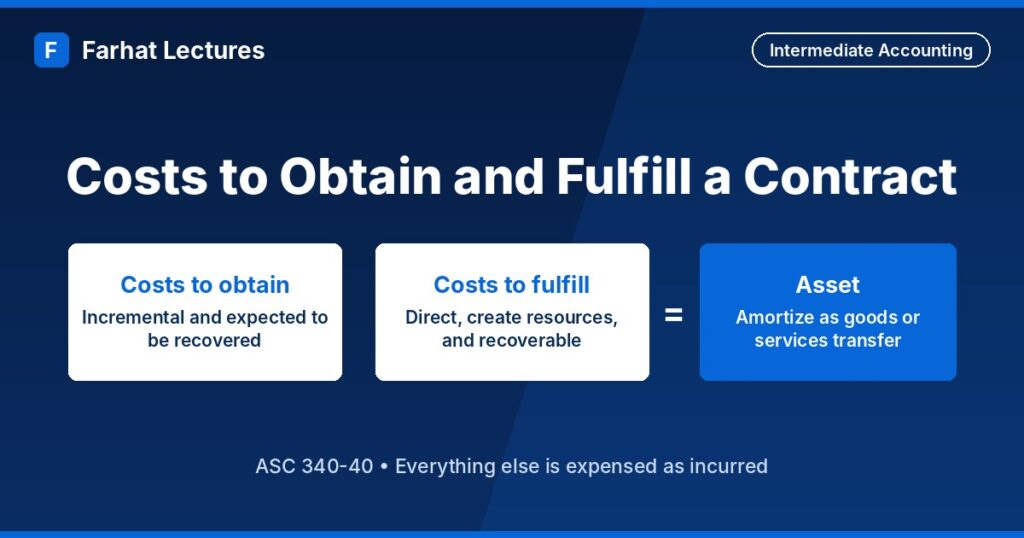
For assets recognized under ASC 340-40, companies disclose the closing balances by main category (such as costs to obtain and setup costs), the amortization and any impairment losses for the period, the judgments used to determine which costs were capitalized, and the amortization method (Deloitte section on contract cost disclosures). The rules for which costs qualify are covered in costs to obtain and fulfill a contract.
Relief from ASC 606 disclosure requirements for nonpublic companies
Nonpublic (private) companies get five separate elections, not one blanket pass. They may elect out of the detailed revenue disaggregation (ASC 606-10-50-7), most of the contract balance detail (ASC 606-10-50-11), the remaining performance obligation disclosure (ASC 606-10-50-16), some of the significant judgment disclosures (ASC 606-10-50-21), and the contract cost disclosures (ASC 340-40-50-4). Each one is a choice the company makes on its own. At a minimum they still disclose revenue disaggregated by the timing of transfer, meaning revenue from goods or services transferred at a point in time shown separately from revenue transferred over time, plus qualitative information about how economic factors affect that revenue (ASC 606-10-50-7), and the opening and closing balances of receivables, contract assets, and contract liabilities (ASC 606-10-50-8(a)) (Deloitte summary for private companies). IFRS 15 has similar disclosure objectives but no separate private-company relief.
Disclosures also capture events during the contract, such as the effects of a contract modification under ASC 606 on contract balances.
Public company vs private company: who discloses what
| Disclosure | Public business entity | Private company election |
|---|---|---|
| Revenue and credit losses shown separately (50-4) | Required | No relief, required |
| Full revenue disaggregation (50-5 and 50-6) | Required | May elect out, but must still split revenue by point in time vs over time and give qualitative information (50-7) |
| Contract balance detail (50-8 through 50-10) | Required | May elect out, but must still give opening and closing balances (50-11) |
| Performance obligation descriptions (50-12) | Required | No relief, required |
| Remaining performance obligations (50-13 through 50-15) | Required, subject to optional exemptions | May elect out entirely (50-16) |
| Significant judgments (50-17 through 50-20) | Required | May elect out of some, not all (50-21) |
| Contract cost assets (340-40-50-2 and 50-3) | Required | May elect out entirely (340-40-50-4) |
Two things are worth noticing. Private companies never get relief from ASC 606-10-50-4 or from describing their performance obligations, and interim reporting adds its own layer: public entities also give disaggregated revenue and contract balance information in interim financial statements under ASC 270-10-50-1A.
Common mistakes
- Putting the backlog under contract balances. Remaining performance obligations are a performance obligation disclosure, not a balance sheet rollforward.
- Using total revenue instead of revenue from the opening balance. The contract balance disclosure asks only for revenue that came out of the opening contract liability.
- Assuming disaggregation means segments. Categories are often more detailed than segments, and the company has to give enough information for a reader to see how the two relate (ASC 606-10-50-6). A formal reconciliation table is not required.
- Forgetting the practical expedient must itself be disclosed. Omitting short contracts from the backlog requires saying so.
- Forgetting the other expedients that have to be disclosed. ASC 606-10-50-22 also asks a company to say when it used the practical expedient for a significant financing component, or the one that lets it expense the costs of obtaining a contract when the amortization period would be a year or less.
Practice questions
Want more of these? The FAR CPA test bank has full question sets on revenue recognition and disclosure.
Revenue Recognition Disclosure Categories Practice
Why do companies disclose information about revenue from contracts with customers? Under ASC 606, qualitative and quantitative disclosures help financial statement users understand the nature, amount, timing, and uncertainty of revenue and related cash flows.
Choose the disclosure category for each item. You may use a category more than once.
1. A company’s contract liability was $50,000 on January 1. During the year it received $120,000 in advance and recognized $45,000 of revenue from the opening balance and $90,000 from new advances. What is the closing balance?
Answer: $35,000 ($50,000 + $120,000 − $45,000 − $90,000). The company also discloses that $45,000 of revenue came from the opening contract liability.
2. Which disclosure category does “the method used to measure progress toward completion” belong to?
Answer: Significant judgments, specifically judgments about the timing of satisfying performance obligations.
3. A gym sells only month-to-month memberships. Must it disclose remaining performance obligations?
Answer: Not the dollar amount. Month-to-month memberships have an original expected duration of one year or less, so the gym can use the optional exemption in ASC 606-10-50-14. It still has to say which exemption it applied, describe what the memberships are, and say how long they run (ASC 606-10-50-15).
Frequently asked questions
What are the main ASC 606 disclosure requirements?
Revenue and credit losses shown separately, disaggregated revenue, contract balances, performance obligations including the remaining performance obligation figure, significant judgments, and capitalized contract costs.
What is the objective of revenue disclosures under ASC 606?
To help users understand the nature, amount, timing, and uncertainty of revenue and cash flows arising from contracts with customers.
What is a remaining performance obligation disclosure?
It reports the transaction price allocated to obligations not yet satisfied at period end and when the company expects to recognize that amount as revenue.
Do private companies have to make all ASC 606 disclosures?
No. Nonpublic companies have five separate elections, but they must still disclose revenue by timing of transfer, qualitative information on how economic factors affect that revenue, opening and closing contract balances, revenue and credit losses separately, and a description of their performance obligations.
What does disaggregation of revenue mean?
Splitting total revenue into categories such as product line, region, customer type, or timing of transfer, so readers can see what drives revenue and its risks.
Where do ASC 606 disclosures appear in the financial statements?
In the notes, usually in a revenue footnote. Revenue from contracts with customers must be shown separately from other revenue sources, either on the face of the income statement or in the notes (ASC 606-10-50-4).
What must a company disclose about its performance obligations?
When it typically satisfies them, its significant payment terms, the nature of the goods or services, any obligations for returns and refunds, and the types of warranties it gives (ASC 606-10-50-12).
Does ASC 606 require a contract balance rollforward?
No. It requires opening and closing balances plus an explanation of significant changes. A rollforward is one clear way to present that, not a requirement.
Are ASC 606 disclosures required in interim reports?
Yes. Public entities disclose disaggregated revenue and contract balance information in interim financial statements under ASC 270-10-50-1A.
What is the difference between a contract balance and a remaining performance obligation?
A contract balance is an amount already recorded on the balance sheet. The remaining performance obligation disclosure reports the transaction price allocated to obligations that are unsatisfied or partly satisfied.
Continue learning with Farhat Lectures
Strengthen your accounting understanding with clear explanations and guided practice.
Explore the free sample course
Responses