
Transfer of Control in Revenue Recognition: 5 Indicators Explained

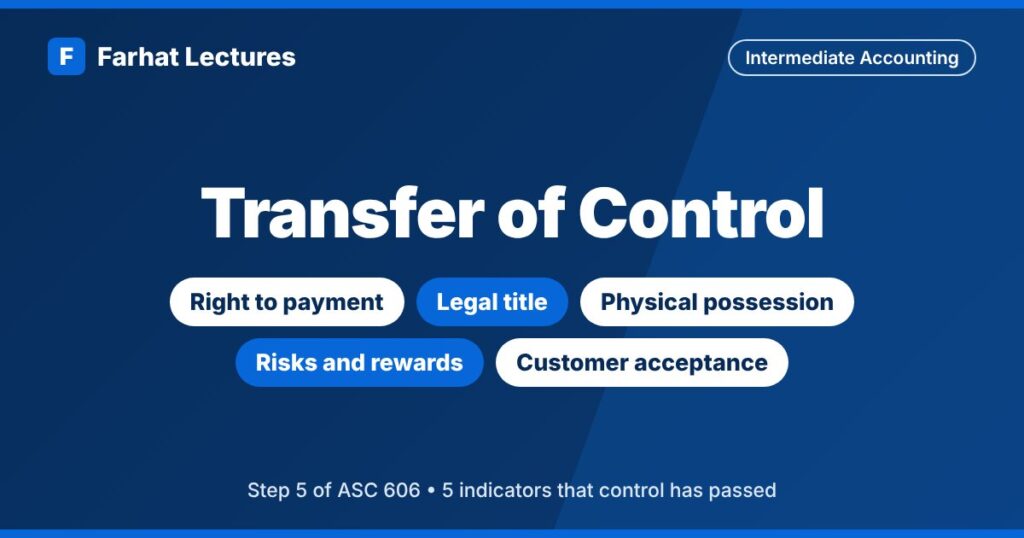
Under ASC 606, a company recognizes revenue when or as the customer obtains control of the promised good or service. Control is the ability to direct its use and obtain substantially all of its remaining benefits. For a performance obligation satisfied at a point in time, five indicators help determine when control transfers: a present right to payment, legal title, physical possession, significant risks and rewards of ownership, and customer acceptance.
A company recognizes revenue when, or as, it satisfies a performance obligation. A performance obligation is simply a promise in a contract to hand over a specific good or service to the customer.
Why does this matter? Step 5 of the revenue model decides when revenue appears in the financial statements. Cash often moves on a different date than the goods, so students who tie revenue to cash, or to a signed contract, put it in the wrong period. Control, not cash, is the deciding factor.
Why this matters for the CPA exam
If you are studying for the CPA exam, this topic sits in Area III, Select Transactions, of the AICPA’s FAR blueprint. That area carries 25 to 35 percent of the FAR section, and the blueprint expects you to apply the five-step model, decide the amount and timing of revenue, and prepare the journal entries.
Simulations love the timing question, because it is easy to write a fact pattern where the cash date, the contract date, and the control date all fall in different periods. Get control right and the entry follows.
Working through FAR right now? The free sample course includes the full revenue recognition lesson and the practice that goes with it.
This guide supports section 17.1, Fundamentals of Revenue Recognition, in Kieso, Weygandt, and Warfield, Intermediate Accounting, 18th edition. In earlier editions of that book, revenue recognition was chapter 18, so your copy may number it differently. It focuses on revenue recognized at a point in time. For an overview of all five steps, see revenue recognition under ASC 606 and IFRS 15.
Watch: Transfer of Control and the Point-in-Time Indicators
Watch this Farhat lesson on YouTube
This video starts at the 1:01 mark of the Farhat Lectures lesson on Step 5, where Professor Farhat explains transfer of control and walks through the five point-in-time indicators, ending with a vending-machine example.
One note on the title: this lesson is framed around IFRS 15, and that is fine here. IFRS 15 and ASC 606 use the same control principle and the same five point-in-time indicators, so everything in the video applies to US GAAP as well.
What does control mean?
Under ASC 606-10-25-25, a customer controls an asset when it has the ability to direct the use of the asset and obtain substantially all of its remaining benefits. Control also includes the ability to prevent others from directing its use or obtaining its benefits.
| Part of control | What it looks like |
|---|---|
| Direct the use | The customer decides how, when, and whether to use the asset. |
| Obtain substantially all remaining benefits | The customer gets the asset’s cash flows or other benefits, by using it, selling it, or pledging it. |
| Prevent others | The seller or anyone else can no longer use the asset or take its benefits. |
The 5 indicators of transfer of control
ASC 606-10-25-30 lists five indicators that control has passed to the customer at a point in time. The codification is clear that this list is not exhaustive, so other facts about a sale can also point to transfer of control. Deloitte’s roadmap section on revenue recognized at a point in time discusses each one.
| Indicator | What it means | Hypothetical example |
|---|---|---|
| 1. Present right to payment | The customer is now obligated to pay the seller for the asset. | An appliance store has delivered a refrigerator, and the customer’s invoice is due in 30 days. |
| 2. Legal title | The customer legally owns the asset. | Title to a car passes to the buyer at signing and pickup. |
| 3. Physical possession | The customer holds the asset. | A customer walks out of a bookstore with a textbook. |
| 4. Significant risks and rewards of ownership | The customer bears losses if the asset is damaged and gains if it rises in value. | After delivery, a dropped laptop is the customer’s loss, not the seller’s. |
| 5. Customer acceptance | The customer has accepted the asset, or acceptance is just a formality. | A business signs off that installed equipment meets the agreed specifications. |
The indicators are not a checklist
The FASB’s basis for conclusions explains that these indicators are not a list of conditions that must all be met. A company weighs them together against the definition of control. Two common situations show why:
- A seller may keep legal title only as protection in case the customer does not pay. If the customer already has possession and the risks and rewards, control has usually passed anyway.
- Physical possession does not always mean control, and the reverse is also true. In a consignment, the manufacturer retains control of the inventory while the dealer holds it. The manufacturer recognizes revenue when control transfers, typically when the dealer sells the goods to the end customer. In a bill-and-hold sale, the customer may control goods that are still sitting in the seller’s warehouse. A trial or evaluation period is a third case, because acceptance is not a formality until the trial ends. Later lessons in the chapter work through each of these.
Examples: when is revenue recognized?
All of the following examples are hypothetical and use Northline Fitness Supply, which sells a treadmill for $1,200.
Example 1: Cash arrives before control transfers
On December 20, a customer pays $1,200 for a treadmill that Northline delivers on January 5. On December 20, Northline has the cash but has not transferred control, so it records a liability. ASC 606 calls this liability a contract liability. Most textbooks and many companies still call it unearned revenue or deferred revenue, and all three names describe the same thing:
| December 20 | Debit | Credit |
|---|---|---|
| Cash | 1,200 | |
| Unearned Revenue | 1,200 |
| January 5 | Debit | Credit |
|---|---|---|
| Unearned Revenue | 1,200 | |
| Sales Revenue | 1,200 |
The revenue belongs to January, the month control passed. Read unearned revenue for more on this liability.
Example 2: Control transfers before cash arrives
Northline delivers a treadmill on December 28. The customer accepts it, and payment is due January 27. At delivery, Northline has a right to payment, and the customer has possession, the risks and rewards, and has accepted the treadmill. Revenue is recognized on December 28:
| December 28 | Debit | Credit |
|---|---|---|
| Accounts Receivable | 1,200 | |
| Sales Revenue | 1,200 |
One thing to watch in a full problem: this entry records only the revenue side. A seller using a perpetual inventory system also records the cost side at the same moment, debiting Cost of Goods Sold and crediting Inventory for what the treadmill cost Northline. Control transferring triggers both halves.
Example 3: Shipping terms
Northline ships a treadmill on December 30, and it arrives on January 2. Shipping contracts use the letters FOB, which stand for free on board. The term that follows tells you the point at which responsibility for the goods passes from the seller to the buyer. If the terms are FOB shipping point, title and the risk of loss usually pass when the goods leave the warehouse, so control (and revenue) typically transfers on December 30. If the terms are FOB destination, they pass on arrival, so revenue is recognized on January 2.
Point in time vs. over time
Every performance obligation is satisfied either at a point in time (most product sales) or over time (many services and some construction contracts). The five indicators above apply to point-in-time sales. When a performance obligation is satisfied over time, revenue is recognized as the company makes progress. A performance obligation is satisfied over time if any one of three criteria is met: the customer receives and uses the benefits as the seller performs, the seller’s work creates or improves an asset the customer controls, or the seller’s performance creates an asset with no alternative use to the seller, and the seller has an enforceable right to payment for performance completed to date. The over-time criteria are covered in the next textbook lesson and in the ASC 606 overview.
When a contract has several performance obligations, each one is recognized when its own control transfers, using the amount allocated in standalone selling price allocation. For guided practice, see the Revenue Recognition Principle lesson in the Intermediate Accounting course.
Key takeaways on transfer of control
- Revenue is recognized when (or as) the customer obtains control of the promised good or service.
- Control means the customer can direct the asset’s use, obtain substantially all of its remaining benefits, and prevent others from doing so.
- The five indicators are weighed together; no single one decides the answer.
- Cash collected before control transfers is a liability, not revenue.
Common mistakes
- Recognizing revenue when cash is received instead of when control transfers.
- Recognizing revenue when a contract is signed, before anything is delivered.
- Requiring all five indicators before recognizing revenue.
- Ignoring shipping terms when goods are in transit at year-end.
Practice questions with answers
1. A customer pays $500 on December 15 for goods delivered on January 4. How much revenue is recognized in December?
Answer: None. Control transfers on January 4, so the $500 is unearned revenue (a liability) at December 31 and becomes revenue in January.
2. Goods are delivered and accepted on November 30, and the customer pays on December 30. When is revenue recognized?
Answer: November 30, when control transfers. The seller records an account receivable on November 30 and collects it on December 30.
3. A seller keeps legal title until the customer pays, only to protect itself if the customer defaults. The customer has the goods, has accepted them, and bears the risk of loss. Has control transferred?
Answer: Yes, in most cases. Title kept only as protection against nonpayment does not stop the customer from directing the use of the goods and obtaining their benefits, and the other indicators point to transfer.
Revenue Recognition Step 5 Practice Quiz: Transfer of Control
Step 5 of the five-step revenue recognition model under ASC 606 links revenue to the satisfaction of a performance obligation. Use these four questions to practice identifying when a customer obtains control, weighing the five control indicators, and distinguishing point-in-time from over-time revenue recognition.
Frequently asked questions
What is transfer of control in revenue recognition?
It is the point when the customer gains the ability to direct the use of a good or service and obtain substantially all of its remaining benefits. Under ASC 606, revenue is recognized when (or as) control transfers.
What are the five indicators of transfer of control?
The seller has a present right to payment, the customer has legal title, the customer has physical possession, the customer has the significant risks and rewards of ownership, and the customer has accepted the asset.
Do all five indicators need to be present?
No. They are indicators, not required conditions. A company considers them together and judges whether the customer has obtained control.
Is revenue recognized when cash is received?
Not under accrual accounting. Cash received before control transfers is recorded as unearned revenue, and cash collected after control transfers settles a receivable.
Does IFRS 15 use the same control indicators?
Yes. IFRS 15 uses the same control principle and the same five indicators for performance obligations satisfied at a point in time.
Is transfer of control tested on the CPA exam?
Yes. Revenue recognition sits in Area III, Select Transactions, of the AICPA’s FAR blueprint, which carries 25 to 35 percent of that section. You are expected to apply the five-step model and prepare the related journal entries.
Is unearned revenue the same as a contract liability?
They describe the same item. ASC 606 uses the term contract liability, while most textbooks and many companies still say unearned revenue or deferred revenue.
What is the difference between transfer of control and transfer of risk?
Risk is only one of the five indicators. ASC 606 asks who can direct the asset’s use and keep substantially all of its benefits, so risk alone does not settle the question.
When does control transfer if goods are in transit at year-end?
It depends on the shipping terms. Under FOB shipping point, control usually passes when the goods leave the seller, so the sale lands in the earlier period. Under FOB destination, it usually passes on arrival.
Continue learning with Farhat Lectures
Strengthen your accounting understanding with clear explanations and guided practice.
Explore the free sample course


Responses