
Significant Influence in Accounting: The 20% Rule and What Overrides It

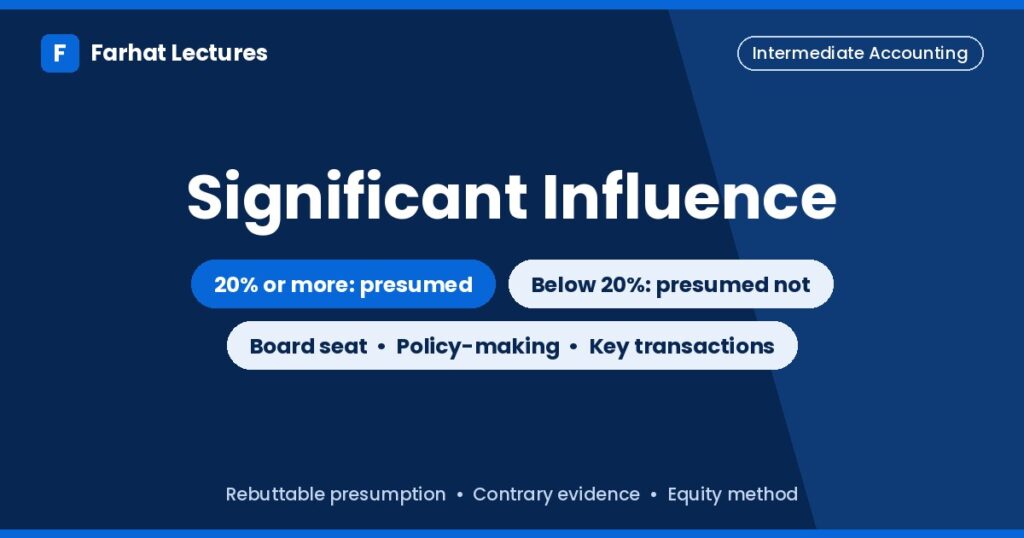
Significant influence is an investor’s ability to affect a company’s operating and financial policies without controlling it. Under U.S. GAAP (ASC 323), owning 20% or more of the voting stock creates a presumption of significant influence, and owning less than 20% creates the opposite presumption. Evidence can overcome either one. Significant influence generally means the equity method.
This matters because significant influence decides which accounting method applies to an equity investment. Get it wrong and the investor records the wrong income, the wrong investment balance, and the wrong treatment of dividends. Once you know the method, the equity method of accounting lesson shows how to record it.
Watch: Equity Method Explained, a Farhat Lectures video. It starts at 1:26, where significant influence and the 20% ownership test are covered.
What is significant influence?
An investor with significant influence can shape decisions like expansion plans, financing, and dividend policy, even though it cannot dictate them. That relationship is closer than a passive holding but weaker than ownership of a majority of the votes.
| Level of influence | Typical voting ownership | Accounting method |
|---|---|---|
| No significant influence | Less than 20% | Fair value through net income under ASC 321 (see equity method vs. fair value method) |
| Significant influence | 20% to 50% | Equity method |
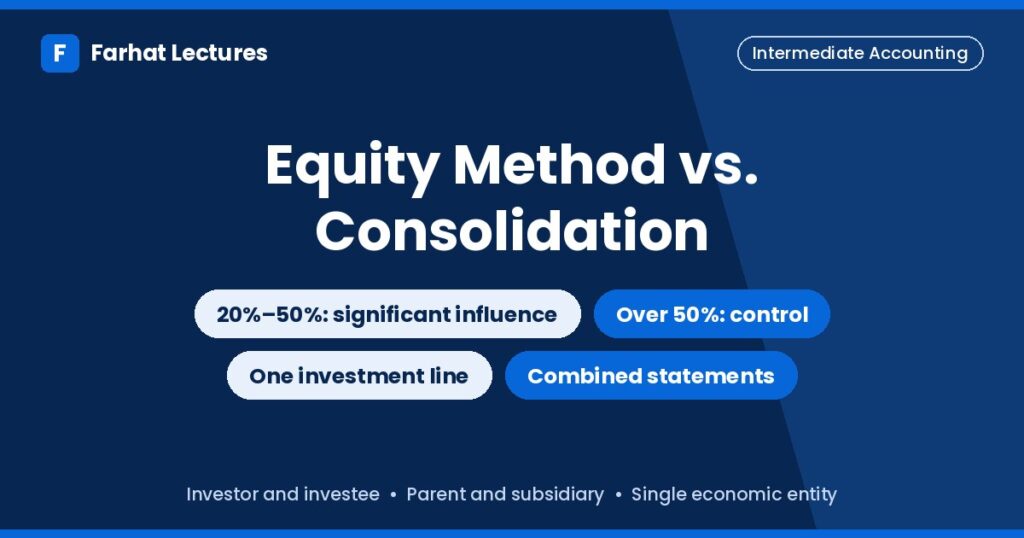
| Control | Usually more than 50% | Consolidation (see equity method vs. consolidation) |
Two notes on this table. First, an investor with significant influence can elect the fair value option instead of the equity method (ASC 825-10). The choice is made at specific dates, such as when the investment first qualifies for the equity method. The election is irrevocable unless a new election date occurs. Second, the fair value method for investments without significant influence comes from ASC 321: the shares are measured at fair value, and changes go through net income. An investor may elect the ASC 321 measurement alternative for an equity security without a readily determinable fair value if the security does not qualify for the net asset value practical expedient. The alternative starts with cost minus impairment and adjusts for observable price changes in orderly transactions for an identical or similar investment of the same issuer.
What is the 20% rule for significant influence?
Judging influence case by case would make companies inconsistent, so U.S. GAAP sets a starting point. An investment, direct or indirect, of 20% or more of the voting stock leads to a presumption that the investor has significant influence, unless there is evidence to the contrary. An investment of less than 20% leads to the opposite presumption (FASB ASC 323-10-15-8, summarized in the Deloitte equity method roadmap).
Both presumptions are rebuttable, which means the facts can overturn them. The percentage is where the analysis starts, not where it ends.
One scope note: the 20% presumption is about corporate stock. For limited partnerships, and LLCs that keep a separate capital account for each owner, current U.S. GAAP sets a lower bar. The equity method generally applies unless the interest is so minor that the investor has virtually no influence, and the SEC staff views an interest of more than 3% to 5% as more than minor (ASC 323-30).
What are the indicators of significant influence?
ASC 323-10-15-6 lists signs that an investor may have significant influence (Deloitte summary):
| Indicator | What it looks like |
|---|---|
| Representation on the board of directors | The investor holds one or more board seats. |
| Participation in policy-making | The investor takes part in decisions on budgets, dividends, or strategy. |
| Material intra-entity transactions | Large purchases or sales between the investor and investee. |
| Interchange of managerial personnel | Managers move between the two companies. |
| Technological dependency | The investee relies on the investor’s technology or know-how. |
The size of the stake compared with other shareholders also matters. An 18% stake can give real influence when no other investor holds more than 5%, because the other votes are scattered.
What evidence overcomes the 20% presumption?
ASC 323-10-15-10 gives examples of facts suggesting that an investor with 20% or more may not have significant influence (PwC guide):
- The investee opposes the investor, for example through lawsuits or complaints to regulators.
- The investor signs an agreement giving up significant shareholder rights.
- A small group of shareholders holds majority ownership and runs the investee without regard to the investor.
- The investor tries and fails to get more financial information than other shareholders receive.
- The investor tries and fails to get a seat on the board.
No single fact decides the question. The investor weighs all the facts and circumstances.
Worked cases
Hypothetical examples. Each investor owns voting common stock of a different investee.
| Investor and facts | Starting presumption | Conclusion |
|---|---|---|
| Arbor Co. owns 15%, holds 2 of 7 board seats, and no other holder owns more than 4%. | No significant influence | Presumption overcome: significant influence, so equity method |
| Birch Inc. owns 22% and has no board seat, but nothing suggests it is shut out. | Significant influence | Presumption stands: equity method |
| Cedar Corp. owns 30%, while one shareholder owns 65% and ignores Cedar. Cedar’s request for a board seat was refused. | Significant influence | Presumption overcome: no significant influence, so fair value method |
| Dune Ltd. owns 100% of a subsidiary that owns 25% of Elm Co. | Significant influence (indirect 25%) | Presumption stands: equity method for the 25% |
A proposal to watch: on October 28, 2026, the FASB issued a proposed Accounting Standards Update that would remove the presumption that an investor below 20% lacks significant influence, while keeping the 20%-or-more presumption. It would also apply the same significant influence test to partnerships and LLCs. Comments are due January 11, 2027, and there is no effective date yet, so today’s rules still apply on the exam (Crowe summary).
What happens when ownership crosses 20% or influence is lost?
Say an investor owns 10% of a company and buys another 15%, reaching 25% and significant influence. The investor does not go back and restate prior years (ASU 2016-07). It first updates the carrying amount of the existing shares under ASC 321, then adds the cost of the new shares. It applies the equity method from that date forward.
For example, if the existing 10% stake is measured at $150,000 under ASC 321 immediately before the investor gains significant influence and the new 15% costs $240,000, the equity method investment starts at $390,000.
It also works in reverse. If the investor loses significant influence, for example by selling down to 8%, it stops using the equity method. It does not restate prior periods. It applies ASC 321 to measure the retained shares when significant influence is lost and thereafter, generally at fair value through net income. The equity method of accounting lesson shows the journal entries.
Significant influence under IFRS vs. U.S. GAAP
IFRS uses the same idea under IAS 28, where the investee is called an associate. The big difference is how each framework treats potential voting rights, meaning options or convertible securities that could become voting shares.
| Point | U.S. GAAP (ASC 323) | IFRS (IAS 28) |
|---|---|---|
| 20% presumption | Yes, rebuttable | Yes, rebuttable |
| Potential voting rights | Ignored. Only shares with voting rights today count | Considered if currently exercisable or convertible |
| Name for the investee | Equity method investee | Associate |
Common mistakes
- Treating 20% as a bright line. It is a presumption that evidence can overturn.
- Ignoring indirect holdings. Shares held through a subsidiary count.
- Counting nonvoting shares. The presumption is based on voting stock.
- Confusing influence with control. Control, usually more than 50%, means consolidation.
- Relying on one fact. Weigh all the indicators together.
- Forgetting the fair value option. An investor with significant influence can elect fair value instead of the equity method, but the election is available only at specified dates and is irrevocable unless a new election date occurs.
- Counting options or convertible securities. U.S. GAAP looks only at shares with voting rights today.
CPA exam tip: when a question gives you a percentage, keep reading. Board seats, a dominant majority owner, or a signed agreement giving up shareholder rights are usually there to move you off the 20% starting point.
Interactive practice on significant influence
Significant Influence and the Equity Method
Apply the U.S. GAAP 20% voting-stock presumption and assess evidence such as board representation and the ownership stakes of other shareholders. Choose the best answer for each of the four scenarios, then check your work before reviewing the worked examples below.
Practice questions with answers
Question 1: A 12% stake with board seats
Fenwick Co. owns 12% of Glade Inc.’s voting stock, appoints 2 of Glade’s 6 directors, and helps set Glade’s dividend policy. Which method should Fenwick use?
Answer:
The equity method
The below-20% presumption is overcome by board representation and participation in policy-making, so Fenwick has significant influence.
Question 2: A 25% stake with a standstill agreement
Harbor Inc. owns 25% of Isle Co. but signed an agreement giving up its voting and board rights. Does Harbor have significant influence?
Answer:
Probably not
Giving up significant shareholder rights is evidence against significant influence and can overcome the 20% presumption. Harbor would likely use the fair value method.
Question 3: 20% or 51%?
Juniper Corp. buys 51% of Kestrel Inc.’s voting stock. Does it use the equity method?
Answer:
No, Juniper consolidates Kestrel
More than 50% of the voting stock usually gives control, which goes beyond significant influence. Juniper prepares consolidated financial statements.
Want more practice like this? Work through the Equity Method lesson in the Farhat Lectures Intermediate Accounting course.
Key takeaways
- Significant influence is the ability to affect an investee’s operating and financial policies without control.
- 20% or more of the voting stock creates a rebuttable presumption of significant influence.
- Board seats, policy-making, major transactions, shared managers, and technology dependence point toward influence.
- Opposition, surrendered rights, or a dominant majority owner can overcome the presumption.
- Significant influence generally means the equity method, unless the investor elects the fair value option; control means consolidation.
Frequently asked questions
Is 20% a strict cutoff for significant influence?
No. It is a rebuttable presumption. An investor with 20% or more is presumed to have significant influence, and one with less than 20% is presumed not to, but evidence to the contrary can overcome either presumption.
Can an investor with less than 20% use the equity method?
Yes, if the facts show significant influence, such as a board seat or participation in policy-making. For example, an 18% stake can carry real influence when no other shareholder owns more than a few percent.
Does significant influence mean the investor controls the investee?
No. Significant influence is the ability to affect operating and financial policies. Control, usually more than 50% of the voting stock, leads to consolidation instead of the equity method.
Do indirect holdings count toward the 20%?
Yes. The presumption looks at direct or indirect ownership, so shares held through a subsidiary count.
Can an investor with significant influence use fair value instead of the equity method?
Yes. U.S. GAAP lets an investor elect the fair value option (ASC 825-10) for an investment that would otherwise use the equity method. The choice is made at specific dates, such as when the investment first qualifies. The election is irrevocable unless a new election date occurs.
Do stock options or convertible securities count toward the 20%?
Not under U.S. GAAP. The test uses shares that carry voting rights today, and potential voting rights are ignored. IFRS is different: it considers potential voting rights that are currently exercisable or convertible.
Is the FASB changing the 20% rule?
Not yet. On October 28, 2026, the FASB proposed removing the presumption that an investor below 20% lacks significant influence, while keeping the 20%-or-more presumption. Comments are due January 11, 2027, and no effective date has been set, so the current rule still applies.
Sources
- Deloitte Roadmap: Equity Method Investments, Section 3.2 General Presumption (ASC 323-10-15-8)
- Deloitte Roadmap: Equity Method Investments, Section 3.3 Other Indicators of Significant Influence (ASC 323-10-15-6)
- PwC Viewpoint: Predominant Evidence to the Contrary (ASC 323-10-15-10)
- Crowe: FASB Proposes Changes to Equity Method Accounting (October 2026 proposal)
- Deloitte DART: FASB Proposes Targeted Improvements to Equity Method of Accounting (October 28, 2026 proposed ASU)
About the author
Mansour Farhat, CPA, CIA, DBA, teaches accounting and CPA exam review at Farhat Lectures and on the Farhat Lectures YouTube channel. His lessons help CPA, CMA, and EA candidates and accounting students work through topics like significant influence and the equity method step by step, with original examples, practice questions, and the mistakes students make most often.
Last reviewed: November 2026, including the FASB’s October 28, 2026 equity method proposal.
Continue learning with Farhat Lectures
Strengthen your accounting understanding with clear explanations and guided practice.
Explore the free sample course



Responses