
Issuance of Common Stock: Par, No-Par, and Stated Value Journal Entries

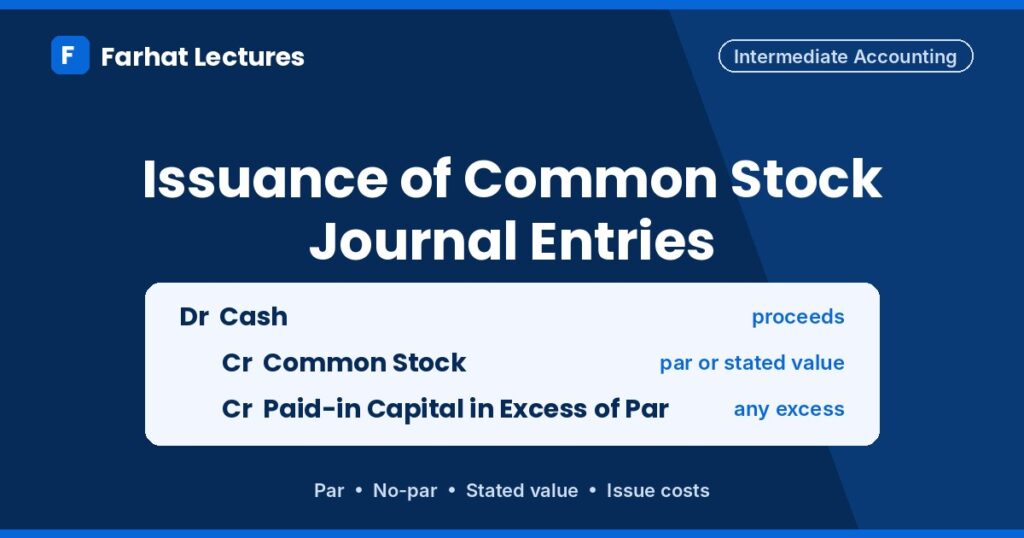
To record the issuance of common stock for cash, debit Cash for the full amount received, credit Common Stock for the shares issued times par or stated value, and credit Paid-in Capital in Excess of Par for the rest. For true no-par stock with no stated value, credit the entire amount to Common Stock.
This entry appears in almost every stockholders’ equity problem, and it shows up on the FAR section of the CPA exam and on CMA Part 1. It also sets up later topics such as treasury stock, dividends, and earnings per share. If you split the proceeds correctly between Common Stock and additional paid-in capital, the rest of the chapter becomes much easier.
This guide covers what common stock is, the rights that come with it, the three par-value situations (par, no-par, and stated value), and how to handle the costs of issuing stock. Every example uses original, hypothetical numbers.
Watch: What is Common Stock? Examples and Journal Entries
In this lesson, Professor Farhat walks through par value, stated value, and no-par entries, plus stock issued for noncash assets and issuance costs, so it pairs well with the examples below.
What is common stock?
Common stock is the basic ownership interest in a corporation. Common stockholders bear the risk of loss and receive the benefit of success, because they are paid only after creditors and any preferred stockholders. If a corporation has only one class of stock, that class is common stock, whatever the charter calls it.
Common stock is part of contributed capital, the amount stockholders have invested. For how contributed capital fits with retained earnings and the rest of equity, see Stockholders’ Equity Explained. For why companies issue shares at all, see the advantages and disadvantages of a corporation.
Rights of common stockholders
| Right | What it means |
|---|---|
| Voting | Vote to elect the board of directors and on major actions that need stockholder approval. |
| Residual claim | Receive what is left of the assets after all liabilities (and preferred claims) are paid. |
| Preemptive right | Buy a proportionate share of new common shares so the stockholder’s ownership is not diluted. In most states today, including Delaware, stockholders have this right only if the corporate charter grants it, so many stockholders do not have it. |
| Term | Usually perpetual. Common stock generally has no maturity or redemption date. |
| Dividends | Receive dividends only when the board declares them. Amounts can vary and are not guaranteed. |
Dual-class common stock
Some companies issue two or more classes of common stock with different voting rights. A common setup gives one vote per share to the class sold to the public and many votes per share to a class held mostly by the founders. Alphabet is a well-known example: each Class A share has one vote, each Class B share has 10 votes, and Class C shares have no votes at all. Meta Platforms uses a similar two-class setup. This lets founders keep control while selling most of the economic ownership to outside investors.
Supporters say the structure lets investors back innovative, founder-led companies. Critics say it gives a small group control over capital provided mostly by others. For accounting, each class is tracked in its own Common Stock account.
The two accounts used to record common stock
- Common Stock records the par value (or stated value) of the shares issued. The company does not change this account again unless it issues more shares or retires shares.
- Paid-in Capital in Excess of Par—Common Stock, also called additional paid-in capital, records any amount stockholders paid above par or stated value. It belongs to the class of stock as a whole and is not tracked by individual stockholder.
Par value is a legal amount set in the charter. It is usually tiny, often a few cents or less per share, and it has no connection to what a share is worth. No-par stock has no par value. Some states require no-par stock to have a stated value, a minimum amount per share that the board sets and that works just like par value in the accounts.
Here is a real example. In a June 2026 offering, Alphabet sold Class A common stock with a par value of $0.001 per share at a public price of about $355 per share, according to its prospectus filed with the SEC. Almost all of that price went to additional paid-in capital, not to Common Stock.
| Type of share | Credit to Common Stock | Credit to paid-in capital in excess |
|---|---|---|
| Par value stock | Shares × par value | Proceeds above par |
| No-par stock, no stated value | Total proceeds | None |
| No-par stock with a stated value | Shares × stated value | Proceeds above stated value |
Authorized, issued, and outstanding shares
Three share counts show up in almost every equity problem:
- Authorized shares are the most shares the charter allows the company to issue. Authorization alone needs no journal entry.
- Issued shares are shares the company has actually sold or given out. Only issued shares are recorded in Common Stock.
- Outstanding shares are issued shares still held by stockholders. They equal issued shares minus any treasury stock, which is stock the company bought back and is holding.
In a simple cash sale like the examples on this page, the entry is recorded when the company receives payment and issues the shares.
Issuance of common stock example: par, no-par, and stated value
Maple Ridge Corp. (a hypothetical company) issues 5,000 shares of common stock for $12 per share, so it receives $60,000 in cash. Here is the entry under each type of share.
Case 1: $1 par value stock
| Account | Debit | Credit |
|---|---|---|
| Cash | 60,000 | |
| Common Stock (5,000 × $1) | 5,000 | |
| Paid-in Capital in Excess of Par—Common Stock | 55,000 |
Case 2: no-par stock with no stated value
| Account | Debit | Credit |
|---|---|---|
| Cash | 60,000 | |
| Common Stock | 60,000 |
No paid-in capital in excess account is needed, because there is no par value to exceed.
Case 3: no-par stock with a $2 stated value
| Account | Debit | Credit |
|---|---|---|
| Cash | 60,000 | |
| Common Stock (5,000 × $2) | 10,000 | |
| Paid-in Capital in Excess of Stated Value—Common Stock | 50,000 |
In all three cases, total contributed capital is the same $60,000. Only the split between accounts changes.
Case 4: common stock issued for land
Sometimes a company gives shares instead of cash, for example to buy land. Record the asset at the fair value of the stock given or the fair value of the asset received, whichever is more clearly evident (ASC 805-50-30-2). If the stock trades actively, its market price is usually the better measure.
Example. Birch Lane Inc. (a hypothetical company) issues 1,000 shares of $1 par common stock for a parcel of land. The stock trades actively at $25 per share, and an appraiser values the land at $24,000. The market price is the more reliable figure, so the land is recorded at 1,000 × $25 = $25,000.
| Account | Debit | Credit |
|---|---|---|
| Land | 25,000 | |
| Common Stock (1,000 × $1) | 1,000 | |
| Paid-in Capital in Excess of Par | 24,000 |
If the shares did not trade and the appraisal were the best evidence, the land would be recorded at $24,000 instead, with $1,000 to Common Stock and $23,000 to Paid-in Capital in Excess of Par.
Quick check: record a common stock issuance above par
Try the entry yourself before moving on to issuance costs. Cedar Ridge Corporation issues 4,000 shares of $2 par common stock for $12 per share. The four questions ask when the entry is recorded, how much is credited to Common Stock, how much goes to additional paid-in capital, and what par value tells you about a share’s worth.
Costs of issuing stock
Selling shares costs money. The rule is to separate direct costs of the offering from ordinary operating costs. The SEC staff’s guidance in Staff Accounting Bulletin Topic 5.A says specific incremental costs directly attributable to an offering are charged against its gross proceeds, while management salaries and other general and administrative expenses are not.
The same SEC guidance appears in the FASB Accounting Standards Codification at ASC 340-10-S99-1. For a sense of scale, Alphabet’s June 2026 prospectus shows an underwriting discount of about $3.46 per Class A share, roughly 1% of the public price.
| Cost | Treatment |
|---|---|
| Underwriting fees, outside legal and accounting fees, printing, registration fees, roadshow travel | Reduce the proceeds: debit Paid-in Capital in Excess of Par |
| Salaries of internal staff and management who worked on the issue | Expense when incurred |
| Recurring registrar and transfer agent fees | Expense when incurred |
Example. Harborview Inc. (hypothetical) issues 200,000 shares of $1 par common stock at $15 per share, for gross proceeds of $3,000,000. It pays underwriting fees of $180,000, outside legal fees of $40,000, and printing costs of $10,000. Its own accounting staff spent time worth $25,000 on the deal.
Direct costs are $180,000 + $40,000 + $10,000 = $230,000, so net proceeds are $2,770,000. The $25,000 of internal staff time is an operating expense.
| Account | Debit | Credit |
|---|---|---|
| Cash ($3,000,000 − $230,000) | 2,770,000 | |
| Common Stock (200,000 × $1) | 200,000 | |
| Paid-in Capital in Excess of Par—Common Stock | 2,570,000 |
| Account | Debit | Credit |
|---|---|---|
| Salaries and Wages Expense | 25,000 | |
| Cash (or Salaries Payable) | 25,000 |
What if the stock is no-par with no stated value? There is no paid-in capital in excess account, so the direct costs simply reduce the amount credited to Common Stock.
When a company issues several securities for one price, the proceeds must be split among them. That situation, along with more noncash examples, is covered in the proportional vs. incremental method guide. Preferred stock is recorded the same way as common stock, using its own accounts, as shown in the preferred stock features guide.
Key takeaways on the issuance of common stock
- Every issuance of common stock credits Common Stock for par or stated value and puts any excess in Paid-in Capital in Excess of Par.
- True no-par stock with no stated value credits the full proceeds to Common Stock.
- Direct issuance costs reduce paid-in capital; indirect and recurring costs are expensed.
- Selling shares never creates a gain or loss. It only increases contributed capital.
Common mistakes
- Crediting Common Stock for the full proceeds when the stock has a par or stated value.
- Using par value as if it were the share’s market price.
- Recording a gain because shares sold above par. Selling stock never creates income; the excess is contributed capital.
- Expensing underwriting fees, or charging management salaries against paid-in capital.
- Forgetting that stated value works exactly like par value in the entry.
- Making a journal entry when shares are only authorized. Authorization alone is never recorded in the accounts.
Practice questions with answers
1. A company issues 3,000 shares of $5 par common stock for $18 per share. Record the entry.
| Account | Debit | Credit |
|---|---|---|
| Cash (3,000 × $18) | 54,000 | |
| Common Stock (3,000 × $5) | 15,000 | |
| Paid-in Capital in Excess of Par—Common Stock | 39,000 |
Why: Common Stock gets par value only. The $13 per share above par goes to additional paid-in capital.
2. A company issues 2,000 shares of no-par common stock with no stated value for $7 per share. Record the entry.
| Account | Debit | Credit |
|---|---|---|
| Cash | 14,000 | |
| Common Stock | 14,000 |
Why: With no par or stated value, the full amount received is credited to Common Stock.
3. While issuing stock, a company pays $50,000 of underwriting and outside legal fees, and its CFO spends time worth $8,000 on the deal. How is each amount treated?
Answer: The $50,000 of direct costs reduces the proceeds, so it is charged against Paid-in Capital in Excess of Par. The $8,000 of CFO time is an indirect cost and is expensed.
Frequently asked questions
What is the journal entry for issuing common stock?
Debit Cash for the amount received. Credit Common Stock for the number of shares times par or stated value, and credit Paid-in Capital in Excess of Par (or Stated Value) for any amount above that. For true no-par stock, credit Common Stock for the full amount.
Is additional paid-in capital the same as paid-in capital in excess of par?
Yes, in this lesson. Paid-in Capital in Excess of Par is the account name, and the amount is reported as part of additional paid-in capital in the stockholders’ equity section.
Does par value tell you what a share is worth?
No. Par value is a legal amount set in the corporate charter and is usually very small. It has no relationship to the share’s fair value.
Are stock issuance costs an expense?
Direct costs of selling the shares, such as underwriting, legal, accounting, and printing fees, reduce the proceeds and are charged against paid-in capital. Indirect costs, such as management salaries, and recurring transfer agent fees are expensed.
Why would a company issue two classes of common stock?
Usually to let founders keep voting control while raising money from outside investors. One class may carry more votes per share than the other.
Is there a journal entry when common stock is authorized?
No. Authorization only gives the company permission to issue shares, so nothing is recorded in the accounts. The entry is made when shares are actually issued.
How do you record common stock issued for land or other noncash assets?
Record the asset at the fair value of the stock issued or the fair value of the asset received, whichever is more clearly evident. Credit Common Stock for par or stated value and Paid-in Capital in Excess of Par for the rest.
Does issuing common stock affect net income?
No. Selling shares is a transaction with owners, so it increases contributed capital and never creates revenue, a gain, or a loss.
How are issuance costs handled for no-par stock with no stated value?
Direct costs reduce the net proceeds, so the company credits Common Stock for the amount received after those costs.
About the author: Mansour Farhat, CPA, CIA, DBA, is the instructor behind Farhat Lectures, where he teaches accounting courses and CPA, CMA, and EA exam review. Learn more about Professor Farhat.
Continue learning with Farhat Lectures
Strengthen your accounting understanding with clear explanations and guided practice.
Want the whole chapter? The Intermediate Accounting course covers stockholders’ equity from start to finish, with video lessons and practice.
Explore the free sample course
Responses