
CPA Exam Score of 75: Passing Score Explained

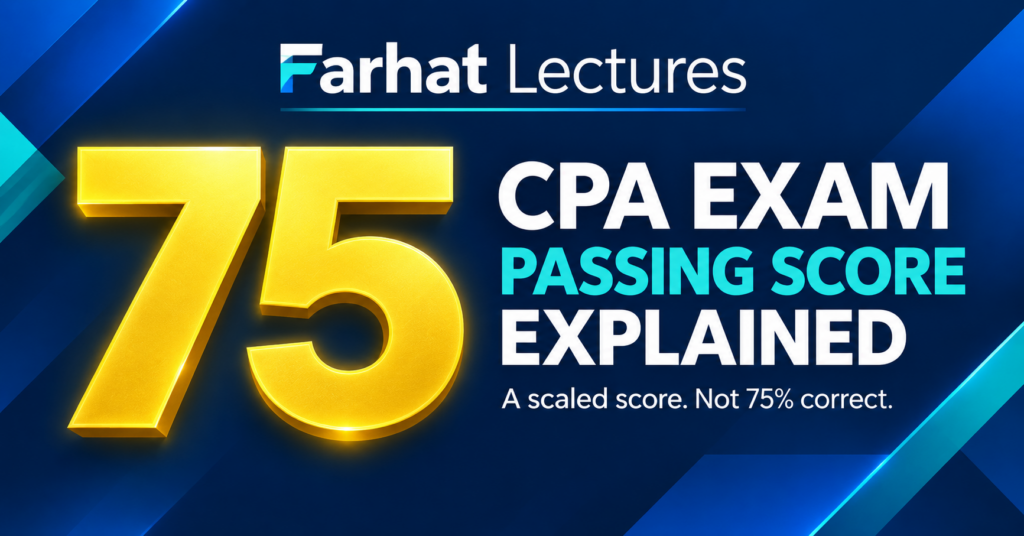
Yes. A CPA Exam score of 75 is the minimum passing score for each section in 2026. Scores range from 0 to 99. A 75 is a scaled score, not 75% correct, and the exam is not graded on a curve.
Many candidates ask what a 75 CPA Exam score really means. It shows that you met the passing standard for that section. Passing the exam is one step toward licensure; you must also satisfy your jurisdiction’s other requirements.
What a CPA Exam Score of 75 Means: A Marathon Analogy
Imagine a marathon challenge with a rule announced before the race: finish within five hours and you qualify. A runner who finishes in 4 hours, 55 minutes qualifies; one who finishes in 5 hours, 5 minutes does not. Other runners’ times do not change that threshold.
On the CPA Exam, a reported score of 75 meets the passing standard; a 74 does not. This analogy illustrates the threshold. The scoring process below explains how the exam accounts for your responses and question difficulty.
How Is the CPA Exam Scored?
The CPA Exam uses a scaled scoring model developed by the AICPA. Your total score combines scaled results from multiple-choice questions (MCQs) and task-based simulations (TBSs). Scoring considers factors including correct responses and question difficulty.
Scored MCQs and TBSs contribute to your result; unscored pretest questions do not. Counting correct answers alone cannot tell you your CPA Exam scaled score. Scaling keeps scores comparable across exam versions and over time.
| CPA Exam sections | MCQ weight | TBS weight |
|---|---|---|
| AUD, FAR, REG, BAR and TCP | 50% | 50% |
| ISC | 60% | 40% |
Source: AICPA CPA Exam scoring guidance.
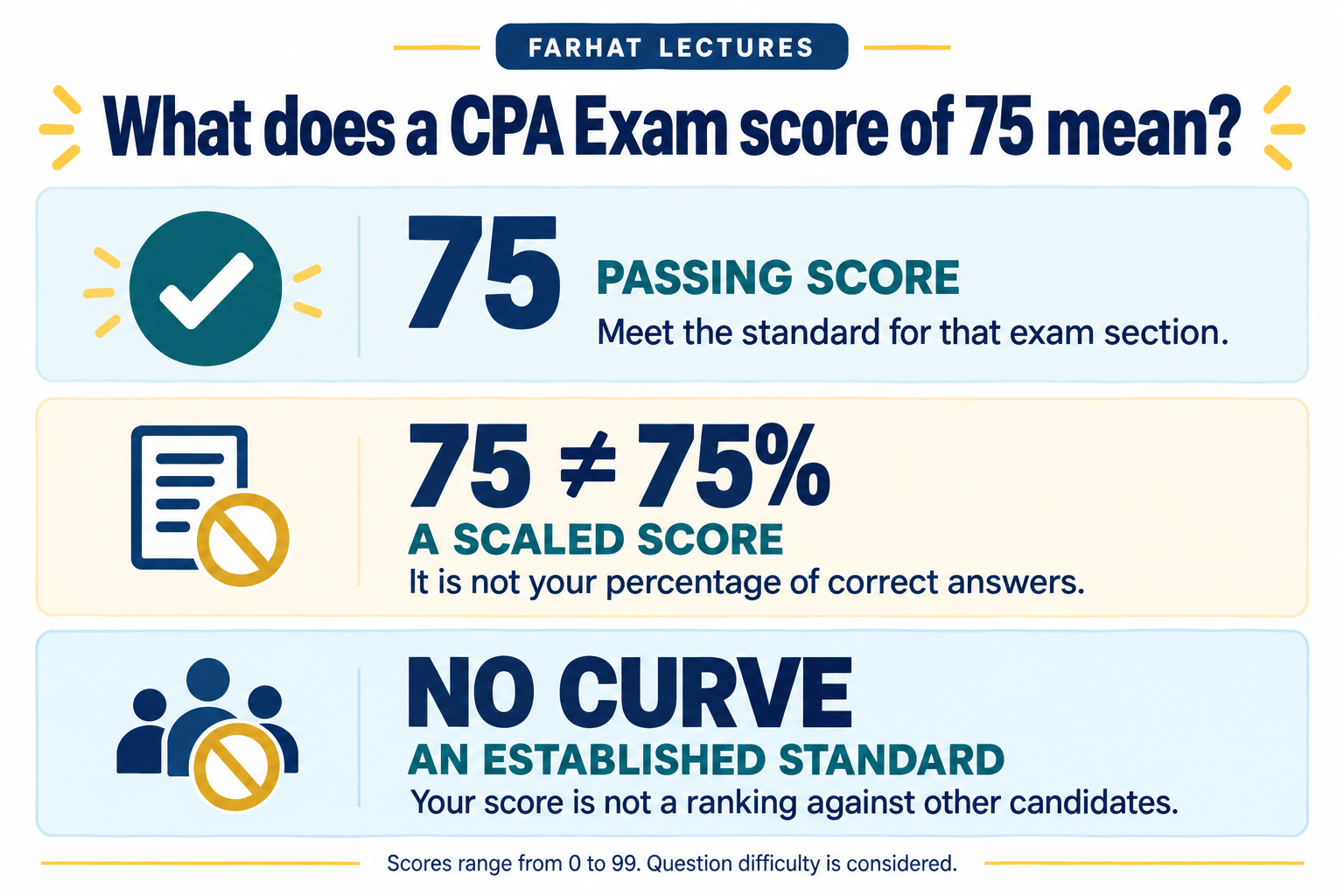
Is the CPA Exam Graded on a Curve?
No. Your score is measured against an established standard of competence. The CPA Exam has no pass/fail quota, and other candidates’ results in your testing window do not create a curve for your score.
A passing score describes your individual result. A pass rate describes the share of section attempts that pass in a reported period. For those statistics, see our CPA exam pass rates and passing percentage guide.
What Your CPA Score Means for Your Next Step
If you earned 75 or higher, you passed that section. Continue preparing for any remaining sections and check your jurisdiction’s requirements for licensure.
If you are preparing or retaking a section, use practice results to identify what needs work. A practice percentage is not a direct conversion to an official CPA score. Review why you missed each question: an unfamiliar concept, a calculation error, a missed fact or time pressure. Revisit the explanation, solve a fresh problem without notes, and practice both MCQs and simulations.
After an unsuccessful attempt, use any available Candidate Performance Report alongside your practice results. It may compare your performance with candidates who scored 75–80; that comparison does not determine your official score. Availability varies by jurisdiction, and content-area indicators are less reliable than the total score.
Give recurring weaknesses extra attention, while continuing to review all content areas. Track whether you can explain a concept, apply it to an unfamiliar fact pattern and complete the work within your practice time limit.
CPA Exam Passing Score FAQ
Is 75 a passing score on the CPA Exam?
Yes. A reported score of 75 or higher passes that CPA Exam section. A 74 is below the passing threshold.
Does a CPA Exam score of 75 mean 75% correct?
No. A 75 is a scaled score. It does not mean you answered 75% of the questions correctly or performed better than 75% of candidates.
Is the CPA Exam graded on a curve?
No. The AICPA uses an established passing standard. There is no quota limiting how many candidates can pass.
How many questions can you miss on the CPA Exam?
There is no single number that converts to a 75. Question difficulty, scoring weights and unscored pretest items prevent a simple correct-answer count from predicting your score.
Is the passing score the same for every CPA Exam section?
Yes. The minimum is 75 for AUD, FAR, REG, BAR, ISC and TCP. Candidates must pass the three Core sections and one chosen Discipline section.
Why does my performance report compare me with other candidates?
The comparison helps identify areas to improve. It is separate from your official score and does not mean your exam was curved.



Responses