
Long-Term Notes Payable: A Simple Guide with Journal Entries

Long-term notes payable are written promises to repay borrowed money more than one year (or one operating cycle, if longer) after the balance sheet date, so they are reported as noncurrent liabilities. Under U.S. generally accepted accounting principles (U.S. GAAP), the borrower records the note at the present value of its future payments and generally recognizes interest expense using the effective-interest method.
The stated interest rate sets the cash interest you pay. The effective interest rate, which is the market rate when the note is issued, sets the interest expense you record. Expense is calculated on the note’s carrying amount, meaning its face amount minus any unamortized discount or plus any unamortized premium. The operating cycle is the time it takes a business to turn cash into inventory, sales, and back into cash.
The distinction matters because the cash paid this year may differ from this year’s borrowing cost. A zero stated rate can still produce interest expense, while an interest-bearing note can still be issued at a discount. This guide uses U.S. GAAP and original, hypothetical examples without transaction costs.
Studying for the CPA exam? Long-term notes payable are tested in the FAR section under debt (financial liabilities), part of Area II, Select Balance Sheet Accounts, in the 2026 AICPA blueprint. Practice calculating present value, building an amortization schedule, and classifying the current portion, because those skills come up again and again.
Video lesson with Professor Farhat
Prefer to watch first? In this video, Professor Farhat explains how long-term notes payable are valued, how zero-interest-bearing notes work, and how effective-interest amortization builds the schedules you will see below. Then use the written examples to practice on your own.
Face amount, carrying amount, and present value: what is the difference?
Face amount is the principal promised at maturity. Carrying amount is the liability reported after subtracting an unamortized discount or adding an unamortized premium. Present value is today’s equivalent of future payments. Notes resemble bonds measured with the effective-interest method, although notes generally trade less readily in public securities markets.
| At issuance | Initial carrying amount | Interest expense versus cash interest |
|---|---|---|
| Stated rate = market rate | Equals face amount | Equal |
| Stated rate < market rate | Below face amount: discount | Expense exceeds cash interest |
| Stated rate > market rate | Above face amount: premium | Expense is below cash interest |
| Zero stated rate with discounted proceeds | Cash received is below maturity amount | Expense exists even without periodic cash interest |
These comparisons assume fixed promised payments, an ordinary cash borrowing, and no additional rights or privileges. A note issued solely for cash is initially measured by the cash proceeds. If the transaction instead exchanges property or services, review imputed interest and the evidence used to measure a note.
How do you record a note issued at face value?
Hypothetical example. On January 1, Maple Design borrows $40,000 for three years at an annual stated and market rate of 7%. Interest is paid each December 31; principal is due at maturity. At issuance, debit Cash $40,000 and credit Notes Payable $40,000. Each full year, debit Interest Expense $2,800 and credit Cash $2,800.
The carrying amount stays at $40,000 until repayment because there is no discount or premium. If interest has accrued but has not yet been paid at a reporting date, credit Interest Payable instead of Cash. Payment later settles that payable; it does not create a second interest expense.
How do you record an interest-bearing note issued at a discount?
Hypothetical example. On January 1, Harbor Analytics issues a two-year, $50,000 note. It pays 6% interest annually, but investors require 10% for comparable risk. Annual cash interest is $3,000. Discount both the $3,000 annual payments and the $50,000 maturity payment at 10%. The interest payments form an ordinary annuity, so you can also value them using the present value of an ordinary annuity.
Present value = $3,000 ÷ 1.10 + $53,000 ÷ 1.10² = $46,528.93. The $53,000 final payment includes both the last $3,000 interest payment and principal. Discount on Notes Payable is $50,000 − $46,528.93 = $3,471.07.
| Account | Debit | Credit |
|---|---|---|
| Cash | $46,528.93 | — |
| Discount on Notes Payable | $3,471.07 | — |
| Notes Payable | — | $50,000.00 |
The discount is a contra-liability, not a separate asset. The initial net obligation is $46,528.93. Effective interest equals the opening carrying amount multiplied by the effective annual rate. The discount amortized is interest expense minus cash interest.
| Year | Opening carrying amount | Interest expense | Cash interest | Closing amount before principal payment |
|---|---|---|---|---|
| 1 | $46,528.93 | $4,652.89 | $3,000.00 | $48,181.82 |
| 2 | $48,181.82 | $4,818.18 | $3,000.00 | $50,000.00 |
At the first year-end, debit Interest Expense $4,652.89, credit Cash $3,000, and credit Discount on Notes Payable $1,652.89. Repeat using year 2’s amounts. At maturity, debit Notes Payable and credit Cash for $50,000. Total expense is $9,471.07: $6,000 cash interest plus the $3,471.07 discount. Figures are rounded to cents.
How do you account for a zero-interest-bearing note payable?
Hypothetical example. Birch Studio receives $30,000 cash and promises $39,930 in three years, with no interim payments. The implicit annual rate is 10% because $30,000 × 1.10³ = $39,930. Debit Cash $30,000 and Discount on Notes Payable $9,930; credit Notes Payable $39,930.
| Year | Opening amount | Interest at 10% | Closing amount |
|---|---|---|---|
| 1 | $30,000 | $3,000 | $33,000 |
| 2 | $33,000 | $3,300 | $36,300 |
| 3 | $36,300 | $3,630 | $39,930 |
Each year, debit Interest Expense and credit Discount on Notes Payable for the interest shown. With no cash paid during the term, the net liability grows to the maturity amount. The discount is fully amortized immediately before settlement. For the underlying calculation, review present value of a single sum.
What changes when a note is issued at a premium?
A premium arises when the stated rate exceeds the required market yield. Debit Cash for proceeds above face value; credit Notes Payable for face value and Premium on Notes Payable for the excess. During amortization, cash interest exceeds effective interest expense, so debit the premium for the difference. The carrying amount decreases toward face value.
Hypothetical example. On January 1, Cedar Logistics issues a two-year, $20,000 note that pays 9% interest annually, while the market rate for similar notes is 6%. Annual cash interest is $1,800. Present value = $1,800 ÷ 1.06 + $21,800 ÷ 1.06² = $21,100.04. The premium is $21,100.04 − $20,000 = $1,100.04.
At issuance, debit Cash $21,100.04, credit Notes Payable $20,000.00, and credit Premium on Notes Payable $1,100.04.
| Year | Opening carrying amount | Interest expense at 6% | Cash interest | Premium amortized | Closing amount |
|---|---|---|---|---|---|
| 1 | $21,100.04 | $1,266.00 | $1,800.00 | $534.00 | $20,566.04 |
| 2 | $20,566.04 | $1,233.96 | $1,800.00 | $566.04 | $20,000.00 |
At the first year-end, debit Interest Expense $1,266.00 and Premium on Notes Payable $534.00, and credit Cash $1,800.00. Total interest expense over the two years is $2,499.96, which equals $3,600 of cash interest minus the $1,100.04 premium. Figures are rounded to cents.
Do not confuse that decrease with an installment payment. Discount or premium amortization adjusts measurement; principal installments repay the borrowing itself. See mortgage notes payable and installment schedules for that payment pattern.
How are long-term notes payable reported on the balance sheet?
A note payable is reported at its carrying amount, not just its face amount. Under FASB ASC 835-30-45-1A, an unamortized discount is shown as a direct deduction from the face amount, and an unamortized premium is added to it. Debt issuance costs, such as legal and lender fees, are also shown as a direct deduction from the face amount. None of these is reported as a separate asset or deferred charge. The note’s description should also disclose its effective interest rate.
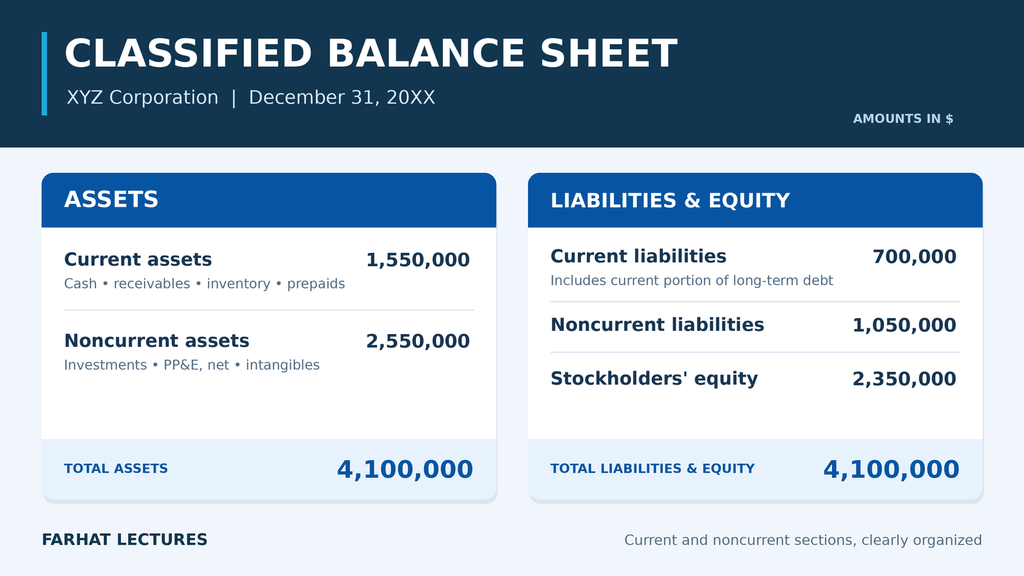
Classification is the other half of the picture. Any principal due within one year of the balance sheet date, or within the operating cycle if longer, is a current liability. The rest stays noncurrent.
Hypothetical example. Willow Supply owes a $90,000 note that was issued at face value. Principal is repaid in three equal annual installments of $30,000, and the next installment is due nine months after year-end. At year-end, Willow reports $30,000 as current maturities of long-term debt and $60,000 as a long-term note payable.
Exam trap. Look back at Harbor Analytics. At the end of year 1, the whole note matures within 12 months. Harbor reports the net amount of $48,181.82 ($50,000 face amount minus the $1,818.18 unamortized discount) as a current liability, unless it meets the refinancing conditions in FASB ASC 470-10.
For more practice with reclassification, see current portion of long-term debt.
Common mistakes
These are the slips that cost students points on exams:
- Mixing up the two rates. Stated rate times face amount gives the cash interest. Effective rate times the opening carrying amount gives the interest expense.
- Discounting only the principal. Discount every promised cash flow, interest and principal.
- Expensing the whole discount on day one. The discount turns into interest expense gradually over the life of the note.
- Showing a discount as an asset. It is a contra-liability, which means it is subtracted from the note’s face amount.
- Updating the effective rate when market rates move. For a fixed-rate note carried at amortized cost, which is the normal treatment, the rate set at issuance stays for the life of the note. A company that elects the fair value option measures the note differently, which is outside the scope of this guide.
- Leaving next year’s principal in long-term liabilities. Any principal due within one year, or within the operating cycle if longer, belongs in current liabilities.
Key takeaways
- Long-term notes payable are liabilities due beyond one year or the operating cycle, whichever is longer.
- A note is recorded at the present value of all its promised cash payments.
- Stated rate times face amount equals cash interest. Effective rate times carrying amount equals interest expense.
- A discount pushes interest expense above the cash paid; a premium pulls it below.
- Zero-interest notes still have interest expense. It is built into the gap between the cash received and the maturity amount.
- Discounts, premiums, and debt issuance costs adjust the note’s face amount directly on the balance sheet.
Practice questions with explained answers
1. A $60,000 note pays 5%, and its effective rate is also 5%. What is annual interest expense?
Answer: $3,000. With issuance at face value and no fees, $60,000 × 5% equals both expense and cash interest.
2. A note opens at $72,000, has an 8% effective rate, and pays $4,000 interest. What discount is amortized?
Answer: $1,760. Expense is $72,000 × 8% = $5,760. Subtract $4,000 cash interest. The carrying amount becomes $73,760 before any principal payment.
3. A borrower receives $25,000 and repays $28,090 in two years with no other payments. What is total interest?
Answer: $3,090. It is the difference between proceeds and repayment. The implicit rate is 6%, since $25,000 × 1.06² = $28,090.
Interactive practice quiz: classifying and measuring long-term notes payable
Test yourself with four multiple-choice questions. They cover how to classify a note as current or long-term, which payments belong in present value, and how a discount or premium is amortized. Choose an answer, use the hints if you get stuck, and read the explanation after each question.
Quick review of the rules in the quiz
A note is current when it is due within one year or the operating cycle, whichever is longer. The present value of an interest-bearing note includes every promised payment, both principal and interest. A discount or premium is amortized over the life of the note, just as with bonds. Notes and bonds both have fixed maturity dates and a stated or implicit interest rate, although notes generally trade less readily in public securities markets.
Want more practice like this? The Intermediate Accounting course includes video lessons and exercises on notes payable, bonds, and present value. Not ready to commit? Try the free sample course first.
Frequently asked questions
Are notes payable and notes receivable the same account?
No. The borrower records a liability and interest expense. The lender records an asset and interest revenue. See the lender’s perspective in notes receivable accounting.
Can the discount be amortized equally each year?
The effective-interest method is the benchmark. Another method is acceptable under U.S. GAAP only when its results are not materially different. Equal allocation should not be assumed automatically.
Why does interest expense rise on a discounted lump-sum note?
The same effective rate is applied to a growing carrying amount. Each period’s discount amortization increases that amount toward the contractual maturity value.
Are long-term notes payable current or noncurrent liabilities?
Mostly noncurrent. Any principal due within one year of the balance sheet date, or within the operating cycle if longer, is reported as a current liability, often labeled current maturities of long-term debt. The rest stays noncurrent.
How are notes payable different from bonds payable?
Both are long-term debt with a fixed maturity date and a stated or implicit interest rate, and both are measured at present value with discounts or premiums amortized. The main difference is that bonds are usually sold to many investors and trade in public markets, while notes are usually arranged with a single lender, such as a bank, and trade less readily.
Where do debt issuance costs go on the balance sheet?
Under U.S. GAAP, debt issuance costs, such as legal and lender fees, are subtracted directly from the note’s face amount, just like a discount. They are then amortized into interest expense over the life of the note.
What if a note is issued for property instead of cash?
If the note has no stated interest, an unreasonable stated rate, or a face amount materially different from the cash price of the property, record it at the fair value of the property or services, or at the market value of the note if that is easier to determine. If neither can be determined, the borrower imputes an interest rate. See imputed interest on notes payable.
About the author: Mansour Farhat, CPA, CIA, DBA, is the professor behind Farhat Lectures, where he teaches intermediate accounting and CPA exam review through video lessons and practice problems like the ones in this guide.
Sources and lesson context
The main U.S. GAAP reference is FASB ASC 835-30, Imputation of Interest, which covers present value measurement, the effective-interest method, and balance sheet presentation of discounts, premiums, and debt issuance costs. Current versus noncurrent classification follows FASB ASC 470-10, Debt. FASB’s archived APB Opinion 21 provides historical background on present value and effective-interest amortization; the current Codification governs accounting.
This original guide supports Wiley Intermediate Accounting, section 13.3, Long-Term Notes Payable. All worked examples and practice questions are hypothetical and original.
Continue learning: Intermediate Accounting course · Farhat Lectures free sample course.

Responses