
Accrual Adjusting Entries: Simple Revenue and Expense Examples


Accrual adjusting entries are journal entries made at the end of an accounting period to record revenue earned or expenses incurred that have not been recorded yet, because the cash will be received or paid in a later period. For accrued revenue, debit a receivable and credit revenue. For an accrued expense, debit the expense and credit a payable.
Watch Professor Farhat: jump to the unpaid payroll example at 5:36 or the accrued interest revenue example at 8:39. The full lesson covers all four types of adjusting entries in under 14 minutes.
What do accrual adjusting entries record?
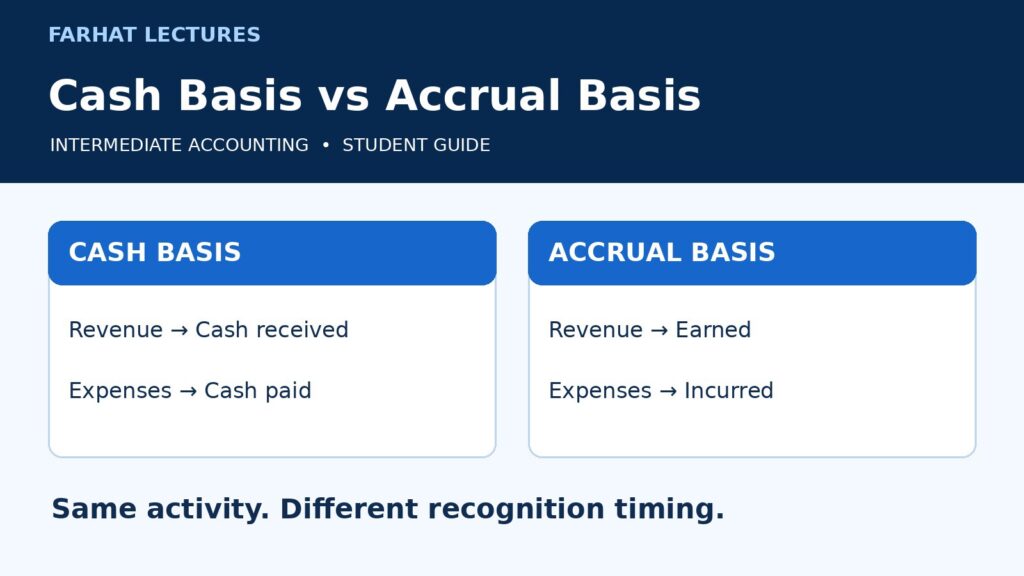
The reporting date is the cutoff, such as December 31. Revenue earned and costs incurred during the current reporting period belong to that period, even when the cash moves afterward. Skip the adjustment and the financial statements leave out money the company has a right to collect, or a bill it already owes. A January invoice or payday does not move December activity into January.
The Financial Accounting Standards Board (FASB) describes this timing distinction in Conceptual Framework paragraph OB17. For the broader classification, review the four types of adjusting entries.
Accrued revenue versus accrued expense
| Feature | Accrued revenue | Accrued expense |
|---|---|---|
| Current-period event | Company provides service or earns interest | Company receives service or incurs interest |
| Missing balance-sheet amount | Asset: receivable | Liability: payable |
| Adjustment | Debit Receivable; credit Revenue | Debit Expense; credit Payable |
| Later cash settlement | Debit Cash; credit Receivable | Debit Payable; credit Cash |
| Effect if omitted | Revenue, assets, and income too low | Expense and liabilities too low; income too high |
The table assumes the amount is genuinely unrecorded. A customer’s unpaid invoice does not require another revenue entry if the sale and receivable were already posted. “Unpaid” and “unrecorded” are different conditions.
How do you record accrued revenue for unbilled work?
Hypothetical example: Alder Consulting completes a $2,750 project on December 29. Assume finishing the project means Alder has done everything it promised (what revenue recognition rules call its performance obligation) and the customer owes the full $2,750, with nothing left to happen except payment. The invoice is issued in January, and no entry was recorded in December.
| December 31 account | Debit | Credit |
|---|---|---|
| Accounts Receivable | $2,750 | — |
| Service Revenue | — | $2,750 |
The adjustment records December revenue and the customer’s obligation. When the $2,750 is collected in January, debit Cash and credit Accounts Receivable. Crediting Service Revenue again would double count the same project.
For customer contracts within its scope, Accounting Standards Codification (ASC) Topic 606 ties revenue to satisfying the performance obligation. Merely planning work or signing a contract does not establish that revenue has been earned. More complex contract-asset distinctions are beyond this introductory example. For the full model, see our revenue recognition lesson.
How do you calculate accrued wages?
Hypothetical example: Alder’s employees collectively earn $1,125 per workday. At December 31, two completed workdays have not been paid or recorded. Ignore payroll taxes and deductions for this illustration.
Accrued wages = daily wages × unpaid days worked = $1,125 × 2 = $2,250.
| December 31 account | Debit | Credit |
|---|---|---|
| Wages Expense | $2,250 | — |
| Wages Payable | — | $2,250 |
Suppose the next payday covers these two days plus three January workdays. Total cash paid is $5,625. The payment entry is:
| Payday account | Debit | Credit |
|---|---|---|
| Wages Payable | $2,250 | — |
| Wages Expense (3 January workdays) | $3,375 | — |
| Cash | — | $5,625 |
The payable removes the December obligation. Only the three new workdays create January expense. This example assumes no reversing entry was made. Reversing entries are a separate topic and are not needed to understand this settlement.
Count the workdays included in the question, not every calendar day. A weekend creates no additional wage accrual when the stated pay arrangement covers weekdays only.
How do you calculate accrued interest?
Hypothetical example: Alder borrows $48,000 on November 1 at 9% annual simple interest. Principal and interest are payable later. No interest entry has been recorded by December 31.
Interest = principal × annual rate × fraction of year = $48,000 × 9% × 2/12 = $720.
| December 31 account | Debit | Credit |
|---|---|---|
| Interest Expense | $720 | — |
| Interest Payable | — | $720 |
Notes Payable remains $48,000 because the interest obligation is recorded separately from principal. Using 9% for each month would overstate the expense. Use the time basis specified in the problem: months divided by 12, or days divided by the stated annual day-count basis (such as 360 or 365 days). For example, a $12,000, 6% note issued on November 16 has 45 days of interest by December 31: 14 days in November after the issue date, plus 31 days in December. On a 360-day basis, accrued interest is $12,000 × 6% × 45/360 = $90.
Now flip it around. If Alder’s lender also closes its books on December 31 and has recorded nothing, it accrues the same $720 as revenue: debit Interest Receivable $720 and credit Interest Revenue $720. That is the accrued interest revenue case Professor Farhat works through at 8:39 in the video, and you can review the lender’s side in our notes receivable lesson. One time calculation, two sets of books: an asset for the lender and a liability for the borrower.
Other common accruals
Wages and interest show up most often in textbook problems, but the same pattern works for any cost used or revenue earned before the paperwork arrives.
- Utilities: December electricity is used in December, even if the bill comes in January. If the meter reading supports a $640 estimate, debit Utilities Expense $640 and credit Utilities Payable $640.
- Income taxes: Tax owed on this period’s income is accrued at period end. Debit Income Tax Expense and credit Income Taxes Payable.
- Rent earned: A landlord who has earned December rent but has not yet received or recorded it debits Rent Receivable and credits Rent Revenue for the unrecorded December amount.
Exam tip: Read the question stem twice. Many questions give you the year-end facts and then ask for the January cash entry, not the December adjustment.
How to check an accrual adjustment
First identify the activity completed by the reporting date. Next verify that the revenue or expense has not already been posted. Calculate only the unrecorded current-period amount, choose the receivable or payable, and check equal debits and credits.
An accrual increases an income-statement account and a balance-sheet account in these examples. However, an expense increase reduces net income; an increase in the expense account is not an increase in profit.
After posting, use the adjusted trial balance example to see how new receivable, payable, revenue, and expense balances enter a complete schedule. Once the financial statements are prepared, the revenue and expense balances are cleared with closing entries.
Common accrual mistakes
Do not wait for the invoice when the period already contains an incurred cost that should be recognized. Conversely, do not accrue a future cost simply because management expects to spend money next month. The current-period event and obligation must exist.
Do not confuse unpaid wages with prepaid wages or a customer advance with accrued revenue. Cash already received for unperformed services belongs to the deferral adjustment process. Keep the cash entry separate from the period-end recognition entry.
Key takeaways
- Accrual adjusting entries record revenue earned or expenses incurred this period when the cash moves in a later period.
- Accrued revenue: debit a receivable, credit revenue. Accrued expense: debit the expense, credit a payable.
- Accrue only what has not been recorded yet. Unpaid is not the same as unrecorded.
- Accrued wages = daily wages × unpaid days worked. Accrued interest = principal × annual rate × fraction of the year.
- When the cash moves later, clear the receivable or payable. Do not record the revenue or expense a second time.
- Skipping an accrual understates both accounts involved. A missed accrued revenue understates net income; a missed accrued expense overstates it.
Adjusting Entries for Accruals: Interactive Exercise
Accrual adjusting entries record revenues earned and expenses incurred in the current accounting period that have not yet been recorded. The related cash is received or paid later. For the basic entries in this exercise, accrued revenue increases an asset and revenue; accrued expense increases an expense and a liability.
Test the debit and credit rules from the examples above. Choose the correct answer for each of the seven questions, then select Check answers. Each correct answer earns one point. Review the explanations, then apply the rules in the worked practice questions below.
Review the rules and answer guide
What are adjusting entries for accruals?
They record current-period revenues earned and expenses incurred that have not yet been recorded, before the related cash is received or paid. Each basic accrual adjusting entry increases a balance sheet account and an income statement account.
| Accrual type | Debit: increase | Credit: increase |
|---|---|---|
| Accrued revenues | Asset account | Revenue account |
| Accrued expenses | Expense account | Liability account |
What happens if an accrual adjustment is omitted?
For accrued revenues, the revenue account and related asset account are understated, and net income is understated. For accrued expenses, the expense account and related liability account are understated, and net income is overstated. An increase in an expense account reduces net income.
Practice questions with explained answers
1. A completed $1,600 service has not been billed or recorded. What is the adjustment, assuming an unconditional receivable?
Answer: Debit Accounts Receivable $1,600 and credit Service Revenue $1,600. The billing date does not delay recognition of the completed service under these facts.
2. Employees earn $800 per workday and have worked three unpaid days. What is accrued?
Answer: $2,400: debit Wages Expense and credit Wages Payable. The calculation follows days already worked.
3. A $30,000 note bears 8% annual interest. Two months are unrecorded. What is the interest adjustment?
Answer: $400: $30,000 × 8% × 2/12. Debit Interest Expense and credit Interest Payable; leave the principal balance unchanged.
4. A lender holds a $20,000, 6% note. Three months of interest are unrecorded. What is the adjustment?
Answer: $300: $20,000 × 6% × 3/12. Debit Interest Receivable and credit Interest Revenue. The note receivable itself stays at $20,000.
Frequently asked questions
Does an accrual adjustment change Cash?
Answer: The timing adjustments here do not. Cash changes when the receivable is collected or the payable is paid.
Is accrued revenue always a receivable?
Answer: The examples assume an unconditional right to payment. Actual customer contracts can require a contract-asset analysis when payment depends on further performance.
Can an accrued expense be estimated?
Answer: Yes. An estimate may be necessary before an invoice arrives. It should reflect the service received and the available evidence, rather than an arbitrary amount.
What is the difference between accruals and deferrals?
Answer: With an accrual, the revenue or expense happens first and the cash comes later, so the adjustment creates a receivable or a payable. With a deferral, the cash comes first and the revenue or expense happens later, so the adjustment reduces a prepaid asset or an unearned revenue liability.
When are accrual adjusting entries recorded?
Answer: At the end of each reporting period, before the adjusted trial balance and financial statements are prepared. That can be monthly, quarterly, or yearly, depending on how often the company reports.
Do accrual adjusting entries have to be reversed?
Answer: No. Reversing entries are optional. In the Alder wages example, a January 1 reversing entry would debit Wages Payable $2,250 and credit Wages Expense $2,250. The payday entry would then debit Wages Expense $5,625 and credit Cash $5,625, leaving January wages expense at $3,375, the same result shown above.
About the author
Mansour Farhat, CPA, CIA, DBA, teaches accounting, CPA, CMA, and EA courses at Farhat Lectures and on the Farhat Lectures YouTube channel. Read more about Professor Farhat.




Responses