
Consignment Accounting: Consignor and Consignee Journal Entries

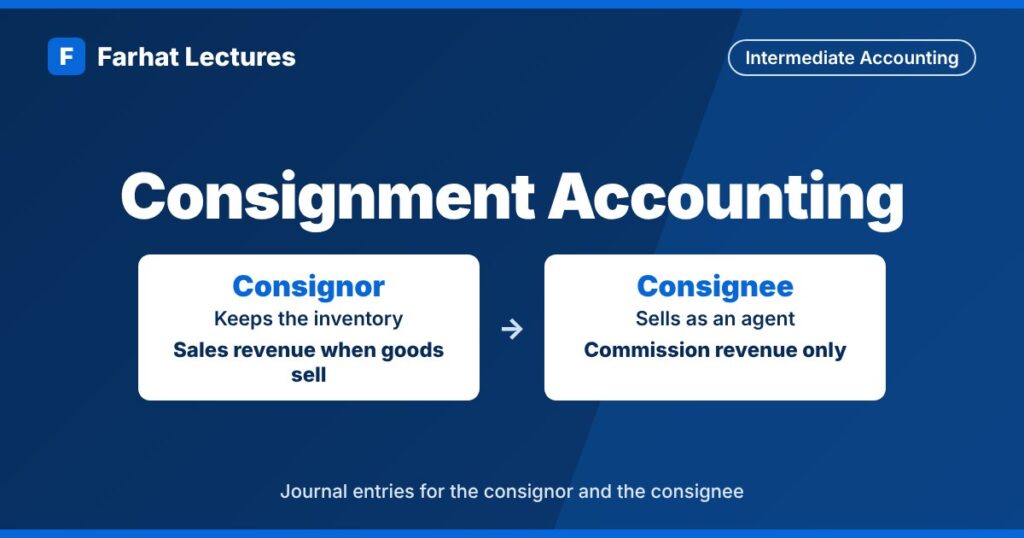
Consignment accounting records goods a consignor ships to a dealer, the consignee, who sells them as the consignor’s agent. Under ASC 606, the consignor keeps the goods in inventory and records no sale at shipment. The consignor recognizes revenue when control transfers to a customer, typically when the consignee sells the goods to an end customer. The consignee records only commission revenue.
Why does this matter? Shipping goods looks like a sale, but in a consignment the dealer has not bought anything. If the consignor booked revenue at shipment, it would overstate revenue and remove inventory it still owns. Consignment questions also test both sides of the same transaction, so you need to know which party records each entry.
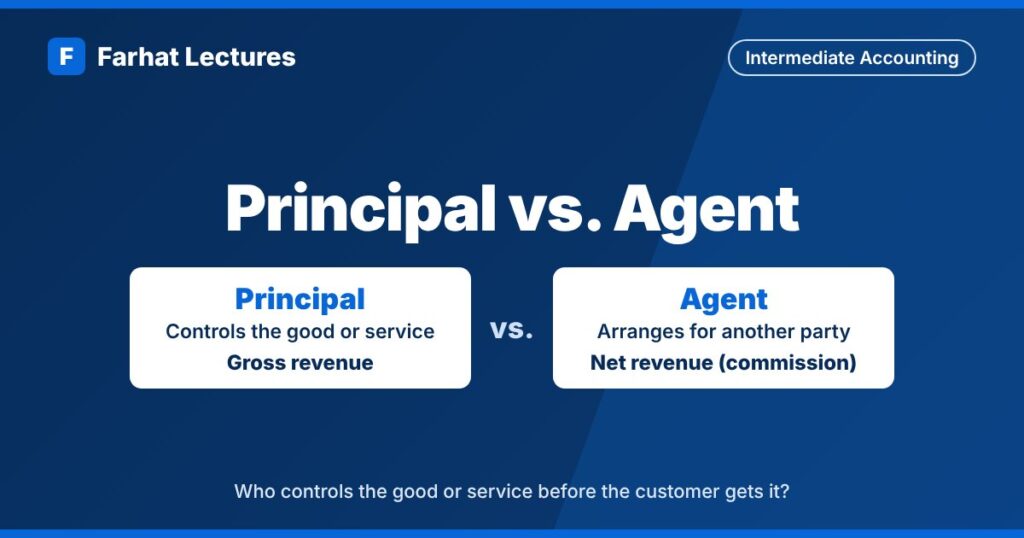
This guide supports lesson 17.3, Accounting for Revenue Recognition Issues, in the Farhat Lectures intermediate accounting series. A consignment is a type of principal-agent relationship, explained in principal vs. agent: gross vs. net revenue.
Watch: how consignment accounting works
Watch this Farhat lesson on YouTube
In this 12-minute lesson, Professor Farhat records a consignment from both sides. He starts with the shipment, then freight and other expenses, then the sales and commission, then the cash settlement, and finishes with cost of goods sold. Watch it before the example below and the entries will already look familiar.
How does a consignment work?
- The consignor (a manufacturer or wholesaler) ships merchandise to the consignee (a dealer) but keeps legal title.
- The consignee acts as the consignor’s agent. It cares for the goods, sells them, and earns a commission.
- The consignee sends the consignor a report called an account sales, listing goods received, goods sold, expenses charged to the consignor, and cash remitted.
- The consignee remits the sales proceeds minus its commission and any reimbursable expenses.
The consignor carries the risk that the goods will not sell, and the consignee avoids tying up its own cash in inventory.
Is it a consignment or a sale?
The FASB sets out these indicators in ASC 606-10-55-80, which tells you when an arrangement is a consignment rather than a sale to the dealer. PwC’s guide on consignment arrangements walks through them in detail. If the dealer has bought the goods but the seller still holds them for the dealer, the sale may be a bill-and-hold arrangement.
| Indicator | What it means |
|---|---|
| The consignor controls the product until a specified event | For example, until the dealer sells it to an end customer or a set period expires. |
| The consignor can require the product back | It can recall the goods or transfer them to another dealer. |
| The dealer has no unconditional obligation to pay | The dealer pays only for goods it sells, although a deposit may be required. |
Consignment accounting example
Example (hypothetical). Ridgeline Outdoor ships 100 kayaks costing $300 each ($30,000) on consignment to Bayside Sports. Ridgeline pays $1,200 of freight to deliver them. Bayside pays $600 for local advertising, which Ridgeline agreed to reimburse. By the end of the period, Bayside sells 60 kayaks at $650 each for $39,000 cash. Bayside reports the sales to Ridgeline, keeps a 15% commission, and remits the rest.
| Item | Amount |
|---|---|
| Sales of consigned kayaks (60 × $650) | $39,000 |
| Less: commission (15% × $39,000) | (5,850) |
| Less: advertising reimbursed to Bayside | (600) |
| Cash remitted to Ridgeline | $32,550 |
Journal entries for the consignor and consignee
Shipment of the kayaks
Ridgeline (consignor): moves the kayaks into a separate inventory account. No sale has occurred.
| Ridgeline Outdoor | Debit | Credit |
|---|---|---|
| Inventory (Consignments) | 30,000 | |
| Finished Goods Inventory | 30,000 |
Bayside (consignee): no entry. It keeps a memo record of the goods received.
Freight paid by the consignor
Ridgeline: adds the freight to the cost of the consigned inventory. Bayside: no entry.
| Ridgeline Outdoor | Debit | Credit |
|---|---|---|
| Inventory (Consignments) | 1,200 | |
| Cash | 1,200 |
Advertising paid by the consignee
Bayside: records a receivable, because Ridgeline will reimburse it. Ridgeline: no entry until notified.
| Bayside Sports | Debit | Credit |
|---|---|---|
| Receivable from Consignor | 600 | |
| Cash | 600 |
Sale of 60 kayaks
Bayside: the cash belongs to Ridgeline, so it records a payable, not revenue. Ridgeline: no entry until notified. Some books record this payable net of the commission instead. Either way the cash Bayside finally sends is the same $32,550.
| Bayside Sports | Debit | Credit |
|---|---|---|
| Cash | 39,000 | |
| Payable to Consignor | 39,000 |
Account sales report and remittance
Ridgeline records the full $39,000 as revenue, with the commission and advertising as expenses:
| Ridgeline Outdoor | Debit | Credit |
|---|---|---|
| Cash | 32,550 | |
| Advertising Expense | 600 | |
| Commission Expense | 5,850 | |
| Revenue from Consignment Sales | 39,000 |
Bayside clears the payable and receivable and records its commission revenue:
| Bayside Sports | Debit | Credit |
|---|---|---|
| Payable to Consignor | 39,000 | |
| Receivable from Consignor | 600 | |
| Commission Revenue | 5,850 | |
| Cash | 32,550 |
Cost of the kayaks sold
Ridgeline: 60 of 100 kayaks were sold, so 60% of the consigned inventory cost, including freight, becomes cost of goods sold: 60% × ($30,000 + $1,200) = $18,720.
| Ridgeline Outdoor | Debit | Credit |
|---|---|---|
| Cost of Goods Sold | 18,720 | |
| Inventory (Consignments) | 18,720 |
Return of the unsold kayaks
After year-end, the consignment arrangement ends and Bayside ships the 40 unsold kayaks back. Ridgeline moves them out of the consignment account and back into finished goods at their carrying amount of $12,480, which is 40 units at $312 each. Bayside makes no entry, because it never owned them.
| Ridgeline Outdoor | Debit | Credit |
|---|---|---|
| Finished Goods Inventory | 12,480 | |
| Inventory (Consignments) | 12,480 |
If Ridgeline pays freight to bring the kayaks home, that freight is an expense of the period. Only the cost of getting inventory ready to sell belongs in inventory, and a return trip does not qualify.
What each party reports
The table shows what each party reports at year-end, while Bayside still holds the 40 unsold kayaks.
| Ridgeline (consignor) | Bayside (consignee) | |
|---|---|---|
| Revenue | Consignment sales $39,000 | Commission revenue $5,850 |
| Expenses | Cost of goods sold $18,720; commission $5,850; advertising $600 | None from this consignment |
| Income from the consignment | $13,830 | $5,850 |
| Ending consigned inventory | $12,480 (40 kayaks × $312) | None |
The consignor recognizes revenue for sales made during the period. If the account sales report arrives after the period ends, the consignor still needs to record the sales that took place before year-end.
Who counts consigned goods at year-end?
Year-end inventory reporting follows ownership. Ridgeline includes the 40 unsold kayaks in its inventory while Bayside holds them in its showroom. Bayside excludes them from its own reported inventory.
This is where exam questions like to hide a consignment. The goods get described by where they are, and you have to work out who owns them. The same test applies to goods in transit at year-end.
Key takeaways on consignment accounting
- Shipping goods on consignment is not a sale.
- The consignor keeps the goods in Inventory (Consignments), including freight to the consignee.
- The consignor recognizes sales revenue when control transfers to the customer. In this example, that happens when Bayside sells a kayak to an end customer.
- The consignee records cash from sales as a payable and recognizes only commission revenue.
- Cost of goods sold is based on the consigned inventory cost of the units sold. Consignment is one of several revenue recognition issues under ASC 606.
Common mistakes
- Recording revenue when goods are shipped to the consignee.
- Recording consigned goods as inventory on the consignee’s books.
- Leaving freight out of the cost of consigned inventory.
- Recording the consignor’s revenue at the net cash remitted instead of the gross sales amount.
- Treating the consignee’s sales proceeds as its own revenue.
Interactive consignment accounting exercise
Test your understanding with five multiple-choice questions on consignor and consignee roles, ownership of unsold inventory, revenue recognition, net cash remittance, and the account sales report. Each question includes a worked explanation of the correct answer.
Consignment Accounting Practice: Inventory and Revenue Recognition
A consignment is a principal-agent arrangement in which a manufacturer or wholesaler sends goods to a dealer to sell on its behalf. Use the questions below to practice identifying the consignor and consignee, tracking inventory, and accounting for sales proceeds.
Practice questions with answers
1. A consignee sells consigned goods for $20,000, earns a 10% commission, and paid $300 of reimbursable delivery costs. How much cash does it remit?
Answer: $20,000 − $2,000 − $300 = $17,700.
2. A consignor ships goods costing $50,000 and pays $2,000 of freight. The consignee sells 25% of the goods. What is the consignor’s cost of goods sold?
Answer: 25% × ($50,000 + $2,000) = $13,000.
3. At year-end, goods costing $8,000 are held by a consignee and remain unsold. On whose balance sheet do they appear?
Answer: The consignor’s, as Inventory (Consignments). The consignee never owned the goods.
Frequently asked questions
What is consignment accounting?
It is the accounting for goods a consignor ships to a consignee to sell on its behalf. The consignor keeps the goods in inventory until they are sold, and the consignee records only the commission it earns.
When does the consignor recognize revenue?
The consignor recognizes revenue when a customer gains control of the goods and can direct their use and obtain their benefits. In this example, that happens when Bayside sells a kayak to an end customer. Bayside’s account sales report documents the sale. Ridgeline records the revenue in the period the sale occurs.
Does the consignee record consigned goods as inventory?
No. The consignee does not own the goods, so it keeps only a memo record of what it received.
Is freight to the consignee an expense?
No. Freight paid by the consignor to deliver goods to the consignee is added to the cost of the consigned inventory and expensed as cost of goods sold when the goods are sold.
What is an account sales?
It is the report a consignee sends the consignor showing goods received, goods sold, expenses charged to the consignor, the commission kept, and the cash remitted.
Is a consignment a sale under ASC 606?
No. ASC 606-10-55-80 points to a consignment when the consignor still controls the product, can require it back or move it to another dealer, and the dealer has no unconditional obligation to pay. Control has not transferred, so there is no sale yet.
What happens when consigned goods come back unsold?
The consignor moves them from the consignment inventory account back into regular inventory at their carrying amount. The consignee records nothing, because it never owned the goods.
Continue learning with Farhat Lectures
Strengthen your accounting understanding with clear explanations and guided practice.
Explore the free sample course

Responses