
Principal vs. Agent: Gross vs. Net Revenue Recognition

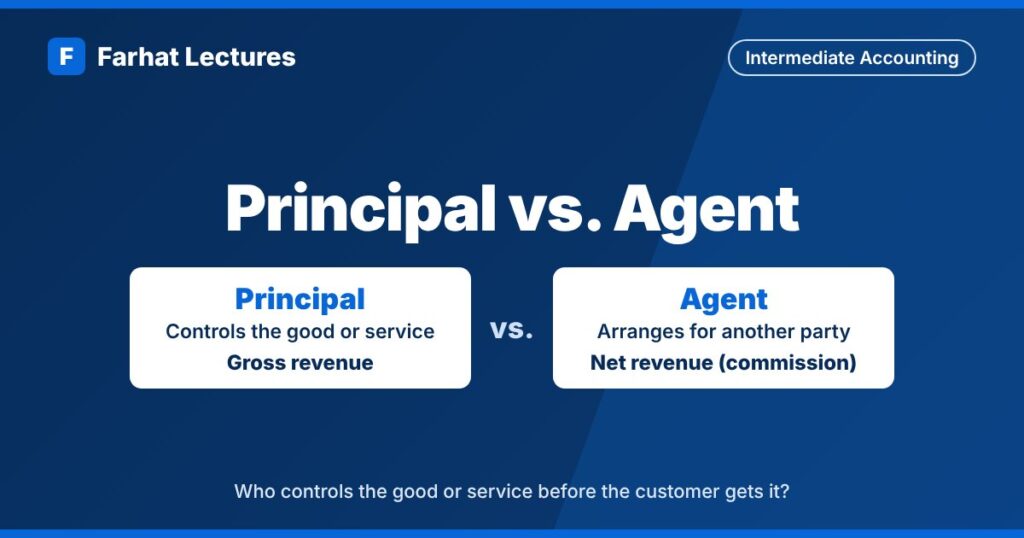
Principal vs. agent decides whether a company reports revenue gross or net. Under ASC 606, a principal controls the specified good or service before the customer gets it and reports the full amount the customer pays. An agent only arranges for someone else to provide it and reports just its fee or commission.
Why does this matter? Gross and net presentation can produce very different reported revenue and gross margins even when the underlying economics are the same. A travel agency that books a $1,000 trip and keeps $100 has either $1,000 or $100 of revenue, depending on whether it is a principal or an agent. Revenue growth, gross margin, and many valuation measures depend on getting this right, which is why the SEC frequently questions companies about it.
This guide supports lesson 17.3, Accounting for Revenue Recognition Issues, in the Farhat Lectures intermediate accounting course. It is one of seven special situations covered under ASC 606.
Principal and agent defined
- Principal: its performance obligation is to provide the specified good or service to the customer.
- Agent: its performance obligation is to arrange for the principal to provide that good or service.
Common examples include a travel agency that books cruises for a cruise line, a ticket website that sells seats for an airline, and an online marketplace that connects buyers with independent sellers. In each case, amounts the agent collects on behalf of the principal are not the agent’s revenue. They are a liability until passed on to the principal.
What is the difference between gross and net revenue?
Suppose a customer pays $1,000 and the intermediary keeps $100. Here is how the two approaches report that sale:
| Line item | Gross (principal) | Net (agent) |
|---|---|---|
| Revenue | $1,000 | $100 |
| Cost of sales | (900) | — |
| Gross profit | $100 | $100 |
| Gross margin | 10% | 100% |
Both columns show $100 of gross profit in this example. The principal reports $1,000 of revenue and a 10% gross margin. The agent reports $100 of revenue and a 100% gross margin. Under ASC 606, an agent reports its fee or commission as revenue.
How to tell a principal from an agent
The deciding question is control: did the company control the specified good or service before it was transferred to the customer? If so, it is the principal. Three indicators help answer that question (ASC 606-10-55-39):
| Indicator | Points to principal | Points to agent |
|---|---|---|
| Primary responsibility | Responsible for fulfilling the promise and for the quality of the good or service | Another party fulfills the promise |
| Inventory risk | Bears inventory risk before the good or service transfers to the customer, or afterward, such as on returns | Never holds inventory or bears that risk |
| Pricing discretion | Sets the price the customer pays | Price is set by the other party, so what it can earn is limited |
Be careful with how the company is paid. Earning a fixed fee or a set percentage of the amount billed is weak evidence of agency at best, and it never settles the question on its own. In 2016 the FASB issued Accounting Standards Update 2016-08, which removed two older indicators from the standard: exposure to credit risk, and whether the consideration is in the form of a commission. The Board took them out because companies were letting them override stronger evidence about control. So the three indicators above support the control assessment. They are not a checklist to count, and the form of payment is not a fourth indicator. FASB’s own Accounting Standards Update 2016-08 explains the framework in more detail. Deloitte’s Accounting Spotlight on principal-versus-agent evaluations covers the same framework in more depth, though it sits behind a subscription.
Exam trap: who collects the cash does not decide it
This is where students lose the point. An intermediary can collect every dollar the customer pays, hold that cash for weeks, and still be the agent. Cash collection is not control. Ask instead whether the company could have directed the use of the good or service, and whether it could have kept the benefits from it, before the customer received it.
Harder cases: drop shipping and marketplaces
The assessment gets difficult when a company never physically holds the goods. Think of a retailer whose supplier ships straight to the customer, or an online marketplace listing an independent seller’s products. Physical possession is only evidence of control, not the test itself. Work through the three indicators instead. Who is on the hook when the product arrives broken? Who absorbs the loss if the customer returns it? Who sets the price the customer actually pays? A company can be the principal without ever touching the goods, and it can be the agent even while running the whole checkout.
What the SEC asks companies about this
Because gross reporting makes a company look much larger, this determination draws regular questions from the Securities and Exchange Commission. The staff has asked companies to describe the nature and material terms of these arrangements, to state separately how much revenue they recognized gross and how much net, and to explain which indicators of control support reporting gross, with reference to ASC 606-10-55-36 through 55-40. In other words, reaching a conclusion is not enough. A company has to show its work.
Is the test the same under IFRS?
Yes, in substance. The International Financial Reporting Standards version sits in IFRS 15, and paragraph B37 contains the same three indicators as ASC 606-10-55-39. A company applying IFRS runs the same control analysis and reaches the same gross or net answer.
Example: a travel agency booking
Example (hypothetical). On April 10, 2027, Harborline Travel sells a $1,200 cruise package for Coral Bay Cruises. Coral Bay sets the price, operates the cruise, and handles any complaints. Harborline collects the cash, keeps a 12% commission of $144, and owes Coral Bay $1,056.
Coral Bay provides the cruise, so it is the principal. Harborline only arranges the sale, so it is the agent. Harborline’s performance obligation is complete once the booking is made, so it recognizes its commission then:
| April 10, 2027 (Harborline, agent) | Debit | Credit |
|---|---|---|
| Cash | 1,200 | |
| Payable to Coral Bay Cruises | 1,056 | |
| Commission Revenue | 144 |
Coral Bay, the principal, reports the full $1,200 as revenue and the $144 commission as an expense. It recognizes the revenue when it provides the cruise, because that is when it satisfies its own performance obligation.
Notice what happens on Coral Bay’s balance sheet in the meantime. The customer paid $1,200, so Coral Bay owes the customer a $1,200 cruise, even though only $1,056 in cash arrived. That full $1,200 obligation is a contract liability, which is the amount a company owes a customer for goods or services it has not yet delivered. You may also see it called unearned revenue. The $144 is not a reduction of that obligation. It is a cost Coral Bay paid to get the booking. Netting the commission into the liability would be the same mistake the gross versus net rule is designed to prevent.
Assume Coral Bay elects the practical expedient in ASC 340-40-25-4 and the commission asset would otherwise be amortized over one year or less. Coral Bay therefore expenses the $144 commission at booking.
Coral Bay makes two entries. First, when it receives the cash from Harborline:
| On booking (Coral Bay, principal) | Debit | Credit |
|---|---|---|
| Cash | 1,056 | |
| Commission Expense | 144 | |
| Contract Liability | 1,200 |
Then, when the cruise takes place:
| When the cruise takes place (Coral Bay, principal) | Debit | Credit |
|---|---|---|
| Contract Liability | 1,200 | |
| Service Revenue | 1,200 |
A consignment is a special type of principal-agent relationship involving goods. The dealer is the agent and records only commission revenue, as shown in consignment accounting.
When is the intermediary the principal?
Change the facts: Harborline buys 40 cabins from Coral Bay in advance at $900 each, sets its own resale prices, and must pay for any cabins it fails to sell. Now Harborline controls the cabins before selling them. It bears inventory risk and has pricing discretion, so it is the principal for those resales. It reports the full selling price as revenue and the $900 cabin cost as cost of sales.
Key takeaways on principal vs. agent
- The question is whether the company controls the good or service before the customer receives it.
- A principal reports gross revenue; an agent reports net revenue (its commission).
- Primary responsibility, inventory risk, and pricing discretion are the three indicators.
- Determine whether the company controls the specified good or service before transfer to the customer. The form of payment does not decide the classification.
- The gross and net columns in the $1,000 example both show $100 of gross profit, with different revenue and gross margins.
Studying this for the CPA exam? Gross versus net is a favorite because the arithmetic is easy and the judgment is not. Candidates lose points by counting indicators or by following the cash. Work the control question first, every time. You can see how we teach the full revenue recognition sequence in the revenue recognition issues lesson.
Common mistakes
- Treating cash collected for the principal as the agent’s revenue.
- Deciding based on who collects the cash rather than who controls the good or service.
- Counting indicators instead of judging control.
- Assuming principal-agent status is the same for every product a company sells; it is decided for each specified good or service.
Interactive Principal vs. Agent Practice
Apply the ASC 606 control test to three multiple-choice questions. Identify the principal, determine the agent’s performance obligation, and decide how much commission revenue the agent recognizes.
Practice questions with answers
1. A food delivery app collects $40 for a restaurant meal, keeps $8, and pays the restaurant $32. The restaurant sets the menu prices and prepares the food. How much revenue does the app report?
Answer: $8. The restaurant controls the meal and sets the price, so the app is an agent and reports only its fee.
2. An electronics retailer buys headphones from a manufacturer for $60, holds them in its stores, and sells them for a price it chooses, $95. Is it a principal or an agent?
Answer: A principal. It holds inventory, bears the risk of unsold goods, and sets the price. It reports $95 of revenue and $60 of cost of goods sold.
3. A ticket website sells $50,000 of concert tickets for a promoter and earns a 6% fee. Prepare the website’s summary entry.
Answer: Debit Cash $50,000; credit Payable to Promoter $47,000 and Commission Revenue $3,000 ($50,000 × 6%).
Frequently asked questions
What is the difference between a principal and an agent in revenue recognition?
A principal controls the good or service before transferring it to the customer and reports revenue gross. An agent arranges for another party to provide it and reports only its fee or commission as revenue.
What is gross vs. net revenue?
Gross revenue is the full amount the customer pays, reported by a principal. Net revenue is the commission or fee the company keeps, reported by an agent.
Does gross vs. net reporting change net income?
For the same transaction in the same reporting period, gross versus net presentation by itself changes reported revenue and gross margin without changing net income. A principal and an agent can satisfy their own performance obligations in different periods.
What indicators show that a company is a principal?
Under ASC 606, the indicators are primary responsibility for fulfilling the promise, inventory risk, and discretion in setting the price. They help determine whether the company controls the good or service.
Is a consignee a principal or an agent?
A consignee is an agent. It sells the consignor’s goods for a commission and records only commission revenue, while the consignor, as principal, records the sales revenue.
Can a company be a principal for one product and an agent for another?
Yes. The assessment is made for each specified good or service promised to the customer, not once for the whole company or even for a whole contract. The same business can report some sales gross and others net.
Does collecting the customer’s cash make a company the principal?
No. Collecting the cash is not control. ASU 2016-08 removed exposure to credit risk from the list of indicators, so holding the customer’s money before passing it on does not decide the question.
Is the principal vs. agent test the same under IFRS?
In substance, yes. IFRS 15 paragraph B37 contains the same three indicators as ASC 606-10-55-39, so the control analysis and the gross or net conclusion are the same.
Who decides whether a company is a principal or an agent?
The company does, using judgment, and then has to support that judgment. Auditors test the conclusion, and the SEC regularly asks public companies to explain which indicators of control support reporting revenue gross.
Continue learning with Farhat Lectures
Strengthen your accounting understanding with clear explanations and guided practice.
Explore the free sample courseRelated lessons
About the author
Mansour Farhat, CPA, CIA, DBA, teaches accounting and auditing to CPA, CMA, and EA candidates and to accounting students through Farhat Lectures. He writes and records every lesson on this site, including the full intermediate accounting, auditing, and financial accounting course libraries, and he publishes the same lessons free on the Farhat Lectures YouTube channel. You can read more about his background here.

Responses