
Bill-and-Hold Arrangements: When Can You Recognize Revenue?

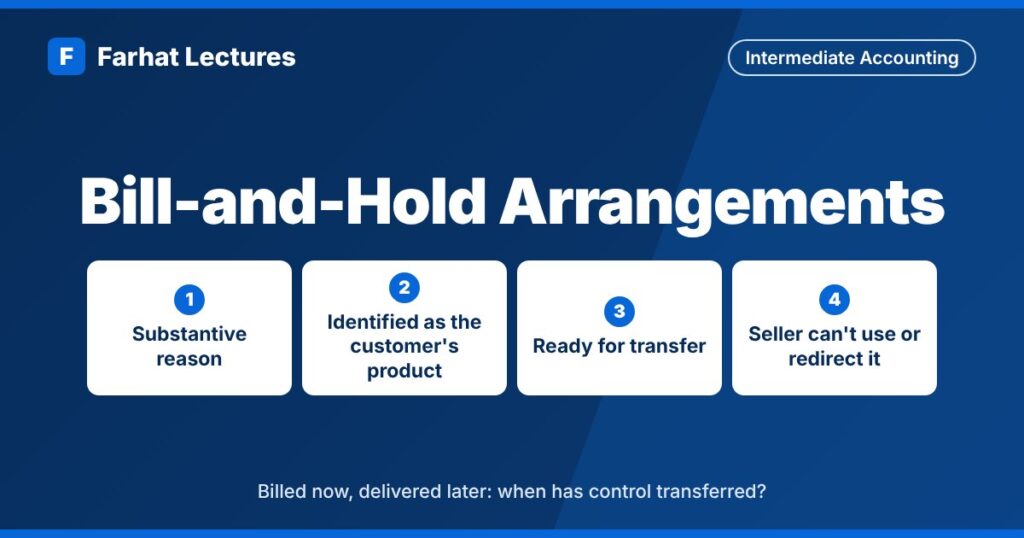
A bill-and-hold arrangement is a sale where the seller bills the customer but keeps the goods until a later delivery date. Under ASC 606, the seller recognizes product revenue when the customer obtains control. Before delivery, ASC 606-10-55-83 also requires four criteria: a substantive reason for the arrangement, separate identification of the product as the customer’s, readiness for physical transfer, and no ability for the seller to use or redirect the product.
Why does this matter? Normally, delivery is strong evidence that control has passed. In a bill-and-hold sale the goods never leave the seller’s warehouse, so it is easy to book revenue that has not really been earned. Bill-and-hold schemes have featured in many revenue frauds, which is why the criteria are strict and why auditors and exam questions look at them closely. If you are studying the audit side, see our lessons on auditing revenue recognition.
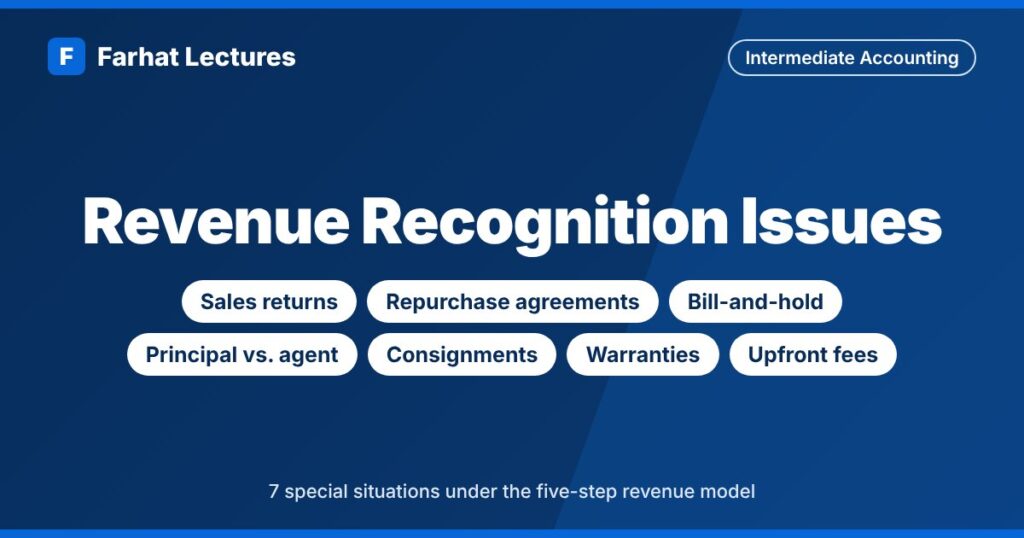
This guide supports the revenue recognition issues topic covered in intermediate accounting courses. Bill-and-hold is one of several special situations that ASC 606 addresses separately, alongside consignment arrangements and repurchase agreements.
Watch: Bill-and-Hold Arrangements for Revenue Recognition
Watch this Farhat lesson on YouTube
In this 13-minute lesson, Professor Farhat defines bill-and-hold sales, explains why they carry fraud risk, walks through the criteria for recognizing revenue, and works a practical example.
What is a bill-and-hold arrangement?
In a typical bill-and-hold sale, the customer signs the contract, accepts the invoice, and often takes legal title, but asks the seller to keep the goods for now. The accounting question is the one every sale raises in Step 5 of the revenue model: has the customer obtained control? Control means the customer can direct the use of the product and obtain substantially all of its remaining benefits, even if someone else is storing it.
Why customers ask for bill-and-hold
- The customer lacks space to store the product.
- The customer’s production schedule or construction project is delayed.
- The customer already has more than enough inventory in its distribution channel.
Each of these reasons comes from the customer. A request that comes from the seller, such as wanting to reach a quarterly sales target, is a warning sign.
The 4 bill-and-hold criteria
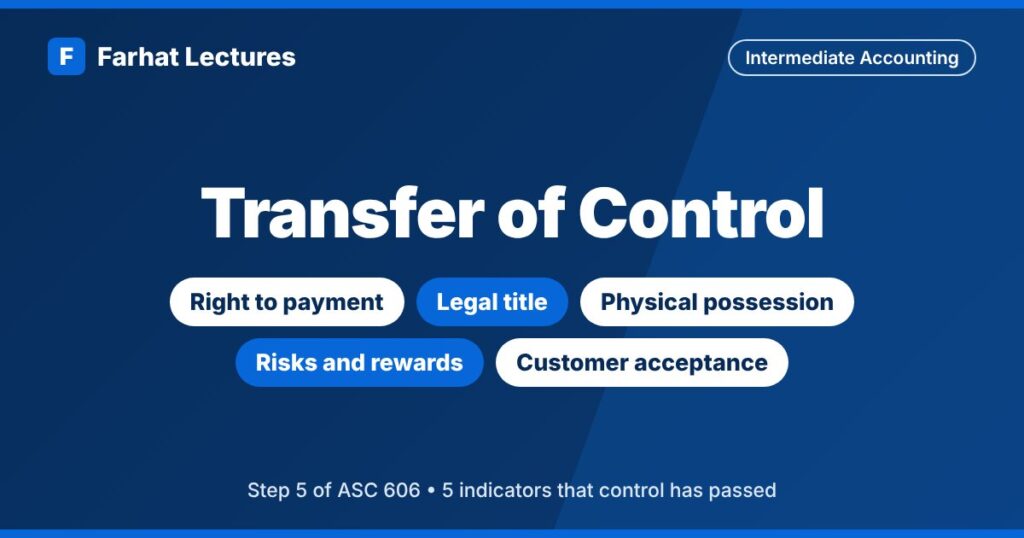
First, the seller applies the usual indicators of transfer of control, such as a present right to payment and legal title. For a bill-and-hold arrangement, ASC 606-10-55-83 then requires all four of the following before the customer can be said to control the product. ASC 606-10-55-81 defines the arrangement, ASC 606-10-55-82 explains how to assess control, and ASC 606-10-55-84 addresses any remaining storage service. IFRS 15 paragraphs B79 to B82 use the same four criteria, so the answer is the same under both frameworks:
| Criterion | What it means | Red flag if missing |
|---|---|---|
| 1. Substantive reason | The arrangement has a real business purpose, usually requested by the customer. | The seller proposed it near the end of a quarter. |
| 2. Identified as the customer’s | The product is separately identified (tagged or set apart) as belonging to that customer. | The goods are mixed in with general inventory. |
| 3. Ready for physical transfer | The product is finished and could be shipped now. | The goods are still being built or assembled. |
| 4. No use or redirection by the seller | The seller cannot use the product or send it to another customer. | The seller fills other orders from the same stock. |
The SEC’s interpretive release on bill-and-hold arrangements (2017) points SEC registrants to these ASC 606 criteria, and PwC’s guide on bill-and-hold arrangements works through examples.
One rule that changed: the fixed delivery schedule
This is a favorite exam trap. Before companies adopted ASC 606, the SEC staff guidance in SAB Topic 13 expected a bill-and-hold contract to include a fixed delivery schedule. ASC 606 has no such requirement.
In August 2017 SEC staff issued Staff Accounting Bulletin 116, which made SAB Topic 13 inapplicable once a company adopted ASC 606. In a separate interpretive release, the SEC told registrants to stop relying on the older criteria from Accounting and Auditing Enforcement Release No. 108 upon adoption. So if a question asks whether a delivery date must be fixed, the answer under ASC 606 is no. What matters is control and the four criteria.
The standard also works through its own illustration. Example 63 in the codification, at ASC 606-10-55-409 through 55-413, applies these criteria to a bill-and-hold fact pattern and is worth reading alongside the example below.
Example: recording a bill-and-hold sale
Example (hypothetical). On June 1, 2027, Corbin Furniture sells 200 office desks to Lakeview Dental Group for $180,000. The desks cost Corbin $110,000. Lakeview’s new clinic will not be finished until September, so Lakeview asks Corbin to keep the desks in its warehouse. Legal title passes and Lakeview must pay within 30 days. The desks are finished, tagged “Lakeview Dental,” and stored in a separate bay, and the contract bars Corbin from using them for other orders.
All four criteria are met, Corbin has a present right to payment, and Lakeview has legal title, so control has passed on June 1. Corbin records:
| June 1, 2027 | Debit | Credit |
|---|---|---|
| Accounts Receivable | 180,000 | |
| Sales Revenue | 180,000 | |
| Cost of Goods Sold | 110,000 | |
| Inventory | 110,000 |
When the desks are delivered in September, Corbin makes no further revenue entry. It simply ships goods it has already sold.
When the criteria are not met
Change one fact: Corbin keeps the desks in its general stock and may ship them to any customer as long as Lakeview eventually gets 200 desks. Now Corbin can redirect the product, so Lakeview has not obtained control. Corbin recognizes no revenue on June 1. If Lakeview pays in advance, Corbin records the cash as a contract liability (unearned revenue). If the facts stay the same until delivery, Corbin recognizes revenue when Lakeview takes control on delivery.
| Control transfers at billing | A criterion is unmet at billing | |
|---|---|---|
| Revenue recognized | Recognize revenue at billing | Defer revenue at billing. Reassess control if the missing criterion is later met or when delivery occurs. |
| Inventory | Removed from the seller’s books | Stays on the seller’s books until control transfers |
| Cash collected at billing | Applied to the sale | Recorded as a contract liability until control transfers |
The indicators behind this decision are covered in transfer of control in revenue recognition.
Is storage a separate performance obligation?
Once control has passed, the seller is holding the customer’s goods, so it may be providing a custodial (storage) service. Storage is a separate performance obligation if it is a distinct service promised to the customer. The customer must be able to benefit from storage on its own or with readily available resources, and the storage promise must be separately identifiable from the promise to transfer the product. When storage is distinct, the seller allocates part of the transaction price to it and recognizes that portion over the storage period. The original Corbin example assumes there is no separate storage performance obligation, so Corbin records the full price as sales revenue.
Now suppose the contract includes three months of distinct warehousing and the full $184,000 is due on June 1, before Corbin provides the storage. The standalone selling prices are $180,000 for the desks and $4,000 for warehousing. Corbin recognizes $180,000 of sales revenue on June 1, when Lakeview obtains control of the desks. Corbin records the $4,000 due for future storage as a contract liability and recognizes it as storage revenue over the three months it holds the desks.
For guided practice, see the Bill and Hold lesson in the Farhat Lectures Intermediate Accounting course. ASC 606 addresses bill-and-hold separately, so it is worth reading alongside consignment arrangements and repurchase agreements.
Key takeaways on bill-and-hold arrangements
- A bill-and-hold arrangement bills the customer now and delivers later.
- Recognize product revenue when the customer obtains control. Before delivery, all four bill-and-hold criteria must also be met.
- The reason must be substantive and usually comes from the customer.
- If a criterion is unmet at billing, reassess when the facts change or delivery occurs.
- A distinct storage service promised to the customer is a separate performance obligation.
Common mistakes
- Treating a signed invoice as enough to recognize revenue.
- Ignoring who requested the arrangement.
- Recognizing revenue on goods that are not finished.
- Forgetting that the seller’s ability to redirect goods means control has not passed.
- Recording revenue a second time when the goods are finally shipped.
Interactive bill-and-hold exercise
Bill-and-Hold Arrangements Practice
Try three quick questions on legal title, physical possession, and why customers ask for a delayed delivery. Think about who controls the goods before you answer, then check your work.
Practice questions with answers
1. A seller bills a customer for $75,000 of machinery that is still on the assembly line. The customer asked to delay delivery. Can the seller recognize revenue now?
Answer: No. The machinery is not ready for physical transfer, so one of the four criteria fails. Reassess when the machinery is ready. The seller can recognize revenue before delivery if the customer obtains control and all four criteria are met.
2. A seller’s sales manager asks a customer to accept an invoice on December 30 for goods the customer does not need until March, so the company can reach its annual target. Is the reason substantive?
Answer: No. The arrangement was requested by the seller to raise reported sales, not for a genuine business reason of the customer. Revenue should not be recognized at billing.
3. Goods costing $40,000 are sold for $65,000. The customer obtains control at billing, all four bill-and-hold criteria are met, and there is no separate storage performance obligation. What entries does the seller make at billing?
Answer: Debit Accounts Receivable $65,000; credit Sales Revenue $65,000. Debit Cost of Goods Sold $40,000; credit Inventory $40,000.
Want more questions like these? Work through the FAR CPA test bank for exam-style revenue recognition practice.
Frequently asked questions
What is a bill-and-hold arrangement?
It is a contract in which the seller bills the customer for a product but keeps physical possession of it until a later date, usually at the customer’s request.
When can revenue be recognized in a bill-and-hold sale?
Recognize product revenue when the customer obtains control. Before delivery, all four bill-and-hold criteria must also be met: a substantive reason, separate identification of the product as the customer’s, readiness for physical transfer, and no ability for the seller to use or redirect it.
Who should request a bill-and-hold arrangement?
Usually the customer, for example because it lacks storage space or its project is delayed. A seller-initiated arrangement, especially near a reporting date, is a warning sign that the reason may not be substantive.
Does the seller keep the goods in its inventory?
No, not if control has transferred. The seller removes the goods from inventory and records cost of goods sold, even though it still stores them.
Why are bill-and-hold sales considered risky?
Because no delivery takes place, they can be used to record revenue early. Regulators and auditors look closely at bill-and-hold sales, especially those recorded near the end of a reporting period.
Is bill-and-hold allowed under IFRS 15?
Yes. IFRS 15 paragraphs B79 to B82 cover bill-and-hold and use the same four criteria as ASC 606-10-55-83, so the answer is the same under both frameworks.
Does the contract need a fixed delivery schedule?
Not under ASC 606. The SEC’s older guidance in SAB Topic 13 did expect a fixed delivery schedule, but that guidance stopped applying once companies adopted ASC 606. Many exam questions still test this difference.
What is the difference between bill-and-hold and consignment?
In bill-and-hold the customer has bought the goods and control has passed, so the seller removes them from inventory. In consignment the goods are still the consignor’s until a third party buys them, so they stay in the consignor’s inventory and no revenue is recorded.
Continue learning with Farhat Lectures
Strengthen your accounting understanding with clear explanations and guided practice.
Explore the free sample courseAbout the author
Mansour Farhat is a CPA, CIA, and DBA who has taught accounting and auditing at the university level and has built over 1,500 free lessons on YouTube for CPA and CMA candidates. He teaches the Intermediate Accounting, Auditing, and CPA review courses at Farhat Lectures.
Last updated: November 20, 2026

Responses