
Contract Modification Under ASC 606: Separate Contract vs Prospective

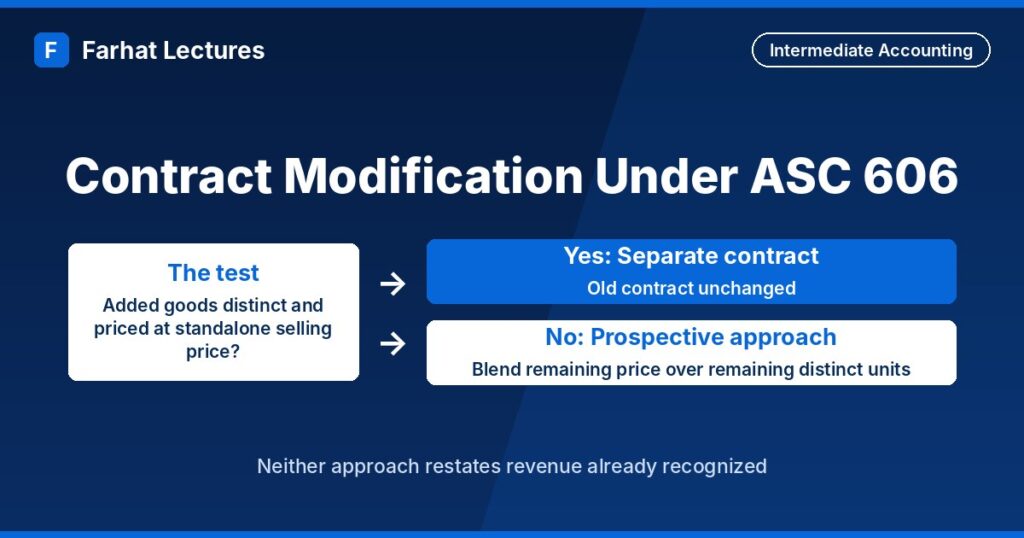
A contract modification under ASC 606 is an approved change to a contract’s scope, price, or both. Account for it as a separate contract when it adds distinct goods or services and the added price reflects their standalone selling prices, including appropriate adjustments. If the separate-contract test fails and the remaining goods or services are distinct from those already transferred, allocate the remaining consideration to the remaining performance obligations.
Why does this matter? Long contracts change all the time: a customer orders more units, asks for a discount, or adds a service. The accounting treatment determines how much revenue the company assigns to the goods or services it still needs to deliver.
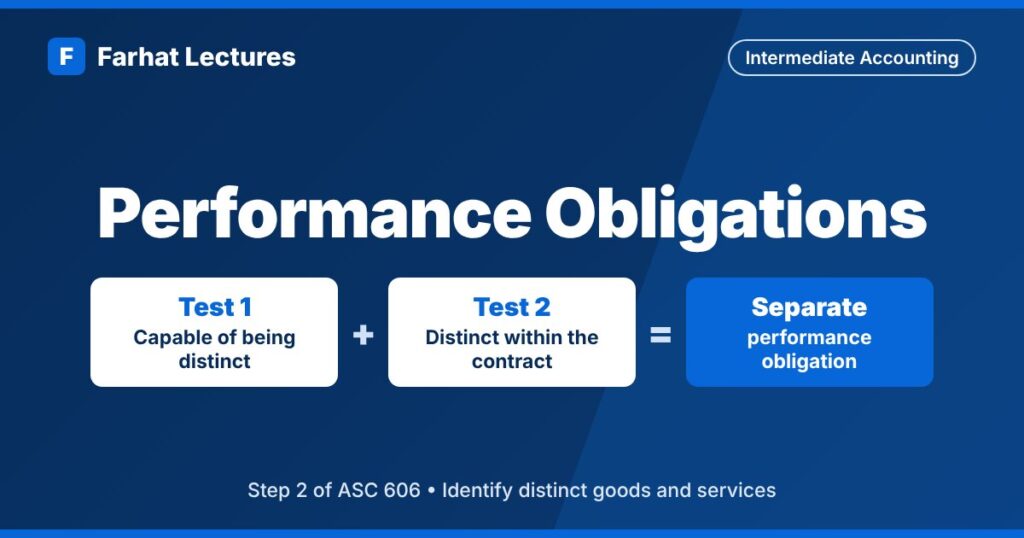
This guide supports the contract modifications topic in the revenue recognition chapter of the Farhat Lectures Intermediate Accounting course. It builds on two ideas from earlier in that chapter: distinct performance obligations and standalone selling price, which is the price a company would charge for a good or service if it sold it on its own.
Watch: Contract Modification: Revenue Recognition ASC 606 & IFRS 15
Watch this Farhat lesson on YouTube
In this 10-minute lesson, Professor Farhat explains the two conditions for treating a modification as a new contract, then compares the new-contract method with the prospective (blended price) method.
What is a contract modification?
ASC 606-10-25-10 defines a contract modification as a change in the scope or price (or both) of a contract that the parties approve. Approval can be written, oral, or implied by normal business practice. Common examples are change orders, added units, extended service periods, and price concessions.
A modification is not the same as a change in an estimate. If the original contract already allowed for a bonus or volume discount, that is variable consideration, which is part of the transaction price, not a modification.
The two conditions for a separate contract
ASC 606-10-25-12 says a modification is accounted for as a separate contract only if both conditions are met:
| Condition | Question to ask | Example that passes |
|---|---|---|
| 1. Added goods or services are distinct | Does the modification add new, distinct goods or services (not just a price change)? | The customer orders 50 more units of a product the company sells on its own |
| 2. Price reflects standalone selling price | Does the added price reflect the standalone selling prices of the added goods or services, including appropriate adjustments for the contract? | The 50 units are priced at the current list price, less a discount for selling costs the company avoids |
A discount can qualify if the added price reflects the standalone selling price after appropriate adjustments for the contract. For example, a company may charge less when it avoids a sales commission it would incur on a new sale.
Separate contract vs prospective approach
ASC 606-10-25-13(a) covers the prospective approach. It applies when the modification fails either condition for a separate contract and the goods or services still to be delivered are distinct from those already delivered. The company accounts for the original contract as if it ended and allocates the remaining consideration, or promised payment, to the goods or services still to be delivered. In the banner example, this gives every remaining banner one blended price. Revenue already recorded stays as reported.
| Feature | Separate contract | Prospective approach |
|---|---|---|
| When it applies | Both conditions met | Conditions not met, and the remaining goods or services are distinct |
| Original contract | Unchanged; keeps its original price | Treated as ended; remaining units roll into a new contract |
| Revenue for remaining original goods or services | As allocated under the original contract | Allocated share of the combined remaining consideration |
| Revenue for added goods or services | As allocated under the separate contract | Allocated share of the combined remaining consideration |
| Revenue already recognized | Not changed | Not changed |
For identical units like the banners below, calculate the blended revenue per unit with this formula.
Blended revenue per identical unit = (Consideration not yet recognized from the original contract + Consideration promised in the modification) ÷ Remaining identical units
Deloitte’s roadmap section on types of contract modifications walks through each path in more depth.
Worked example: added banners
This example is hypothetical. Cedar Print Co. contracts to deliver 500 trade-show banners at $40 each ($20,000 total). Each banner is distinct and is delivered at a point in time. After 300 banners are delivered (and $12,000 of revenue is recognized), the customer orders 100 more banners for $3,500 ($35 each).
Case A: $35 is the standalone selling price
Suppose $35 is Cedar’s normal price for a 100-banner add-on order. The added banners are distinct and priced at standalone selling price, so the change is a separate contract.
- Remaining original banners: 200 × $40 = $8,000
- New contract: 100 × $35 = $3,500
- Revenue after the modification: $11,500
Case B: $35 is below the standalone selling price
Now suppose the standalone selling price for a 100-banner add-on order is $40 per banner, and $35 per banner fails to reflect that price after any appropriate adjustments for the contract. The remaining banners are distinct from the 300 already delivered, so Cedar uses the prospective approach.
| Item | Amount |
|---|---|
| Original consideration not yet recognized (200 × $40) | $8,000 |
| Consideration from the modification (100 × $35) | $3,500 |
| Total remaining consideration | $11,500 |
| Remaining units (200 + 100) | 300 |
| Blended price per banner ($11,500 ÷ 300, rounded) | $38.33 |
| Approach | Before modification | After modification | Total |
|---|---|---|---|
| Case A: separate contract | $12,000 | $11,500 ($40 and $35 prices) | $23,500 |
| Case B: prospective | $12,000 | $11,500 (300 × the unrounded blended price) | $23,500 |
Both cases result in the same total revenue, and the $12,000 already recognized stays as reported. Revenue can fall in different periods if the original and added banners ship at different times. In Case B, Cedar recognizes the same blended revenue per banner as control transfers.
The journal entry after the modification
Assume Cedar has no contract asset or contract liability before its first shipment after the modification. Cedar transfers control of 100 banners from the original order and invoices them at the agreed $40 each, making $4,000 unconditionally due. It recognizes $3,833.33 of revenue using the unrounded blended rate of $11,500 ÷ 300, then records the $166.67 difference as a contract liability for banners it still owes the customer.
| Account | Debit | Credit |
|---|---|---|
| Accounts receivable | $4,000.00 | |
| Revenue | $3,833.33 | |
| Contract liability | $166.67 |
Cedar keeps the $12,000 of revenue already recorded for the first 300 banners as reported. If Cedar ships banners while its right to payment still depends on a condition beyond waiting for payment, it debits a contract asset. A contract asset is a conditional right to payment for goods or services already transferred. Cedar reclassifies it to accounts receivable once the right to payment becomes unconditional.
What about cumulative catch-up?
Your textbook focuses on the two approaches above. For completeness, ASC 606-10-25-13 has a third path: if the remaining goods or services are not distinct (for example, one construction project still in progress), the modification is treated as part of the existing contract and revenue is adjusted on a cumulative catch-up basis in the current period. The same framework applies under IFRS 15.
Common mistakes
On the Financial Accounting and Reporting (FAR) section of the CPA exam, start with one question. Which price applies to the units you still need to deliver? Use the Financial Accounting Standards Board (FASB) guidance in ASC 606-10-25-12 to check both conditions for a separate contract. Watch for these common mistakes.
- Restating earlier revenue. Neither approach changes revenue for units already delivered.
- Checking only one condition. A separate contract needs distinct goods and a price that reflects standalone selling price.
- Including delivered units in the blended-rate calculation. When the remaining units are identical, use only the number still to be delivered. In the banner example, the denominator is 300.
- Calling a price-only change a separate contract. A price cut with no added goods can never be a separate contract.
- Forgetting the balance sheet. A modification can change billing terms, which affects the contract asset or contract liability for that contract.
Key takeaways
- A contract modification is an approved change to a contract’s scope, its price, or both.
- It is a separate contract only when it adds distinct goods or services and the added price reflects their standalone selling price. Both conditions, every time.
- If it fails either condition and the remaining goods are distinct, use the prospective approach. In the banner example, that means one blended price across the remaining units.
- If the remaining goods are not distinct, adjust revenue on a cumulative catch-up basis instead.
- Revenue already recognized is never restated under the separate contract or prospective approach.
- In the banner example, both approaches produce the same total contract revenue. The timing of revenue recognition can differ.
ASC 606 Contract Modification Practice
How do distinct goods and standalone selling prices affect revenue recognition after an ASC 606 contract modification? Compare two pricing scenarios, then calculate total remaining revenue and blended revenue per unit under the prospective approach.
Practice questions
1. A company has delivered 40 of 100 units priced at $50. The customer adds 30 units at $48, which is the standalone selling price. How much revenue is recognized on the remaining units?
Answer: $4,440. It is a separate contract: 60 × $50 = $3,000 on the original contract plus 30 × $48 = $1,440 on the new one.
2. Same facts, but the standalone selling price of the added units is $50 and the $48 price fails to reflect it after appropriate adjustments for the contract. What is the blended price?
Answer: $49.33. Remaining consideration is $3,000 + $1,440 = $4,440, divided by 90 remaining units.
3. Midway through a contract for 12 distinct monthly cleaning visits, the parties agree to cut the price of the last 6 visits from $200 to $180. No visits are added. Which approach applies?
Answer: The prospective approach. No distinct goods are added, so it cannot be a separate contract, but the remaining visits are distinct from those already performed. Each remaining visit is recognized at $180, and earlier revenue is not changed.
Got all three? Keep going with the rest of revenue recognition under ASC 606, or try the free sample course to see how the full lessons are built.
Frequently asked questions
What is a contract modification in revenue recognition?
It is an approved change in the scope or price of a contract with a customer, such as adding units, extending a service, or granting a price concession.
When is a contract modification treated as a separate contract?
When the modification adds distinct goods or services and the added price reflects their standalone selling prices, including appropriate adjustments for the contract.
What is the prospective approach for contract modifications?
If the remaining goods or services are distinct from those already transferred, treat the original contract as ended for accounting purposes. Allocate the unrecognized consideration from the original contract plus the consideration promised in the modification to the remaining performance obligations.
Does a contract modification change revenue already recognized?
Not under the separate contract or prospective approaches. Only a modification of goods that are not distinct leads to a cumulative catch-up adjustment in the current period.
Is contract modification accounting the same under IFRS 15?
Yes. IFRS 15 uses the same conditions and approaches for contract modifications as ASC 606.
How do you calculate the blended price after a contract modification?
For identical remaining units like the banners in this example, add the unrecognized consideration from the original contract to the consideration promised in the modification. Divide the total by the identical units still to be delivered. Here, $8,000 plus $3,500 gives $11,500. Dividing by 300 gives $38.33 per banner, rounded.
What is the difference between a contract modification and variable consideration?
A modification is a new agreement that changes the scope or price after the contract starts. When the original terms already allow for a volume discount or a bonus, that amount is variable consideration. The company estimates it when determining the transaction price.
Is a price cut on its own a contract modification?
Yes. A price change the parties approve is a modification even when nothing is added. It can never be a separate contract, because that test requires added distinct goods or services. If the goods still to be delivered are distinct, use the prospective approach.
About the author. Mansour Farhat, CPA, CIA, DBA, teaches the intermediate accounting and CPA exam review lessons at Farhat Lectures, including the revenue recognition series this guide supports.
Continue learning with Farhat Lectures
Want the rest of the revenue recognition chapter taught this way, with the videos, worked examples, and graded practice? The free sample course is a good place to start.
Explore the free sample course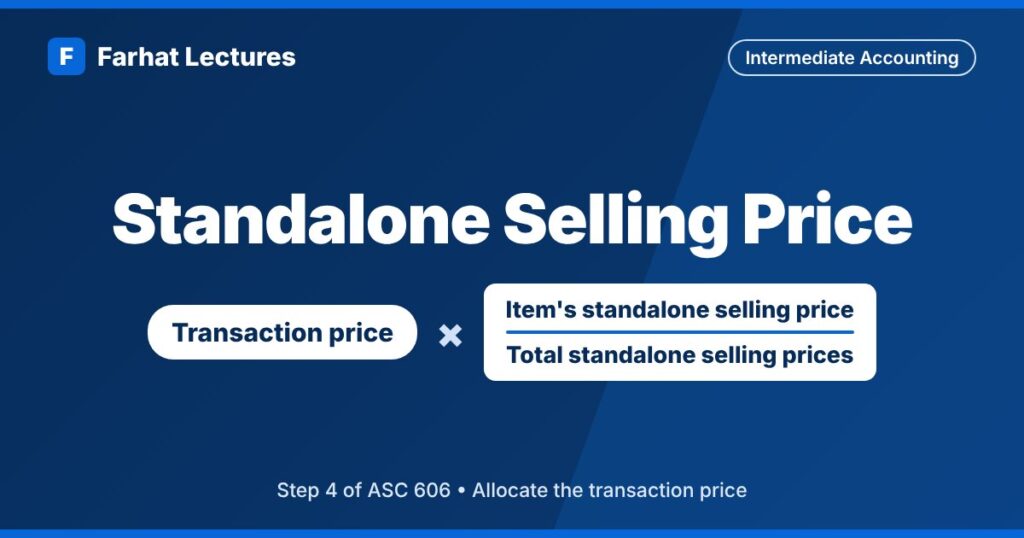
Responses