
Advantages and Disadvantages of a Corporation: C Corp vs. S Corp

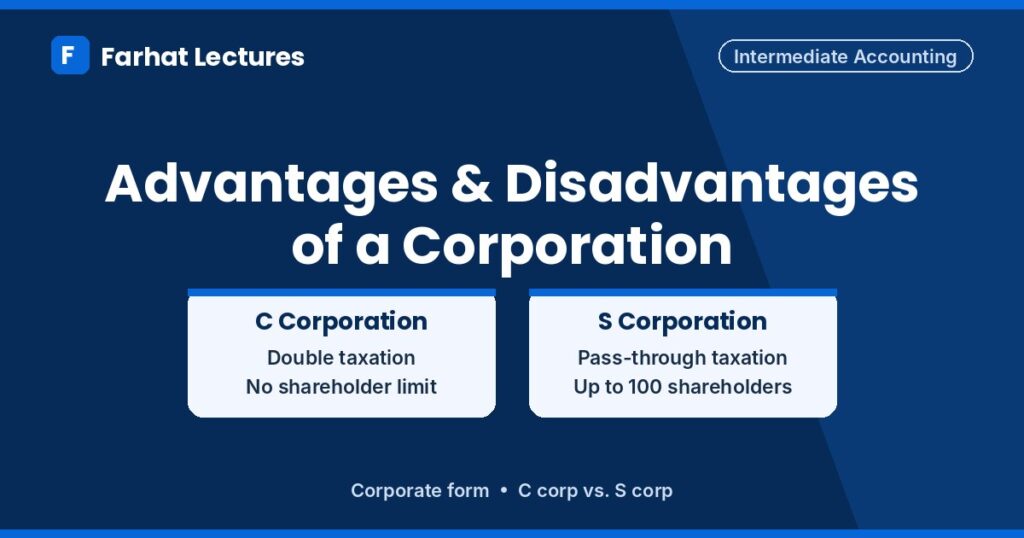
A corporation is a legal entity, created under state law, that is separate from its owners. Its main advantages are limited liability, easy access to capital, unlimited life, transferable shares, and professional management. Its main disadvantages are double taxation for C corporations, formation cost and paperwork, government regulation, and the gap between owners and managers.
Knowing the advantages and disadvantages of a corporation matters in intermediate accounting because the corporate form shapes everything you record in stockholders’ equity. Shares, par value, preferred stock, and dividends only exist because a corporation can divide its ownership into transferable shares. Once you understand why companies incorporate, the equity accounts in the rest of the chapter make much more sense.
This guide covers the C corporation versus S corporation distinction, the advantages and disadvantages of the corporate form, how a corporation compares with other business forms, how corporations are classified and formed, and a quick preview of how stockholders’ equity is organized. A short interactive quiz lets you check your understanding along the way. It supports lesson 14.1 (Corporate Capital) in the Farhat Lectures Intermediate Accounting course.
Watch: Accounting for Corporation: Advantages & Disadvantages
What is the difference between a C corporation and an S corporation?
Every corporation is created under state law. The letters C and S refer to subchapters of the Internal Revenue Code, the federal tax law administered by the Internal Revenue Service (IRS). They describe how the corporation is taxed, not a different kind of legal entity.
A C corporation pays income tax on its own profit. An S corporation elects to pass its income, losses, deductions, and credits through to its shareholders, who report them on their personal returns. According to the IRS, an S corporation must have no more than 100 shareholders, only allowable shareholders (such as individuals, certain trusts, and estates), and only one class of stock.
On the tax side, a C corporation files Form 1120. To become an S corporation, the company files Form 2553, signed by all shareholders. After that, it files Form 1120-S each year, and each shareholder receives a Schedule K-1 showing their share of income, deductions, and credits.
| Feature | C corporation | S corporation |
|---|---|---|
| Who pays income tax on profit | The corporation, then stockholders again on dividends | Generally the shareholders, through pass-through reporting |
| Number of owners | No limit | No more than 100 shareholders |
| Classes of stock | Can issue several classes, such as common and preferred | Only one class of stock |
| Who can own shares | Individuals, other corporations, funds, and foreign investors | Individuals, certain trusts, and estates; not partnerships, corporations, or nonresident aliens |
| Typical example | Large public companies traded on an exchange | Closely held family or small businesses |
Sole proprietorships are the most common business form by count because they are cheap and easy to start, according to IRS Statistics of Income data. C corporations are far fewer in number, but they dominate in revenue, total assets, and market value. That is why intermediate accounting focuses on the corporate form.
What are the advantages of a corporation?
| Advantage | What it means for owners |
|---|---|
| Limited liability | A stockholder’s loss is generally limited to the amount invested. The corporation’s debts and lawsuits are not the stockholder’s personal responsibility. |
| Separate legal entity | The corporation signs contracts, borrows, owns property, and sues or is sued in its own name. |
| Ease of capital formation | The company raises money by selling shares. Ownership is easy to measure: owning 250 of 1,000 outstanding shares means owning 25%. |
| Unlimited life | The corporation continues even when managers change or stockholders sell their shares. |
| Transferability of ownership | Stockholders can usually sell their shares without the consent of the company or other owners. |
| Professional management | Owners do not have to run the business. The board of directors hires skilled managers. |
One caution about limited liability: lenders to small corporations often ask the owners to personally guarantee loans. A court can also “pierce the corporate veil” and hold owners personally liable if they mix personal and business money or ignore corporate formalities.
What are the disadvantages of a corporation?
| Disadvantage | Why it matters |
|---|---|
| Double taxation (C corporations) | Profit is taxed at the corporate level, and dividends are taxed again to stockholders. |
| Formation cost and formality | Incorporating requires legal documents and fees. Corporations must hold board and stockholder meetings, give proper notice, and keep minutes and records. |
| Government regulation | Corporations report to their state of incorporation and to the states where they operate. Public companies also face federal securities rules. |
| Separation of ownership and management | Managers may not always act in stockholders’ interests. In extreme cases, they may use aggressive accounting to raise their own pay. |
Double taxation only bites when profit is paid out. Profit that a C corporation keeps and reinvests is taxed once, at the flat 21% corporate rate. The flip side: if a C corporation loses money, the loss stays inside the company, and the owners cannot deduct it on their personal returns. S corporation losses pass through to shareholders, generally limited to each shareholder’s investment (called basis).
Interactive quiz: match corporate advantages and disadvantages
Check your understanding before moving on. Each of the 10 scenarios below shows one advantage or disadvantage of a corporation, such as limited liability, unlimited life, or double taxation. Choose the most specific match, use the hints if you get stuck, then open the solution to see why the answer fits.
How does a corporation compare to other business forms?
Here is how a C corporation stacks up against the other common ways to own a business.
| Feature | Sole proprietorship | General partnership | LLC | C corporation |
|---|---|---|---|---|
| Owner liability | Unlimited personal liability | Unlimited personal liability for general partners | Limited liability for members | Limited liability for stockholders |
| Federal income tax | Owner reports profit on Form 1040, Schedule C | Partnership files Form 1065; partners pay tax on their shares | Pass-through by default; can elect to be taxed as a corporation | Corporation pays tax on Form 1120; dividends are taxed again |
| Life of the business | Ends when the owner stops or dies | May end when a partner leaves, depending on the agreement and state law | Usually continues under the operating agreement | Unlimited life |
| Raising money | Owner’s funds and loans | Partners’ funds and loans | Members’ contributions and loans; selling an interest often needs other members’ approval | Can sell shares to many investors |
| Formation | No state filing needed to form; local licenses may apply | No state filing needed; a written partnership agreement is recommended | File articles of organization with the state | File articles of incorporation with the state |
The takeaway: a corporation gives you the strongest tools for raising money and the longest life, but it costs more to form and run. That is why many small businesses start as LLCs and incorporate later when they need outside investors.
Studying for the CPA REG section? Review how entities are set up in our Formation of Corporation lesson, and see how corporations file and pay tax in our Entity Tax course.
Example: double taxation in numbers
Here is a simplified, hypothetical example. Two companies each earn $100,000 of taxable income and want to give all remaining profit to their owners. Assume a 21% corporate tax rate, a 15% tax rate on dividends, and a 24% personal rate on pass-through income. Real rates depend on the facts, and state taxes are ignored.
| Step | C corporation | S corporation |
|---|---|---|
| Taxable income | $100,000 | $100,000 |
| Corporate-level income tax | $21,000 (21%) | $0 |
| Available to owners | $79,000 paid as dividends | $100,000 passed through |
| Owner-level tax | $11,850 (15% of $79,000) | $24,000 (24% of $100,000) |
| Owners keep | $67,150 | $76,000 |
The C corporation’s earnings were taxed twice: once at the company and again when distributed. The S corporation’s income was taxed once, at the owner level. That is the core of the double taxation disadvantage. The S election is not available to large public companies, though, because of the 100-shareholder and one-class-of-stock limits.
One more real-world detail: S corporation owners may qualify for the qualified business income (QBI) deduction under Internal Revenue Code Section 199A. It lets eligible owners deduct up to 20% of their business income, and the One Big Beautiful Bill Act made it permanent in July 2025. If the owner in this example qualified for the full deduction, taxable income would drop to $80,000, the tax would be $19,200 (24% of $80,000), and the owner would keep $80,800. We left it out of the table to keep the comparison simple.
How corporations are classified
Besides the C and S tax labels, accountants classify corporations in two other common ways.
- By purpose. A for-profit corporation is organized to earn a return for its owners. A not-for-profit corporation is organized for charitable, medical, educational, or similar purposes.
- By ownership. A publicly held corporation can have thousands of stockholders, and its shares trade on a national exchange such as the New York Stock Exchange or Nasdaq. A privately held corporation usually has few stockholders and does not sell shares to the general public. Some privately held companies are very large.
How a corporation is formed
To incorporate, the founders file a corporate charter (also called articles of incorporation) with one state. The charter states the corporation’s name and purpose, the types and number of shares it is authorized to issue, and who is forming it. A company incorporates in only one state, even if it operates nationwide. In each other state where it does business, it registers as a foreign corporation.
Many large companies choose Delaware. Its corporate law is flexible, its courts have decided many corporate cases (which makes outcomes more predictable), and filings are processed efficiently. You can see the state’s own resources at the Delaware Division of Corporations.
Each state writes its own corporate law, and the accounting for stockholders’ equity follows those laws. Many states base their statutes on the Model Business Corporation Act, but definitions of terms such as par value or legal capital can still differ from state to state.
One more term you may see in this lesson is a special purpose acquisition company (SPAC), sometimes called a blank-check company. It is a shell company with no operations of its own. It raises cash through its own initial public offering (IPO) and then merges with a private operating company. The merger lets that private company become public without running a traditional IPO of its own. The Securities and Exchange Commission (SEC) adopted rules in January 2024 that expanded SPAC disclosures to look more like those of a traditional IPO.
Contributed capital vs. earned capital
Once a corporation exists, its owners’ interest appears in the stockholders’ equity section. Stockholders’ equity is the residual interest: assets minus liabilities. It is not a claim to any specific asset, and it grows when the company is profitable and shrinks when it loses money.
| Part of equity | Where it comes from | Typical accounts |
|---|---|---|
| Contributed (paid-in) capital | Amounts stockholders invest in the corporation | Preferred stock, common stock, additional paid-in capital |
| Earned capital | Profitable operations that have not been distributed | Retained earnings |
Two other items also show up in stockholders’ equity but fit neither group. Accumulated other comprehensive income (AOCI) collects certain unrealized gains and losses that skip the income statement. Treasury stock is the company’s own shares that it has bought back, and it reduces total equity.
For the full equity formula and a worked balance sheet, read Stockholders’ Equity Explained: Formula, Components, and Examples. To see how contributed capital is recorded, continue with how to record the issuance of common stock and the main preferred stock features.
Key takeaways: advantages and disadvantages of a corporation
- The biggest advantages of a corporation are limited liability, easy access to capital through share sales, unlimited life, and easy transfer of ownership.
- The biggest disadvantages are double taxation for a C corporation, the cost and formality of forming and running one, and heavy regulation.
- An S corporation avoids double taxation, but it is limited to 100 shareholders and one class of stock.
- Because shares can be bought and sold, a corporation needs the stockholders’ equity accounts you will study in the rest of this chapter.
Common mistakes
- Calling an S corporation a different legal entity. It is a corporation that made a federal tax election.
- Assuming limited liability means stockholders cannot lose their investment. They can lose what they put in.
- Thinking a company must incorporate in the state where its headquarters is located.
- Saying an S corporation pays no tax at all. The income is still taxed, generally at the shareholder level.
- Treating the number of corporations as a measure of their economic importance. C corporations are few but very large.
- Thinking an S corporation cannot have voting and nonvoting shares. Differences in voting rights alone do not create a second class of stock, so an S corporation can issue both.
Practice questions with answers
1. A company earns $50,000, pays corporate income tax, and then pays dividends that its owners report on their own returns. Which corporate form does this describe?
Answer: A C corporation. Profit is taxed at the corporate level, and dividends are taxed again to the stockholders. That two-level tax is double taxation.
2. A start-up plans to have 150 investors and to issue both common and preferred stock. Can it elect S corporation status?
Answer: No. It fails two IRS requirements: an S corporation can have no more than 100 shareholders and only one class of stock. It would be taxed as a C corporation.
3. You own 300 of a corporation’s 1,200 outstanding shares, which you bought for $9,000. The corporation loses a $5 million lawsuit and cannot pay. What percentage do you own, and what is your maximum loss?
Answer: You own 25% (300 ÷ 1,200). Because of limited liability, your maximum loss is generally your $9,000 investment. The plaintiff cannot normally collect the judgment from your personal assets.
Frequently asked questions
Is an S corporation a different legal entity from a C corporation?
No. Both are corporations under state law. The S and C labels come from the federal tax code. An S corporation is a corporation that elects pass-through tax treatment and meets the IRS eligibility rules.
What are the main advantages and disadvantages of a corporation?
The main advantages are limited liability, a separate legal identity, easy capital raising, unlimited life, transferable ownership, and professional management. The main disadvantages are double taxation for C corporations, formation cost and formality, regulation, and the risk that managers act against owners’ interests.
Why is a C corporation taxed twice?
The corporation pays income tax on its profit. When it pays some of the after-tax profit to stockholders as dividends, the stockholders pay personal income tax on those dividends, so the same earnings are taxed at two levels.
Can a corporation have unlimited stockholders?
A C corporation has no limit on the number of stockholders. An S corporation can have no more than 100 shareholders and only one class of stock.
Does limited liability mean a stockholder can never lose money?
No. A stockholder can lose the entire investment if the company fails. Limited liability means the loss is generally capped at that investment, so creditors cannot normally pursue the stockholder’s personal assets.
Why do so many large companies incorporate in Delaware?
Companies often choose Delaware for its flexible corporate law, its large body of court decisions that make outcomes more predictable, and an efficient filing process. A company can incorporate in one state and operate in many others.
What is the difference between a corporation and an LLC?
Both protect owners with limited liability, and both are formed by filing with a state. An LLC is taxed as a pass-through by default and has flexible management rules. A corporation issues shares, has a board of directors, and is taxed as a C corporation unless it elects S status.
What tax forms do C and S corporations file?
A C corporation files Form 1120. A corporation elects S status by filing Form 2553, signed by all shareholders, and then files Form 1120-S each year. Each shareholder receives a Schedule K-1 showing their share of income, deductions, and credits.
Continue learning with Farhat Lectures
Strengthen your accounting understanding with clear explanations and guided practice.
Explore the free sample course
Responses