
Depletion Journal Entry: Inventory and Sales Explained

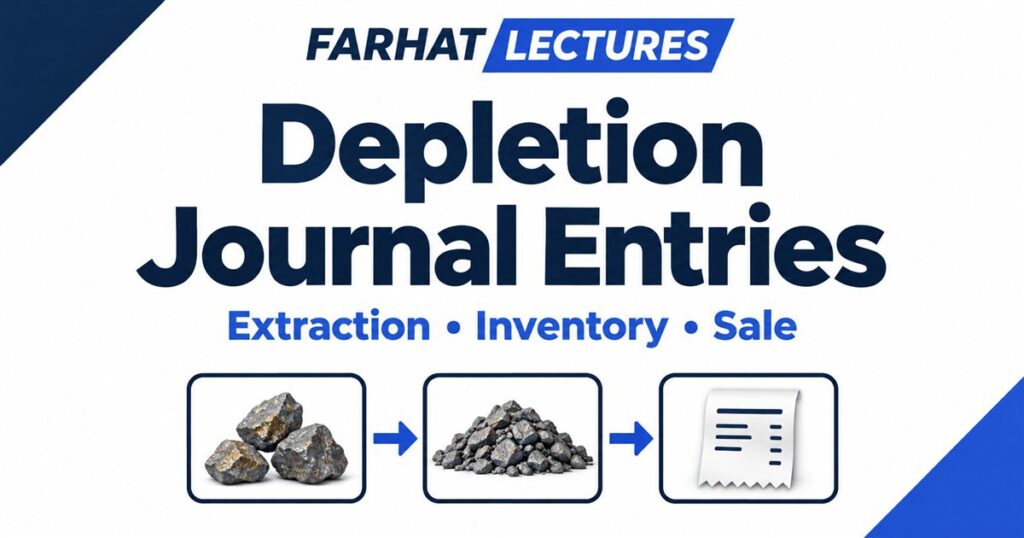
A depletion journal entry records the cost of a natural resource used up as it is extracted. Debit Inventory and credit the natural-resource asset (or Accumulated Depletion) for units extracted × the depletion rate. When those units are sold, debit Cost of Goods Sold and credit Inventory. Depletion included in inventory is normally recognized in Cost of Goods Sold when the inventory is sold. An inventory write-down can result in a loss before sale.
This distinction matters on exams: an otherwise correct rate can still produce incorrect inventory and profit if you multiply by the wrong unit count. In the examples below, we credit the resource account directly, and we also show the Accumulated Depletion alternative, because textbooks and exam questions use both.
What Is the Journal Entry for Depletion?
| When | Debit | Credit | Amount |
|---|---|---|---|
| Units are extracted | Inventory | Natural-resource asset (or Accumulated Depletion) | Units extracted × depletion rate |
| Units are sold | Cost of Goods Sold | Inventory | Depletion cost and other production costs assigned to the units sold under the company’s inventory cost-flow method |
Depletion rate = (depletion base − salvage value) ÷ estimated recoverable units. The depletion base is the capitalized cost of acquiring, exploring, developing, and restoring the resource.
Video lesson: This short Farhat Lectures video works through a depletion expense example for the CPA exam. Watch it first, then use the inventory-and-sales example below to see where the cost goes when not every extracted unit is sold.
Follow the resource cost through three stages
| Stage | Where the cost belongs | What happened? |
|---|---|---|
| Before extraction | Natural-resource asset | The minerals remain in the deposit. |
| Extracted but unsold | Inventory, a current asset | The minerals are available as a product. |
| Sold | Cost of Goods Sold, an expense | The product’s cost is matched with the sale. |
Inventory is still an asset. Moving cost from the mine to ore inventory does not, by itself, mean the company has incurred an expense on its income statement. It changes the asset holding that cost.
Start with the correct per-unit amount. Our depletion calculation guide explains acquisition, qualifying development, restoration, salvage, and reserve estimates. A missing restoration amount or an incorrectly capitalized loader affects every later entry.
Depletion journal entry: an original worked example
Hypothetical example: Harbor Stone has a $900,000 mineral-resource asset and zero salvage value. Its estimated recoverable quantity is 150,000 tons. The rate is $6 per ton. During year 1, Harbor extracts 24,000 tons and sells 18,000 tons. There is no beginning inventory.
To isolate depletion, assume these examples exclude labor, processing, transportation, and other production costs. In a complete inventory calculation, applicable additional costs would also be included.
Step 1: Record extraction
The depletion journal entry uses 24,000 tons extracted × $6 = $144,000.
| Account | Debit | Credit |
|---|---|---|
| Inventory—Stone | $144,000 | — |
| Mineral Resource | — | $144,000 |
The debit records the depletion cost attached to the stone now on hand. The credit reduces the resource’s carrying amount. No Cash account appears because this entry allocates previously recorded cost; it is not a second payment for the deposit.
Step 2: Record the cost of the units sold
The depletion component of cost of goods sold is 18,000 tons sold × $6 = $108,000.
| Account | Debit | Credit |
|---|---|---|
| Cost of Goods Sold | $108,000 | — |
| Inventory—Stone | — | $108,000 |
The sales-revenue entry is separate. For example, if all 18,000 tons are sold on account for $20 per ton, debit Accounts Receivable and credit Sales Revenue for $360,000. The selling price measures revenue; the $6 depletion rate measures one component of product cost.
Reconcile ending inventory and the resource balance
Harbor has 6,000 tons of extracted stone left: 24,000 − 18,000. Its ending inventory includes $36,000 of depletion cost, or 6,000 × $6.
| Check | Amount |
|---|---|
| Depletion assigned to all extraction | $144,000 |
| Depletion included in cost of goods sold | $108,000 |
| Depletion remaining in inventory | $36,000 |
| Reconciliation | $108,000 + $36,000 = $144,000 |
| Remaining mineral-resource carrying amount | $900,000 − $144,000 = $756,000 |
The balance sheet therefore reports the remaining deposit separately from the extracted inventory. Do not subtract only the sold units’ depletion from the deposit: all 24,000 extracted tons have already left it.
At a $20 selling price, revenue is $360,000 and the depletion component of cost of goods sold is $108,000. Their $252,000 difference is not necessarily final gross profit because the illustration deliberately leaves other production costs out.
Direct credit or accumulated depletion?
Some textbooks credit the resource asset directly, and that is the convention this article uses. Others credit Accumulated Depletion, a contra-asset (an account that offsets an asset’s balance) that reduces the resource’s reported net carrying amount. If your course or homework system specifies one approach, follow it.
Under that alternative, the extraction entry debits Inventory $144,000 and credits Accumulated Depletion $144,000. The balance sheet then shows the $900,000 resource cost less $144,000 accumulated depletion, leaving the same $756,000 net amount.
These are alternative credit presentations. Do not credit both accounts for the same extraction. The inventory debit and subsequent sale entry are unchanged.
What Happens When Reserve Estimates Change?
Reserve estimates are educated guesses, and they change as the company learns more about the deposit. A revision is a change in accounting estimate, so you update the rate going forward. You do not go back and fix earlier entries.
Let’s continue the Harbor Stone example from above. After year 1, the resource has a $756,000 carrying amount. At the start of year 2, engineers estimate that 140,000 tons remain, instead of the 126,000 tons left under the original estimate.
New rate: $756,000 ÷ 140,000 tons = $5.40 per ton.
If Harbor extracts 30,000 tons in year 2, the extraction entry uses 30,000 × $5.40 = $162,000.
| Account | Debit | Credit |
|---|---|---|
| Stone Inventory | $162,000 | — |
| Mineral Resource | — | $162,000 |
The 6,000 tons still in inventory from year 1 keep their $6 per ton depletion cost, or $36,000. Only units extracted after the revision use the new $5.40 rate. When units from these different production periods are sold, assign their depletion cost to Cost of Goods Sold using the company’s inventory cost-flow method.
After the year 2 extraction, the resource balance is $756,000 − $162,000 = $594,000. That equals the 110,000 tons still in the ground × $5.40, so the numbers tie out.
Depletion vs. Depreciation of Mining Equipment
Depletion covers the natural resource itself. Equipment used to extract it, like trucks, drills, or a loader, is depreciated separately.
If the equipment can be used only at this site and will be abandoned when the deposit runs out, companies often depreciate it over the shorter of its useful life or the resource’s life, frequently using the units-of-production method. That depreciation is also a cost of producing the inventory, so in a full inventory calculation it is added to inventory alongside depletion.
Equipment that can be moved to other sites is depreciated over its own useful life, no matter how long this deposit lasts.
Book Depletion vs. Tax Depletion
If you are studying for the EA exam or the REG section of the CPA exam, keep book and tax depletion separate.
Book depletion, used in financial statements under U.S. GAAP, follows the cost-based units-of-production approach shown in this article.
Tax depletion follows Internal Revenue Code sections 611 through 613A. Taxpayers generally compute cost depletion and, where they qualify, percentage depletion, and deduct the larger amount. Percentage depletion is a set percentage of gross income from the property, subject to limits, and it can continue even after the property’s tax basis reaches zero. For oil and gas, percentage depletion is generally limited to independent producers and royalty owners.
Because the two systems follow different rules, book depletion and tax depletion often differ.
Common mistakes with a depletion journal entry
- Expensing all extracted units: this overstates cost of goods sold when some units remain unsold.
- Crediting Cash: the depletion journal entry allocates cost; cash was handled in the original transactions.
- Using the selling price as cost: $20 per ton measures revenue in this example, not depletion.
- Mixing up depletion and dividends: a liquidating dividend returns shareholders’ capital. It is a separate equity transaction, not the entry for extracting minerals.
- Keeping the old rate after a reserve revision: a new reserve estimate changes the rate for future extraction only. Do not restate earlier entries or reprice inventory already on hand.
Quick Check: What Goes Into the Depletion Base?
Depletion allocates the cost of a natural resource as it is consumed. Textbooks usually group the depletion base into four cost categories: acquisition, exploration, development, and restoration. In oil and gas, how much exploration cost is capitalized depends on whether the company uses the successful efforts or full cost method. Use the three questions below to check your understanding of the depletion base.
Practice questions and explained answers
1. Record an extraction
A hypothetical mine’s rate is $5 per ton and it extracts 12,000 tons. Credit the resource account directly, as in the worked example.
Answer: Debit Inventory $60,000 and credit the mineral-resource (mine) asset $60,000. The 12,000 extracted units determine the transfer from the resource.
2. Find the unsold cost
Of those 12,000 tons, 9,500 are sold. Beginning inventory is zero. What depletion cost remains in inventory?
Answer: $12,500, calculated as 2,500 tons × $5. Cost of goods sold receives $47,500, and the two amounts sum to the $60,000 extracted cost.
3. Explain the effect on profit
A company extracts 4,000 units at a $7 rate and sells none. Does the $28,000 depletion allocation immediately reduce profit in this example?
Answer: No. It transfers $28,000 from the resource to Inventory. Under the illustrated inventory treatment, the cost becomes expense when the units are sold.
4. Apply a Revised Rate
After two years, a mine’s remaining carrying amount is $480,000, and engineers now estimate that 120,000 tons remain. Assume zero salvage value. The company extracts 25,000 tons this year. What is the extraction entry?
Answer: The new rate is $480,000 ÷ 120,000 = $4 per ton. Debit Inventory $100,000 (25,000 × $4) and credit the mineral-resource asset $100,000. Earlier entries are not changed.
Key Takeaways
- Extraction: debit Inventory and credit the resource (or Accumulated Depletion) for units extracted × the depletion rate.
- Sale: debit Cost of Goods Sold and credit Inventory for the depletion cost assigned to units sold under the inventory cost-flow method, together with applicable other production costs.
- Extracted units that are not sold yet stay in inventory as an asset, not an expense.
- The resource balance drops by all units extracted, not just the units sold.
- A revised reserve estimate changes the rate going forward only.
- The depletion entry is noncash. It allocates previously capitalized cost.
Frequently asked questions
Can the debit ever be Depletion Expense?
Yes, in simplified problems. When every extracted unit is sold in the same period, some textbooks debit Depletion Expense directly, and the income statement result is the same. When a problem gives different extracted and sold quantities, debit Inventory for extraction and move only the sold units to Cost of Goods Sold, as this lesson does.
Is accumulated depletion a liability?
No. It is a contra-asset used to show the resource’s cost allocation to date. It is not money owed to someone.
What happens when reserves are revised?
Use a revised rate prospectively for affected production. Do not automatically reprice inventory already produced under the earlier estimate.
Is Depletion a Cash Expense?
No. The depletion entry is a noncash allocation of previously capitalized cost. Some capitalized amounts, such as asset retirement costs, relate to obligations that will be paid in the future. Depletion moves the allocated cost into inventory and then into Cost of Goods Sold when the inventory is sold.
What Is the Difference Between Depletion, Depreciation, and Amortization?
All three spread an asset’s cost over time or use. Depletion applies to natural resources like minerals, oil, and timber. Depreciation applies to tangible assets like buildings and equipment. Amortization applies to intangible assets like patents.
Where Does Depletion Appear on the Financial Statements?
Depletion on units not yet sold sits in inventory, a current asset. Depletion on units sold is part of cost of goods sold on the income statement. The remaining resource, net of any accumulated depletion, is reported as a noncurrent asset.
Sources and lesson context
Wiley section 10.3, Depletion explains extraction, inventory, sale, and the alternative accumulated-depletion presentation. For authoritative guidance, see FASB ASC 330, Inventory, which sets the general rules for what goes into inventory cost. Depletion in extractive industries is also addressed in ASC 930 (Mining) and ASC 932 (Oil and Gas). The SEC’s oil-and-gas reporting release also explains that reserve quantities affect the allocation of capitalized costs. All examples here are hypothetical and original.
Want more practice like this? Explore the Intermediate Accounting course, or start with the Farhat Lectures free sample course to see how the lessons work.
About the Author
Mansour Farhat is the founder and instructor of Farhat Lectures, where he teaches accounting courses and CPA, CMA, and EA exam review.




Responses