
PPE Valuation: Lump-Sum, Stock, and Cash Discount Examples


PPE valuation is how a company sets the initial recorded cost of property, plant and equipment (PP&E). Under U.S. GAAP, record the cash or cash-equivalent price plus costs to get the asset ready for use. For a lump-sum purchase, split total cost by relative fair values. When shares pay for an asset, use fair value, not par value.
The amount matters because it becomes the starting point for later accounting. Assigning too much cost to a building and too little to land changes future depreciation even if total assets initially look correct. This guide explains initial PP&E acquisition accounting under U.S. GAAP and includes a brief comparison with subsequent measurement under IFRS. Acquisitions of entire businesses are outside its scope.
Video lesson with Professor Farhat
Professor Farhat walks through how to value property, plant and equipment at acquisition. Jump to 4:00 for the cash-purchase discussion, which pairs with the cash discount section below.
What amount is recorded for PP&E?
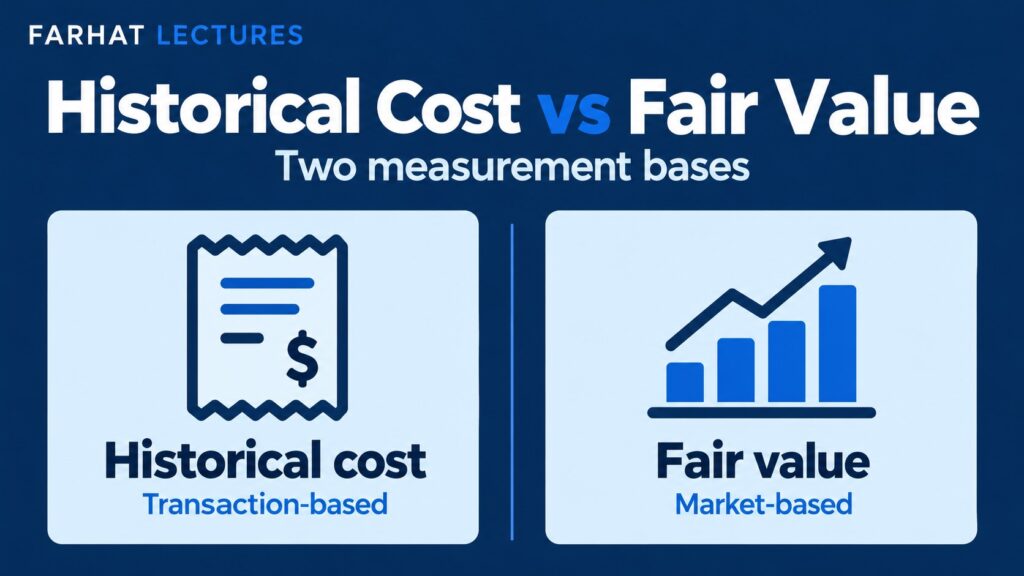
Fair value estimates a current market-based amount. Historical cost records the amount assigned when the asset is acquired. For the initial acquisition entries in this guide, fair value helps measure or allocate acquisition cost. The two steps answer different questions: what did the acquisition cost, and how much belongs to each asset?
| Acquisition method | Starting point | Avoid this shortcut |
|---|---|---|
| Cash purchase | Cash-equivalent acquisition cost | Substituting an unsupported asking price |
| Group of assets for one price | Allocate total cost by relative fair values | Using the seller’s book values |
| Shares issued for property | Reliable fair value of consideration or property | Measuring the asset at par value |
| Long-term installment contract | Cash price or present value of payments | Treating all future payments as asset cost |
A long-term promise to pay includes a financing question; see deferred-payment contracts and present value. Trading an existing machine involves a different issue: gain and loss recognition in nonmonetary exchanges.
How do cash discounts affect PPE valuation?
A cash discount is a price reduction a seller offers for paying quickly. Terms of 2/10, n/30 mean you get 2% off if you pay within 10 days; otherwise the full amount is due in 30 days.
Under the net method used in this example, record the asset and payable net of the available cash discount. If the discount is lost because payment is late, recognize the lost discount as an expense rather than adding it to the asset’s cost.
Hypothetical example. Ridge Co. uses the net method and buys equipment with a $20,000 invoice price on terms of 2/10, n/30. The discount is $20,000 × 2% = $400, so the recorded cost is $19,600.
At purchase: Debit Equipment $19,600; credit Accounts Payable $19,600.
If Ridge pays within 10 days: Debit Accounts Payable $19,600; credit Cash $19,600.
If Ridge pays after 10 days: Debit Accounts Payable $19,600 and Purchase Discounts Lost $400; credit Cash $20,000. The $400 is an expense. The equipment stays at $19,600 either way.
How do you allocate a lump-sum purchase?
A lump-sum purchase, also called a basket purchase, puts one price on several assets. First estimate each asset’s fair value using appropriate evidence, such as supported appraisals or comparable transactions. Add those values. Then multiply total acquisition cost by each asset’s percentage of the combined fair value.
Allocated cost = Total acquisition cost × Individual fair value ÷ Total fair value. Use the unrounded proportion when calculating dollars. The allocated amounts must add back to the cost being distributed.
Hypothetical example. Harbor Services pays $450,000 cash for land and a building in an asset purchase. Supported fair values are $180,000 for land and $420,000 for the building. Assume no additional acquisition costs.
| Asset | Fair value | Share | Recorded cost |
|---|---|---|---|
| Land | $180,000 | 30% | $135,000 |
| Building | $420,000 | 70% | $315,000 |
| Total | $600,000 | 100% | $450,000 |
Debit Land $135,000 and Building $315,000; credit Cash $450,000. The $150,000 difference between total appraisals and price is not an immediate bargain gain in this asset acquisition. The appraisals supply allocation weights. They do not replace the actual cost with $600,000.
What if the purchase includes legal or closing costs?
Qualifying acquisition costs that relate jointly to the land and building are added to the lump-sum price and allocated using the same relative fair-value percentages. Costs directly attributable to one asset are assigned to that asset.
Hypothetical example. Suppose Harbor also paid $15,000 of legal and title fees attributable jointly to acquiring the land and building, with no portion specific to either asset. Total cost becomes $450,000 + $15,000 = $465,000. Land gets 30% × $465,000 = $139,500, and the building gets 70% × $465,000 = $325,500. The two amounts add back to $465,000.
Costs that clearly belong to one asset go straight to that asset. For example, the cost of tearing down an old building to prepare the land is charged to Land.
The seller’s original cost and accumulated depreciation describe the seller’s accounting history. They are not the buyer’s allocation weights. Recording the whole payment as Building would also be wrong: the land portion needs its own account. For the broader measurement distinction, review historical cost versus fair value.
For more basket-purchase practice, see the relative sales value method.
How do you value an asset bought with stock?
A company can issue common shares instead of paying cash. If those shares trade actively, their market price provides evidence of the property’s cash-equivalent cost. Par value is the legal or nominal amount assigned to a share. It determines the Common Stock credit, not the asset’s value.
Hypothetical example. Mesa Co. issues 4,000 common shares for land. Each share has a $2 par value and a reliable $15 market value. Land cost is 4,000 × $15 = $60,000. Common Stock is credited for 4,000 × $2 = $8,000. The remaining $52,000 is additional paid-in capital, also called paid-in capital in excess of par. To see where this fits in the balance sheet, review the components of stockholders’ equity.
| Account | Debit | Credit |
|---|---|---|
| Land | $60,000 | — |
| Common Stock | — | $8,000 |
| Additional Paid-in Capital | — | $52,000 |
If a reliable stock price is unavailable but the property’s fair value is clearly supported, use the property’s value to measure the exchange. Do not assume unlisted shares have no value. Also do not record a gain simply because the land’s value exceeds the shares’ par amount: the difference is an equity classification.
Does a bargain or overpayment change PPE valuation?
For the straightforward asset acquisitions in this lesson, a favorable purchase price or efficient self-construction does not create an immediate gain. Record the acquisition or construction cost. Likewise, an appraisal below the price does not automatically justify an acquisition-date loss. For a group of assets, allocate cost using relative fair values after checking the facts and estimates.
You may hear the phrase “prudent cost” in class. It’s a theoretical idea: if a company clearly overpaid, some argue the excess should be a loss right away. In practice, the entry for an asset purchase still records cost and allocates it. If the asset later can’t support its carrying amount, impairment rules handle that separately, and impairment is outside this lesson.
Does IFRS allow revaluing PP&E?
Yes, with conditions. Under IFRS, IAS 16 also records PP&E at cost when it’s acquired. After that, a company chooses either the cost model or the revaluation model for each class of PP&E, such as all land or all buildings.
If it chooses revaluation, it must revalue the entire class, not just one asset. Increases generally go to other comprehensive income and build up in a revaluation surplus in equity, unless they reverse an earlier loss recognized in profit or loss.
U.S. GAAP does not allow revaluing PP&E upward. Assets stay at historical cost less accumulated depreciation and any impairment.
Key takeaways
- PP&E starts at cost: the cash or cash-equivalent price plus costs to get it ready for use.
- In a lump-sum purchase, allocate the price and jointly attributable acquisition costs by relative fair values. Assign asset-specific costs directly.
- Appraisals above the price don’t create a gain in an asset purchase.
- When shares pay for an asset, use the fair value of the shares or the asset, whichever is more clearly evident. Par value only sets the Common Stock credit.
- Under the net method, record assets net of available cash discounts. A lost discount is an expense.
- IFRS permits a revaluation model; U.S. GAAP does not.
Interactive PPE valuation practice
Apply the acquisition-cost rules in six questions covering lump-sum allocations, stock issued for assets, cash discounts under the net method, and deferred-payment contracts. For long-term credit purchases, distinguish the note’s face value from its initial carrying amount. Select one answer per question; at least five correct answers meet the 80% mastery threshold.
Practice questions with explained answers
1. Assets have fair values of $50,000 and $150,000. The group costs $160,000. What amounts are recorded?
Answer: $40,000 and $120,000. The fair-value proportions are 25% and 75%, applied to the $160,000 cost. The total remains $160,000.
2. A company issues 3,000 shares, $1 par and $12 market value, for equipment. What is the entry?
Answer: Debit Equipment $36,000; credit Common Stock $3,000 and Additional Paid-in Capital $33,000. Market value measures the acquisition; par value divides the equity credit.
3. A machine is built efficiently for $72,000 but is worth $90,000. Is an $18,000 gain recorded?
Answer: No. The cost saving does not create an immediate gain. Record $72,000 of qualifying construction cost under the stated facts.
4. Land and a building have fair values of $200,000 and $300,000. The price is $440,000, plus $10,000 of legal fees attributable jointly to both assets. What amounts are recorded?
Answer: Land $180,000 and Building $270,000. Total cost is $450,000. The fair-value proportions are 40% and 60%, applied to the full $450,000, not just the $440,000 price.
Want more practice like this? The Intermediate Accounting course goes deeper into PP&E with full video lessons, and you can try the Farhat Lectures free sample course first.
Frequently asked questions
Is relative fair value the same as recording every asset at fair value?
No. It allocates total cost in proportion to fair value. Individual recorded costs can be above or below the appraised amounts.
Can I allocate a lump-sum price equally?
Only when equal allocation follows from equal relative fair values. Equal asset counts alone are not a valuation method.
Does this guide cover bargain purchases of entire businesses?
No. These examples are asset acquisitions. Business-combination rules require a separate analysis and should not be imported into these entries.
What costs are included in the cost of PP&E?
The purchase price plus costs needed to get the asset ready for its intended use, such as freight, installation, and legal or title fees. Routine repairs after the asset is in use are expenses.
Where do transaction costs go in a lump-sum purchase?
Add qualifying costs attributable jointly to the acquisition to the purchase price, then allocate the total by relative fair values. Costs directly attributable to one asset go to that asset.
How are cash discounts treated under the net method?
Under the net method, record the asset net of the available discount. If the company pays late and loses the discount, recognize the lost amount as an expense.
Can PP&E be revalued to fair value under U.S. GAAP?
No. U.S. GAAP keeps PP&E at historical cost less accumulated depreciation and impairment. IFRS allows a revaluation model for an entire class of assets.
Is PPE valuation tested on the CPA exam?
Yes. PP&E acquisition cost, including lump-sum allocations and assets bought with stock, is part of the Financial Accounting and Reporting (FAR) section.
Sources and lesson context
The Financial Accounting Standards Board Accounting Standards Codification (FASB ASC) is the authoritative U.S. GAAP reference. ASC 805-50-30 addresses asset acquisition cost, including noncash consideration and relative-fair-value allocation. FASB’s ASU 2010-08, pages 13–15 shows the asset acquisition guidance as amended in 2010, along with an allocation illustration that includes transaction costs. Later updates have amended parts of Subtopic 805-50, so check the current Codification for the latest wording. An Accounting Standards Update explains Codification changes rather than replacing the Codification.
This original guide supports Wiley Intermediate Accounting, section 9.3. All examples and practice questions are hypothetical and original. The acquisition examples use U.S. generally accepted accounting principles (GAAP); the IFRS section provides a brief subsequent-measurement comparison. See the IFRS Foundation’s IAS 16 Property, Plant and Equipment overview for the IFRS framework.
Continue learning: Intermediate Accounting course · Farhat Lectures free sample course.
About the author
Mansour Farhat is the instructor behind Farhat Lectures, where he teaches accounting and CPA, CMA, and EA exam topics on this site and on the Farhat Lectures YouTube channel. The examples on this page come from the same intermediate accounting material he covers in his video lessons.



Responses