
Cash to Accrual Conversion: Revenue, Expenses, and Net Income

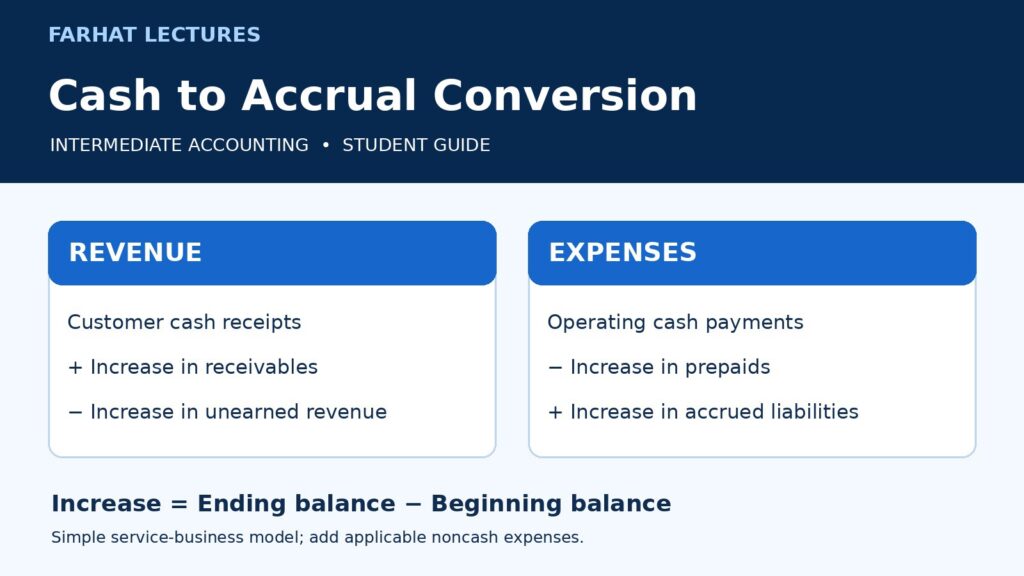
Cash to accrual conversion turns cash collected and cash paid into the revenue and expenses a business actually earned and incurred in a period. Start with cash receipts, then adjust for changes in accounts receivable and unearned revenue. Start with cash payments, then adjust for prepaid expenses and accrued liabilities. Finally, include noncash expenses such as depreciation.
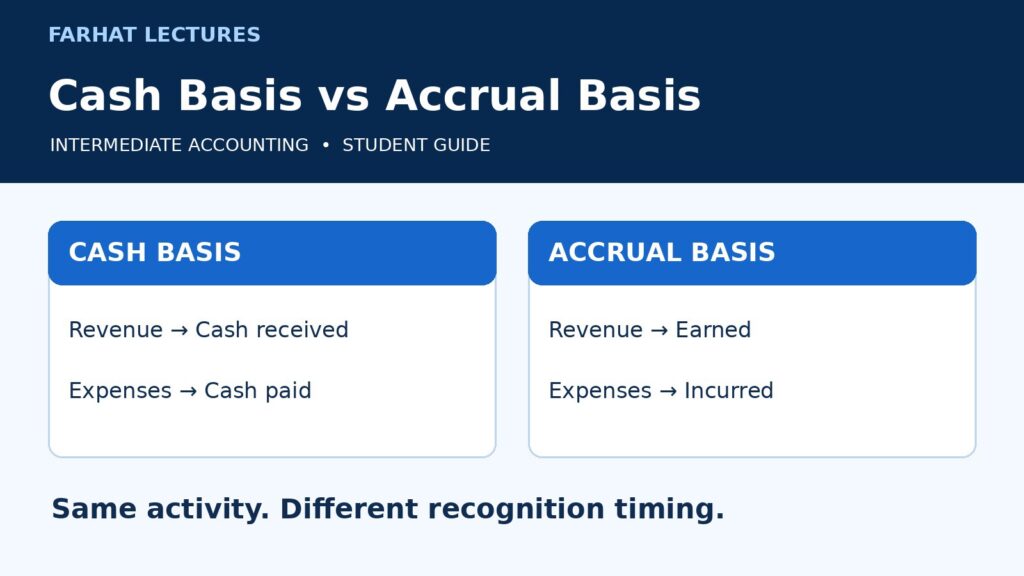
The most reliable method is to explain what each beginning and ending balance represents. If recognition timing is unfamiliar, first read cash basis vs accrual basis accounting.
Why does this matter? Businesses that keep cash-basis records often need accrual numbers for a bank loan, investors, a buyer, or GAAP financial statements (GAAP means generally accepted accounting principles, the U.S. financial reporting rules). It’s also a common calculation in Intermediate Accounting and in CPA FAR (Financial Accounting and Reporting) practice questions.
Watch Professor Farhat: Review cash and accrual timing, then follow the worked calculations.
Watch the matching Farhat Lectures video on YouTube. The opening covers cash versus accrual timing. Jump to revenue conversion at 3:50 (receivables at 4:24, unearned revenue at 6:18) or expense conversion at 8:03 (prepaids at 8:17, accrued liabilities at 10:07).
Cash to accrual conversion: define the starting amounts
Begin with cash collected from customers and cash paid for operating expenses. Leave out cash that isn’t part of day-to-day operations: loan proceeds, owner contributions, loan principal repayments, owner withdrawals, equipment purchases, and cash from selling long-term assets. Classifying the cash amounts correctly comes before changing their timing.
This guide assumes a simple service business with no inventory, no receivable write-offs, and no unusual adjustments. Inventory and write-offs are covered in the exam traps section below. For anything more complex, reconcile each account separately instead of forcing it into these formulas.
A balance increase equals ending balance minus beginning balance. A decrease produces a negative change. Write that definition above your work to avoid reversing it halfway through the calculation.
Key Terms In Plain English
- Accounts receivable: money customers owe for work already done.
- Unearned revenue: cash customers paid in advance for work not done yet. It’s a liability until you do the work.
- Prepaid expenses: costs paid ahead of time, like insurance or rent, that you’ll use up later. They’re assets.
- Accrued liabilities: expenses you’ve already incurred but haven’t paid yet, like wages or utilities.
- Noncash expense: an expense with no cash payment in the period, such as depreciation.
How Do You Convert Cash Receipts To Accrual Revenue?
Accrual revenue = Customer cash receipts − Beginning accounts receivable + Ending accounts receivable + Beginning unearned revenue − Ending unearned revenue.
Equivalently: Revenue = Customer receipts + Increase in receivables − Increase in unearned revenue.
| Balance | Adjustment to customer receipts | Reason |
|---|---|---|
| Beginning accounts receivable | Subtract | Collections of previously earned revenue are not current revenue |
| Ending accounts receivable | Add | Current earned revenue has not yet been collected |
| Beginning unearned revenue | Add | Opening advances are available to be earned in this period |
| Ending unearned revenue | Subtract | These advances still represent unperformed services |
Using both the beginning and ending balances doesn’t mean every opening balance gets cleared during the year. The ending balance picks up whatever is still left. For example, if a customer paid in advance last year and the work still isn’t done at year-end, that advance shows up in both balances. It cancels out and has no effect on revenue.
The related account equations explain the signs. Beginning receivables + credit revenue − collections = ending receivables. Beginning unearned revenue + advance receipts − revenue earned from advances = ending unearned revenue. Combining the two streams produces the formula above.
Accrual-Basis Revenue: Choose the Correct Adjustments
How do you convert cash receipts from customers into revenue on an accrual basis? Choose Add (+) or Subtract (−) for each account below.
Practice the revenue step of cash to accrual conversion before moving to expenses. Use the simple service-business assumptions explained above. Select all four adjustments, check your answers, and review the formula and explanations if needed.
View the accrual-basis revenue formula and answers
Revenue on an Accrual Basis = Cash Receipts from Customers − Beginning Accounts Receivable + Ending Accounts Receivable + Beginning Unearned Service Revenue − Ending Unearned Service Revenue.
- Subtract beginning accounts receivable: Remove the opening balance of revenue recognized before the current period.
- Add ending accounts receivable: Include the closing balance of earned revenue still awaiting collection. Using both receivable balances captures the net change, including any opening receivables still outstanding.
- Add beginning unearned service revenue: Include opening customer advances in the reconciliation of amounts available to be earned.
- Subtract ending unearned service revenue: Exclude advances still unearned at the reporting date. An opening advance that remains unearned appears in both balances and cancels out.
How Do You Convert Operating Cash Payments To Accrual Expenses?
Accrual operating expenses = Operating cash payments + Beginning prepaid expenses − Ending prepaid expenses − Beginning accrued liabilities + Ending accrued liabilities.
Equivalently: Expenses = Operating payments − Increase in prepaids + Increase in accrued liabilities.
| Balance | Adjustment to operating payments | Reason |
|---|---|---|
| Beginning prepaid expenses | Add | Prior payments may provide benefits consumed this period |
| Ending prepaid expenses | Subtract | Unconsumed benefits remain assets |
| Beginning accrued liabilities | Subtract | Paying a prior-period expense does not create current expense |
| Ending accrued liabilities | Add | Current expenses remain unpaid |
Here, accrued liabilities means unpaid operating costs, such as wages or utilities you owe at year-end. Don’t include a loan balance just because it’s a liability, since borrowing isn’t an expense. And if the same expense has both a prepaid balance and an unpaid balance (for example, rent paid ahead for some months and owed for others), adjust for both.
A complete hypothetical conversion example
Maple Advisory collected $180,000 from customers and paid $112,000 for operating expenses during 20X7. Its excess of these receipts over payments is $68,000. Assume the following balances and no other revenue or expenses except $4,000 depreciation, which is not included in the operating cash payments.
| Account | Beginning | Ending | Change |
|---|---|---|---|
| Accounts receivable | $8,000 | $13,000 | +$5,000 |
| Unearned service revenue | $6,000 | $4,000 | −$2,000 |
| Prepaid expenses | $3,000 | $5,000 | +$2,000 |
| Accrued operating liabilities | $7,000 | $10,000 | +$3,000 |
Step 1: Calculate accrual revenue
$180,000 − $8,000 + $13,000 + $6,000 − $4,000 = $187,000. The $5,000 increase in receivables raises revenue above collections. The $2,000 decrease in unearned revenue adds another $2,000 because earnings from advances exceed new advances received.
Step 2: Calculate accrual operating expenses
$112,000 + $3,000 − $5,000 − $7,000 + $10,000 = $113,000. The $2,000 increase in prepaids reduces expense relative to payments. The $3,000 increase in unpaid operating costs increases expense.
Step 3: Add the noncash expense and calculate income
Total expenses are $113,000 + $4,000 depreciation = $117,000. Accrual net income is $187,000 − $117,000 = $70,000. Depreciation is included once because it was absent from the starting cash payments.
If your cash records already include depreciation (some modified cash basis records do, since that method mixes cash records with a few accrual items), don’t add it again. Equipment purchases are covered in the exam traps section below.
Check accrual net income and avoid sign errors
| Bridge from cash operating surplus | Effect on net income |
|---|---|
| Starting receipts less operating payments | $68,000 |
| Increase in receivables | +$5,000 |
| Decrease in unearned revenue | +$2,000 |
| Increase in prepaid expenses | +$2,000 |
| Increase in accrued operating liabilities | −$3,000 |
| Depreciation not already included | −$4,000 |
| Accrual net income | $70,000 |
Notice that increasing a prepaid asset reduces expense but increases net income. Many mistakes come from applying an expense adjustment directly to income without reversing its effect. Reconcile revenue and expenses separately whenever the signs feel uncertain.
These timing adjustments implement the distinction discussed in the FASB Conceptual Framework, paragraph OB17. The framework is conceptual guidance rather than authoritative GAAP. For the debit-and-credit approach, study adjusting entries and their four types. For the two account families used here, see deferral adjusting entries for prepaids and unearned revenue, and accrual adjusting entries for receivables and unpaid expenses.
Common Exam Traps: Write-Offs, Inventory, And Equipment
The formulas above assume a simple service business. Exam questions often add one twist. Here are three to watch for.
Trap 1: Receivables Written Off
This example uses gross accounts receivable before the allowance for credit losses and assumes no changes in unearned revenue or other receivable adjustments. A write-off reduces gross receivables without a cash collection, so add it back when reconciling collections to revenue. The write-off itself does not create revenue.
Under the allowance method, a write-off reduces both gross receivables and the allowance, leaving net receivables unchanged. Do not apply the following formula to net receivables.
Revenue = Collections + Write-offs + Ending gross accounts receivable − Beginning gross accounts receivable.
Example: Collections are $120,000, beginning receivables are $10,000, ending receivables are $14,000, and $1,000 of receivables were written off. Revenue = $120,000 + $1,000 + $14,000 − $10,000 = $125,000. Check it: $10,000 + $125,000 − $120,000 − $1,000 = $14,000 ending receivables.
Trap 2: Inventory In A Merchandising Business
A business that sells goods needs two steps. First, turn cash paid to suppliers into purchases using accounts payable (amounts owed to suppliers). Then turn purchases into cost of goods sold using inventory.
Purchases = Cash paid to suppliers − Beginning accounts payable + Ending accounts payable. Cost of goods sold = Beginning inventory + Purchases − Ending inventory.
Example: Cash paid to suppliers is $70,000. Accounts payable rose from $9,000 to $12,000, and inventory fell from $15,000 to $11,000. Purchases = $70,000 − $9,000 + $12,000 = $73,000. Cost of goods sold = $15,000 + $73,000 − $11,000 = $77,000.
Trap 3: Equipment Purchases And Depreciation
Cash paid for equipment isn’t an operating expense. Pull it out of cash payments first, then add depreciation as the expense for the period. If you leave the purchase in and also add depreciation, you count the cost twice.
Key Takeaways
- Revenue = Customer cash receipts + Increase in accounts receivable − Increase in unearned revenue.
- Expenses = Operating cash payments − Increase in prepaid expenses + Increase in accrued liabilities.
- Quick sign rule: for revenue, an increase in receivables adds and an increase in unearned revenue subtracts. For expenses it flips: an increase in prepaids subtracts and an increase in accrued liabilities adds.
- Include depreciation once; do not add it again if it is already recognized in the starting records.
- Check your answer with a net income bridge that starts from the cash surplus.
Practice questions with answers
1. Customer receipts are $90,000. Receivables rise by $4,000 and unearned revenue rises by $1,500. What is accrual revenue?
Answer: $92,500 = $90,000 + $4,000 − $1,500. Add earned amounts awaiting collection; remove the net increase in advances not yet earned.
2. Operating payments are $50,000. Prepaids fall by $1,000 and accrued liabilities fall by $2,000. What is accrual operating expense?
Answer: $49,000 = $50,000 − (−$1,000) + (−$2,000). Consuming earlier prepayments adds expense; reducing earlier unpaid expenses removes prior-period costs from current payments.
3. Accrual revenue is $100,000 and adjusted operating expense is $62,000 before $6,000 depreciation. What is net income?
Answer: $32,000 = $100,000 − $62,000 − $6,000. Depreciation is an additional noncash expense under these stated facts.
Frequently asked questions
Why subtract beginning receivables?
They represent revenue recognized before the current period. Their collection belongs in cash receipts but should not create current revenue again.
Is this the same as the indirect cash flow method?
No. This guide starts with operating receipts and payments to find accrual income. The indirect method starts with accrual income and works back to operating cash flow. See the indirect method cash flow steps for a full example.
Can I prepare GAAP statements using only this formula?
No. These formulas handle the timing accounts in a simple service-business example. A full conversion also means reviewing every relevant asset, liability, and noncash item, plus the reporting requirements that apply. If you’re reporting on the cash or modified cash basis instead of GAAP, see special purpose frameworks (OCBOA).
When Should A Business Convert From Cash To Accrual?
When someone needs accrual-basis numbers, such as a lender, investors, a buyer, or an auditor reviewing GAAP financial statements. Some small businesses keep cash-basis books during the year and convert only when accrual numbers are needed.
Does Converting My Books Change My Tax Accounting Method?
Not by itself. Restating your numbers for a lender or for GAAP statements doesn’t change how you report to the IRS. Changing your tax accounting method generally requires IRS consent, which is usually requested on Form 3115, Application for Change in Accounting Method.
What Is The Quickest Way To Remember The Signs?
For revenue, an increase in receivables adds and an increase in unearned revenue subtracts. For expenses, an increase in prepaids subtracts and an increase in accrued liabilities adds. Decreases work the opposite way.
Is Cash To Accrual Conversion Tested On The CPA Exam?
It often appears in CPA FAR (Financial Accounting and Reporting) practice questions. A typical question gives cash amounts plus beginning and ending balances and asks for accrual revenue, expenses, or net income.
About The Author
Mansour Farhat, CPA, CIA, DBA, is the professor behind Farhat Lectures. He teaches accounting through video lectures, interactive exercises, and exam practice for college students and CPA, CMA, and EA candidates.




Responses