
Mastering CPA Exam MCQ Time Management: 5 Positive Tips!

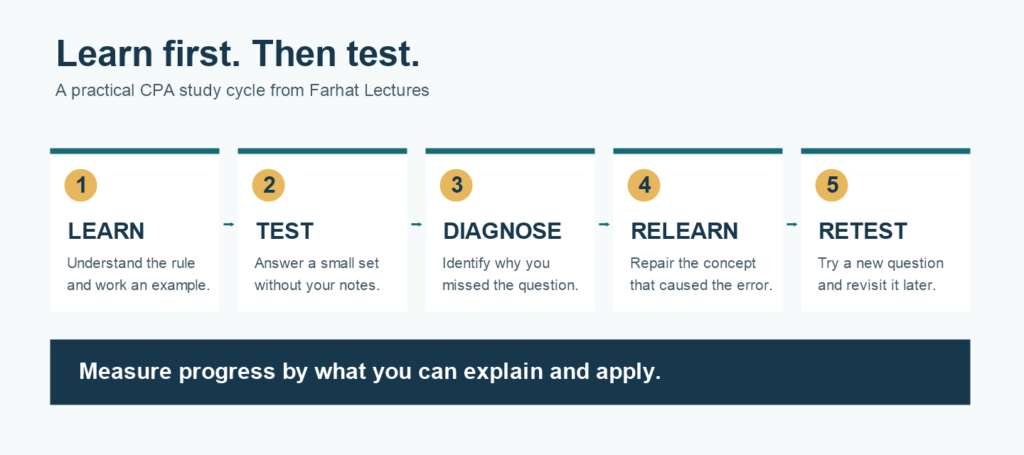
CPA exam study strategy · Farhat Lectures
For CPA exam MCQ time management, Professor Farhat recommends averaging about one minute per multiple-choice question (MCQ) in practice. That pace can help preserve time for task-based simulations (TBS), the case-style questions in the final three testlets. It is a practice guideline, not an official AICPA rule. Adjust your time budget to your section and practice results.
The short answer: Budget time for the whole set, monitor both pace and accuracy, and review the causes of slow answers afterward.
Watch Professor Farhat’s pacing advice on YouTube
Video published September 22, 2026. Runs 1 minute 22 seconds.
Why One Minute Per MCQ? Watch Professor Farhat Explain
Professor Farhat cautions that routinely spending two or three minutes on MCQs can leave you rushing through simulations. Use that observation to examine your practice habits.
Watch the video, then apply the routine below. The worked example and checklist are illustrations of how to use the advice during study; they are not additional exam rules.
5 Tips to Manage Your Time on CPA Exam MCQs
1. Learn the concept before measuring speed
A timer cannot repair a missing foundation. Before a timed set, work through the topic and explain the underlying rule in your own words. If you cannot explain why an answer is correct, return to the lesson before increasing your question volume.
Farhat’s guide to learning concepts before repeatedly practicing MCQs explains this approach. Familiarity with an answer can feel like progress even when the reasoning remains unclear. Use unfamiliar questions to check whether you can apply what you learned.
2. Set a time budget for the whole practice set
Choose a manageable set and set an answering-time budget before you begin. Keep explanation review separate so you can measure how long you spent solving the questions independently. The 30-question example below shows how to balance faster and slower questions within a set.
Write down both elapsed time and accuracy. Finishing faster while making more avoidable errors is a reason to adjust your approach. Compare practice sets of reasonably similar difficulty before concluding that your pace has improved.
Studying FAR? You can pull a timed set straight from the Farhat FAR CPA test bank.
3. Read the requirement and use the relevant facts
Identify what the question asks before starting a calculation. Determine the requested amount, classification, or conclusion, then connect the relevant facts to that requirement. An orderly approach can prevent unnecessary calculations and repeated reading.
For a calculation question, write the formula or a short sequence of steps. For a conceptual question, identify the rule and explain which facts make it applicable. Answer efficiently when the reasoning is clear, leaving more of your practice budget for questions that need additional work.
4. Recognize when to answer and move on
Distinguish productive analysis from rereading the same sentence without making progress. If you understand the rule and are completing a calculation, a longer question may be reasonable. If you keep circling between options without identifying new evidence, the extra time may not improve your answer.
During practice, eliminate alternatives you can explain as incorrect, make your best supported choice, and continue. Record the question for review after the timed set. Use the review checklist below to identify the cause of each delay. For exam-day navigation, see the testlet rules in the section below.
5. Protect simulation practice and review your results
Include separate simulation work in your study plan. Simulations require you to organize information and apply concepts across several tasks. Completing more MCQs should not repeatedly eliminate the time you intended to spend on that work.
After the timed set, examine incorrect answers, correct guesses, and slow correct answers. Revisit the relevant explanation, then attempt a different question on the same concept. That’s how timed practice turns into real understanding.
CPA exam MCQ time management: a 30-question example
The following illustration shows why an average is more useful than a rigid limit on each item. Assume a student answers 30 practice questions with the timing shown below.
| Question group | Questions | Time each | Total time |
|---|---|---|---|
| Straightforward | 10 | 30 seconds | 5 minutes |
| Moderate analysis | 15 | 60 seconds | 15 minutes |
| More involved | 5 | 120 seconds | 10 minutes |
| Total | 30 | 60-second average | 30 minutes |
Average time = total answering time ÷ questions answered. Here, 30 minutes ÷ 30 questions = one minute per question. Five questions took two minutes each, yet the overall set still met the practice target because other questions took less time.
Review the answers before judging the session successful. A one-minute average with weak understanding identifies a different study need from a slightly slower set with accurate, independently reasoned answers.
How Much Time Do You Have for MCQs on Each CPA Exam Section?
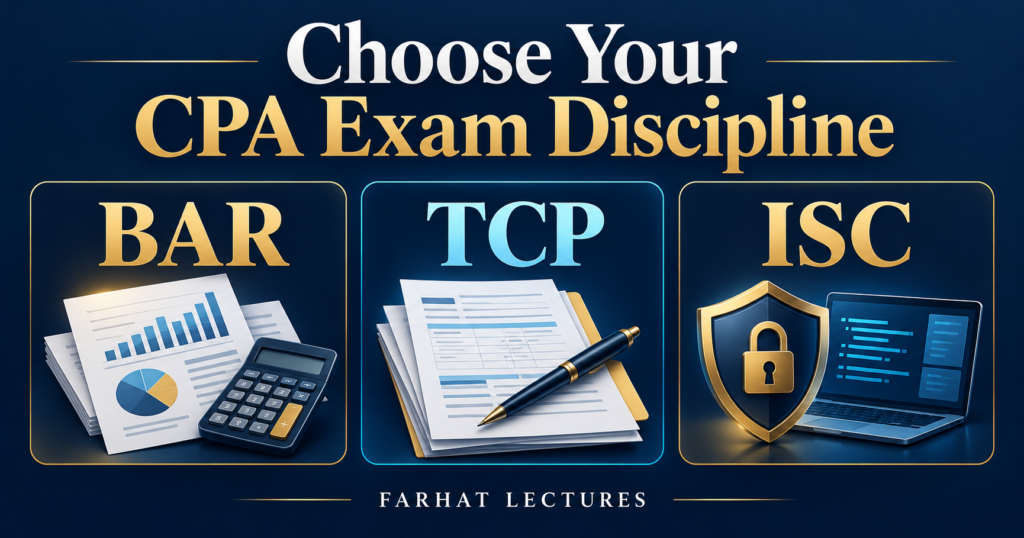
Every CPA exam section gives you four hours of testing time. That includes the three Core sections (AUD, FAR, REG) and the three Discipline sections (BAR, ISC, TCP). Each section is split into five testlets, which are timed blocks of questions. Testlets 1 and 2 are multiple-choice. Testlets 3, 4, and 5 are task-based simulations.
The number of MCQs is different in every section, so the same one-minute pace leaves different amounts of time for simulations. Here’s how it works out under the AICPA Blueprints effective January 1, 2026.
| Section | MCQs (two testlets) | Simulations | MCQ time at 1 minute each | Time left for simulations | About per simulation |
|---|---|---|---|---|---|
| AUD | 78 (39 + 39) | 7 | 78 minutes | 162 minutes | 23 minutes |
| FAR | 50 (25 + 25) | 7 | 50 minutes | 190 minutes | 27 minutes |
| REG | 72 (36 + 36) | 8 | 72 minutes | 168 minutes | 21 minutes |
| BAR | 50 (25 + 25) | 7 | 50 minutes | 190 minutes | 27 minutes |
| ISC | 82 (41 + 41) | 6 | 82 minutes | 158 minutes | 26 minutes |
| TCP | 68 (34 + 34) | 7 | 68 minutes | 172 minutes | 25 minutes |
Counts include a few unscored pretest questions. Times ignore optional breaks, which use your clock, and any time spent reviewing flagged questions.
A few things stand out. AUD and ISC have the most MCQs, so a slow pace costs you more there. ISC is also the only section where MCQs are worth 60% of your score and simulations 40%. In every other section, each counts for 50%.
For context, NASBA describes a retired AICPA FAR simulation as designed to take about 20 to 30 minutes. That lines up with the roughly 27 minutes per simulation a one-minute MCQ pace leaves you on FAR.
Exam-Day Rules That Affect Your Pacing
- You can’t go back after you submit a testlet. Inside a testlet you can move between questions and change answers. Once you submit it, it’s locked.
- Flag questions you want to revisit. Mark a question, keep going, and come back to it before you submit that testlet.
- The standardized break doesn’t use your time. You’ll be offered a 15-minute break after the first simulation testlet (testlet 3), and the clock stops while you take it. You can take other breaks between testlets, but your clock keeps running during those.
- Set checkpoint times before you start. Split your MCQ time between the two MCQ testlets. On FAR at a one-minute pace, that’s about 25 minutes per testlet. Note the clock when you submit each one so you always know where you stand.
Sources: AICPA, Uniform CPA Examination Blueprints, NASBA CPA Exam FAQ, and NASBA, A Look Inside Retired FAR Simulations.
Diagnose what is slowing you down
Use a short review log to connect each problem to a specific action. Record the topic, the source of the delay, and what you will do before the next set.
- Knowledge gap: You could not identify the rule. Return to the relevant Farhat lesson and work through an example without copying the solution.
- Reading error: You missed a date, qualifier, or requested amount. State the requirement before calculating in your next practice session.
- Calculation difficulty: You knew the concept but lost your place. Practice a consistent formula and a short, organized calculation.
- Second-guessing: You repeatedly reconsidered an answer without new evidence. Write down what would actually justify changing it.
- Correct guess: The selected answer was right, but you could not explain it. Treat the topic as unfinished and test it with a new question.
For your next session, choose one recurring weakness to address. Record your time and accuracy again after studying that weakness. Good pacing comes from repeating that loop: practice, diagnose, adjust.
Frequently asked questions
How long should I spend on a CPA exam MCQ?
Aim for about one minute on average during practice, rather than a fixed limit on every question. See the 30-question example for how longer and shorter questions balance.
Is one minute per MCQ an official CPA exam rule?
No. It is Professor Farhat’s practice guideline, not an official per-question time limit.
What if I consistently need several minutes per question?
Use the review checklist to identify whether the delay comes from knowledge, reading, calculations, or second-guessing.
Should every practice session be timed?
No. Work without a timer when learning a concept; add timed sets when you can solve questions independently.
How many multiple-choice questions are on each CPA exam section?
The counts vary by section. Consult the section comparison table for MCQ counts and an illustrative time budget.
Can I go back to a question after I submit a testlet?
No. Review flagged questions before submitting the testlet; submission locks it.
Should I guess if I’m running out of time?
Yes. Choose the best-supported answer and continue; leaving a question blank cannot earn credit.
Ultimately, your success hinges on effective CPA exam MCQ time management.
As you study, always keep CPA exam MCQ time management strategies in mind to maximize your learning.
Mastering CPA exam MCQ time management will not only help you in the exam but in your future career.
Make CPA exam MCQ time management part of your routine to ensure you are fully prepared.
Focus and practice on CPA exam MCQ time management can lead to significant improvements in your scores.
Refining your CPA exam MCQ time management abilities will help you navigate the test confidently.
Remember, CPA exam MCQ time management is not just about speed, but also about understanding.
With diligent practice in CPA exam MCQ time management, you’ll feel ready to tackle any question.
Integrate CPA exam MCQ time management into your study plan to set yourself up for success.
Ultimately, effective CPA exam MCQ time management can be the key to achieving your certification goals.
As you approach the exam, focus on refining your CPA exam MCQ time management techniques.
Strategizing your CPA exam MCQ time management can make a significant difference in your performance.
Enhancing your CPA exam MCQ time management skills can lead to fewer errors and improved accuracy.
Use CPA exam MCQ time management to help you stay calm and collected during the exam.
Adjusting your study methods to include CPA exam MCQ time management is a smart move for any candidate.
By prioritizing CPA exam MCQ time management, you can achieve better exam outcomes.
Focus on CPA exam MCQ time management to enhance your cognitive endurance during the test.
Your approach to CPA exam MCQ time management can determine your readiness for the exam.
Practice makes perfect; dedicate time to refining your CPA exam MCQ time management techniques.
Effective CPA exam MCQ time management is essential for maintaining a steady pace throughout the exam.
Incorporate CPA exam MCQ time management practices into your study schedule to maximize your learning.
Developing effective CPA exam MCQ time management skills will give you an advantage on exam day.
Understanding the importance of CPA exam MCQ time management is the first step towards exam success.
Regularly assessing your CPA exam MCQ time management methods can help identify areas for improvement.
Utilizing CPA exam MCQ time management strategies can significantly improve your overall exam performance.
Make sure to practice CPA exam MCQ time management in every study session to achieve the best results.
Incorporating CPA exam MCQ time management techniques in your study routine will help you feel more prepared and confident.
Effective CPA exam MCQ time management is crucial for success in all sections of the exam. By implementing strategies for CPA exam MCQ time management, you can enhance your efficiency and accuracy.



Responses