
Interperiod Tax Allocation: A Three-Year ASC 740 Example

Interperiod tax allocation spreads income tax expense across the periods that caused it. Under ASC 740, you record current tax based on this year’s taxable income. Temporary differences can create deferred tax assets or liabilities. Eligible tax loss and tax credit carryforwards can create deferred tax assets. Permanent differences never reverse, so they affect the effective tax rate and create no deferred tax balance.
A temporary difference is a gap between the book carrying amount of an asset or liability and its tax basis, which is the amount the tax law assigns to that same item. The gap closes, or reverses, in a later year. A permanent difference never closes. The three-year example below reconciles book income to taxable income, measures the deferred balances, and posts the entries for each year.
Temporary versus permanent differences at a glance
| Question | Temporary difference | Permanent difference |
|---|---|---|
| Does it reverse later? | Yes | No |
| Creates a deferred tax asset or liability? | Yes | No |
| Changes the effective tax rate in this example? | No | Yes |
| Example in this lesson | Depreciation timing and the warranty accrual | The nondeductible penalty |
Prefer to watch first? This lecture walks through the same method, then the example below lets you work it on paper.
Three-year case facts
Riverline Supply buys equipment for $120,000 at the start of Year 1. Annual book depreciation is $40,000 for three years. The hypothetical tax schedule allows deductions of $60,000, $45,000, and $15,000 over those years. There is no residual value.
Riverline records $18,000 of book warranty expense in Year 1. It deducts warranty costs for tax as it pays $8,000 in Year 2 and $10,000 in Year 3. It also records a permanently nondeductible $4,000 penalty in Year 1.
Pretax book income is $100,000, $120,000, and $140,000, respectively. These amounts already reflect the relevant book expenses for each year. Assume one tax jurisdiction, a 25% enacted rate for all three years, fully realizable deferred tax assets, no opening deferred balances, and no installments, credits, or other book-tax differences. The 25% rate is a round number chosen to keep the arithmetic clean. The current US federal corporate rate is 21%, and the method works the same way at any enacted rate. All tax effects relate to continuing operations.
How do you calculate taxable income and current tax?
For depreciation, add back the book expense and subtract the tax deduction. For warranties, add back the book accrual and subtract payments that qualify for a tax deduction. Add back the nondeductible penalty in Year 1. Positive adjustments increase taxable income. If the depreciation side is what is tripping you up, work through the tax versus book depreciation lesson first and then come back.
| Line item | Year 1 | Year 2 | Year 3 |
|---|---|---|---|
| Pretax book income | 100,000 | 120,000 | 140,000 |
| Book less tax depreciation | −20,000 | −5,000 | +25,000 |
| Warranty accrual less tax deduction | +18,000 | −8,000 | −10,000 |
| Nondeductible penalty | +4,000 | 0 | 0 |
| Taxable income | 102,000 | 107,000 | 155,000 |
| Current tax at 25% | 25,500 | 26,750 | 38,750 |
How do you calculate ending deferred tax balances?
At the end of Year 1, the equipment has an $80,000 book carrying amount and a $60,000 tax basis. Only $60,000 remains deductible for tax as the company recovers the $80,000 carrying amount. The $20,000 taxable temporary difference creates a $5,000 deferred tax liability (DTL).
The $18,000 warranty liability has a zero tax basis because the full carrying amount will be deductible when paid. This deductible temporary difference creates a $4,500 deferred tax asset (DTA). The penalty never becomes deductible and creates no deferred tax balance.
One more step before the entries. The ledger keeps the deferred tax asset and the deferred tax liability in separate accounts, which is how the journal entries below are written. The balance sheet does not. For each tax-paying component within a single tax jurisdiction, you offset its deferred tax assets and liabilities and present one net noncurrent amount.
So at the end of Year 1 the $5,000 liability and the $4,500 asset net to a single noncurrent deferred tax liability of $500. At the end of Year 2 the net liability is $3,750. At the end of Year 3 it is zero.
Here is a quick check you can use in this example, where opening balances are zero and all tax effects go through continuing operations. The net deferred balance should equal the deferred tax expense you have recorded so far. Year 1 gives $500. Year 2 gives $500 plus $3,250, which is $3,750. Year 3 gives $3,750 minus $3,750, which is zero. If those two numbers do not match, something is off.
This example assumes the deferred tax asset is fully realizable. When that is not a safe assumption you have to test it and may need a valuation allowance, which the deferred tax asset lesson covers.
| Line item | Year 1 | Year 2 | Year 3 |
|---|---|---|---|
| Equipment book carrying amount | 80,000 | 40,000 | 0 |
| Equipment tax basis | 60,000 | 15,000 | 0 |
| Taxable temporary difference | 20,000 | 25,000 | 0 |
| Ending DTL at 25% | 5,000 | 6,250 | 0 |
| Warranty liability deductible when paid | 18,000 | 10,000 | 0 |
| Ending DTA at 25% | 4,500 | 2,500 | 0 |
Prepare the annual journal entries
This is the asset-and-liability method, which U.S. generally accepted accounting principles (GAAP) require. You measure the deferred balances first, from the basis differences at the end of each year, and the expense falls out of the change in those balances.
Calculate deferred tax expense using the change in each balance. For this continuing-operations example, deferred expense equals the change in the DTL minus the change in the DTA. Treat a decrease as a negative change. Add the resulting deferred expense or benefit to current tax expense.
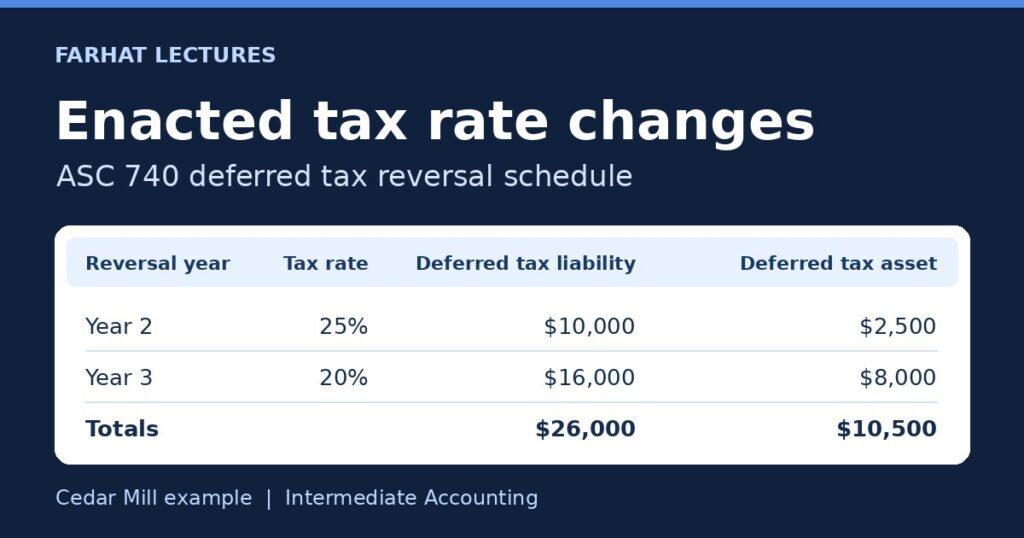
One thing to watch. You are never asked to remember what rate was in effect when a difference first arose. You measure the balance at the enacted rate expected to apply when it reverses. If a new rate is enacted, remeasure the existing balances using the enacted rates that apply when they reverse. Recognize the adjustment in income tax expense from continuing operations in the period of enactment.
| Component | Year 1 | Year 2 | Year 3 |
|---|---|---|---|
| Current expense | 25,500 | 26,750 | 38,750 |
| Deferred expense (benefit) | 500 | 3,250 | (3,750) |
| Total income tax expense | 26,000 | 30,000 | 35,000 |
| Account | Debit | Credit |
|---|---|---|
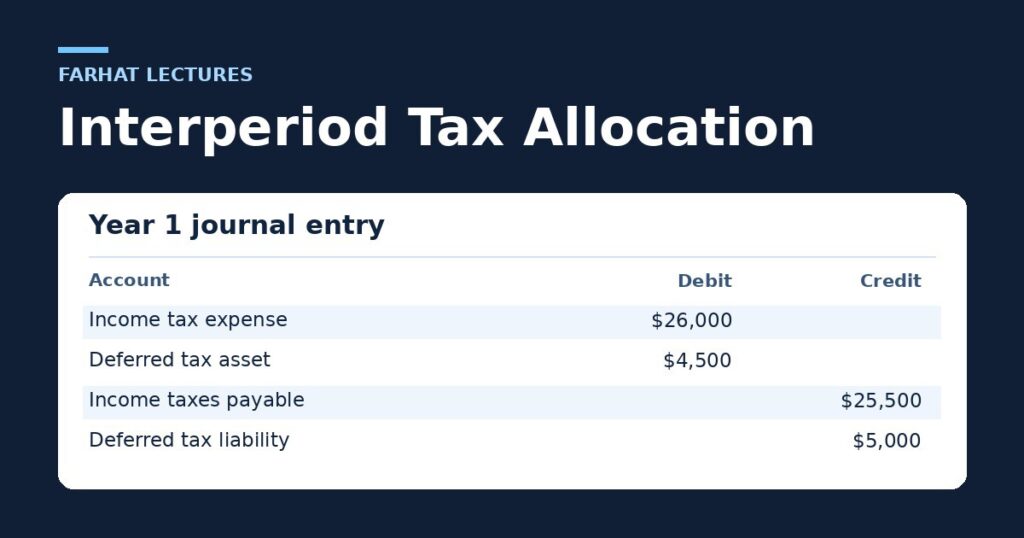
| Income tax expense | 26,000 | — |
| Deferred tax asset | 4,500 | — |
| Income taxes payable | — | 25,500 |
| Deferred tax liability | — | 5,000 |
| Account | Debit | Credit |
|---|---|---|
| Income tax expense | 30,000 | — |
| Deferred tax asset | — | 2,000 |
| Income taxes payable | — | 26,750 |
| Deferred tax liability | — | 1,250 |
| Account | Debit | Credit |
|---|---|---|
| Income tax expense | 35,000 | — |
| Deferred tax liability | 6,250 | — |
| Deferred tax asset | — | 2,500 |
| Income taxes payable | — | 38,750 |
Cross-check. Year 1 income tax expense is 26% of pretax book income. The nondeductible penalty adds $1,000 to tax expense at the assumed 25% rate. The effective rate is 25% in Years 2 and 3. Over all three years, current tax and total tax expense each total $91,000. Both temporary differences fully reverse, so the net deferred expense over the three years is zero.
Ready to put it to work? The six questions below use these exact facts. If you want the full lecture series on income taxes, including valuation allowances, rate changes, and loss carryforwards, that lives in the Farhat Lectures Intermediate Accounting course.
Practice questions
Use ending balances to measure deferred tax assets and liabilities. Use year-to-year changes in those balances to calculate deferred tax expense or benefit. Try the six questions before checking the reconciliation and journal entry tables above.
1. How much deferred tax expense comes from the warranty in Year 2?
Show answer
$2,000. The $8,000 payment uses part of the future deduction. The DTA falls from $4,500 to $2,500, so credit the DTA and recognize $2,000 of deferred expense.
2. What would Year 1 tax expense be if the penalty were deductible immediately?
Show answer
Holding pretax book income constant, taxable income falls to $98,000. Current tax is $24,500. Deferred expense stays at $500, giving total expense of $25,000 and an effective rate of 25%.
Key takeaways
- Interperiod tax allocation puts income tax expense in the period that earned the income. It does not change the total tax a company pays, only the timing of the expense.
- Temporary differences and eligible carryforwards can create deferred taxes. Permanent differences affect the effective tax rate.
- Measure the deferred balances from the basis differences at year end, then take the expense from the change in those balances.
- Use the enacted rate expected to apply when the difference reverses, not the rate in effect when it arose.
- The ledger keeps the deferred tax asset and liability separate. The balance sheet shows one net noncurrent amount per tax-paying component in each jurisdiction.
- In this example, the deferred tax expense nets to zero once both temporary differences fully reverse. In this example both current tax and total tax expense come to $91,000 across the three years.
Frequently asked questions
What is interperiod tax allocation in simple terms?
It is matching income tax expense to the period that produced the income. You record current tax on the amount from the tax return, then record deferred tax for differences that will reverse in a later year.
What is the difference between a temporary and a permanent difference?
A temporary difference reverses in a future period, so it creates a deferred tax asset or liability. A permanent difference never reverses, so it creates no deferred balance and instead moves the effective tax rate away from the statutory rate.
How do deferred tax assets and liabilities appear on the balance sheet?
For each tax-paying component within a single tax jurisdiction, offset the deferred tax assets and liabilities and present a single noncurrent amount. In Year 1 of this example, the $5,000 liability and the $4,500 asset net to one $500 noncurrent deferred tax liability.
Which tax rate do you use to measure deferred taxes?
The enacted rate expected to apply when the difference reverses. If a new rate is enacted, remeasure the existing balances using the enacted rates that apply when they reverse. Recognize the adjustment in income tax expense from continuing operations in the period of enactment.
Does interperiod tax allocation change the total tax a company pays?
No, only the timing of the expense. Here both current tax and total tax expense add up to $91,000 over three years because every temporary difference fully reverses.
Why is there a Year 3 deferred tax benefit when both ending balances are zero?
Both accounts had opening balances. Reversing the opening DTL produces a $6,250 benefit. Reversing the opening DTA produces $2,500 of expense. The net deferred benefit is $3,750.
How do interperiod and intraperiod tax allocation differ?
Interperiod tax allocation addresses timing across reporting periods through deferred taxes. Intraperiod tax allocation assigns tax expense or benefit among categories within a reporting period, such as continuing operations and other comprehensive income.
Sources. The recognition and measurement rules are in FASB ASC 740-10-25 and 740-10-30, and the presentation rule used above is in ASC 740-10-45-6 as amended by ASU 2015-17. The FASB Codification and Deloitte’s DART library both ask you to sign in. For a detailed treatment you can open without an account, see RSM’s whitepaper on accounting for income taxes.
Continue with the Farhat Lectures Intermediate Accounting course.





Responses