
Costs to Obtain and Fulfill a Contract: Capitalize or Expense?

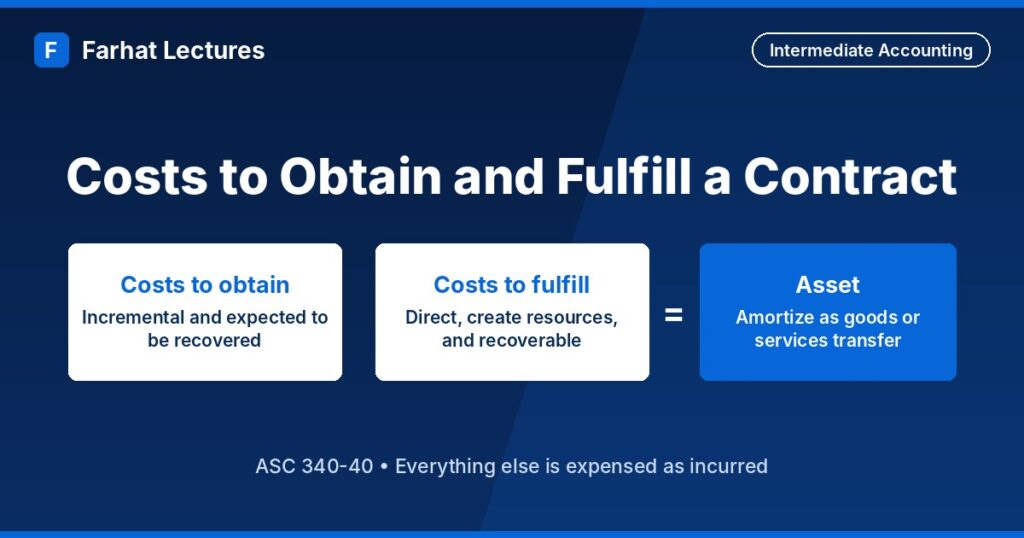
Under ASC 340-40, the FASB’s rules on contract costs, an incremental cost to obtain a contract, like a sales commission paid only because the customer signed, becomes an asset if the company expects to recover it. A cost to fulfill a contract becomes an asset only if no other standard covers it and it meets three tests. Other costs within the scope of ASC 340-40 are expensed as incurred.
Those three tests, from ASC 340-40-25-5, are that the cost relates directly to a specific contract, that it creates or enhances a resource the company will use to meet a performance obligation later, and that the company expects to recover it. A performance obligation is simply a promise in the contract to transfer a good or service to the customer.
Why does this matter? ASC 340-40 (Other Assets and Deferred Costs: Contracts with Customers) was issued alongside ASC 606. It decides whether a contract cost hits the income statement now or is spread over the life of the contract. That choice changes profit in every period of a multi-year deal, so it is a favorite exam topic.
Key takeaways
- Costs to obtain and costs to fulfill a contract are two separate populations with two separate tests. Never apply one test to the other.
- An incremental cost of obtaining a contract, such as a commission paid only on signing, is capitalized when the company expects to recover it (ASC 340-40-25-1).
- A fulfillment cost is capitalized only if no other standard covers it and all three criteria in ASC 340-40-25-5 are met.
- The one-year practical expedient is an accounting policy election applied consistently to similar contracts, and the one-year test uses the amortization period, which can include expected renewals.
- Capitalized contract costs are not contract assets. A contract asset is a conditional right to payment.
- Base salaries and bid and proposal costs are generally expensed as incurred. General and administrative overhead is expensed unless explicitly chargeable to the customer, and wasted labor is expensed when it was excluded from the contract price.
This guide supports the Farhat Lectures lesson on presentation and disclosure, where these capitalized costs show up as assets on the balance sheet.
Watch: Contract Costs: Capitalize or Expense? ASC 340-40
Watch this Farhat lesson on YouTube
In this 23-minute lesson, Professor Farhat covers incremental costs of obtaining a contract, the three criteria for capitalizing fulfillment costs, amortization, and the one-year practical expedient, with a quiz at the end.
Jump to the part you need: incremental costs of obtaining a contract at 2:56, the three fulfillment criteria at 12:12, amortization at 20:33, and the one-year practical expedient at 21:38.
Two types of contract costs
ASC 340-40 splits contract costs into two groups:
- Costs to obtain a contract: costs of winning the deal, such as sales commissions.
- Costs to fulfill a contract: costs of doing the work, such as setup, labor, and materials.
Each group has its own test. Keep them separate on exams, because a cost that passes one test may not even be considered under the other.
Costs to obtain a contract
A company recognizes an asset for the incremental costs of obtaining a contract if it expects to recover them (ASC 340-40-25-1). A cost is incremental if the company would not have incurred it had the contract not been obtained (ASC 340-40-25-2). The textbook example is a commission paid only when the customer signs.
Costs the company would incur whether or not it wins the deal are expensed, unless the contract explicitly lets the company charge them to the customer (ASC 340-40-25-3). Examples are a salesperson’s base salary, travel to pitch a prospect, and preparing a bid proposal.
Practical expedient: a company may expense incremental costs of obtaining a contract as incurred if the asset’s amortization period would be one year or less (ASC 340-40-25-4). A practical expedient is a shortcut the standard allows to keep the accounting simple. Two details decide most exam questions here. First, the test uses the amortization period, which can include expected renewals, not just the stated contract term. Second, the expedient is an accounting policy election, so a company that elects it applies it consistently to similar contracts rather than picking and choosing deal by deal. Note also that capitalizing is not optional: outside this expedient, a recoverable incremental cost has to be recognized as an asset. Deloitte’s roadmap section on costs of obtaining a contract gives more examples.
Costs to fulfill a contract
Start with scope. If another standard covers the cost, follow that standard instead. For example, inventory follows ASC 330, equipment the company keeps follows ASC 360 (property, plant, and equipment), and internal-use software follows ASC 350-40.
If you are shaky on any of those, it is worth reviewing the inventory costing rules, the PP&E capitalization rules, and the internal-use software rules first, because the scope step decides the answer before ASC 340-40 ever comes into play.
For costs not covered elsewhere, ASC 340-40-25-5 requires an asset only if all three criteria are met:
- The costs relate directly to a contract or to a specific anticipated contract the company can identify. ASC 340-40-25-7 lists what counts here: direct labor, direct materials, allocations of costs that relate directly to the contract or to contract activities (such as contract management and supervision, insurance, and depreciation of tools and equipment used on the contract), costs explicitly chargeable to the customer, and other costs incurred only because the company entered into the contract, such as payments to subcontractors.
- The costs generate or enhance resources the company will use to satisfy performance obligations in the future.
- The costs are expected to be recovered.
ASC 340-40-25-8 lists costs that are always expensed: general and administrative costs (unless explicitly chargeable to the customer), wasted materials or labor not reflected in the contract price, costs that relate to performance obligations already satisfied, and costs the company cannot tie to unsatisfied obligations. See Deloitte’s roadmap section on costs of fulfilling a contract.
Costs to obtain and fulfill a contract: quick reference
| Cost | Usual treatment | Why |
|---|---|---|
| Commission paid only if the contract is signed | Asset (or expense under the one-year expedient) | Incremental and recoverable |
| Salesperson’s base salary | Expense | Incurred whether or not the contract is won |
| Travel and proposal costs for a bid | Expense | Not incremental, unless explicitly chargeable to the customer |
| Setup, design, or migration work for a specific contract | Asset if all three fulfillment criteria are met | Direct, creates a resource, recoverable |
| Equipment the company keeps and uses on the contract | Property, plant, and equipment | Covered by ASC 360, not ASC 340-40 |
| General and administrative overhead | Expense | Listed in ASC 340-40-25-8 |
| Rework from a mistake (wasted labor) | Expense | Wasted resources not priced into the contract |
Worked example: a managed IT contract
This example is hypothetical. Bluewave IT signs a four-year contract to run a clinic’s computer network. Bluewave expects no renewals and expects the contract to be profitable. It incurs these costs:
- Sales commission paid on signing: $12,000
- Share of the salesperson’s base salary for the period: $5,000
- Travel to pitch the clinic: $1,800
- Configuring monitoring tools and migrating the clinic’s data to Bluewave’s platform: $30,000
- Servers Bluewave buys and keeps: $45,000
- General office overhead: $4,000
- Redoing a botched data transfer: $2,500
| Treatment | Costs | Amount |
|---|---|---|
| Asset under ASC 340-40 (cost to obtain) | Commission | $12,000 |
| Asset under ASC 340-40 (cost to fulfill) | Configuration and data migration | $30,000 |
| Property, plant, and equipment (ASC 360) | Servers | $45,000 |
| Expense as incurred | Salary $5,000 + travel $1,800 + overhead $4,000 + rework $2,500 | $13,300 |
Bluewave now carries two separate ASC 340-40 assets, not one: a $12,000 cost to obtain the contract and a $30,000 cost to fulfill it, $42,000 in total. Keeping them apart matters, because ASC 340-40-50-2 asks companies to disclose closing balances by main category, and because each asset’s amortization period is determined on its own. Here both assets track the same four years of service, and Bluewave expects no renewals, so if the service is delivered evenly the commission amortizes at $3,000 a year and the fulfillment asset at $7,500 a year, which is $10,500 a year in total. The $45,000 of servers sits outside ASC 340-40 and is depreciated under the PP&E rules.
Journal entries for contract costs
Here are the entries Bluewave records, using the numbers from the example above.
1. Capitalize the commission (cost to obtain)
- Debit Contract cost asset, costs to obtain: $12,000
- Credit Cash or Commissions payable: $12,000
2. Capitalize the configuration and migration work (cost to fulfill)
- Debit Contract cost asset, costs to fulfill: $30,000
- Credit Cash or Accounts payable: $30,000
3. Expense the costs that fail the tests
- Debit Selling expense (salary $5,000 and travel $1,800): $6,800
- Debit General and administrative expense: $4,000
- Debit Contract cost expense, rework: $2,500
- Credit Cash or Accounts payable: $13,300
4. Year one amortization, assuming service is delivered evenly
- Debit Amortization of contract costs: $10,500
- Credit Contract cost asset: $10,500
That $10,500 is $3,000 from the commission asset plus $7,500 from the fulfillment asset. ASC 340-40 does not dictate which income statement line the amortization goes on, so companies present it based on the nature of the cost, often in cost of revenue for fulfillment costs and in selling expense for commissions.
5. Impairment, if it happens
- Debit Impairment loss on contract costs
- Credit Contract cost asset
Bluewave records an impairment loss when the asset’s carrying amount exceeds the amount it expects to collect for the related services plus payments already received for those services that are still deferred as revenue, less directly related costs it has yet to expense.
The renewal trap: when one year is not one year
This is the detail that catches the most people, so it is worth its own example.
A software company pays a $6,000 commission on a one-year subscription. On the face of it the contract term is twelve months, so the one-year expedient looks available. But the company’s customers usually renew for two more years, and the salesperson earns nothing extra on those renewals, so the commission relates to the renewal periods too. That makes the amortization period roughly three years, not one.
The expedient is therefore unavailable. The company capitalizes the $6,000 and amortizes it over about three years, which is $2,000 a year if the benefit is spread evenly.
The lesson: read for the amortization period, not the contract term. A twelve-month contract fails the one-year test when expected renewals extend the amortization period beyond one year. A thirteen-month contract also fails the test if the commission is amortized over its stated term.
Amortization and impairment
Capitalized contract costs are amortized on a systematic basis consistent with the transfer of the related goods or services to the customer, which can include anticipated renewals (ASC 340-40-35-1). Under ASC 340-40-35-3, compare the asset’s carrying amount with the consideration for the goods or services to which the asset relates. Include amounts the company expects to receive and amounts it has already received but has yet to recognize as revenue. Subtract directly related costs that have yet to be expensed. Record an impairment loss for any excess of the carrying amount over that net amount. See Deloitte’s section on amortization and impairment.
Two impairment details are heavily tested. First, order matters. Before testing a contract cost asset under ASC 340-40, a company first recognizes any impairment required on related assets under other standards, such as inventory or software held for sale, and it considers the asset group under the long-lived asset rules afterward. The ASC 340-40 test sits in the middle of that sequence. Second, the write-down is permanent. ASC 340-40-35-6 does not allow a company to reverse an impairment loss it has already recognized on a contract cost asset, even if the contract later turns profitable again.
The disclosure rules sit in ASC 340-40-50-1 through 50-3, not in ASC 606 itself. A company describes the judgments it made in deciding what to capitalize and the method it uses to determine amortization each period. It also discloses the closing balances of these assets by main category, such as costs to obtain contracts, precontract costs, and setup costs, along with the amortization and any impairment losses recognized during the period. Eligible entities may elect under ASC 340-40-50-4 to omit the disclosures in ASC 340-40-50-2 through 50-3. A company that uses the one-year practical expedient generally discloses that election under ASC 340-40-50-5, and eligible entities may omit that disclosure under ASC 340-40-50-6. For how this fits the wider revenue note, see our guide to ASC 606 disclosure requirements.
Keep in mind that these capitalized costs are not contract assets; a contract asset is a conditional right to payment, covered in contract asset vs contract liability.
Where do they sit on the balance sheet? ASC 340-40 does not prescribe a caption, so companies present these assets separately from contract assets, often as deferred contract costs or inside other assets, and split them between current and noncurrent based on when each piece will amortize. If the Bluewave assets amortize at $10,500 a year, roughly $10,500 is current and the rest is noncurrent.
Common mistakes
- Capitalizing base salaries or bid costs. They are not incremental because they are paid whether or not the deal closes.
- Applying the one-year expedient to the contract term alone. Expected renewals can stretch the amortization period beyond one year.
- Skipping the scope step. Equipment, inventory, and software follow their own standards first.
- Assuming setup and testing costs are always expensed. They are capitalized when they meet all three fulfillment criteria.
- Capitalizing wasted labor. Rework and abnormal waste are expensed.
ASC 340-40 Contract Cost Classification Practice
Time to test yourself. Work through each cost below and pick a treatment before you check your answers. If one of them trips you up, scroll back to the quick reference table and see which test the cost fails.
Costs to Obtain and Fulfill a Customer Contract
Select the accounting treatment for each cost. Assume the commission would be amortized over more than one year, the company expects to recover the commission and qualifying fulfillment costs, and no other accounting standard applies to the fulfillment costs in these scenarios.
Practice questions
1. A company pays a $3,000 commission on a nine-month service contract with no expected renewal. What are its options?
Answer: If the company has elected the one-year practical expedient, it expenses the $3,000 as incurred, because the amortization period is nine months. If it has not elected the expedient, it capitalizes the $3,000 and amortizes it over the nine months of service. The key point for the exam: the expedient is an accounting policy election applied consistently to similar contracts, so a company cannot expense this commission and capitalize a similar one on the next deal.
2. A consulting firm spends $8,000 on legal fees to prepare a proposal and loses the bid. How is the cost treated?
Answer: Expense. Proposal and legal costs of this kind are incurred whether or not the company wins the work, so they are not incremental under ASC 340-40-25-2 and are expensed under 25-3. Two things make this one easy: the firm lost the bid, so there is no contract to support an asset at all, and even on a win these costs would still be expensed unless the contract explicitly allowed the firm to charge them to the customer.
3. A firm capitalizes $36,000 of contract costs on a three-year contract with services delivered evenly. What is the annual amortization?
Answer: $12,000 per year ($36,000 ÷ 3), assuming no anticipated renewals that would lengthen the period.
Want the primary source? The costs-to-obtain and costs-to-fulfill guidance sits in Subtopic 340-40 of the FASB Accounting Standards Codification, which you can read through the FASB’s own Codification access at asc.fasb.org. It was added by ASU 2014-09, the update that also created ASC 606.
Frequently asked questions
What are incremental costs of obtaining a contract?
They are costs a company incurs only because it obtained the contract, such as a sales commission paid on signing. They are capitalized if the company expects to recover them.
Are sales commissions capitalized under ASC 340-40?
Yes, when they are incremental and recoverable. A company may expense them instead if it has elected the one-year practical expedient and the amortization period would be one year or less.
What are the three criteria for capitalizing costs to fulfill a contract?
The costs must relate directly to a specific contract, generate or enhance resources used to satisfy future performance obligations, and be expected to be recovered. All three are required under ASC 340-40-25-5, and the cost must not be covered by another standard.
How are capitalized contract costs amortized?
On a systematic basis consistent with the transfer of the related goods or services to the customer, which may include anticipated contract renewals.
Is a capitalized commission a contract asset?
No. A contract asset is a conditional right to payment. A capitalized commission is a separate asset recognized under ASC 340-40.
Can you use the one-year practical expedient on one contract and not a similar one?
No. The expedient in ASC 340-40-25-4 is an accounting policy election. Once a company elects it, it applies the election consistently to similar contracts in similar circumstances rather than deal by deal.
What is the journal entry to capitalize a sales commission?
Debit a contract cost asset and credit cash or commissions payable. As the company transfers the goods or services, it debits amortization expense and credits the contract cost asset.
Can an impairment loss on capitalized contract costs be reversed?
No. ASC 340-40-35-6 prohibits reversing an impairment loss already recognized on a contract cost asset, even if the contract later becomes profitable again.
Where do capitalized contract costs appear on the balance sheet?
They are presented separately from contract assets and split between current and noncurrent based on when they will amortize. ASC 340-40 does not prescribe a caption, so companies commonly use deferred contract costs or include them in other assets.
Continue learning with Farhat Lectures
Contract costs show up in the revenue recognition testlets on FAR, usually as a classification question or a short amortization calculation. The revenue recognition lessons walk through the full ASC 606 model with the same kind of worked examples and practice you just used here.
Explore the free sample course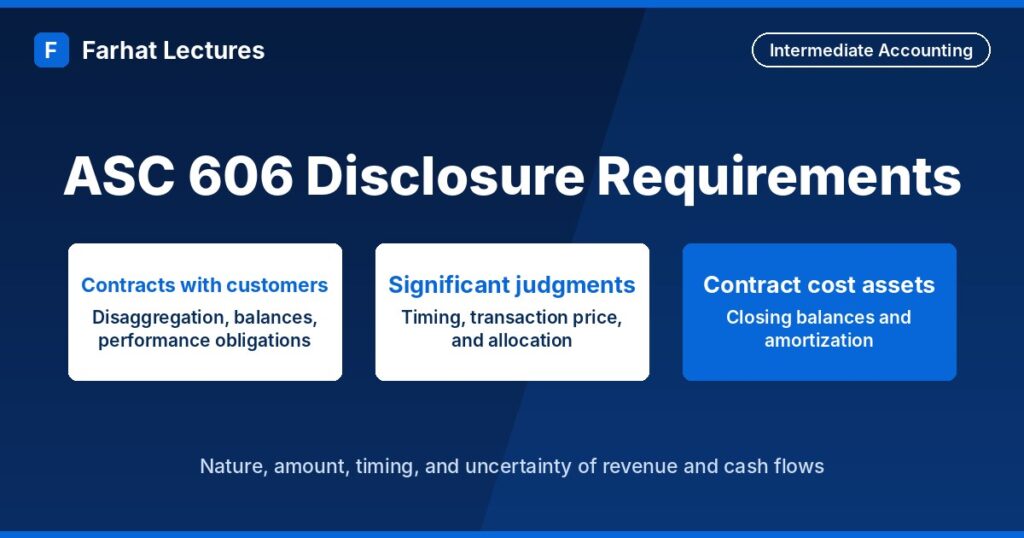
Responses