
Prior Period Adjustment: Definition, Journal Entry, and Examples

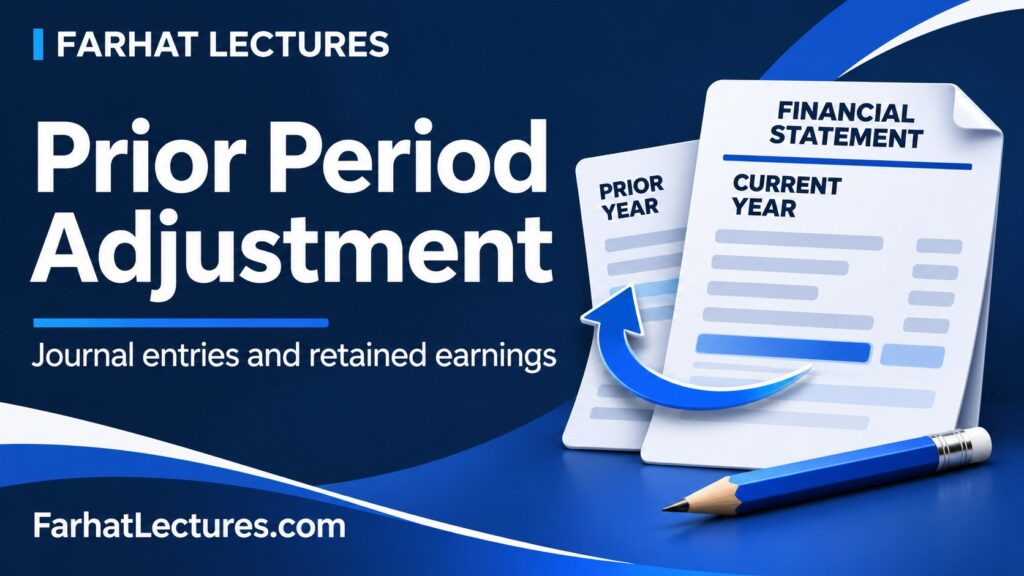
A prior period adjustment corrects the effect of a material error on earnings reported in previously issued financial statements. Under U.S. GAAP (FASB ASC 250), the company restates each affected prior period presented. If the error affected earnings before the earliest period presented, the company adjusts that period’s beginning retained earnings for the cumulative effect, net of tax.
This matters because correcting last year’s mistake through this year’s revenue or expense can make both years misleading. The key is to identify when the error occurred, which balances remain wrong, and which periods the financial statements present.
Key Takeaways
- A prior period adjustment fixes a material error in financial statements that were already issued.
- Restate each comparative period affected by the error. If the error arose during a year shown, correct that year’s column.
- Adjust beginning retained earnings, net of tax, for the cumulative effect on earnings from before the earliest period presented.
- A change in accounting estimate is not an error. It is handled prospectively, which means in current and future periods only.
- The rules are in FASB ASC 250, Accounting Changes and Error Corrections.
Video: Prior Period Adjustments Explained by Professor Farhat
Professor Farhat’s lesson covers changes in accounting principle, changes in accounting estimate, and corrections of errors. Under ASC 250, the third type of accounting change is a change in reporting entity. Error corrections are a separate category. This segment (11:49 to 15:56) shows how to correct an error and record a prior period adjustment net of tax. The player starts at the right spot. Earlier chapters cover changes in accounting principle (1:56) and changes in accounting estimate (6:23).
When is a prior period adjustment needed?
An accounting error can arise from incorrect arithmetic, misapplying an accounting principle, or overlooking facts available when the statements were prepared. Switching from a method that GAAP does not allow to one that it does allow also counts as correcting an error. It is not a change in accounting principle. A reasonable estimate revised because of new information is different: see change in accounting estimate examples.
| Situation | Basic response |
|---|---|
| Current-year mistake found before the statements are issued | Correct the affected current-year accounts before issuance |
| Material error in previously issued financial statements | Restate affected prior-period figures and correct opening balances as appropriate |
| Reasonable estimate updated for new information | Apply the change prospectively |
| Justified switch between acceptable accounting methods | Apply the principle-change guidance, usually retrospectively |
Materiality considers both the amount and the circumstances. The U.S. Securities and Exchange Commission (SEC) staff’s materiality guidance cautions against relying exclusively on a percentage threshold. The examples below explicitly assume material prior-year errors, closed books, and previously issued statements. Ignore income taxes unless stated otherwise.
Restatement, Revision, or Current-Period Fix?
Not every old error gets the same treatment. It depends on materiality, which means whether the error is big enough to matter to someone relying on the statements. Public companies usually sort errors into three groups.
| If the error is | The company |
|---|---|
| Material to the prior-year statements | Restates and reissues those statements. People often call this a “Big R” restatement. |
| Not material to the prior year, but correcting it all at once would distort the current year | Revises the prior-year numbers the next time they are presented. This is often called a “little r” revision. |
| Not material to any year | Corrects it in the current period as an out-of-period adjustment. |
Mattel’s 2019 announcement shows both ends. It restated the last two quarters of 2017 for a tax error it judged material. Separately, it revised other periods for smaller errors it judged immaterial.
The entry logic in this guide applies to the first two groups.
Journal entry example: omitted depreciation
Hypothetical example. In February 20X9, Elm Design discovers that $9,000 of depreciation was omitted from its issued 20X8 financial statements. The equipment was correctly recorded, but the year-end depreciation entry was missed. No part of the omission has been corrected. The company has not recorded 20X9 depreciation yet.
In 20X8, expense was too low, so net income was too high by $9,000. That income closed into retained earnings. Accumulated depreciation is also $9,000 too low. The correction in the 20X9 ledger is:
| Account | Debit | Credit |
|---|---|---|
| Retained earnings | $9,000 | — |
| Accumulated depreciation | — | $9,000 |
The debit reduces overstated retained earnings. The credit increases accumulated depreciation and reduces the equipment’s net carrying amount. It does not reduce the equipment’s recorded historical cost.
Do not debit 20X9 depreciation expense for the omitted 20X8 amount. Record normal 20X9 depreciation separately. Otherwise the correction would overstate this year’s expense while leaving last year’s reported income uncorrected.
Journal entry example: duplicate revenue
Hypothetical example. Alder Services discovers in 20X9 that a $14,000 credit sale was accidentally recorded twice in 20X8. The duplicate receivable remains outstanding in the ledger. The original sale was valid; only the duplicate is being removed. Assume no related expense, tax, or allowance effects.
| Account | Debit | Credit |
|---|---|---|
| Retained earnings | $14,000 | — |
| Accounts receivable | — | $14,000 |
Prior-year revenue and income were overstated. The revenue account has already closed, so the correction reduces retained earnings. Accounts receivable is a permanent account whose balance carries forward, so crediting it removes the remaining overstatement.
What About Errors That Fix Themselves?
Some errors reverse on their own in the next year. Accountants call these counterbalancing errors. Ending inventory is the classic example.
Hypothetical example. Birch Supply overstated its December 31, 20X7 ending inventory by $5,000. Ignore taxes. That made 20X7 cost of goods sold $5,000 too low and 20X7 income $5,000 too high. The same $5,000 became 20X8 beginning inventory, so 20X8 cost of goods sold was $5,000 too high and 20X8 income was $5,000 too low.
By the end of 20X8 the two effects cancel, and retained earnings is correct again. If Birch finds the error in 20X9, after the 20X8 books are closed, no journal entry is needed. If 20X7 or 20X8 appears in the comparative statements, those columns still have to be restated, because each year’s income was wrong.
If Birch had caught the error during 20X8, before closing the books, the entry would be a $5,000 debit to retained earnings and a $5,000 credit to inventory.
Elm’s missed depreciation is different. It is a non-counterbalancing error, because accumulated depreciation stays wrong until someone records a correcting entry.
Prior period adjustment in retained earnings
Return to Elm Design. Suppose its beginning 20X9 retained earnings was reported as $125,000. Correct 20X9 net income is $40,000 after normal current-year depreciation, and dividends are $10,000. Only the 20X9 statement of retained earnings is shown below.
| Item | Amount |
|---|---|
| Beginning retained earnings, as previously reported | $125,000 |
| Prior period adjustment: omitted 20X8 depreciation | ($9,000) |
| Beginning retained earnings, as adjusted | $116,000 |
| Add: 20X9 net income | $40,000 |
| Less: dividends | ($10,000) |
| Ending retained earnings | $146,000 |
Check the arithmetic: $125,000 − $9,000 + $40,000 − $10,000 = $146,000. The correction appears before current-year income is added. This placement preserves the meaning of the $40,000 current-year result.
What if 20X8 and 20X9 are presented together?
Restate the 20X8 column: increase depreciation expense by $9,000, decrease net income by $9,000, and correct accumulated depreciation and ending retained earnings. There is no beginning-20X8 adjustment for an error that arose during 20X8. Beginning 20X9 retained earnings then carries forward the corrected ending 20X8 balance.
If an additional error arose before 20X8, its cumulative effect would adjust the beginning balances of the earliest period presented, here 20X8. Do not record the same $9,000 as both an opening-20X8 adjustment and an expense correction within 20X8.
Where do taxes fit?
The main examples ignore taxes so the entry logic is easy to see. On the CPA exam and in practice, though, a prior period adjustment is recorded in retained earnings net of tax. That means after subtracting the related income tax effect.
Go back to Elm Design and assume a 25% tax rate. The omitted depreciation overstated 20X8 pretax income by $9,000. The tax effect is $9,000 × 25% = $2,250, so retained earnings falls by $6,750 ($9,000 − $2,250).
Assume Elm deducted the depreciation correctly on its 20X8 tax return, so the mistake was only in the books. The $2,250 then goes to deferred taxes, the account that tracks timing differences between book income and taxable income.
| Account | Debit | Credit |
|---|---|---|
| Retained earnings | $6,750 | |
| Deferred tax liability | $2,250 | |
| Accumulated depreciation | $9,000 |
If Elm also omitted the depreciation from its tax return, overpaid its tax, and can recover the $2,250, it debits an income tax refund receivable. In that case, retained earnings still falls by $6,750.
On the retained earnings statement above, the adjustment line would then read ($6,750). Adjusted beginning retained earnings would be $118,250, and ending retained earnings would be $148,250.
Common mistakes and disclosure
- Charging every correction to current expense. Trace the error to the period it affected.
- Assuming all errors change retained earnings. A balance-sheet classification error may require reclassification without changing total equity.
- Confusing errors with method changes. Compare the change in accounting principle section of the ASC 250 guide.
- Stopping after the journal entry. Comparative statements and the explanatory note also need the appropriate correction.
In the notes, a company that restates must say that its previously issued statements were restated and describe the error. It also shows the effect of the correction on each financial statement line item and any per-share amounts for each prior period presented. Finally, it shows the cumulative effect on retained earnings at the beginning of the earliest period presented (ASC 250-10-50-7). The SEC’s Topic 1 financial-statement guidance also explains why prior-year misstatements must be considered when assessing the current statements. Detailed materiality and filing judgments go beyond this introductory lesson.
CPA exam tip: Accounting changes and error corrections is a named topic in FAR Area III (Select Transactions) of the AICPA CPA Exam Blueprint. Questions usually give you a pretax error and a tax rate, then ask for the adjustment to beginning retained earnings. Multiply the pretax error by (1 − tax rate), then check the direction. If prior income was overstated, retained earnings goes down.
Practice with answers
For questions 1 and 2, use the original Elm Design example and ignore income taxes.
1. Which account is debited for Elm’s omitted 20X8 depreciation?
Answer: retained earnings, $9,000. The omitted expense overstated prior-year income, which has already closed into retained earnings.
2. What is Elm’s adjusted beginning 20X9 retained earnings?
Answer: $116,000. Subtract the $9,000 prior period adjustment from the previously reported $125,000. Current income and dividends are applied afterward.
3. A current-year expense was recorded twice and is discovered before issuance. Must beginning retained earnings change?
Answer: no. Correct the current-year duplicate in the affected accounts. The facts do not describe an error in previously issued prior-year statements.
Want more practice? The Intermediate Accounting course includes a full lesson on accounting changes. You can also try the free sample course first.
Prior Period Adjustments: Accounting Error Quiz
Answer seven questions about material errors in previously issued financial statements, including examples from Mattel and MetLife.
How does a prior-period error affect retained earnings?
Restate each comparative period affected by a material error. If the error affected earnings before the earliest period presented, adjust that period’s opening retained earnings for the cumulative effect. An error caught before the current-year statements are issued is corrected in the affected current-year accounts.
Instructions: Choose one answer for each question, then select “Check answers.” Each question is worth one point.
Review notes: causes, corrections, and examples
- Causes: Mathematical mistakes, mistakes in applying accounting principles, and oversight or misuse of facts that existed when the financial statements were prepared.
- Affected items: Errors can involve revenue, stock compensation, allowances for receivables, inventories, and other provisions.
- Correction: Correct the affected accounts and restate the comparative periods in which a material error occurred.
- Timing and presentation: Record the correcting entry when the error is discovered. Adjust the earliest opening retained earnings shown for any cumulative earnings effect from before that period.
- Comparative statements: Restate prior statements for the effects of the error.
- Mattel Inc.: A tax valuation allowance error understated Mattel’s third-quarter 2017 net loss by $109 million. Its fourth-quarter net loss was overstated by the same amount. Read Mattel’s filing.
- MetLife: MetLife released reserves for certain retirees it could not reach. This understated its benefit liabilities and overstated reported income. Read the SEC’s findings.
Frequently asked questions
Does a prior period adjustment reduce current-year net income?
No. The earlier-period effect is corrected outside current-year income. Normal current-year revenue and expense still belong in this year’s income statement.
Is every prior-year error treated identically?
No. Consider materiality, the affected accounts, and the periods presented. The examples assume material errors affecting income and accumulated earnings.
Can retained earnings increase after a correction?
Yes. If a prior error understated accumulated income, the correction can increase retained earnings. Determine the direction from the original mistake.
What is the journal entry for a prior period adjustment?
Debit or credit retained earnings for the after-tax effect of the error. Post the other side to the balance sheet account that is still wrong. For omitted depreciation, debit retained earnings and credit accumulated depreciation. Do not use the old year’s revenue or expense accounts, because they are already closed.
Where is a prior period adjustment reported?
Restate the affected amounts in each comparative period shown. If the error affected earnings before the earliest period presented, show the cumulative after-tax effect as an adjustment to that period’s beginning balance on the statement of retained earnings or the statement of stockholders’ equity.
Is a prior period adjustment the same as a restatement?
They work together. Restatement is the process of revising previously issued financial statements to correct an error. The prior period adjustment is the dollar correction itself, which shows up in beginning retained earnings when the error year is not presented.
Is a change in accounting estimate a prior period adjustment?
No. A change in estimate, such as a new useful life for equipment, is handled prospectively. That means it affects the current and future periods only. Prior period adjustments are for errors in statements that were already issued.
Is a prior period adjustment recorded net of tax?
Yes. Retained earnings is adjusted for the after-tax amount. The tax effect goes to the related tax account, such as deferred taxes or an income tax payable or receivable, depending on the facts.
Sources and further study
The current rules are in the Financial Accounting Standards Board (FASB) Accounting Standards Codification (ASC), Topic 250, Accounting Changes and Error Corrections. That topic is part of U.S. generally accepted accounting principles (GAAP). See ASC 250-10-45-23 for how to restate and ASC 250-10-50-7 for the required disclosures. FASB Statement 154, paragraphs 25 and 26, is the public source document for that error-correction guidance. The existing ASC 250 guide provides the wider context on accounting changes and error corrections.
About the Author
Mansour Farhat, CPA, CIA, DBA, is the instructor behind Farhat Lectures. He teaches accounting and exam prep for CPA, CMA, and EA candidates through video lectures and practice questions. Learn more about Professor Farhat.
CONTINUE LEARNING
Explore the connected lessons
For the complete overview, visit the Accounting Changes and Error Corrections: ASC 250 Guide.




Responses