
Stop Hammering MCQs for the CPA Exam: Learn the Concepts First
CPA exam study strategy · Farhat Lectures
More questions do not automatically mean more understanding.
If you are hammering MCQs for the CPA Exam but still struggle when a question changes, it is time to revisit how you study.
My recommendation: learn the concept first, use questions to test it, and return to the lesson when you find a gap.

Should you hammer MCQs for the CPA Exam? Practice is essential, but repeatedly answering questions should not replace learning the underlying accounting, auditing, or tax concepts. Learn a manageable topic, attempt MCQs without notes, diagnose your mistakes, relearn weak areas, and test yourself again with unfamiliar questions.
Watch · 1 minute 27 seconds
Stop Hammering MCQs for the CPA Exam
Professor Farhat explains why recognizing an answer can feel like progress even when a conceptual gap remains.
- Learn the material before using questions to measure your understanding.
- Use mistakes to identify what you need to revisit.
- Prepare to apply the same concept from a different angle.
What does “hammering MCQs” actually mean?
In CPA study discussions, “hammering MCQs” usually means completing many multiple-choice questions, often in repeated or mixed sets. Candidates use the phrase differently: some mean a final review after learning the material; others mean starting with a question bank and skipping instruction.
That distinction matters. An r/CPA discussion about hammering MCQs describes cumulative practice alongside lectures. Another candidate asks whether rising scores reflect understanding or simply memorizing familiar answers. These are personal experiences, not controlled evidence that one routine works for everyone.
My concern is using question volume as a substitute for a conceptual foundation. Reading an explanation can teach you something, and thoughtful practice can reinforce learning. But if the explanation does not make sense, another set of questions will not automatically repair the missing foundation.
Build the understanding behind the answer.
Farhat Lectures provides step-by-step explanations and worked examples to help you strengthen the concepts behind your CPA review questions.
Or browse the course library to find the topic you need to relearn.
Why memorizing MCQ answers can create false confidence
A familiar question gives you extra clues: the company name, a distinctive number, the wording, or the position of the correct answer. You may remember the answer before you have worked through the underlying rule.
A fact pattern is the set of circumstances in a question: dates, amounts, relationships, assumptions, and the specific task you must perform. Your goal is to interpret those facts and apply a principle. Memorizing one familiar arrangement of facts is a fragile shortcut.
| When you recognize an answer | When you understand the concept |
|---|---|
| “I remember choosing B.” | “I can explain the rule that makes this answer correct.” |
| A changed date or assumption throws you off. | You identify the change and adjust your reasoning. |
| You count completed questions. | You track mistakes you can now explain and correct. |
| You rely on the answer choices to get started. | You can outline a solution before looking at the choices. |
A simple example: same topic, different question
Assume equipment costs $60,000, has a $10,000 residual value, and a five-year useful life. With straight-line depreciation and full years of use, annual depreciation is ($60,000 − $10,000) ÷ 5 = $10,000.
Now change only the question: what is the carrying amount after two full years? The answer is $60,000 − (2 × $10,000) = $40,000.
Remembering “the answer is $10,000” does not solve the second question. Understanding cost, residual value, depreciation expense, and accumulated depreciation does.
Illustrative teaching example, not an actual CPA Exam question.
A better CPA Exam MCQ study strategy: five steps
You do not need to finish an entire review course before attempting a question. Apply this cycle to one manageable topic at a time.
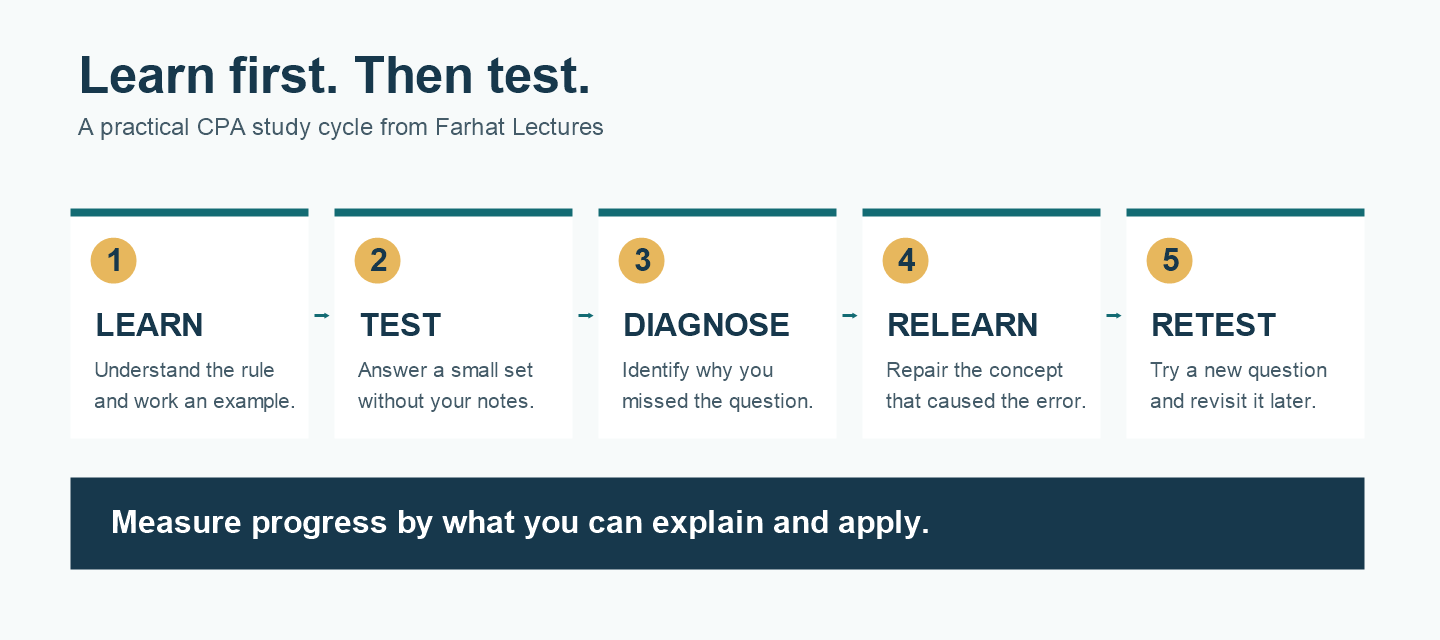
- Learn the concept. Read the relevant lesson or watch an explanation. Work through an example and state the rule in your own words. Identify when it applies and which facts would change the result.
- Test yourself with a focused set. Put away your notes and attempt a small group of MCQs. For example, start with 5–10 questions if that leaves enough time for careful review. This is a practical starting point, not a passing-score formula.
- Diagnose the error. Was the problem a missing concept, a misread fact, an incorrect calculation, or a rule you could not recall? Review correct answers too, especially guesses. Explain why the alternatives do not fit the facts.
- Relearn the weak area. Return to the specific explanation you need. Write one brief note about the misunderstanding and work the example again without copying the solution.
- Retest and revisit. Try an unfamiliar question on the same concept. Later, mix it with previously studied topics. Reusing a question can still be useful practice, but a remembered answer is weaker evidence of readiness than an independently reasoned solution.
How many MCQs should you do per day?
Set a target that allows you to solve and review each question thoughtfully. A daily question count by itself cannot establish whether you understand the material. Calculation-heavy questions and short conceptual questions also take different amounts of time.
One workable 60-minute session is 20 minutes learning or repairing a concept, 20 minutes answering questions, and 20 minutes explaining errors and revisiting earlier material. Adjust the balance as your knowledge develops, and include separate time for task-based simulations.
During initial learning, use focused sets to connect the rule to its application. During review, mix topics you have already covered and investigate recurring weaknesses. If you keep making the same conceptual error, pause the question count and address the cause.
Do not let MCQ practice crowd out simulations
Multiple-choice questions are only part of the CPA Exam. The AICPA’s CPA Exam Blueprints and exam overview describe both MCQs and task-based simulations, along with the content and skill levels tested.
Practice simulations to organize information, connect related concepts, and work through tasks that offer fewer answer-choice clues. If your MCQ scores improve but simulations remain difficult, investigate the specific obstacle rather than assuming more MCQs will solve it.
The learn-first approach applies across FAR, AUD, REG, BAR, ISC, and TCP. Adjust your practice to the section and the weaknesses you actually observe.
How can you tell whether you understand the material?
Before marking a topic “done,” use these checks:
- Can I explain the rule without repeating the answer explanation?
- Can I work the problem without looking at the answer choices?
- Can I explain why each incorrect option is wrong for these facts?
- Can I change one assumption and explain how the answer changes?
- Can I solve an unfamiliar question after a break?
If the answer is no, you have found a useful study target. That is what MCQs should help you discover.
Frequently asked questions
Can you pass the CPA Exam with only MCQs?
Some candidates report passing with an MCQ-heavy approach. Those reports do not establish that the same method will work for you. I recommend learning the underlying material and practicing both MCQs and simulations, particularly when you have knowledge gaps.
Should I skip lectures and just do MCQs?
If you already understand a topic and can apply it to unfamiliar questions, you may not need to watch every explanation again. If you cannot explain the rule or keep missing the same concept, return to a lesson, textbook explanation, or worked example before continuing.
Is memorizing CPA questions bad?
Remembering rules, terms, and formulas is part of studying. The problem is mistaking memory of a particular answer for understanding. Check your knowledge by explaining the reasoning and solving a question with different facts.
Should I practice MCQs by topic or in random sets?
Start with focused practice while learning a topic. Then use mixed sets drawn from topics you have studied to check whether you can identify and apply the right rule without being told the category.
Why am I doing lots of MCQs but not improving?
Review your errors for a pattern: missing concepts, misread questions, calculation mistakes, or weak recall. Change the study activity to address that cause. Repeating the same questions without resolving the underlying mistake can keep you stuck.
How should I review a question I got right by guessing?
Treat the guess as a topic to revisit. Explain the correct answer, rule out the alternatives, and try a fresh question. A correct guess does not yet show that you can reproduce the reasoning.
About the author. Mansour Farhat, CPA, is the educator behind Farhat Lectures. This guide expands on his video, “Stop Hammering MCQs for the CPA Exam,” and his teaching philosophy: learn first, then test.
Sources and further reading
- AICPA & CIMA: Learn what to study for the CPA Exam — exam structure and current blueprint resources.
- r/CPA: Information about “Hammering MCQ” — an example of cumulative practice alongside instruction.
- r/CPA: Hammering MCQs all day. What’s the point? — candidate concerns about memorization and simulations.
Reddit discussions are included to explain candidate questions and terminology; they do not establish the effectiveness of a study method.